


Tit for tat meaning encapsulates the principle of responding to an action with an equivalent one, embodying fairness, retaliation, or cooperation.
This idiom, deeply rooted in English language and culture, reflects the human instinct to mirror behaviors, whether returning a favor or settling a score.
Originating in the 16th century, tit for tat appears in everyday conversations, psychology, game theory, and classic literature, shaping interactions across contexts.
From Shakespeare’s plays to modern films like The Godfather, the phrase highlights the balance of give-and-take.
Tit for Tat Definition

The tit for tat definition describes a reciprocal exchange where one party mirrors another’s action, ensuring balance or consequence. It applies to positive acts, like repaying kindness, or negative ones, like retaliation.
- Core Concept: Action equals reaction, maintaining fairness or asserting justice.
- Usage: Spans casual speech, literature, and strategic contexts.
- Example: If someone helps you move, you return the favor; if they betray you, you might respond in kind.
- Synonyms: Quid pro quo, eye for an eye, give-and-take.
Tit for Tat Phrase Origin
The tit for tat phrase origin dates back to the 16th century, evolving from “tip for tap,” meaning a blow for a blow, recorded in 1546. The terms “tit” and “tat” mimic the sound of quick, reciprocal actions, like slaps.
- Historical Roots: Early English proverbs used it to describe retaliatory justice.
- Evolution: By the 17th century, it became a common idiom for reciprocity.
- Literary Use: Appears in texts like Ben Jonson’s 1599 play, reflecting its cultural staying power.
- Cultural Impact: Shapes narratives in literature and modern media, emphasizing fairness or revenge.
What Does Tit for Tat Mean in Modern Contexts?
What does tit for tat mean today? It signifies responding to an action with a comparable one, often to maintain balance or assert consequences. Its versatility spans personal, professional, and global settings.
- Everyday Use: “She ignored my text, so I gave her tit for tat and didn’t reply.”
- Professional Setting: Matching a competitor’s discount in business negotiations.
- Cultural Nuances: Can imply fairness (returning a favor) or pettiness (petty retaliation).
- Example: In a friendship, sharing resources is tit for tat; in conflict, it might mean matching insults.
Tit for Tat in a Sentence
Using tit for tat in a sentence illustrates its meaning through context. Below are diverse examples showcasing its flexibility.
- Friendly Exchange: “When Maria lent me her car, I gave tit for tat by cooking her dinner.”
- Conflict Scenario: “After John spread gossip, Lisa responded tit for tat by revealing his mistake.”
- Business Context: “The firms engaged in tit for tat price cuts to win customers.”
- Playful Interaction: “The siblings played tit for tat, swapping pranks all afternoon.”
- Literary Use: “In the story, the hero’s generosity was met tit for tat with betrayal, driving the plot.”
Tit for Tat Examples in Everyday Life
Tit for tat examples demonstrate how the principle operates in daily interactions, from personal relationships to global affairs.
- Personal Relationships:
- A neighbor shares garden produce; you reciprocate with baked goods.
- Someone cuts you off in traffic, so you gesture back.
- Workplace Dynamics:
- A colleague covers your shift; you return the favor next week.
- A rival takes credit for your work, so you highlight your contributions.
- International Relations:
- Nation A imposes sanctions; Nation B responds tit for tat with trade restrictions.
- Diplomatic gifts, like cultural exchanges, reflect positive tit for tat.
- Family Dynamics:
- A child takes a toy; their sibling grabs it back, a classic tit for tat moment.
Tit for Tat in Psychology: The Reciprocity Norm
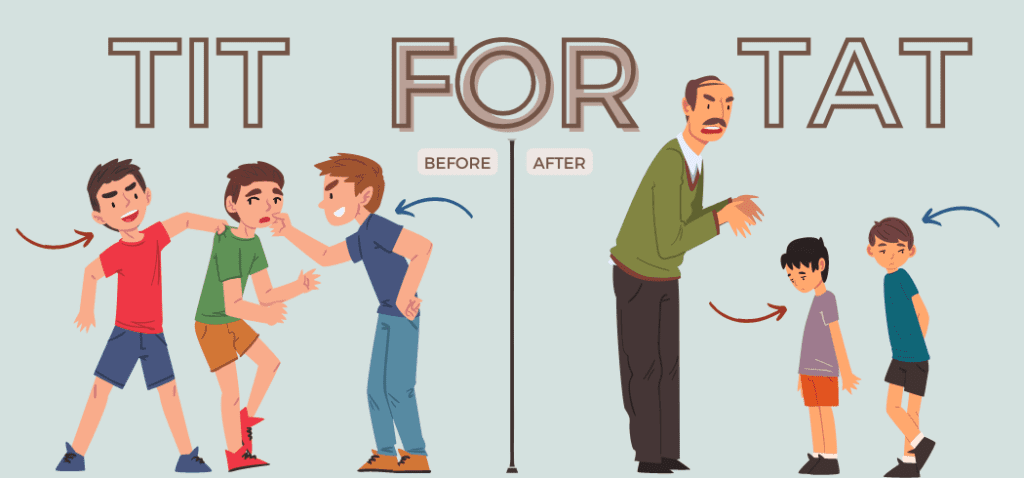
Tit for tat psychology explores how reciprocal behavior shapes human interactions. Rooted in the reciprocity norm, it shows people naturally mirror actions to maintain fairness or protect interests.
- Reciprocity Norm: Studied by Robert Cialdini in 1966, people feel obligated to repay kindness or harm.
- Social Impact: Tit for tat fosters trust (e.g., returning favors) or escalates conflicts (e.g., revenge cycles).
- Behavioral Research: A 1980 study found 85% of participants reciprocated help, showing tit for tat tendencies.
- Example: If a friend helps with a project, you’re likely to assist them later, reinforcing social bonds.
Tit for Tat Strategy in Game Theory
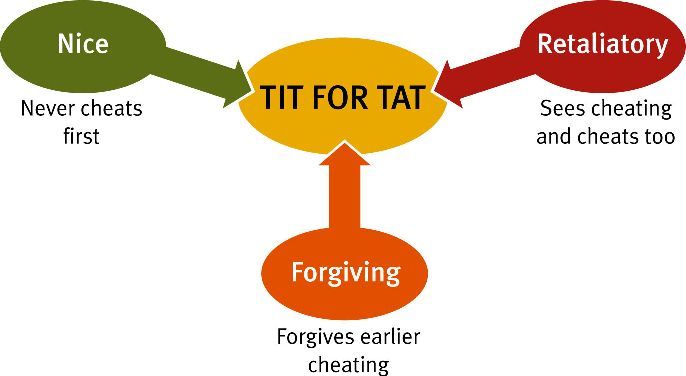
The tit for tat strategy is a cornerstone of game theory, notably in the Prisoner’s Dilemma, formalized by Robert Axelrod in 1984. It involves cooperating first, then mirroring the opponent’s previous action.
- Mechanism:
- Start with cooperation.
- In subsequent rounds, copy the opponent’s last move (cooperate or defect).
- Strengths:
- Encourages mutual cooperation by rewarding trust.
- Deters betrayal by retaliating promptly.
- Applications:
- Business: Matching competitors’ promotions.
- Diplomacy: Reciprocating trade agreements or sanctions.
- Example: In Axelrod’s 1984 tournament, tit for tat outperformed aggressive strategies, winning through consistent reciprocity.
Tit for Tat Retaliation: Balancing Justice and Risk
Tit for tat retaliation involves responding to negative actions with equivalent measures, often to assert justice or deter harm. While effective, it carries potential downsides.
- Benefits:
- Deters aggression by signaling consequences.
- Maintains fairness in competitive environments.
- Example: Matching a rival’s low bid in a business deal ensures equity.
- Risks:
- Escalates conflicts, creating cycles of revenge.
- Misunderstandings can trigger unwarranted tit for tat responses.
- Example: A misinterpreted comment leads to ongoing workplace tension.
- Mitigation: Clear communication and restraint prevent destructive cycles.
Tit for Tat Idiom Meaning Across Cultures
The tit for tat idiom meaning varies slightly across cultures, reflecting universal themes of reciprocity. In English, it balances positive and negative exchanges; other languages have similar expressions.
- English: Implies fairness or retaliation (e.g., “He gave tit for tat for her rudeness”).
- French: “Rendre la pareille” (return the same) emphasizes reciprocity.
- Spanish: “Ojo por ojo” (eye for an eye) focuses on retribution.
- Chinese: “以牙还牙” (tooth for tooth) highlights retaliatory justice.
- Example: In international trade, a tit for tat tariff response reflects cultural reciprocity norms.
Famous Tit for Tat Quotes and Proverbs
Tit for tat quotes and proverbs capture the essence of reciprocity in wisdom traditions and literature. Below are notable examples.
- Biblical Proverb: “An eye for an eye, a tooth for a tooth” (Exodus 21:24, Old Testament).
- Shakespeare: “Measure for measure” (Measure for Measure, 1604), reflecting tit for tat justice.
- Folk Wisdom: “Give as good as you get,” a 19th-century English saying.
- Modern Saying: “What you give is what you get,” popular in self-help contexts.
- Literary Quote: In The Merchant of Venice (1596), Shylock’s demand for a pound of flesh embodies tit for tat retribution.
Tit for Tat in Literature: Reciprocity in Storytelling
Tit for tat drives narratives in literature, highlighting themes of justice, revenge, and cooperation. Below are examples across classic and modern works.
- The Count of Monte Cristo (Alexandre Dumas, 1844):
- Dantès’ calculated revenge against his betrayers reflects tit for tat justice.
- Example: Dantès repays Danglars’ betrayal with financial ruin.
- Wuthering Heights (Emily Brontë, 1847):
- Heathcliff’s vengeance against the Earnshaws mirrors their mistreatment, a tit for tat cycle.
- Example: Heathcliff’s cruelty to Hareton repays Hindley’s abuse.
- Pride and Prejudice (Jane Austen, 1813):
- Darcy’s initial snub of Elizabeth prompts her sharp retort, a subtle tit for tat exchange.
- Example: Elizabeth’s wit matches Darcy’s pride, driving their dynamic.
- A Tale of Two Cities (Charles Dickens, 1859):
- Sydney Carton’s sacrifice for Darnay repays a debt of honor, a positive tit for tat.
- Example: Carton’s act mirrors Darnay’s earlier kindness.
Tit for Tat in Film and Media
In modern media, tit for tat shapes compelling narratives, from revenge plots to cooperative dynamics.
- The Godfather (1972):
- The Corleone family responds to betrayals with equivalent force, embodying tit for tat retaliation.
- Example: Michael avenges Sonny’s death with strategic strikes.
- Mean Girls (2004):
- Cady’s pranks against Regina reflect teenage tit for tat, escalating their rivalry.
- Example: Regina’s burn book prompts Cady’s counterattacks.
- Game of Thrones (2011-2019):
- Political betrayals, like Arya’s revenge list, follow tit for tat principles.
- Example: Arya’s actions mirror betrayals against her family.
- The Dark Knight (2008):
- The Joker’s chaos prompts Batman’s calculated responses, a tit for tat struggle.
- Example: Batman counters the Joker’s schemes with equal intensity.
Tit for Tat in Historical Contexts: Real-World Reciprocity
Tit for tat has influenced historical events, from diplomacy to conflict, showcasing its role in shaping human interactions.
- Cold War (1947-1991):
- The U.S. and Soviet Union engaged in tit for tat arms races, matching missile deployments.
- Example: The 1962 Cuban Missile Crisis saw reciprocal concessions to avoid war.
- Trade Wars:
- In 2018, U.S.-China tariffs escalated as each nation responded tit for tat to trade policies.
- Example: China matched U.S. tariffs on $50 billion in goods.
- Diplomacy:
- Reciprocal state visits, like India-Japan exchanges in 2019, reflect positive tit for tat.
- Example: Cultural exchanges strengthened bilateral ties.
- Colonial Era:
- The 1773 Boston Tea Party prompted British tit for tat restrictions, escalating tensions.
Tic for Tat: Correcting a Common Error
The phrase “tic for tat” is a frequent misspelling of tit for tat, caused by phonetic similarity. The correct form is essential for clarity.
- Correct Usage: Use tit for tat in formal and informal contexts.
- Example Correction:
- Incorrect: “She gave tic for tat after the argument.”
- Correct: “She gave tit for tat after the argument.”
- Tip: Recall the 16th-century origin as “tip for tap” to ensure accuracy.
Tit for Tat Essay: Crafting an Analytical Perspective
Writing a tit for tat essay involves analyzing its role in human behavior, literature, or strategy. Below is a detailed framework for such an essay.
- Introduction:
- Define tit for tat and its significance in reciprocity.
- Thesis: “Tit for tat drives cooperation and conflict, shaping interactions across contexts.”
- Body:
- Psychology: Explore Cialdini’s 1966 reciprocity norm and its impact on trust.
- Game Theory: Discuss Axelrod’s 1984 tit for tat strategy in the Prisoner’s Dilemma.
- Literature: Analyze examples like Wuthering Heights or Pride and Prejudice.
- Historical Context: Examine events like the Cold War or 2018 trade wars.
- Media: Highlight tit for tat in films like The Godfather or Mean Girls.
- Conclusion: Emphasize the balance of fairness and risk in tit for tat dynamics.
- Example Point: “In The Count of Monte Cristo, Dantès’ tit for tat revenge illustrates the destructive power of retribution.”
Practical Strategies for Applying Tit for Tat
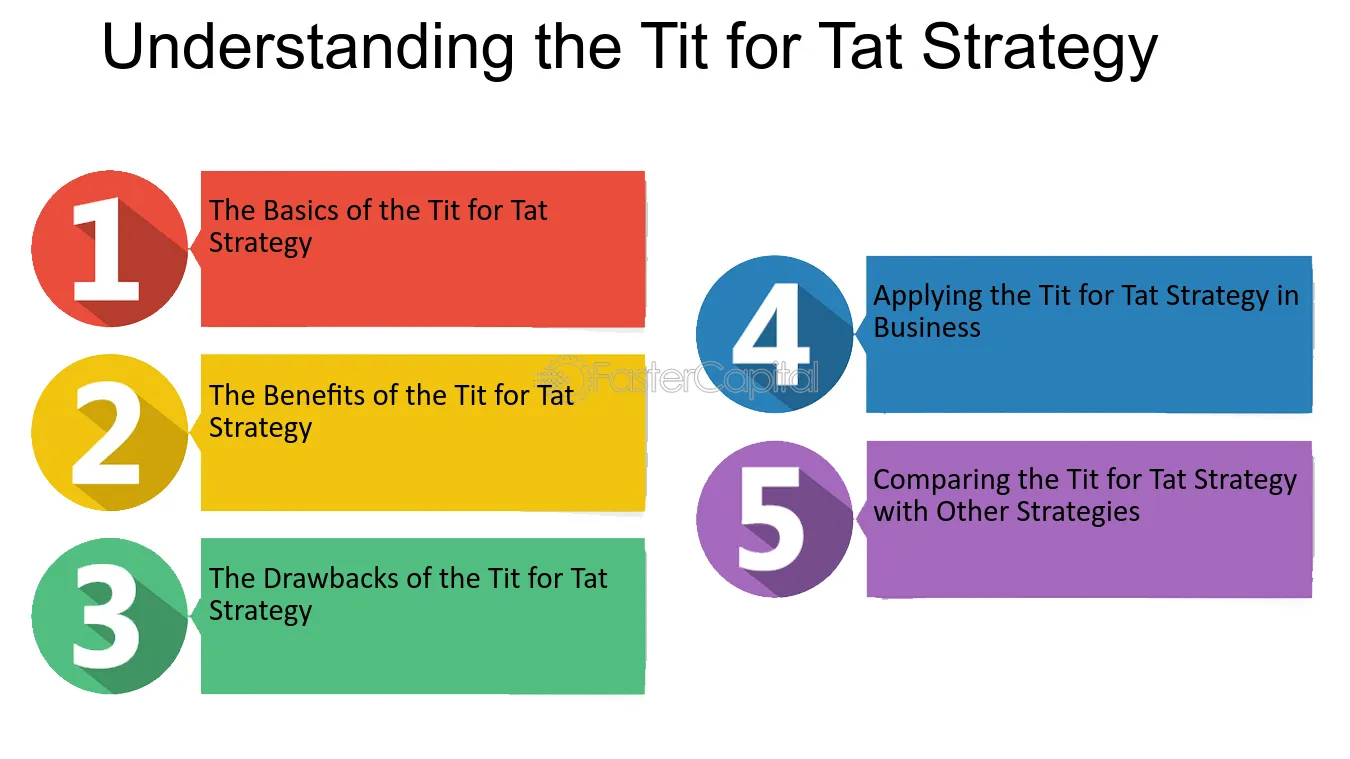
Using tit for tat effectively in personal or professional life requires balance to foster cooperation without escalation.
- Start Positively: Begin with kindness to encourage mutual trust.
- Mirror Proportionally: Match actions in scale, whether favors or consequences.
- Communicate Clearly: Avoid misunderstandings that spark unnecessary tit for tat.
- Break Cycles: Pause retaliatory responses to de-escalate conflicts.
- Example: In a workplace, reciprocate a colleague’s support with help, but address sabotage calmly to avoid tit for tat tension.
Table: Tit for Tat Across Contexts
| Context | Example | Action | Outcome |
|---|---|---|---|
| Personal Relationships | Neighbor shares tools; you bake cookies | Positive tit for tat | Strengthens community |
| Workplace | Rival takes credit; you highlight your work | Retaliatory tit for tat | Restores fairness, risks tension |
| Game Theory | Cooperate, then mirror in Prisoner’s Dilemma | Strategic tit for tat | Promotes mutual cooperation |
| Literature | Darcy’s snub met with Elizabeth’s wit | Narrative tit for tat | Drives character dynamics |
| Film | Michael Corleone avenges betrayal (Godfather) | Dramatic tit for tat | Intensifies plot conflict |
| Diplomacy | Tariff response to trade restrictions | Political tit for tat | Balances trade, risks escalation |
| Psychology | Returning a favor to a friend | Social tit for tat | Builds trust and reciprocity |
FAQs About Tit for Tat Meaning
What is the tit for tat meaning in English?
The tit for tat meaning refers to responding to an action with an equivalent one, balancing fairness or retaliation.
What is the tit for tat definition?
The tit for tat definition describes a reciprocal exchange where one mirrors another’s behavior, like returning a favor or retaliating.
Can you provide a tit for tat example?
If a friend helps with a task, you reciprocate; if someone insults you, you might reply tit for tat with a sharp comment.
What is the tit for tat phrase origin?
The tit for tat phrase originated in the 16th century from “tip for tap,” meaning a blow for a blow.
How does tit for tat work in psychology?
In tit for tat psychology, it reflects the reciprocity norm, where people mirror kindness or harm, as studied by Cialdini in 1966.
What is the tit for tat strategy in game theory?
The tit for tat strategy involves cooperating initially, then mirroring the opponent’s last action, proven effective in Axelrod’s 1984 study.
What are some famous tit for tat quotes?
Examples include “An eye for an eye” (Exodus 21:24) and “Measure for measure” (Shakespeare, 1604), reflecting tit for tat principles.
Conclusion
The tit for tat meaning weaves a thread of reciprocity through the fabric of human interactions, balancing fairness and consequence with timeless relevance.
Rooted in 16th-century English, this idiom captures the essence of give-and-take, from everyday favors to calculated revenge. In psychology, it underpins the reciprocity norm, fostering trust or fueling conflict, as seen in Cialdini’s 1966 studies.
In game theory, Axelrod’s 1984 tit for tat strategy proves its power to promote cooperation. Literature and media, from Pride and Prejudice to The Godfather, use tit for tat to drive narratives and deepen character dynamics.
Historically, it shapes events like the Cold War and modern trade wars, reflecting its global impact. Whether in personal relationships, where a kind gesture sparks another, or in diplomacy, where nations mirror policies, tit for tat remains a cornerstone of human behavior.
By understanding its nuances, we navigate life’s delicate dance of cooperation and conflict, ensuring fairness while avoiding destructive cycles. This proverb endures as a vibrant lens for exploring justice, trust, and the intricate interplay of human actions.
