

Why must fire extinguishers be routinely maintained? The answer is simple: a neglected extinguisher can fail silently, look fine on the wall, and do nothing when a real fire breaks out.
Routine maintenance keeps every unit pressure-correct, chemically stable, and ready to operate under emergency conditions.
It also protects you legally, satisfies insurance requirements, and gives every person in a building genuine confidence that their first line of fire defense actually works.
The Core Reason: Extinguishers Degrade Without Use
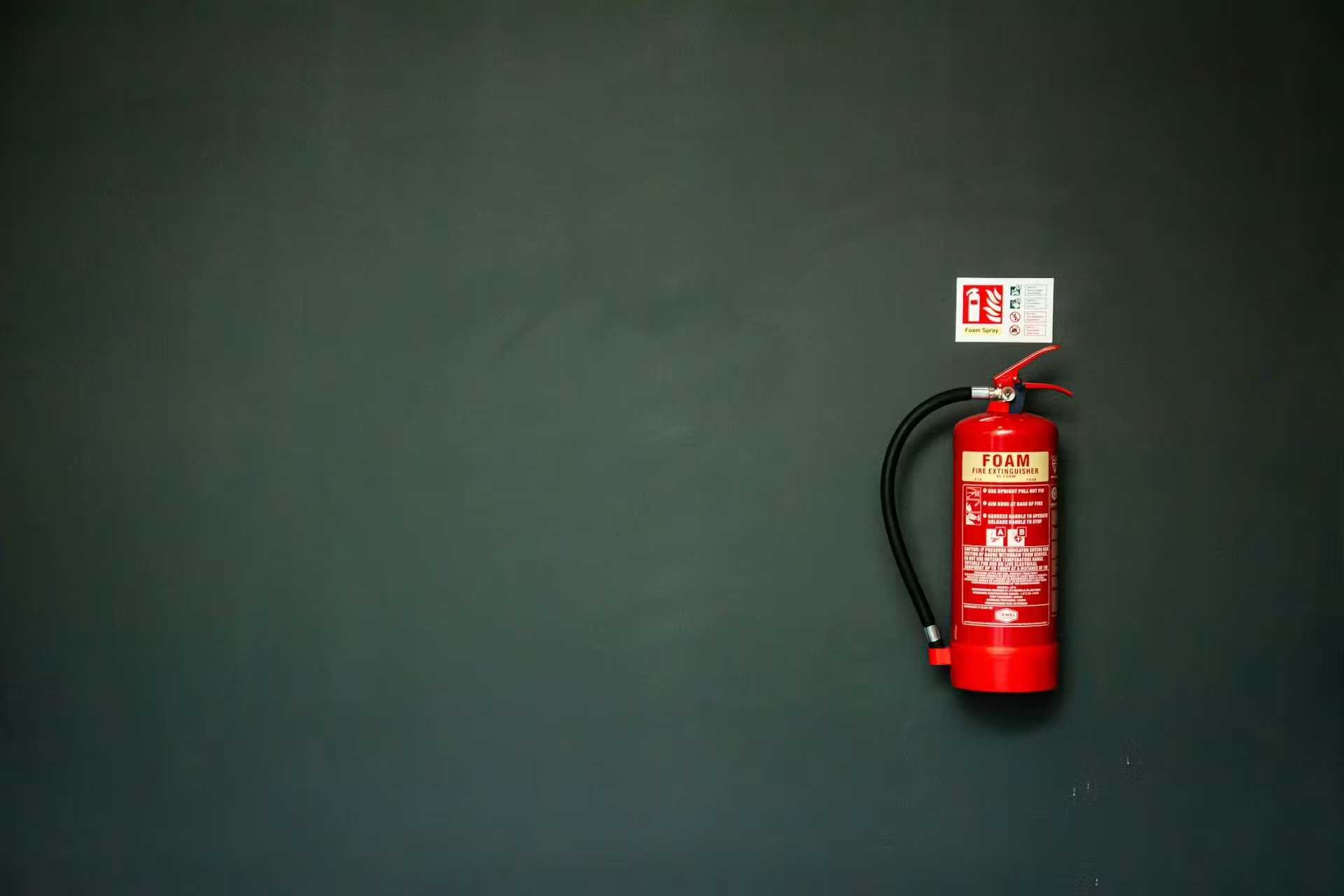
Most people assume a fire extinguisher sitting untouched on a wall stays in perfect condition. It does not.
Internal pressure drops over time. Extinguishing agents — especially dry chemical powder — can clump, settle, or degrade. Seals and O-rings harden and crack. None of this is visible from the outside without a proper inspection.
When someone grabs that extinguisher during a fire emergency and nothing comes out, the damage is already done. Routine maintenance exists specifically to catch these invisible failures before they cost lives.
What Routine Maintenance Actually Means
Routine maintenance is not a single event. It is a layered system of checks that happen at four different intervals, each serving a different purpose.
Monthly visual checks are quick self-inspections done by building staff. Annual professional inspections are performed by certified technicians who examine every mechanical component. Six-year internal maintenance involves fully discharging, disassembling, and rebuilding stored-pressure units. Twelve-year hydrostatic testing pressure-tests the cylinder itself to verify structural integrity.
Skipping any of these layers creates a compliance gap and a genuine safety risk, regardless of whether the Fire Marshal catches it on inspection day.
The NFPA 10 Standard: What the Law Requires
The National Fire Protection Association’s NFPA 10 — Standard for Portable Fire Extinguishers — is the primary regulation governing fire extinguisher maintenance across the United States.
NFPA 10 requires that all portable fire extinguishers be visually inspected when first placed in service and at minimum every 30 days thereafter. Annual full maintenance must be performed by a licensed fire extinguisher professional. The 2026 edition of NFPA 10 introduced performance-based inspection programs that can adjust inspection frequency based on documented history, as well as new requirements for condemned-extinguisher disposal.
Compliance with NFPA 10 is not optional in most jurisdictions. It is a legal requirement for commercial and industrial property owners, with non-compliance resulting in fines, forced closures, and increased liability exposure in the event of a fire-related injury.
NFPA 10 Inspection and Maintenance Schedule
| Inspection Type | Frequency | Who Performs It |
|---|---|---|
| Visual Check | Monthly (every 30 days) | Facility staff |
| Full Maintenance Inspection | Annually (every 12 months) | Certified technician |
| Internal Examination and Recharge | Every 6 years | Certified technician |
| Hydrostatic Pressure Testing | Every 12 years | Certified technician |
Reason 1: Pressure Loss Renders an Extinguisher Useless
The extinguishing agent inside a fire extinguisher is expelled by internal pressure — typically compressed nitrogen or CO2 gas. This pressure can drop slowly over months and years due to micro-leaks around valve seals, temperature cycling, or physical damage.
A pressure gauge reading in the green zone is not a guarantee the extinguisher will work. A cracked seal or a tampered pin can allow partial discharge too small to register on the gauge.
During a monthly visual check, staff should verify the pressure needle is in the operational range — typically 100 to 195 PSI for most stored-pressure units. During the annual inspection, a certified technician weighs CO2 and clean-agent units and tests the valve assembly to confirm the extinguisher is fully charged.
Reason 2: Extinguishing Agents Degrade Over Time
Different extinguishing agents have different shelf-life concerns.
Dry chemical powder (ABC extinguishers) is the most widely used type. Over time, dry chemical can absorb moisture from the environment, causing it to clump and cake. A caked agent will not flow through the discharge hose correctly and will fail to coat the fire effectively.
Wet chemical agents in Class K extinguishers can separate or lose potency over years of inactivity. CO2 extinguishers lose weight as the gas gradually seeps out, which is why they have no pressure gauge — weight is the only way to verify fullness.
The six-year internal maintenance process specifically addresses chemical condition. Technicians discharge the unit, inspect and replace the agent if needed, and recharge to manufacturer specifications before returning the extinguisher to service.
Reason 3: Physical Damage That Is Not Obvious
Fire extinguisher cylinders are pressure vessels. Even small amounts of physical damage — a dent, surface corrosion, pitting — can compromise the structural integrity of the cylinder under the stress of use.
A corroded or structurally weakened cylinder can rupture at full pressure. This is not a theoretical risk. NFPA 10 specifically requires that extinguishers showing evidence of corrosion, pitting, or prior repair by soldering or welding be permanently condemned and removed from service.
Routine maintenance includes an external visual examination for dents, rust, corrosion, and label damage. The 12-year hydrostatic test is specifically designed to detect internal cylinder weakness by pressurizing the unit to above operating pressure in a controlled test environment.
Reason 4: Hose and Nozzle Blockages
The discharge hose and nozzle of a fire extinguisher can become blocked over time by debris, dried chemical residue, insects, or deteriorated hose material. A blocked nozzle means zero discharge when the handle is squeezed — even if the cylinder is fully pressurized.
O-rings within the hose connector also deteriorate with age. A failed O-ring creates a leak point that reduces discharge pressure and can cause the agent to spray backward toward the operator.
Annual inspections specifically include inspection of the hose for cracks, blockages, and connector condition. O-rings are replaced on a scheduled basis during six-year maintenance.
Reason 5: Tampering and Displacement
Fire extinguishers in publicly accessible areas are subject to tampering. Pulling the safety pin, breaking the tamper seal, partially discharging the unit, or simply moving the extinguisher from its designated location can all render it non-functional in an emergency.
Sometimes the displacement is unintentional — an extinguisher used as a doorstop, moved during cleaning, or shifted after renovation work. In a real fire scenario, a person running to where the extinguisher should be and finding an empty bracket wastes critical seconds.
Monthly visual checks verify that each extinguisher is present, visible, and accessible. The tamper seal and safety pin are examined to confirm no unauthorized use or discharge has occurred.
Reason 6: Legal Compliance and Avoiding Fines
Fire extinguisher maintenance is not a suggestion in most jurisdictions. It is codified law.
In the United States, OSHA Standard 29 CFR 1910.157 requires employers to provide and maintain portable fire extinguishers in workplaces. NFPA 10 provides the detailed framework for how that maintenance must be conducted. Many states layer additional requirements on top of federal standards.
Non-compliance consequences include fines from OSHA and fire marshals, loss of business operating licenses, voided insurance coverage in the event of a fire-related claim, and increased civil liability if someone is injured because a poorly maintained extinguisher failed.
Maintaining proper inspection records — tags on each unit documenting the date, technician name, and work performed — is the documented evidence that protects a business owner from negligence claims.
Reason 7: Insurance Requirements
Most commercial insurance policies that cover fire damage include specific language about fire safety equipment maintenance. Businesses that cannot demonstrate current fire extinguisher inspection compliance may face:
Claim denials on fire damage if inspections were overdue at the time of the fire. Premium increases tied to fire safety audit failures. Policy cancellations when inspections are found to be consistently delinquent.
Keeping extinguishers properly tagged and maintaining a written inspection log provides the documentation an insurer needs to confirm compliance. Many fire protection companies offer automatic service reminders and digital recordkeeping precisely because their clients need this paper trail.
Reason 8: Cost-Effectiveness Over Replacement
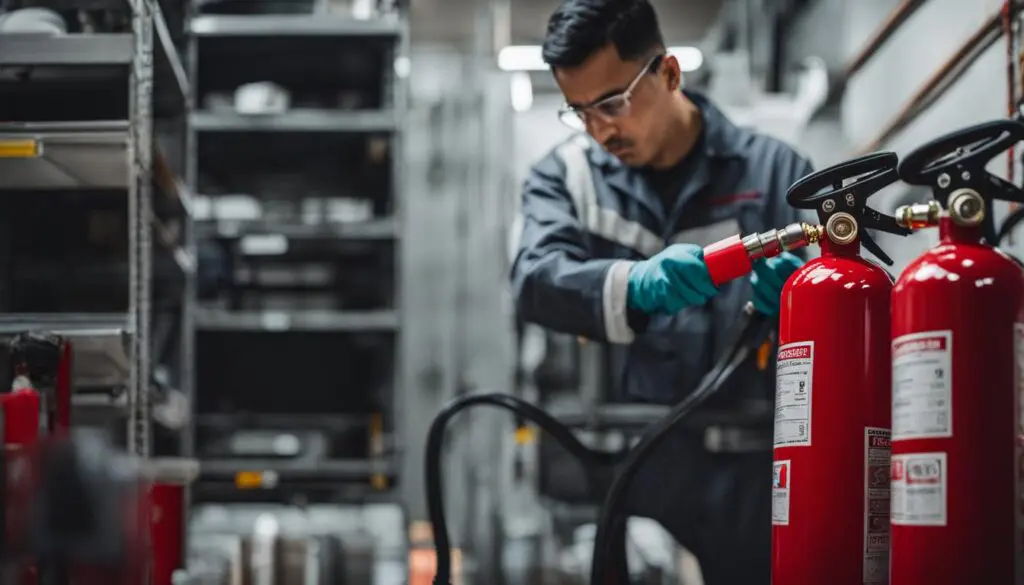
A common misconception is that regular maintenance is an ongoing expense that adds up quickly. The reality is the opposite.
A standard annual inspection costs approximately $20 per unit. The six-year internal maintenance and recharge runs $30 to $75 per unit depending on type and size. These are small costs compared to the replacement cost of a new extinguisher ($50–$200+) or, more critically, the cost of fire damage from a failed extinguisher — property damage, business interruption, legal liability, and insurance claims.
Routine maintenance also extends the service life of an extinguisher. A well-maintained unit can remain in service for 20 years or more. Without maintenance, agents degrade, cylinders corrode, and extinguishers are condemned during inspections and require early replacement.
Cost Comparison: Maintenance vs Replacement
| Action | Approximate Cost |
|---|---|
| Monthly visual check (staff time) | $0 – minimal |
| Annual professional inspection | ~$20 per unit |
| 6-year internal maintenance and recharge | $30–$75 per unit |
| 12-year hydrostatic test | $20–$50 per unit |
| New ABC extinguisher (replacement) | $50–$200+ |
| Fire damage (average small commercial fire) | $50,000–$200,000+ |
Reason 9: Building Occupant Confidence and Emergency Preparedness
A fire emergency is not the time for uncertainty about equipment.
When a person grabs an extinguisher and hesitates — wondering if it will actually work — that hesitation costs seconds. A well-maintained extinguisher with a current inspection tag and visible green gauge needle eliminates doubt.
Routine maintenance also creates an opportunity for facilities teams to confirm that extinguishers are still the right type for the hazard present in each location. Businesses change layouts, add equipment, and introduce new materials. An annual inspection review should confirm that Class K extinguishers are present in kitchen areas, CO2 or clean-agent units are positioned near electrical equipment and servers, and ABC units cover general areas.
Understanding Fire Extinguisher Types and Their Maintenance Needs
Not all fire extinguishers follow identical maintenance timelines. The type of agent inside determines specific service intervals.
Fire Extinguisher Classes and Maintenance Intervals
| Type | Fire Classes | Key Agent | Hydrostatic Test Interval |
|---|---|---|---|
| ABC Dry Chemical | A, B, C | Monoammonium phosphate | Every 12 years |
| CO2 | B, C | Carbon dioxide gas | Every 5 years |
| Wet Chemical (Class K) | K (also A) | Potassium acetate | Every 5 years |
| Clean Agent | B, C (some A) | Halon alternative gas | Every 12 years |
| Water/Foam | A (foam also B) | Water / AFFF | Every 5 years |
| Class D (Dry Powder) | D only | Sodium chloride powder | Every 12 years |
ABC dry chemical extinguishers — the most common type in homes, offices, and businesses — require 12-year hydrostatic testing but 6-year internal maintenance and annual professional inspection.
CO2 extinguishers are high-pressure vessels that require more frequent hydrostatic testing (every 5 years) and an annual hose conductivity test. They have no pressure gauge — fullness is verified by weight only.
Class K wet chemical extinguishers in commercial kitchens operate on a 5-year hydrostatic cycle, faster than ABC units. Facilities running both in the same building must track two completely separate maintenance timelines.
How to Conduct a Monthly Visual Inspection
Monthly checks are the responsibility of building owners or designated facility staff. They do not require certification and take approximately 5 minutes for a typical building.
The extinguisher must be in its designated, clearly visible, and accessible location — not blocked by boxes, furniture, or equipment. The pressure gauge needle must be in the green operational zone. The safety pin must be fully inserted and the tamper seal must be intact and unbroken. There must be no visible physical damage, dents, corrosion, or leaking around the valve. The inspection label and operating instructions must be legible. The inspection date and the initials of the person performing the check must be recorded on the tag or log.
NFPA 10 requires these records to be maintained and available for review. A break in the monthly inspection record is itself a compliance violation, even if the extinguisher appears functional.
What Happens During a Professional Annual Inspection
A certified technician’s annual inspection goes well beyond a visual check. It is a systematic review of every functional component.
The technician examines the cylinder externally for dents, rust, and corrosion. The valve assembly is tested and lubricated if needed. The safety pin and tamper seal are replaced. The hose and nozzle are inspected for cracks, blockages, and O-ring condition. Operating instructions are confirmed to be present, correctly positioned, and legible. The pressure gauge is verified against the manufacturer’s operational range. For units where weight determines fullness (CO2 and clean-agent types), the technician weighs each unit and compares against the manufacturer’s specification.
After the inspection, a new current-year tag is attached to each extinguisher documenting the date, technician name, and service company. This tag is the first item a fire marshal checks during an inspection visit.
The Six-Year Internal Maintenance Process
Every six years, stored-pressure dry chemical extinguishers must be fully disassembled and internally inspected by a certified technician.
The process involves fully discharging the extinguishing agent into an approved recovery container. The valve is removed and all internal components — including the dip tube, valve stem, and O-rings — are inspected and replaced as needed. The cylinder interior is inspected for corrosion, pitting, and structural integrity. Fresh dry chemical agent is loaded to the manufacturer’s specified weight. The unit is recharged with nitrogen to the correct operating pressure. The hose assembly is pressure-tested. A six-year compliance sticker is applied alongside the annual inspection tag.
This process is mandatory per NFPA 10 regardless of whether the visual gauge appears normal. Chemical degradation and internal corrosion can exist without any visible external indicator.
The Twelve-Year Hydrostatic Test
Hydrostatic testing is performed on the cylinder itself — not the extinguisher mechanism — to verify structural integrity under pressure.
The test uses water or another non-compressible fluid to pressurize the cylinder above its normal operating rating. Any cylinder that expands permanently beyond acceptable tolerances, shows weeping, or fails the visual examination during this process is condemned and permanently removed from service.
This test requires specialized equipment and trained technicians. It cannot be performed on-site with standard maintenance tools. Extinguishers sent for hydrostatic testing are typically replaced temporarily during the test period to maintain coverage.
Non-rechargeable extinguishers (disposable units) do not undergo hydrostatic testing. Instead, they must be permanently removed from service 12 years from the date of manufacture. The manufacture date is stamped on the cylinder body.
Signs Your Extinguisher Needs Immediate Service
Certain conditions require immediate service regardless of where the extinguisher sits in its scheduled maintenance cycle.
The pressure gauge is in the red zone (either over- or under-pressurized). The tamper seal is broken or missing. The safety pin has been pulled. There is visible corrosion, denting, or damage to the cylinder. The hose is cracked, kinked, or partially blocked. The extinguisher has been used — even partially. The inspection tag is expired or missing. Any of these conditions means the extinguisher should be treated as non-functional and serviced immediately. It should not remain in service until the next scheduled inspection date.
Building a Maintenance System That Does Not Fail
The most common reason fire extinguishers fall out of compliance is not neglect — it is a lack of a system. When everyone is responsible, no one is responsible.
Effective maintenance systems assign a specific named person to monthly visual checks and record-keeping. They use a fire protection service company with automatic annual service reminders. They keep digital or physical logs of every inspection, maintenance action, and technician tag. They include fire extinguisher status as a line item in safety committee reviews.
Printing a visual checklist and hanging it near each extinguisher reinforces the habit for staff performing monthly checks. Setting a recurring calendar reminder ensures the annual professional inspection is scheduled before the current tag expires.
Fire Extinguisher Placement Requirements Under NFPA 10
Maintenance also covers placement compliance, not just mechanical function.
NFPA 10 specifies that in commercial and industrial buildings, no employee should have to travel more than 75 feet to reach a fire extinguisher. Extinguishers weighing 40 lbs or less must have their handle mounted no higher than 5 feet from the floor. Units must be visible and unobstructed at all times.
These placement requirements are reviewed during annual inspections. Changes in office layout, new equipment, or renovation work that obstructs an extinguisher or increases travel distance creates a compliance gap that must be corrected immediately.
Documentation: The Proof That Protects You
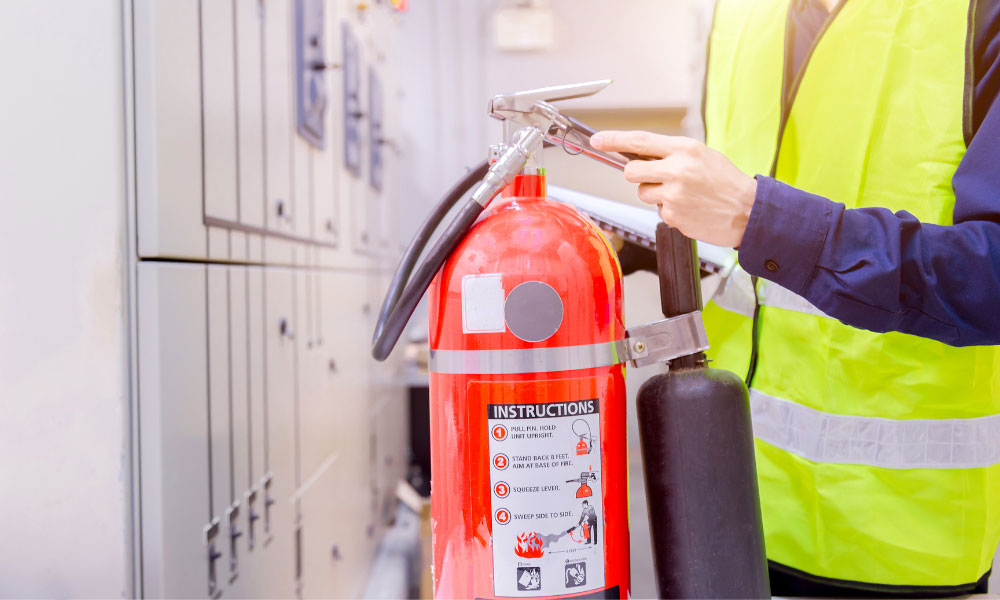
Documentation is the part of fire extinguisher maintenance that most businesses underestimate.
NFPA 10 requires that inspection, maintenance, and hydrostatic testing records be maintained for the life of each extinguisher. Monthly inspection records must show the date and the initials of the person who performed the check. Annual maintenance records must show the date, the name of the servicing individual or company, and the work performed.
In the event of a fire-related insurance claim or personal injury lawsuit, these records are the evidence that the building owner exercised their duty of care. Missing records — even for extinguishers that were functionally maintained — can expose a property owner to negligence liability they would otherwise have been protected from.
Frequently Asked Questions (FAQs)
Why must fire extinguishers be routinely maintained?
Fire extinguishers must be routinely maintained to ensure they remain functional during an emergency. Pressure loss, chemical degradation, corrosion, and tampering can all cause a unit to fail silently without any visible warning.
How often should fire extinguishers be inspected?
NFPA 10 requires monthly visual checks by facility staff, annual professional inspections by a certified technician, six-year internal maintenance, and 12-year hydrostatic pressure testing.
Can building staff perform fire extinguisher inspections?
Staff can and must perform monthly visual checks. Annual, six-year, and 12-year service must be performed by a certified and licensed fire extinguisher technician — these cannot be done in-house.
What happens if fire extinguisher maintenance is neglected?
Neglected extinguishers may fail to discharge during a fire emergency. Building owners face OSHA fines, fire code violations, insurance claim denials, forced closures, and potential civil liability for injuries or property damage.
What does NFPA 10 require for fire extinguisher maintenance?
NFPA 10 requires monthly visual inspections, annual professional maintenance, six-year internal examination and recharge for stored-pressure dry chemical units, and 12-year hydrostatic testing. All inspections must be documented and records retained.
How long does a fire extinguisher last with proper maintenance?
A well-maintained rechargeable fire extinguisher can remain in service for 20 years or more. Non-rechargeable disposable units must be removed from service 12 years from their manufacture date regardless of condition.
What is the six-year fire extinguisher maintenance requirement?
Every six years, stored-pressure dry chemical extinguishers must be fully discharged, internally inspected, and recharged by a certified technician per NFPA 10. This is separate from and in addition to the annual inspection.
Does fire extinguisher maintenance affect insurance coverage?
Yes. Many commercial insurance policies require documented proof of fire extinguisher maintenance compliance. Claims related to fires where extinguishers were not properly maintained can be denied or disputed by insurers.
What is hydrostatic testing for fire extinguishers?
Hydrostatic testing pressurizes the extinguisher cylinder with water above its operating pressure to check for structural weaknesses. It is required every 5 or 12 years depending on extinguisher type and must be performed by a specialized testing facility.
How much does annual fire extinguisher maintenance cost?
Annual professional inspection typically costs around $20 per unit. Six-year internal maintenance runs $30–$75 per unit. These costs are significantly lower than premature replacement and vastly lower than the costs of a fire caused by equipment failure.
Conclusion
Why must fire extinguishers be routinely maintained? Because a fire extinguisher that fails in an emergency is not a safety tool — it is a false sense of security that costs lives and property.
Routine maintenance, carried out on the four-tier schedule required by NFPA 10, ensures that every unit holds correct pressure, contains viable extinguishing agent, shows no physical damage, and is properly positioned for immediate use.
It satisfies legal obligations under OSHA and local fire codes, protects businesses from insurance claim disputes, and gives every building occupant the genuine assurance that their fire safety equipment will perform when it matters most. The cost of regular maintenance is minimal.
The cost of skipping it — measured in fines, liability, property damage, and human safety — is not. Build a system, assign responsibility, keep records, and schedule service before the tag expires. That is the entire job.
