

Why is my cat biting me is one of the most frustrating questions cat owners ask, and the answer is almost never “just because.” Cat biting is a form of communication, and every bite has a reason behind it.
Some bites are gentle expressions of affection. Others are urgent warnings that your cat has reached its limit. And some point to medical problems that need professional attention.
Understanding the type of bite, the body language that comes with it, and what triggered it gives you a real path forward.
The Hidden Truth About Why Cats Bite
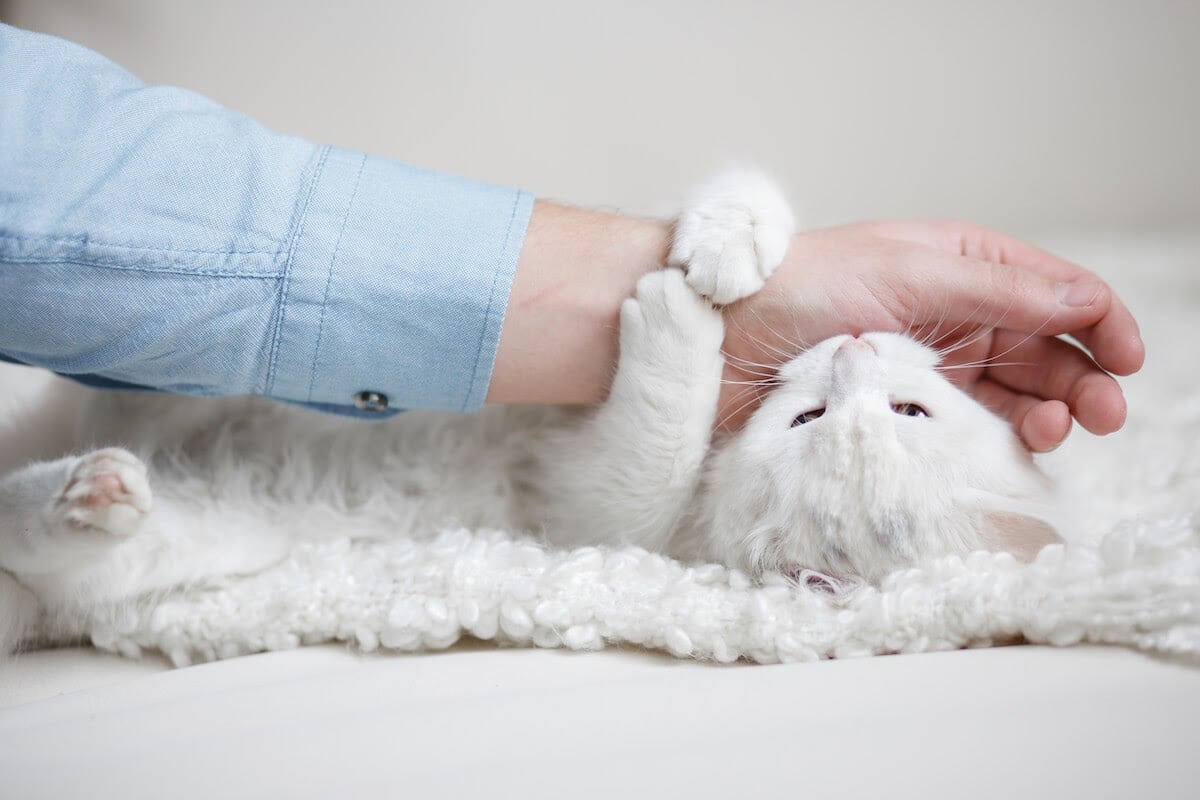
Most people assume cat biting is about aggression or bad behavior. That is rarely the full picture.
Cats do not bite out of spite or anger. According to animal behavior experts, cats bite because they are fearful, stressed, overstimulated, in pain, or trying to communicate a need. The bite is their clearest available message.
The challenge is that cats give plenty of warning signals before they bite. Most owners simply do not know what to look for. By the time the teeth land, the cat has often been escalating for minutes without anyone noticing.
Types of Cat Bites and What Each One Means
Not all bites are the same. Understanding the type of bite your cat delivers changes everything about how you respond.
| Bite Type | Description | What It Usually Means |
|---|---|---|
| Love bite | Gentle nibble, no broken skin | Affection, slight overstimulation |
| Play bite | Quick, light nip during play | Hunting instinct, needs redirection |
| Warning bite | Firm, sudden nip with tension | “Stop what you’re doing” |
| Fear bite | Hard, defensive, unpredictable | Extreme stress or feeling trapped |
| Pain-triggered bite | Sudden bite when touched in one area | Medical issue, needs vet evaluation |
| Redirected aggression bite | Bite aimed at you from unrelated trigger | External stressor the cat cannot reach |
| Predatory bite | Ankle ambush, stalking behavior | Prey drive, needs play outlet |
Knowing which category applies to your situation helps you choose the right response instead of guessing.
Reason 1: Play Aggression and Hunting Instinct
One of the most common reasons people ask why is my cat biting me is entirely tied to natural predatory behavior.
Cats are hardwired hunters. The stalking, pouncing, and biting sequence is not something they choose — it is embedded in their biology. When they do not have appropriate outlets for that energy, hands, feet, and ankles become the prey.
This is especially common in kittens and young adult cats. Kittens raised without siblings miss out on a critical learning experience. Littermates teach each other through squealing and pulling away when a bite is too hard. Without that feedback, kittens never develop proper bite inhibition.
Kittens that were separated from their mothers and siblings before eight weeks of age are significantly more likely to develop play biting problems that carry into adulthood.
The solution is never to use your hands as toys. Once a cat learns that fingers are prey, unlearning that association takes considerable time and consistent training.
Reason 2: Overstimulation and Petting-Induced Aggression
This is probably the most misunderstood type of cat biting, and it catches owners completely off guard.
You are having a calm, enjoyable petting session. Your cat is purring. Everything seems fine. Then suddenly your cat bites you. It feels completely random, but it is not.
Petting-induced aggression, also called overstimulation or petting reactivity, happens when repetitive physical contact gradually shifts from pleasant to irritating for the cat. The ASPCA compares it to someone rubbing the same single spot on your back over and over — what started as nice quickly becomes deeply unpleasant.
Cats build up to this point with a series of escalating signals. They are communicating clearly. The problem is that most humans miss the early signs and keep petting until the cat has no option left but to bite.
Warning Signs of Overstimulation to Watch For
Learning to recognize these signals before the bite happens is the single most effective way to prevent petting-induced biting.
| Warning Signal | What It Looks Like | Urgency Level |
|---|---|---|
| Tail flicking or thumping | The tail begins to swish back and forth | Early warning |
| Skin rippling | The skin along the back twitches or shivers | Early to mid warning |
| Ears rotating backward | Ears flatten or turn outward | Mid warning |
| Body tension | The cat stiffens or becomes very still | Mid to late warning |
| Dilated pupils | Eyes widen noticeably | Late warning |
| Head turning toward your hand | Cat looks at the hand being used to pet | Imminent bite |
| Growling or low vocalization | Any sound of irritation | Imminent bite — stop immediately |
If you see any of these signals, stop petting immediately. Do not wait for the cat to escalate further. Move your hand away slowly and give the cat space to decompress.
Reason 3: Fear and Defensive Aggression
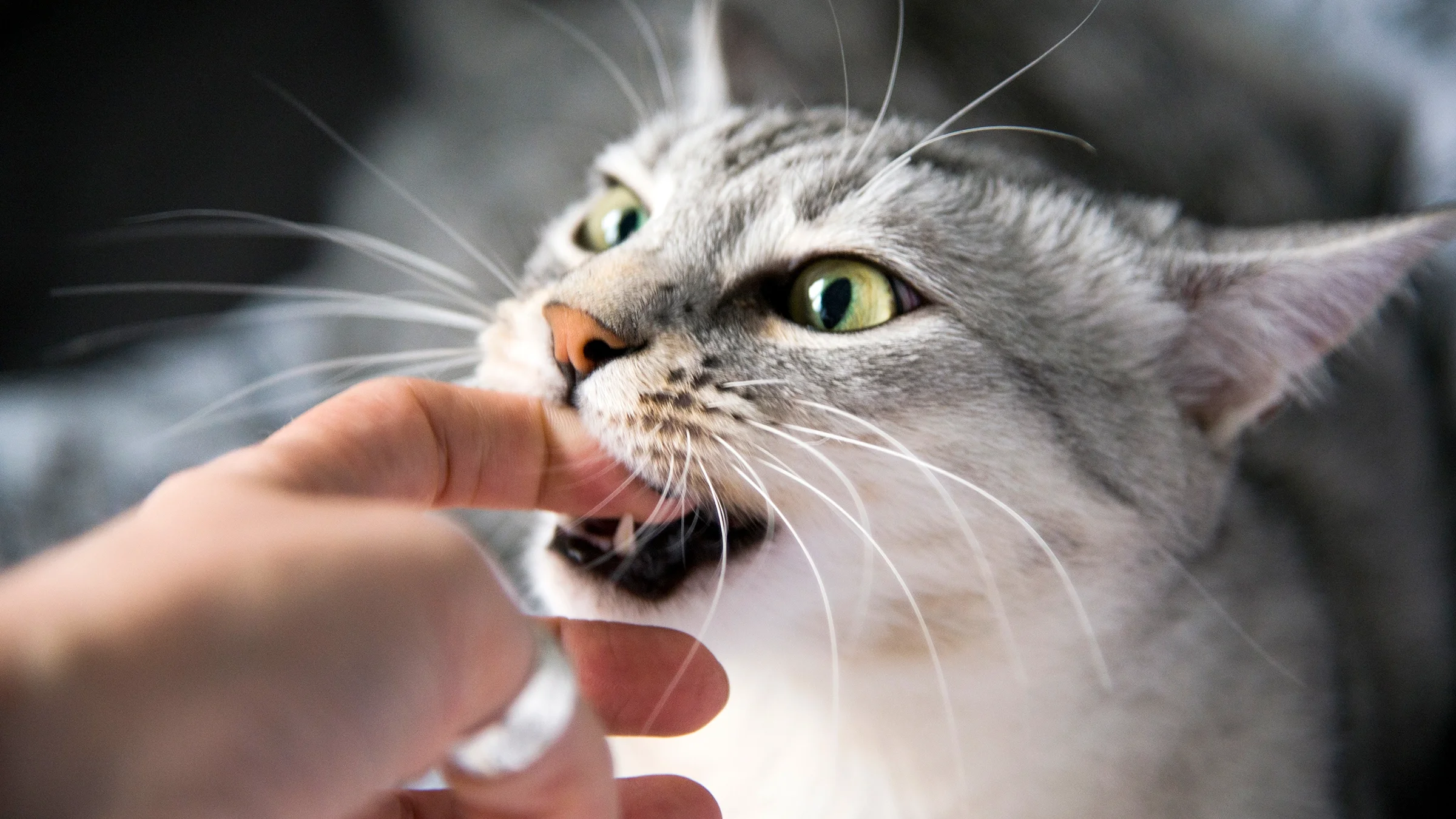
A frightened cat that feels trapped will bite. It is not a choice — it is a survival response.
When cats are scared, their preferred response is to flee and hide. Biting is a last resort. It only happens when the cat feels it has no other way out. Before a fear bite, a cat will typically show clear body language: crouching low, flattening ears against the head, arching the back, puffing up the fur, and hissing.
Common triggers for fear biting include loud sudden noises, unfamiliar people or animals, being handled roughly or restrained, and changes to the home environment. Cats with a history of poor socialization during the critical window of two to eight weeks of age are significantly more prone to fear-based aggression throughout their lives.
If your cat bites when being picked up, handled, or approached, fear is very likely involved. Forcing contact with a frightened cat never helps. It only confirms the cat’s belief that it needs to defend itself.
Reason 4: Pain and Medical Causes
A sudden change in biting behavior — especially in a cat that was not previously a biter — is a red flag that demands veterinary attention.
Pain is one of the most reliable hidden causes of biting. When a cat is hurting, it becomes hypersensitive to touch. Being petted or handled in an area that is sore, inflamed, or injured triggers a bite as a protective reflex.
Conditions that commonly cause pain-related biting include arthritis (especially in senior cats), dental disease and tooth pain, skin conditions and dermatitis, abscesses or wounds, joint injuries, gastrointestinal discomfort, and internal pain from systemic illness.
The ASPCA lists several medical conditions that can directly contribute to aggression, including hyperthyroidism, epilepsy, toxoplasmosis, and cognitive dysfunction in older cats.
If your cat bites specifically when you touch one area of its body, or if biting started suddenly without any obvious behavioral trigger, do not attempt to train the behavior away. Go to the vet first.
Reason 5: Redirected Aggression
This is one of the most confusing cat biting scenarios because the cat seems to bite you completely out of nowhere, for no reason.
Redirected aggression happens when a cat becomes highly aroused or agitated by something it cannot directly confront — a cat outside the window, a loud noise, another animal in the house — and then redirects that frustration onto whoever is nearby. That is usually you.
The cat is not angry at you specifically. It is in a heightened state of arousal and needs to discharge that energy somewhere. You happen to be within reach.
This type of biting can be intense and is often the hardest to predict. The key is recognizing when your cat has been exposed to an external stressor. If your cat was just watching a bird outside, staring at another cat through a window, or startled by a loud sound, give it significant space before attempting any interaction.
Never try to comfort a cat in the middle of a redirected aggression episode. The arousal state can last 20 minutes or longer, and any contact during that window increases bite risk.
Reason 6: Attention-Seeking and Communication Biting
Sometimes cats bite simply because it works. They nip, and you respond. The behavior gets reinforced.
Attention-seeking biting is typically lighter than aggressive biting. The cat may nip your hand, arm, or ankle when you stop petting it, when you are not paying attention, or when it wants something like food or play. These are often called love nips, and while they are less dangerous, they still need to be addressed.
The rule here is simple: do not reward the bite with attention. If your cat nips you to get you to keep petting, and you keep petting, you have just taught the cat that biting works. The cat will do it again, and possibly harder.
The correct response is to stand up, turn away, and completely ignore the cat for a short period. Remove any attention that could be interpreted as a reward.
Reason 7: Territorial and Dominance-Related Biting
Some cats, particularly in multi-cat households or when new animals are introduced, bite as part of establishing or defending territory.
This type of biting is usually directed more at other animals than at humans, but it can spill over into human interactions when the cat is in a heightened territorial state. Cats that feel their resources — food, sleeping spots, litter boxes, or attention — are being threatened become significantly more reactive and prone to biting.
Introducing a new pet too quickly, moving to a new home, or changes in the household that shift the social dynamic can all trigger this response. Slow, structured introductions and ensuring all cats have access to adequate separate resources goes a long way in reducing territorial tension.
Reason 8: Kitten Teething
If you have a young kitten and you are asking why is my cat biting me constantly, teething is very likely part of the answer.
Kittens go through two rounds of teething. They develop their milk teeth from around two to six weeks, and their permanent adult teeth come in between three and six months of age. During the second phase especially, sore gums drive kittens to chew and bite anything within reach.
This is temporary, but it still requires management. Providing appropriate teething toys gives the kitten a sanctioned outlet for the chewing urge. Hands should never be used as teething toys, because the habit that forms during teething often persists well into adulthood.
Reason 9: Boredom and Lack of Stimulation
A bored cat is a biting cat. This is consistently underestimated as a cause of cat biting problems.
Indoor cats, in particular, need daily mental and physical stimulation. Without it, they become frustrated, restless, and often fixate on humans as their primary source of activity. When play and enrichment needs are not met, biting becomes the cat’s way of generating the interaction it craves.
A minimum of two dedicated daily play sessions of at least 10 to 15 minutes each, using wand toys or other interactive toys that allow the cat to complete its full hunt sequence (stalk, chase, pounce, catch), can dramatically reduce biting related to boredom and overstimulated hunting drive.
Reason 10: Crepuscular Activity and Nighttime Biting
If your cat regularly bites your feet or hands while you are trying to sleep or in bed, this is almost certainly related to your cat’s natural activity pattern.
Cats are crepuscular, meaning their peak activity periods are dawn and dusk. This timing is tied to when their prey animals — small rodents and birds — are most active in the wild. Your cat is operating on its natural schedule, which does not align with human sleep hours.
Nighttime foot biting is play behavior triggered by the movement of feet under blankets, which closely mimics the movement of prey. The cat is not being malicious. It is doing exactly what its instincts tell it to do at precisely the time its body says is appropriate for hunting.
An intensive play session in the evening, followed by a feeding, can help burn off the peak activity energy and make nighttime biting significantly less likely.
How to Tell the Difference Between Love Bites and Aggressive Bites
This distinction matters, because the response to each is different.
| Feature | Love Bite | Aggressive Bite |
|---|---|---|
| Pressure | Gentle, does not break skin | Hard, may cause puncture wound |
| Context | During relaxed petting or grooming | During handling, startling, or provocation |
| Body language before bite | Relaxed, soft eyes, purring | Tense, flat ears, tail flicking |
| After the bite | Cat stays calm or continues contact | Cat runs off or maintains defensive posture |
| Paired behaviors | Licking, kneading, slow blink | Hissing, growling, dilated pupils |
A love bite during a calm petting session with purring and soft eyes is a signal your cat is reaching its limit — but it is not a threat. An aggressive bite with tense body posture and flat ears is a clear communication that something has gone wrong.
Where Cats Like and Dislike Being Touched
Knowing where your cat does and does not want to be touched dramatically reduces the likelihood of biting during petting sessions.
Most cats enjoy being touched around the head — under the chin, on top of the head, and along the sides of the face near the cheeks. These are also the areas where cats carry scent glands, and being touched there often feels like a form of mutual scent exchange, which is comforting and socially positive for them.
Areas that are more likely to trigger biting include the belly, the lower back near the tail, the legs, and the paws. Even in cats that occasionally tolerate belly rubs, the belly is a vulnerable area that can shift quickly from tolerated to triggering.
Sticking to safe zones and keeping petting sessions shorter than the cat’s apparent threshold is the simplest and most effective preventive strategy.
How to Stop Your Cat from Biting: Proven Steps
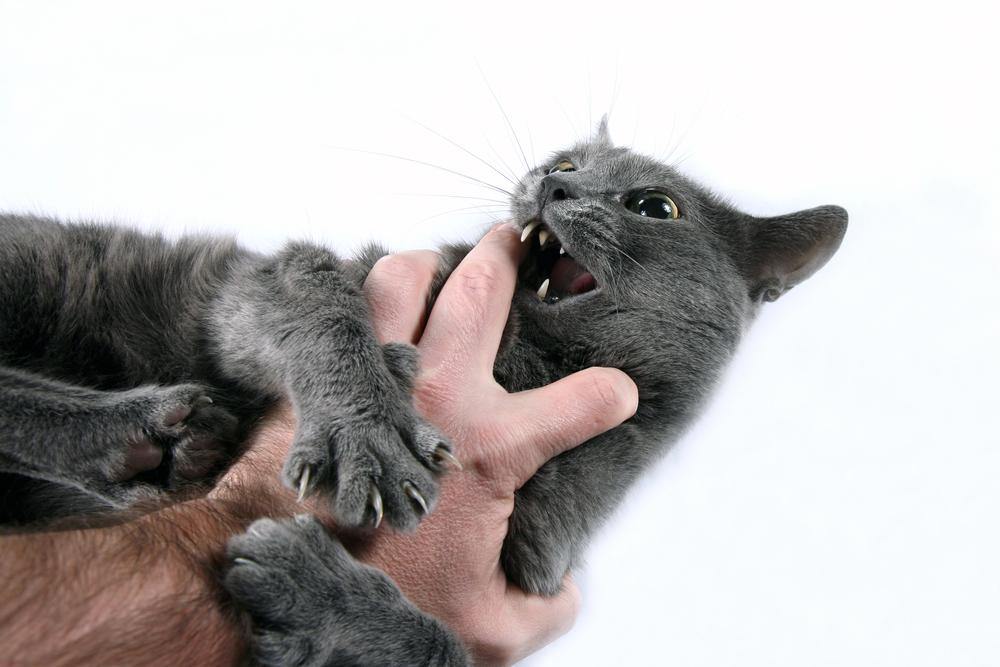
Stopping biting behavior requires consistency, patience, and understanding what type of biting you are dealing with. There is no single universal fix, but these strategies are consistently recommended by certified cat behavior consultants and veterinary behaviorists.
Never Use Your Hands as Toys
This is the foundational rule. Once a cat learns that hands and feet are prey objects, unlearning this takes significant effort. Use wand toys, feather toys, and interactive toys for all play sessions. Keep hands away from the play zone.
Redirect Before the Bite Happens
When you see early warning signs of overstimulation or excitement during play, redirect immediately. Introduce a toy to redirect the energy before the bite lands. Do not wait until the bite has already happened to act.
Stop All Interaction When Bitten
The moment a bite happens, immediately and calmly stop all interaction. Stand up, turn away, and leave the cat alone for several minutes. Do not yell, push the cat away, or engage in any way. Any reaction — even a negative one — can function as reinforcement by giving the cat the attention it sought.
Keep Petting Sessions Short
Do not pet until the cat bites. Pet for less time than it takes for your cat to become overstimulated, then stop and let the cat choose whether to continue contact. Letting the cat control the interaction prevents the frustration that leads to biting.
Provide Daily Play and Enrichment
At least two play sessions per day using interactive toys. Puzzle feeders, window perches, cat trees, and environmental enrichment all reduce boredom and the restless energy that drives unprovoked biting.
Never Punish a Cat for Biting
Punishment — yelling, spraying with water, physical corrections — does not teach a cat to stop biting. It teaches the cat to fear you, which increases fear-based aggression and biting. It also damages the bond between cat and owner significantly. Positive reinforcement and consistent boundary-setting are always more effective.
When to See a Veterinarian
Some biting situations require a vet visit, not just behavior training.
See your vet promptly if biting started suddenly with no obvious behavioral cause, if the cat bites consistently when a specific area of its body is touched, if the biting is accompanied by other behavior changes like hiding, changes in appetite, or increased vocalization, or if the cat is biting hard enough to cause significant injury.
Medical causes of aggression — including arthritis, dental pain, thyroid disease, skin conditions, and neurological changes — require medical treatment, not behavioral intervention alone.
Cat Bite First Aid: What to Do if You Are Bitten
Cat bites carry a high infection risk. The teeth of cats create deep, narrow puncture wounds that seal over quickly, trapping bacteria inside.
Cat teeth have tiny vertical grooves on the enamel surface where bacteria reside. When a cat bites, those bacteria are transferred deep into the skin. The closed nature of puncture wounds creates ideal conditions for rapid infection.
Clean the wound immediately with soap and water for several minutes. Apply antiseptic and monitor the area closely. See a doctor if the wound punctures the skin, if the bite is on your hand or near a joint, if you develop redness, swelling, or warmth around the wound within 24 hours, or if you do not know the cat’s vaccination history.
Cat scratch disease (bartonellosis, caused by Bartonella henselae) is another infection cats can transmit through bites and scratches, causing flu-like symptoms particularly in people with compromised immune systems.
Cat Biting by Age Group
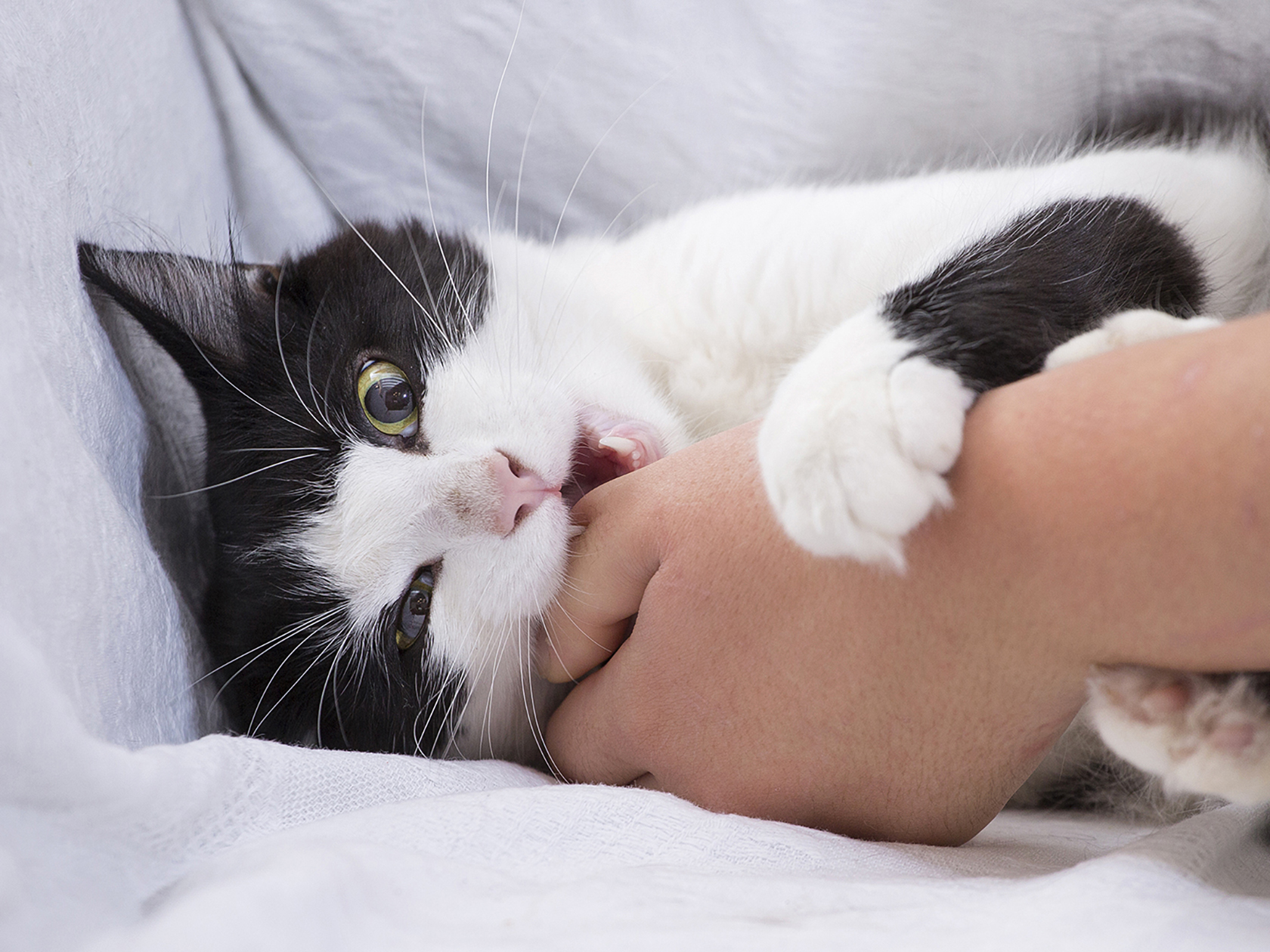
Biting behavior often has different primary causes depending on the age of the cat.
| Age Group | Most Common Biting Causes |
|---|---|
| Kitten (under 6 months) | Teething, play aggression, learning bite inhibition |
| Young adult (6 months – 2 years) | Play aggression, hunting drive, insufficient enrichment |
| Adult (2 – 10 years) | Overstimulation, fear, redirected aggression, territory |
| Senior (10+ years) | Pain, arthritis, dental disease, cognitive decline |
Understanding where your cat is developmentally helps you target the right intervention immediately rather than applying a generic solution that does not address the root cause.
Frequently Asked Questions (FAQs)
Why is my cat biting me for no reason?
There is always a reason, even when the bite seems random. The most likely causes are overstimulation from petting, redirected aggression from an external trigger, or an undetected medical issue causing pain.
Why does my cat bite me gently while purring?
This is a love bite and usually signals your cat is enjoying interaction but is approaching its stimulation limit. It is a polite request to ease up on petting rather than a sign of aggression.
Why does my cat bite me when I pet it?
Your cat is most likely overstimulated. Repetitive petting builds irritation over time. Watch for early warning signs like tail flicking or ear rotation and stop petting before the cat reaches its limit.
Why does my cat bite me out of nowhere?
What looks like “out of nowhere” usually follows missed warning signals. Look back at the 60 to 90 seconds before the bite — tail movement, body tension, or ear changes almost certainly happened before the bite landed.
Why does my cat bite me and then lick me?
Biting followed by licking is typically affectionate grooming behavior. The cat is treating you as a social companion. It may also signal the cat wants you to stop petting so it can groom you instead.
Why does my kitten bite me so hard?
Kittens have not yet learned bite inhibition — how hard is too hard. They need consistent feedback. Stop play immediately the moment a bite is too hard, so the kitten learns that biting ends the fun.
Why does my cat bite me when I stop petting it?
Your cat is communicating that it wants more attention. Do not reward this by resuming petting. Stand up and walk away calmly. Reinforcing the behavior teaches the cat that biting gets results.
Can a cat bite be dangerous?
Yes. Cat bites carry a high infection risk because puncture wounds trap bacteria deep in the skin. Any bite that breaks the skin should be cleaned thoroughly and monitored. Seek medical attention if signs of infection develop.
Why does my cat bite my ankles and feet?
This is predatory play behavior triggered by moving targets. Your feet and ankles mimic the movement of prey. Increase daily interactive play with appropriate toys to reduce hunting energy directed at you.
Should I punish my cat for biting?
Never. Punishment increases fear and anxiety, which makes biting worse over time. Consistently removing your attention immediately after a bite, while providing appropriate play outlets, is the most effective long-term approach.
Conclusion
Why is my cat biting me is never a question without an answer.
Every bite communicates something — overstimulation, fear, pain, boredom, redirected frustration, or simply a learned habit that was never properly addressed.
The key is learning to read the signals your cat gives before the bite happens, responding consistently when biting does occur, and investigating medical causes whenever biting starts suddenly or changes in character.
Cats are not mean, spiteful, or random. They are complex communicators operating with a vocabulary most owners have not yet learned to read fluently.
The more accurately you understand what your cat is telling you, the fewer bites you will receive — and the stronger the bond between you and your cat will become.
When in doubt, consult your veterinarian or a certified cat behavior consultant. Professional guidance always shortens the path to a calmer, safer relationship with your cat.
