

Why does my cat sleep at my feet is one of the most common questions cat owners search in 2026, and the answer is both simple and deeply heartwarming.
Your cat is not curling up at your feet by accident. Every feline sleeping choice is driven by instinct, trust, warmth, and emotional bonding.
According to research, around 62% of cats sleep with their owners, and a large portion of those consistently choose the foot of the bed.
What Does It Mean When Your Cat Sleeps at Your Feet?
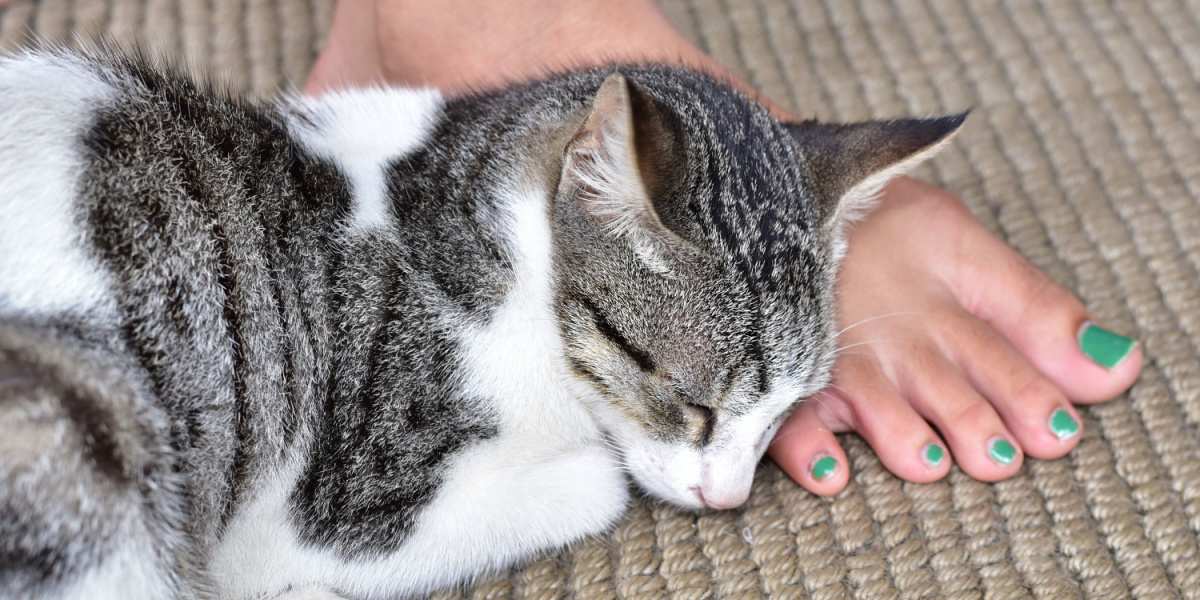
When your cat curls up at your feet, it is sending you a clear signal. It means they feel safe, comfortable, and bonded to you. This is not random behavior.
Cats are highly selective about where they sleep. The fact that your cat chooses your feet over every other spot in the house is a meaningful statement about the trust they have placed in you.
Is It Normal for a Cat to Sleep at Your Feet Every Night?
Yes, it is completely normal. Sleeping at or near your feet is one of the most documented feline sleeping behaviors recognized by vets and certified animal behaviorists worldwide.
A 2019 study published in Current Biology by Kristyn Vitale and colleagues at Oregon State University found that cats form real attachment bonds with their owners, similar to those seen in dogs and human infants. Sleeping near you is a direct expression of that attachment.
If your cat does this every single night, they have simply incorporated your feet into their routine. Cats are creatures of habit and once they find a spot that checks all their instinctive boxes, they return to it consistently.
9 Real Reasons Why Your Cat Sleeps at Your Feet
1. Your Feet Provide Warmth
Cats have a thermoneutral zone between 86°F and 97°F (30°C – 36°C). This is the temperature range where they do not need to burn energy to regulate their body heat.
Your feet radiate a steady, gentle warmth throughout the night. This makes them an ideal thermal source — warm enough to be comfortable, but not so hot that your cat overheats the way they might sleeping on your chest or stomach.
This behavior traces back to kittenhood. Kittens huddle with their mother and littermates for warmth. Your feet recreate that same safe, warm pile of bodies they instinctively seek.
2. It Is an Instinctive Safety Choice
Cats are both predators and prey animals. Even your fully indoor cat carries millions of years of survival instinct in its DNA.
Sleeping at your feet gives your cat a position close to you (a source of protection) while keeping them near the edge of the bed where they have a clear escape route. They get proximity to safety without being trapped.
This is why cats almost never sleep in the very center of the bed alone. They always position themselves with an exit strategy in mind, even during deep sleep.
3. Your Cat Trusts You Completely
Sleep is the most vulnerable state any animal can be in. When a cat chooses to sleep near you, they are placing their life — at least symbolically — in your hands.
A cat that sleeps at your feet is telling you they feel 100% safe in your presence. They are not worried you will harm them. They are not on high alert. They are at ease.
This is one of the highest forms of trust a cat can express. It is far more meaningful than simply being friendly or playful during waking hours.
4. Scent Marking and Territorial Behavior
Cats have scent glands located in several places on their body, including their paws. When your cat rests on or near your feet, they are naturally depositing their scent onto you and your bedding.
This is not aggressive territorial behavior. It is a bonding mechanism. Your cat is essentially saying, “This human is mine and I am theirs.” It reinforces their sense of security by surrounding themselves with familiar scent.
Over time, the area around your feet becomes thoroughly marked with their scent, making it feel even more like their own personal safe zone.
5. Your Feet Move Less Than the Rest of You
The average person shifts positions 40 to 50 times per night during sleep. For a small animal trying to rest peacefully next to you, your torso and chest area is essentially a rolling earthquake zone.
Your feet, on the other hand, are comparatively still. They move less than your arms, legs, and torso. This makes them a much safer and more comfortable resting spot from your cat’s perspective.
Cats likely learned through experience that sleeping near your feet means fewer rude awakenings and fewer near misses with a flailing elbow.
6. It Gives Your Cat an Easy Escape Route
Cats are crepuscular animals, meaning they are naturally most active at dawn and dusk. This means your cat may want to slip out of bed at 2 a.m. to patrol the house, eat a snack, or do midnight zoomies.
Sleeping near your feet means they can get up and leave the bed without climbing over your entire body. They maintain their independence while still enjoying the comfort of sleeping close to you.
This balance between closeness and freedom is a central feature of cat behavior. They want connection without confinement.
7. Your Scent Is Comforting to Them
Feet tend to carry a strong concentration of human scent due to sweat glands. While this might not be pleasant from a human perspective, cats interpret scent very differently.
To your cat, the scent of your feet means safety, familiarity, and home. It is the olfactory equivalent of a warm hug. Cats rely heavily on scent to evaluate their environment, and your scent signals to them that they are exactly where they belong.
This is also why cats will sometimes sleep in your shoes, on your clothing, or on items that smell strongly of you.
8. Affection and Emotional Bonding
Despite their reputation for independence, cats form genuine emotional bonds with their owners. The 2019 Oregon State University study referenced earlier demonstrated that cats use their owners as a “secure base,” returning to them for reassurance in the same way human infants return to a parent.
Sleeping at your feet is a physical expression of that bond. Your cat is not just looking for warmth or a comfortable surface. They genuinely want to be near you while they sleep.
It is an act of love expressed in the only way cats know how — through proximity, routine, and trust.
9. Consistency and Routine
Cats thrive on routine. Once your cat finds a sleeping spot that satisfies their instincts — warm, safe, familiar, close to you, with an exit route — they will return to it every single night.
This consistency is itself a sign of contentment. An anxious or unsettled cat will move around and avoid settling anywhere. A cat that sleeps at your feet every night is a cat that feels stable and secure in their environment.
If your cat suddenly stops sleeping at your feet after doing it consistently, that behavioral change can sometimes signal stress, illness, or environmental disruption worth paying attention to.
Cat Sleeping Position Comparison Table
| Sleeping Position | What It Means | Normal? |
|---|---|---|
| At your feet | Trust, warmth, safety, bonding | Yes, very common |
| On your chest | Deep affection, seeks heartbeat | Yes, sign of strong bond |
| On your pillow near your head | Wants maximum closeness | Yes, very bonded cat |
| Between your legs | Feels very safe and enclosed | Yes, normal |
| On your clothes or shoes | Scent comfort, misses you | Yes, normal |
| Alone in a corner | Independent, likes space | Yes, normal |
| In a box or enclosed space | Security-seeking behavior | Yes, normal |
| Suddenly hiding and isolating | Possible stress or illness | Monitor and see a vet |
Why Does My Cat Prefer My Feet Over My Partner’s Feet?
Cats choose sleeping spots based on who they are most bonded with. If your cat consistently picks your feet over everyone else in the household, you are their chosen person.
This choice is based on who feeds them, who plays with them most, who speaks to them most often, and who provides the most consistent positive interaction. It is the full picture of your relationship, not just one factor.
Some cats rotate between people. Some are exclusively loyal to one person. Both patterns are completely normal and reflect individual feline personality.
When Does Foot Sleeping Become Something to Watch?
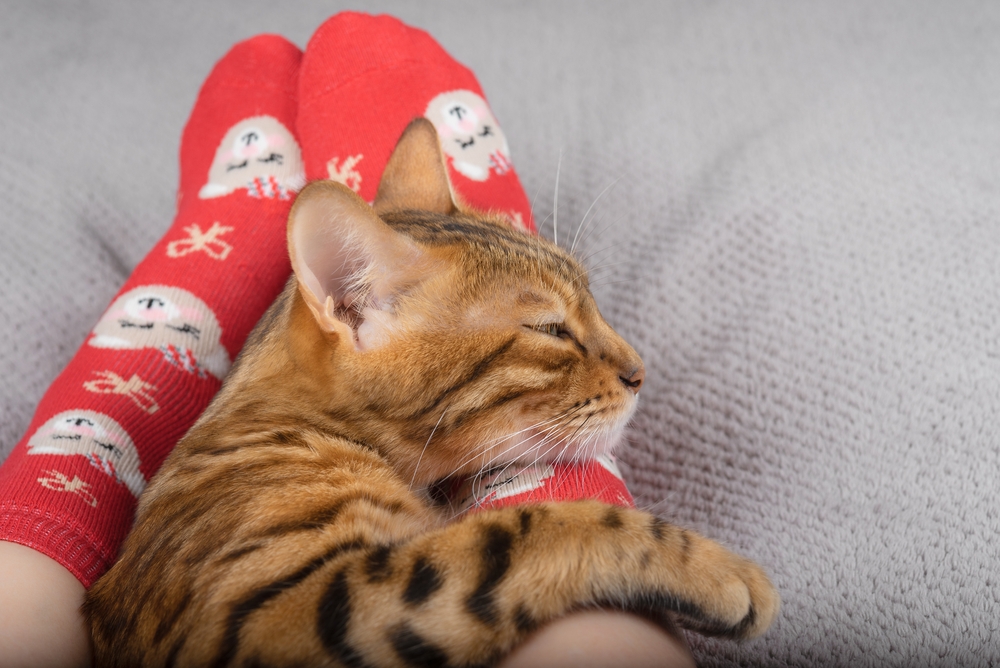
In almost all cases, this behavior is healthy and positive. But there are a few situations where a change in sleeping behavior is worth noting.
If your cat suddenly starts sleeping at your feet much more than usual, it could signal anxiety or stress from a change in the home environment, such as a new pet, a move, or a change in your schedule.
If the increased foot-sleeping comes alongside other behavioral changes like loss of appetite, hiding, excessive grooming, or changes in litter box use, a vet visit is a good idea to rule out underlying health issues.
Does This Behavior Change as Cats Age?
Yes, it can shift over time. Kittens tend to be more active and may sleep in a wider variety of spots. As cats mature into adulthood, they often settle into consistent routines and may become more reliably attached to specific spots.
Senior cats sometimes sleep closer to their owners as they age, especially if they experience discomfort or early cognitive changes. An older cat sleeping more at your feet than before is not automatically a concern, but it is worth monitoring alongside their overall health.
If a senior cat seems to be sleeping more, moving stiffly to reach their spot, or appearing disoriented, a veterinary check-up is appropriate.
The Science Behind Cat Sleeping Behavior
Cats spend between 12 and 16 hours sleeping per day on average. Some cats, especially older ones, can sleep up to 20 hours. This is not laziness — it is a biological adaptation.
In the wild, cats expend enormous energy in short, intense bursts of hunting activity. Long sleep periods allow them to conserve energy between those bursts. Even indoor cats retain this biological programming.
During sleep, cats cycle through both light sleep and REM sleep. You may notice your cat twitching, moving their paws, or making small sounds during REM sleep — this is normal dreaming behavior.
The position they sleep in reflects how safe they feel. Curled up tightly means slightly more alert. Fully stretched out or belly exposed means completely at ease. At your feet means safe, comfortable, and bonded.
What Your Cat’s Feet Sleeping Habit Says About Your Relationship
| Behavior | What It Tells You |
|---|---|
| Sleeps at your feet every night | You are their person; they feel fully safe |
| Purrs while sleeping at your feet | Deep contentment and relaxation |
| Kneads before settling at your feet | Strong comfort association, traces back to nursing behavior |
| Follows you to bed specifically | You are a key part of their security routine |
| Starts at your feet, moves closer overnight | Increasing comfort throughout the night |
| Grooms you then settles at your feet | You are part of their social group |
How to Make Your Cat’s Foot-Sleeping Habit More Comfortable for You
If you love the habit but find it disruptive to your sleep, there are a few easy adjustments that help both of you.
Place a folded blanket at the foot of your bed. This gives your cat a clearly defined, warm, and slightly elevated spot that is “theirs.” Many cats respond well to having a dedicated surface rather than sleeping directly on your feet or legs.
A heated cat mat placed at the foot of the bed can also redirect your cat slightly away from your actual feet while keeping them in the same general location. This satisfies all of their instinctive needs — warmth, closeness, routine — while giving you a bit more room to move.
Consistency matters. Whatever adjustment you make, keep it in place every night so your cat can adapt their routine without feeling displaced or anxious.
Should You Encourage or Discourage This Behavior?
For most cat owners, encouraging the behavior is perfectly fine. It is a healthy expression of your cat’s instincts and your bond with them. There are no negative behavioral consequences to allowing your cat to sleep at your feet.
The main reasons some owners choose to discourage it are practical: disrupted sleep, allergies, or simply personal preference for space. If you want to redirect the behavior, do so gently and consistently, never punitively.
Provide an attractive alternative, like a premium cat bed placed close to where you sleep, and reward your cat for using it. Never physically force your cat away or punish them for trying to sleep near you — this damages the trust that makes the behavior so meaningful in the first place.
Cat Foot-Sleeping vs Other Common Cat Behaviors Compared
| Behavior | Reason | Sign of Bond? |
|---|---|---|
| Sleeping at your feet | Safety, warmth, trust, routine | Yes |
| Head bunting (rubbing their head on you) | Scent marking, affection | Yes |
| Slow blinking at you | Trust and relaxation signal | Yes |
| Bringing you “gifts” (toys, prey) | Hunting instinct, care behavior | Yes |
| Kneading on you | Comfort, traces back to nursing | Yes |
| Following you room to room | Social bonding, monitoring | Yes |
| Sitting with their back to you | Complete trust, no threat perceived | Yes |
| Sleeping in a separate room entirely | Independent personality, not necessarily rejection | Normal variant |
How Breed and Personality Affect This Behavior
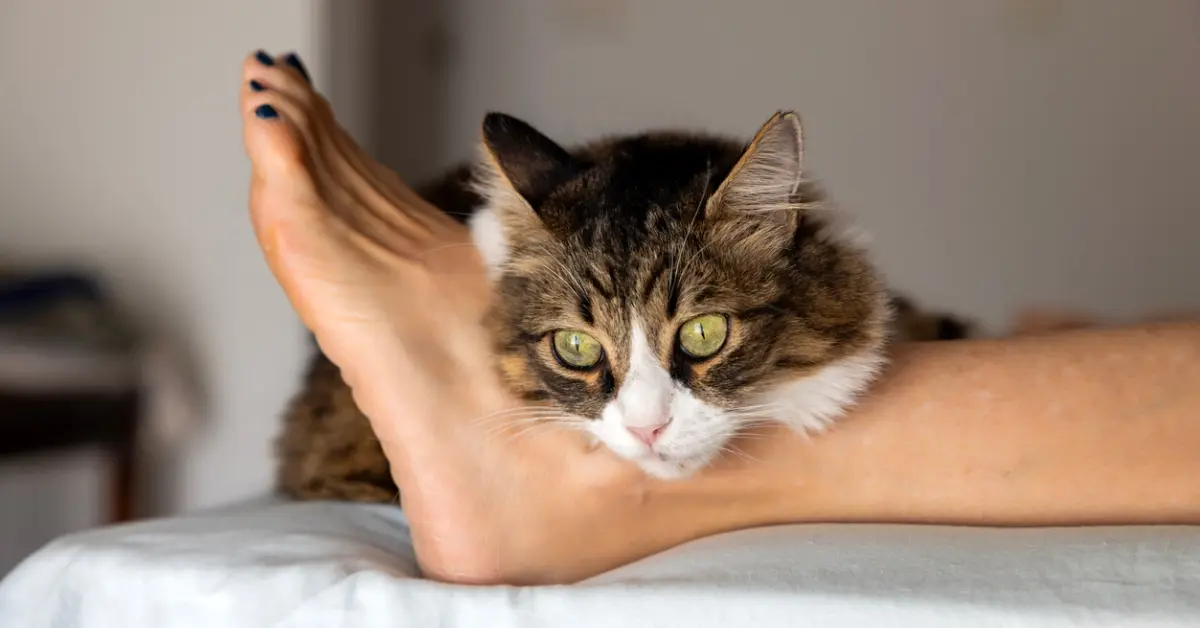
Not all cats sleep at their owner’s feet equally. Breed and individual personality play significant roles.
Naturally social and people-oriented breeds like Ragdolls, Maine Coons, Burmese, and Siamese cats are more likely to consistently seek out their owners for sleep. These breeds have been selectively developed for companionship and tend to form stronger co-sleeping habits.
More independent breeds like Norwegian Forest Cats or some domestic short-haired cats may prefer to sleep nearby but not directly at your feet. Both patterns are normal and reflect the individual cat’s personality, not a lack of affection.
Rescue cats with a history of trauma or instability may initially avoid sleeping near their owner but gradually move closer as trust builds over months or years. Foot-sleeping in a rescue cat that was previously standoffish is a significant milestone.
Key Takeaways at a Glance
| Reason | Core Instinct Behind It |
|---|---|
| Warmth | Thermoregulation, traces to kittenhood huddling |
| Safety and escape route | Prey animal survival instinct |
| Trust | Vulnerability during sleep requires total security |
| Scent marking | Territory and bonding behavior |
| Less movement | Practical comfort preference |
| Affection | Genuine emotional bond with owner |
| Routine | Cats thrive on consistency |
| Crepuscular activity | Need for easy nocturnal exit |
| Proximity with independence | Balance of connection and autonomy |
Frequently Asked Questions (FAQs)
Why does my cat sleep at my feet and not my head?
Your feet move less during sleep, stay at a comfortable temperature, and allow your cat an easy escape. Your head, while warm, is surrounded by more movement and unpredictable shifting during the night.
Is it okay to let my cat sleep at my feet every night?
Yes, it is perfectly safe and healthy for both of you in most cases. The main exceptions are if you have cat allergies, severe sleep disruption, or your cat is an outdoor cat that may bring in parasites.
Why does my cat only sleep at my feet and not my partner’s?
You are likely their chosen primary person. Cats bond most strongly with whoever feeds them most consistently, interacts with them most positively, and matches their energy and communication style best.
Does my cat sleeping at my feet mean they love me?
Yes, in feline terms it is a clear expression of affection, trust, and bonding. It is one of the most genuine signs of love a cat can show you, given that sleep is when they are most vulnerable.
Why did my cat suddenly start sleeping at my feet?
A change in routine, a new stressor in the home, or a stage of life transition can prompt this. It often means your cat is seeking extra reassurance and comfort from you. Monitor for any other behavioral changes.
Why does my cat knead and then sleep at my feet?
Kneading is a deep comfort behavior that traces back to nursing behavior from kittenhood. When your cat kneads before settling at your feet, it means they associate that spot with intense feelings of safety and contentment.
Can co-sleeping with my cat affect my sleep quality?
It can for some people. Cats are crepuscular and may be active during the night, causing minor disturbances. If your sleep is being significantly disrupted, a comfortable cat bed at the foot of your bed is a good compromise.
My cat used to sleep at my feet but stopped. Should I be worried?
Not necessarily. Cats adjust their sleeping spots based on temperature, mood, and life stage. If the change is accompanied by other symptoms like appetite loss, hiding, or lethargy, consult your vet.
Why does my cat sleep at my feet when I am sick?
Cats are sensitive to changes in your body, including temperature, scent, and behavior. When you are ill, you are likely spending more time in bed, your body temperature may change, and your scent shifts. Your cat is drawn closer and may be responding to your need for comfort.
Is it normal for a cat to sleep at my feet every single night without fail?
Absolutely. This level of consistency is a sign that your cat has made your feet a core part of their nightly security routine. It reflects deep habituation, trust, and contentment. It is one of the most normal and healthy feline behaviors there is.
Conclusion
Why does my cat sleep at my feet is not a mystery once you understand how cats think, feel, and process the world around them.
This behavior is completely normal in 2026 and in every year before it. Your cat sleeps at your feet because your feet are warm, safe, familiar, and close to you without being overwhelming.
They offer your cat warmth from your body heat, an escape route for midnight adventures, protection through proximity, and the comforting scent of the person they trust most in the world.
Every time your cat settles at the foot of your bed, they are telling you something important. They are telling you that out of every place in the entire world they could sleep, they choose to be near you.
That is not a small thing. That is a cat’s highest expression of love, loyalty, and trust — and it deserves to be understood and appreciated for exactly what it is.
