

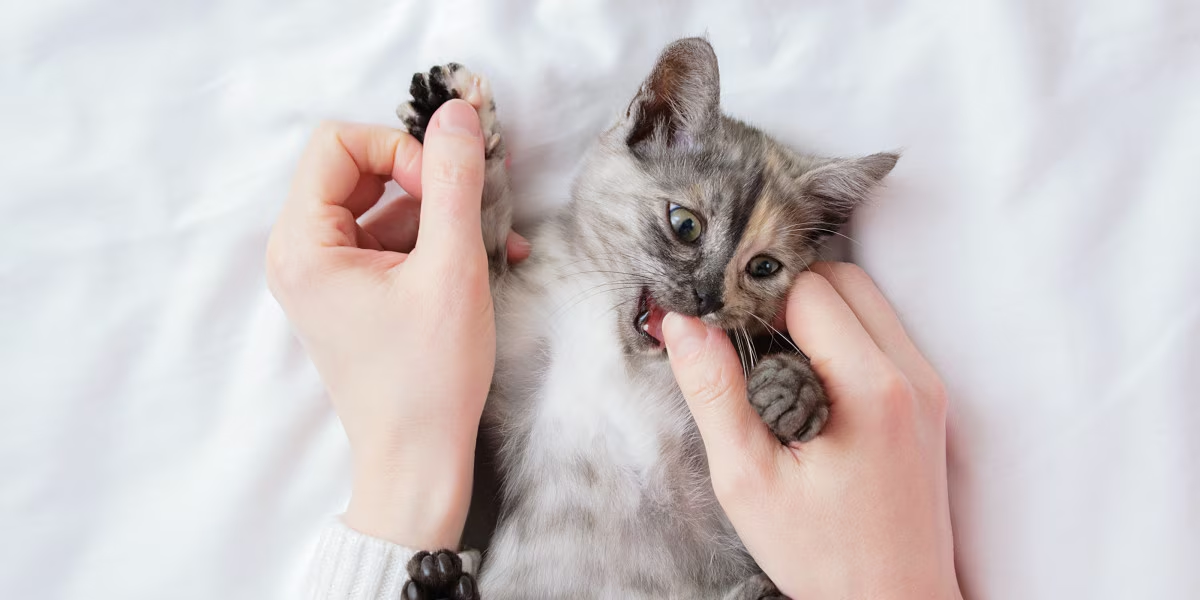
Why does my cat keep biting me? This is one of the most common questions cat owners ask, and the answer is not as simple as “my cat is aggressive.”
Cats bite for many different reasons, from playful instincts to overstimulation, fear, or even hidden pain. Understanding why your cat bites is the first step to fixing the behavior.
What Does Cat Biting Actually Mean?
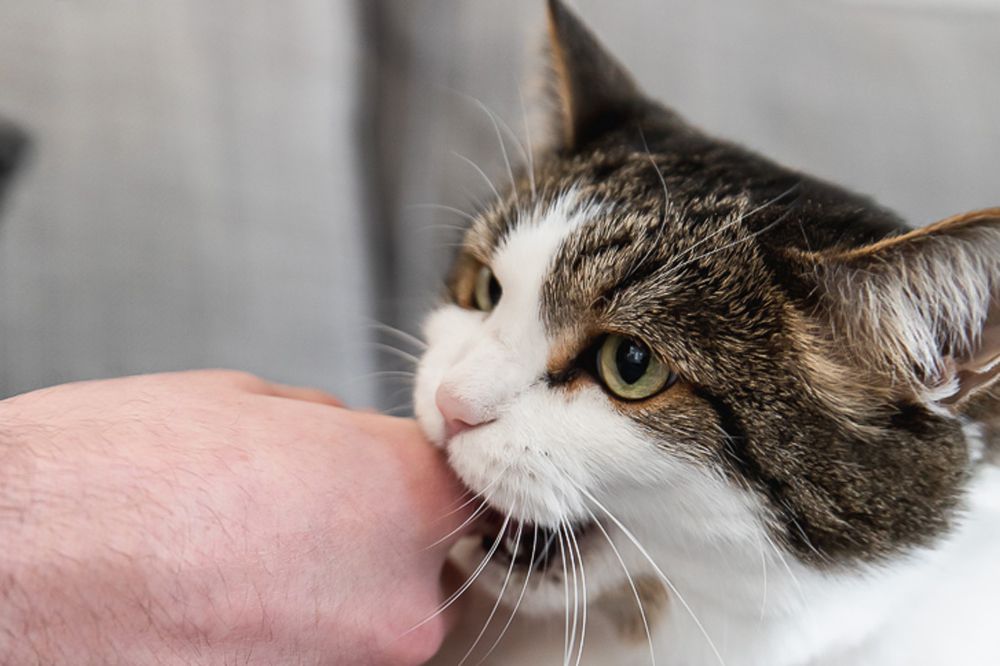
Cat biting is a form of communication. Unlike dogs, cats rarely use loud vocalizations to express every emotion. Instead, they use their bodies and their teeth to send messages.
When your cat bites you, it is not always out of anger. It could mean they are overstimulated, scared, playing, or asking you to stop what you are doing.
Learning to read the context of a bite is everything. A soft nibble during cuddles is very different from a sudden hard bite out of nowhere.
The Difference Between a Love Bite and an Aggressive Bite
Not every cat bite is a warning sign. Knowing the type of bite helps you respond correctly.
| Type of Bite | Signs | What It Means |
|---|---|---|
| Love Bite / Nip | Gentle, no broken skin, cat is relaxed, may purr | Affection or mild overstimulation warning |
| Play Bite | Comes with pouncing, grabbing, pupils dilated | Hunting instinct triggered during play |
| Fear Bite | Sudden, hard, accompanied by hissing or flat ears | Cat feels threatened or cornered |
| Pain Bite | Happens when a specific body area is touched | Possible injury or medical condition |
| Redirected Bite | Happens when cat is agitated by something else | Frustration displaced onto nearest person |
Understanding this table alone will help you avoid many biting situations before they happen.
Why Does My Cat Keep Biting Me? The 8 Most Common Reasons
1. Play Aggression and Hunting Instincts
Cats are natural-born hunters. Even indoor cats carry strong instincts to stalk, pounce, and bite prey.
During playtime, your moving hands or wiggling feet can easily trigger this hunting drive. If you have ever used your fingers as toys, your cat has likely learned that hands equal prey.
Kittens and young cats are especially prone to play biting. They learn bite control from their littermates, and cats separated too early from their siblings often bite harder than normal.
2. Overstimulation and Petting-Induced Aggression
This is one of the most surprising reasons for cat biting. Your cat is sitting in your lap, purring, everything feels perfect, and then suddenly they bite your hand.
This is called petting-induced aggression. Repeated petting, especially on sensitive spots like the base of the tail, can overstimulate a cat’s nervous system. The sensation shifts from pleasant to irritating very quickly.
Most cats give warning signals before they reach this point. Recognizing those signals early will save you from a bite.
Warning Signs of Overstimulation
- Tail begins to flick or lash
- Skin twitches or ripples along the back
- Ears flatten or rotate backward
- Cat turns its head toward your hand
- Body stiffens or muscles tense
- Pupils dilate suddenly
When you see these signs, stop petting immediately and give your cat space.
3. Fear and Defensive Biting
A scared cat is a biting cat. Fear bites happen when a cat feels trapped, threatened, or startled.
Loud noises, sudden movements, unfamiliar visitors, or being picked up unexpectedly can all trigger this response. The bite is usually quick, hard, and followed by the cat fleeing the area.
Cats with a history of trauma, rough handling, or poor socialization tend to bite defensively more often. Patience and slow trust-building are the keys here.
4. Redirected Aggression
Redirected aggression is one of the most misunderstood forms of cat biting. Your cat gets frustrated or aroused by something they cannot reach, like a bird outside the window or another cat on the other side of a door, and then bites you instead.
You become the target not because of anything you did, but simply because you were nearby. This type of bite can be intense and seem completely random.
The best approach is to wait until your cat has fully calmed down before trying to interact with them again.
5. Pain or Underlying Medical Issues
If your cat bites suddenly and has never done so before, pain may be the cause. Cats in discomfort often bite when a sore area is touched.
Conditions like arthritis, dental disease, ear infections, skin problems, or injuries can all lead to unexpected biting. If your cat becomes sensitive to touch in a specific area, make a note of it.
A sudden change in biting behavior is always worth a visit to the vet to rule out health problems.
6. Lack of Proper Socialization
Kittens that were not handled often during their early weeks, or were taken from their mother too early, may not have learned appropriate bite inhibition.
These cats did not get feedback from siblings or a mother cat telling them when bites were too hard. As adults, they may bite without realizing the force they are using.
Consistent positive training and patience can still help adult cats with poor socialization learn better habits.
7. Attention-Seeking or Demand Biting
Some cats learn that biting gets results. If you have ever jumped up to feed your cat after they nipped you, they now know exactly what to do to get what they want.
This is a learned behavior. It develops over time when biting is accidentally rewarded with attention, food, or playtime.
Breaking this habit requires consistency. You must stop rewarding biting with any reaction, even negative attention.
8. Stress and Environmental Changes
Cats are creatures of habit. New pets, a move to a new home, a new baby, construction noise, or any major change in the household can raise stress levels significantly.
Stressed cats have lower tolerance for interaction. They may bite more quickly than usual when their threshold drops due to anxiety.
Providing a safe retreat space, keeping routines predictable, and using calming products can all help reduce stress-related biting.
Cat Body Language Guide: Read the Signs Before the Bite
Understanding your cat’s body language is your best defense against bites. Cats almost always give signals before they bite. Most owners miss these subtle cues.
| Body Language Signal | What It Means |
|---|---|
| Tail lashing side to side | Irritation building up |
| Flattened ears | Fear or aggression |
| Dilated pupils | High arousal or fear |
| Skin twitching on back | Overstimulation warning |
| Turning head toward your hand | About to bite |
| Slow blink, soft eyes | Relaxed and comfortable |
| Crouched low, weight shifted back | About to pounce or flee |
| Exposed belly with tense body | This is NOT an invitation, it is a defense position |
The belly is one of the most common bite traps. Cats show their bellies as a sign of trust, not an invitation for tummy rubs. Touching the belly often results in a bite because it triggers a defensive reflex.
Why Does My Cat Bite Me When I Pet Them?
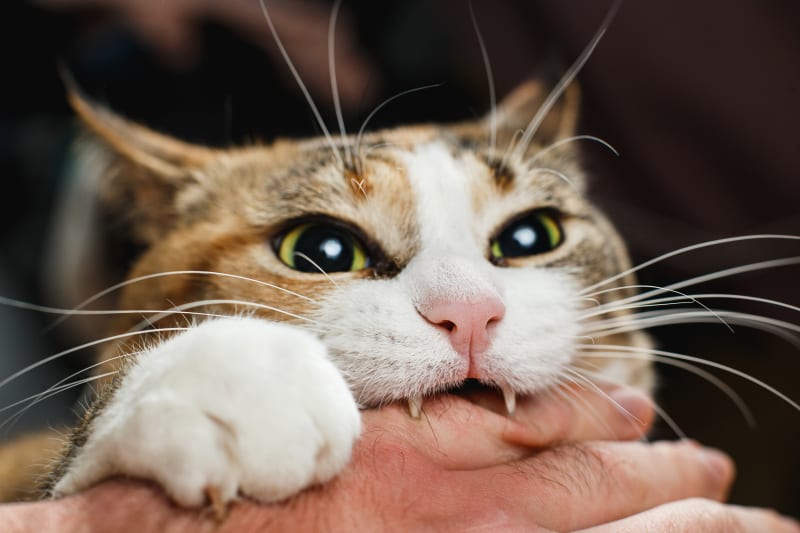
Petting bites are among the most common complaints from cat owners. The answer usually comes down to one of three things.
Your cat has reached their petting limit. Every cat has a tolerance for physical contact. Some enjoy long petting sessions, others want only a few strokes. Once the limit is reached, a bite follows.
You are petting a sensitive area. The base of the tail, the belly, and the legs are all sensitive zones. Sticking to the head, cheeks, and behind the ears tends to be safer and more welcome.
Your cat was not fully comfortable to begin with. Petting a cat that approached you cautiously or is still getting used to your presence can lead to biting as soon as they feel slightly overwhelmed.
Why Does My Cat Bite Me Out of Nowhere?
Bites that seem completely random usually have a hidden cause. Here are the most likely explanations.
Your cat was already overstimulated or agitated by something else, and you happened to make contact at the wrong moment. This is redirected aggression.
Your cat experienced a sudden pain when you moved or shifted your weight, and they reacted reflexively.
Your cat received a sensory trigger you did not notice, like a smell, sound, or sight that caused a stress spike.
In nearly all cases, the bite was not truly random. Once you track patterns, a cause usually becomes clear.
How to Stop Your Cat From Biting: What Actually Works
Use Toys, Not Hands
The most important rule in preventing play biting is to never use your hands as toys. Always redirect your cat to wand toys, feather teasers, or toy mice.
When your cat bites your hand during play, stop moving immediately. Movement triggers the hunting instinct. Stillness removes the reward.
Positive Reinforcement Training
Reward calm, gentle behavior with treats and praise. When your cat plays nicely without biting, reinforce that behavior.
Never punish a bite with yelling, hitting, or spraying water. Punishment increases fear and anxiety, which leads to more biting, not less.
Respect Your Cat’s Signals
Stop petting when you see the first warning signs. Do not wait for a bite to know your cat has had enough.
Let your cat choose when interaction starts and ends. Cats that feel in control of their interactions bite far less often.
Provide Enough Mental and Physical Stimulation
A bored cat is a biting cat. Interactive toys, puzzle feeders, window perches, and daily play sessions all help drain energy before it builds into biting.
Aim for at least two dedicated play sessions each day, especially for young or high-energy cats.
Create a Stress-Free Environment
Give your cat places to retreat and feel safe. This means vertical space like cat trees, quiet hiding spots, and a predictable daily routine.
If you have multiple pets, ensure each cat has their own resources to reduce competition and stress.
When to See a Vet
You should consult a vet if your cat suddenly starts biting with no behavioral explanation, biting is accompanied by changes in eating, litter box habits, or energy levels, or if your cat’s bite wounds are breaking skin and causing infection.
A vet or a certified animal behaviorist can rule out medical causes and create a personalized behavior plan.
Types of Cat Bites and How to Treat Them
Cat bites can cause serious infections because cats carry bacteria in their mouths that can spread quickly into human tissue.
| Bite Severity | What to Do |
|---|---|
| Shallow scratch or nip, no broken skin | Clean with soap and water, monitor |
| Skin is broken but minor | Wash thoroughly, apply antiseptic, watch for swelling or redness |
| Deep puncture wound | Seek medical attention within 24 hours |
| Signs of infection (redness, swelling, warmth, fever) | See a doctor immediately |
Cat bites are known to become infected faster than dog bites. Never ignore a puncture wound from a cat bite.
How Age Affects Cat Biting Behavior
Kittens (0–6 Months)
Biting is extremely common and largely normal in kittens. They are learning bite inhibition and exploring the world through their mouths.
This is the critical window to teach them that human skin is off-limits. Redirect consistently and never roughhouse with bare hands.
Young Adult Cats (6 Months–2 Years)
This is the most energetic period. Play aggression peaks and biting can escalate if not redirected.
Regular play sessions and appropriate toys are essential during this phase.
Adult Cats (2–7 Years)
Adult cats that bite usually have established habits from earlier years or are responding to stress or health issues.
Behavior modification is still very effective with adult cats when done consistently.
Senior Cats (7+ Years)
Increased biting in older cats often signals pain, cognitive changes, or discomfort. A vet check is the first step.
Do not assume old age means personality change. Pain is often the underlying cause in senior cats.
Common Myths About Cat Biting
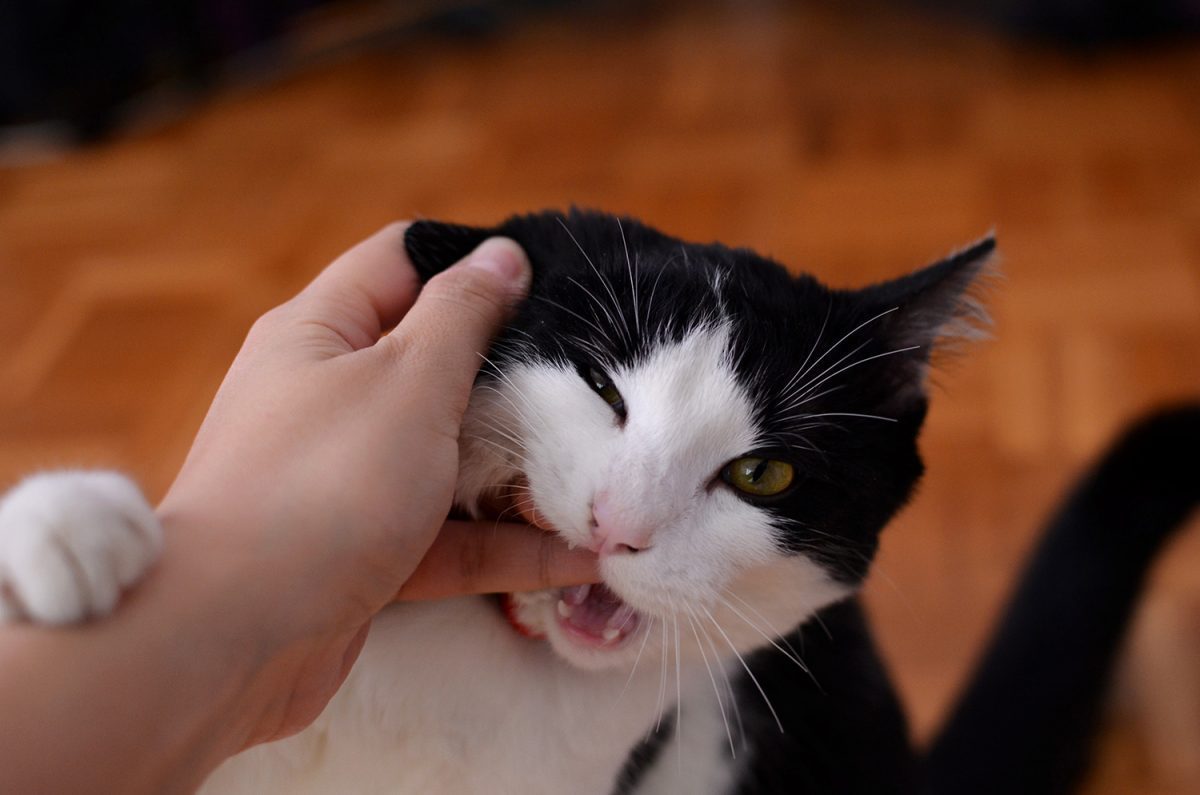
Myth: Cats bite because they are mean. Truth: Biting is communication. There is always a reason behind it.
Myth: Love bites mean your cat loves you deeply. Truth: Many love bites are actually early warning signs that your cat wants you to stop.
Myth: You should punish your cat for biting. Truth: Punishment increases fear and stress, making biting worse over time.
Myth: If your cat bites, they cannot be trained. Truth: With consistency and positive reinforcement, nearly all biting behavior can be reduced.
Myth: A cat showing its belly wants a belly rub. Truth: An exposed belly is a sign of trust, not an invitation. Many belly touches end in bites.
Quick Reference: Cat Biting Reasons and Solutions
| Reason for Biting | Solution |
|---|---|
| Play aggression | Use toys, never hands; daily structured play sessions |
| Overstimulation | Watch for warning signals; keep petting sessions short |
| Fear biting | Reduce stressors; give space; build trust slowly |
| Redirected aggression | Remove the trigger; wait for cat to calm down completely |
| Pain or health issue | Visit the vet; identify sensitive areas |
| Attention seeking | Stop rewarding biting; reinforce calm behavior |
| Poor socialization | Patient, consistent positive training over time |
| Stress or anxiety | Stable routine; safe retreat spaces; calming products |
Frequently Asked Questions (FAQs)
Why does my cat bite me when I pet them?
Your cat has likely reached their petting limit or you touched a sensitive spot. Watch for tail flicking and ear flattening as early warning signs.
Why does my cat bite me and then lick me?
This is a combination of grooming behavior and a gentle overstimulation signal. The lick shows bonding while the bite says the interaction has gone far enough.
Are cat love bites a sign of affection?
Gentle nibbles during calm moments can reflect bonding, but they are often a signal that your cat wants you to ease up rather than a clear display of love.
Why does my cat bite me out of nowhere?
Most sudden bites are tied to overstimulation, redirected aggression from an outside trigger, or pain when a sore area is accidentally touched.
How do I get my cat to stop biting me?
Stop using hands as toys, respect your cat’s body language signals, redirect biting to appropriate toys, and consistently reward calm gentle behavior.
Why does my kitten bite so much?
Kittens bite to explore, play, and learn. They are still developing bite inhibition. Redirect to toys every single time and never play with bare hands.
Should I punish my cat for biting?
Never punish biting physically or with yelling. This increases fear and anxiety and makes biting worse. Positive redirection works far better.
Why does my cat bite me when I walk past?
Your moving feet trigger the hunting instinct. Your cat is treating your feet as prey. Redirect with a dragging toy and give your cat a proper play session.
Can pain cause a cat to bite?
Yes. Sudden biting, especially when touching a specific area, is a strong signal of pain. Arthritis, dental disease, and injuries are common causes in cats.
When should I see a vet about my cat’s biting?
See a vet if biting starts suddenly, if it is increasing in frequency, if it is paired with other behavioral or health changes, or if you cannot find a behavioral explanation.
Conclusion
Why does my cat keep biting me is one of the most asked questions in the cat owner community, and the good news is that there is almost always a clear reason behind every bite.
Whether your cat is playing too rough, feeling overstimulated during petting, defending themselves out of fear, or quietly telling you about hidden pain, every bite is a message.
The key is learning to read what your cat is communicating before the bite even happens. Respect your cat’s body language, provide enough daily stimulation, use toys instead of hands, and never respond to biting with punishment.
With consistency and patience, most cats show a significant reduction in biting behavior within just a few weeks. Your relationship with your cat is worth the effort, and understanding their communication style will make it stronger than ever.
