

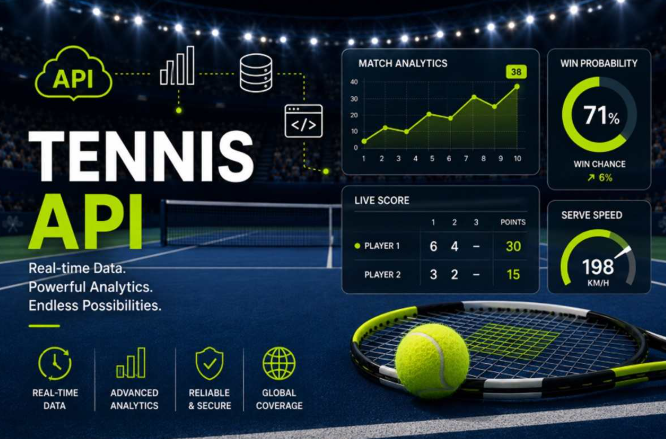
Tennis has become one of the most data-rich sports in modern analytics. Every match produces a detailed statistical profile covering service performance, return efficiency, pressure situations, rally outcomes, and surface-specific trends.
Over the last decade, analysts and developers have increasingly used these datasets to build predictive systems capable of modeling match outcomes with far greater sophistication than traditional rankings alone.
As structured tennis datasets become more accessible through services such as professional ATP, WTA, and ITF Tennis APIs, statistical forecasting continues becoming a major part of modern sports analytics.
Today, predictive models are used across:
- Sports analytics platforms
- Broadcasting and media
- Performance coaching
- Betting and forecasting systems
- Research and machine learning projects
At the center of all these applications is one critical element: high-quality match statistics.
Why Tennis Is Well-Suited for Predictive Modeling
Tennis offers several characteristics that make it especially valuable for statistical analysis.
Unlike many team sports where dozens of interacting variables influence outcomes simultaneously, tennis provides:
- Clearly structured scoring systems
- Large historical datasets
- Individual player accountability
- Consistent tournament formats
- Detailed point-by-point statistics
This structure allows predictive systems to isolate patterns more effectively than in many other sports.
The Evolution of Tennis Forecasting
Early tennis forecasting relied heavily on:
- ATP and WTA rankings
- Recent match results
- Simple head-to-head records
- General player reputation
While these indicators remain useful, they often fail to capture deeper contextual variables that strongly influence outcomes.
Modern forecasting systems now incorporate:
- Surface-adjusted ratings
- Serve and return efficiency
- Pressure-point performance
- Fatigue indicators
- Tournament-level weighting
- Historical matchup data
- Recent momentum trends
This has significantly improved predictive accuracy across ATP and WTA events.
Service Metrics and Match Modeling
Serving remains one of the most important areas in tennis analytics.
Elite serving can dramatically reduce pressure throughout matches by shortening rallies and limiting break opportunities.
Important service metrics include:
- First serve percentage
- First serve points won
- Second serve points won
- Ace percentage
- Double fault frequency
- Break points saved
These indicators often provide stronger predictive value than raw win-loss records because they reveal underlying performance efficiency.
Return Statistics Often Reveal Hidden Strengths
While powerful serving tends to attract attention, return performance often provides a clearer picture of long-term consistency.
Strong returners create continuous pressure and usually perform well across different conditions.
Important return metrics include:
- Return points won
- Second serve return efficiency
- Break point conversion rate
- Return games won percentage
Return statistics become especially important on slower surfaces such as clay, where rallies extend and serve dominance decreases.
Surface-Specific Performance Modeling
One of the biggest developments in modern tennis analytics is surface-adjusted modeling.
Different court conditions create entirely different tactical environments.
Clay Courts
Clay rewards:
- Endurance
- Defensive movement
- Heavy topspin
- Long-rally consistency
Grass Courts
Grass favors:
- Big serving
- Short points
- Aggressive returning
- Fast reactions
Hard Courts
Hard courts generally provide more balanced conditions between offensive and defensive play.
Because of these differences, predictive systems often create separate player ratings for each surface.
Pressure Metrics and Clutch Performance
One of the most difficult areas to evaluate in tennis is performance under pressure.
Not all points carry equal importance during matches.
Modern predictive systems increasingly track:
- Tie-break performance
- Break point conversion rates
- Break point save percentages
- Deciding set records
- Performance against elite opponents
Some players consistently outperform expectations during critical moments, while others struggle despite strong overall statistics.
Pressure-adjusted analysis has therefore become a major part of modern forecasting systems.
The Importance of Historical Match Data
Historical data forms the foundation of nearly every predictive tennis model.
Large datasets allow analysts to identify:
- Long-term performance trends
- Surface specialization
- Recurring matchup problems
- Fatigue-related declines
- Scheduling effects
However, modern systems rarely treat all historical matches equally.
Instead, contextual weighting is applied based on:
- Opponent quality
- Tournament level
- Match recency
- Surface type
- Indoor vs outdoor conditions
This approach produces more realistic forecasting models.
Elo Ratings and Dynamic Player Strength
Elo systems have become increasingly important within tennis forecasting.
Originally developed for chess, Elo ratings dynamically estimate player strength based on results and opponent quality.
Modern systems now commonly use:
- Overall Elo ratings
- Surface-adjusted Elo ratings
- Recent-form weighted Elo systems
- Tournament-adjusted Elo models
Because Elo ratings update continuously, they often respond faster to changing player form than ATP or WTA rankings.
Machine Learning and AI Forecasting
Machine learning has significantly expanded the sophistication of predictive tennis analytics.
AI-driven systems can process enormous datasets and identify subtle statistical relationships that traditional analysis may miss.
Common techniques include:
- Gradient boosting algorithms
- Regression analysis
- Neural networks
- Bayesian probability systems
- Random forest models
These systems continuously refine forecasts as new statistical information becomes available.
Real-Time Tennis Analytics
Live forecasting has become one of the fastest-growing areas in tennis analytics.
Modern systems now update probabilities dynamically during matches using:
- Current serve percentages
- Momentum shifts
- Break point trends
- Medical interruptions
- Recent point sequences
Platforms discussed within guides covering the best tennis data APIs increasingly focus on real-time statistical processing because live analysis depends heavily on speed and reliability.
Matchup Analysis and Tactical Styles
Player styles create another layer of complexity within tennis forecasting.
Some competitors consistently struggle against:
- Elite servers
- Heavy topspin players
- Counterpunchers
- Left-handed opponents
- Aggressive returners
These matchup effects often persist across multiple seasons and surfaces.
As a result, advanced forecasting systems increasingly incorporate matchup-specific adjustments into predictive models.
Fatigue and Scheduling Effects
Professional tennis schedules are physically demanding, especially during long tournament runs.
Modern analytics systems increasingly evaluate:
- Travel schedules
- Back-to-back matches
- Recovery periods
- Recent match duration
- Surface transition fatigue
These variables can strongly influence short-term player performance.
The Future of Tennis Outcome Modeling
Tennis analytics will likely continue evolving rapidly over the next several years.
Future developments may include:
- Shot-placement analysis
- Player movement tracking
- Biomechanical efficiency models
- AI-driven tactical simulations
- Real-time behavioral analysis
As structured datasets continue improving, predictive systems will likely become even more context-aware and accurate.
Conclusion
Modern tennis forecasting has evolved far beyond rankings and simple match records. By combining service metrics, return efficiency, pressure analysis, surface-adjusted ratings, and machine learning, analysts can now build highly sophisticated predictive models.
As access to structured tennis data continues expanding, statistical modeling will remain central to understanding professional tennis performance and forecasting match outcomes across ATP, WTA, Challenger, and ITF competition.
