

Why was the Battle of Gettysburg important is a question that cuts straight to the heart of American history.
Fought July 1 through 3, 1863, in a small Pennsylvania town of just 2,400 residents, this three-day clash between Union and Confederate forces produced over 50,000 casualties and permanently changed the direction of the Civil War.
It ended Robert E. Lee’s most ambitious invasion of the North, crushed Confederate hopes for foreign recognition, and gave President Lincoln the platform to redefine the entire purpose of the war.
Its impact is still felt in American democracy today.
Quick Facts at a Glance
| Detail | Information |
|---|---|
| Battle Dates | July 1–3, 1863 |
| Location | Gettysburg, Pennsylvania |
| Union Commander | Major General George G. Meade |
| Confederate Commander | General Robert E. Lee |
| Union Army Size | ~94,000–100,000 troops |
| Confederate Army Size | ~71,000–75,000 troops |
| Total Casualties | ~46,000–51,000 killed, wounded, or missing |
| Outcome | Decisive Union victory |
| Followed By | Lincoln’s Gettysburg Address (November 19, 1863) |
The State of the Civil War Before Gettysburg
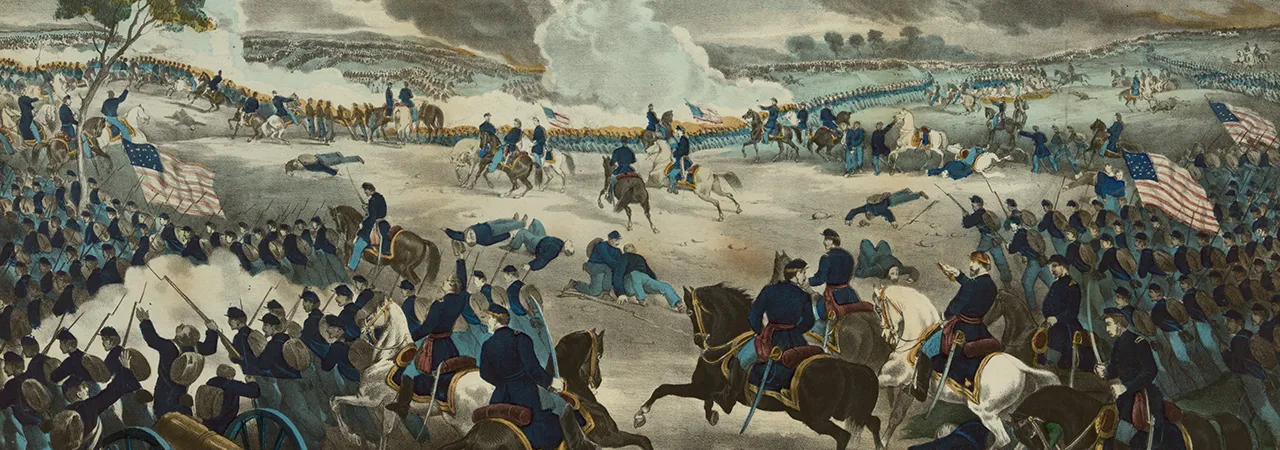
By the summer of 1863, the war looked grim for the Union. Confederate General Robert E. Lee had delivered stunning defeats at Fredericksburg in December 1862 and at Chancellorsville in May 1863.
Northern morale was eroding fast. A growing peace movement in the North — led by politicians known as Copperheads — was pushing for a negotiated end to the war that would have effectively granted Confederate independence.
Lee’s army was riding high on momentum and confidence. Many soldiers in the Army of Northern Virginia genuinely believed they were invincible. That belief would be shattered at Gettysburg.
Why Robert E. Lee Invaded Pennsylvania
Lee’s decision to push into the North was strategic and urgent. He had several goals that went well beyond a single battlefield victory.
He wanted to relieve the pressure on war-exhausted Virginia, which had been bearing the weight of constant fighting. He also wanted to draw Union forces away from the Siege of Vicksburg in the West.
Most critically, Lee believed a decisive Confederate victory on Northern soil could force Lincoln’s government to negotiate peace — and potentially convince Britain and France to formally recognize the Confederacy as an independent nation. Both goals collapsed at Gettysburg.
Why Was the Battle of Gettysburg Important? The Main Reasons
It Was the Turning Point of the Civil War
The Battle of Gettysburg is widely regarded as the defining turning point of the entire Civil War. Before July 1863, the Confederacy held the strategic initiative and had credible hope of winning the war.
After Gettysburg, that initiative shifted permanently to the Union. Lee’s army never launched another major strategic offensive into Northern territory. From that point forward, the Confederates were forced to react to Union pressure rather than dictate the terms of the conflict.
Historian Bruce Catton described it simply: Gettysburg was the great moment of decision. Once the Union won there, a Confederate victory in the war was no longer truly possible.
It Ended Lee’s Invasion and Protected Northern Cities
Lee’s march into Pennsylvania threatened Harrisburg, Philadelphia, and potentially Washington D.C. itself. The fall of any of these cities would have been a catastrophic blow to the Union war effort.
The Union victory at Gettysburg shut that threat down completely. Lee was forced to retreat south on July 4, his army battered and depleted, never to threaten major Northern territory again.
The Confederate soldiers made the torturous retreat back through Maryland toward Virginia with severely reduced ranks. The dream of taking the war to the North’s doorstep was finished.
The Casualties Were Staggering and Decisive
Between 46,000 and 51,000 soldiers from both armies were killed, wounded, captured, or went missing over just three days. It remains the bloodiest battle ever fought on American soil.
The Confederate losses were especially devastating in terms of their strategic impact. Lee lost approximately 28,000 men — more than a third of his entire army. That level of attrition was simply irreplaceable given the South’s smaller population and limited resources.
The Union lost around 23,000 men, which was painful. But the North had the manpower and industrial base to absorb those losses and keep fighting. The South did not.
| Metric | Union | Confederacy |
|---|---|---|
| Total Troops Engaged | ~94,000 | ~71,000 |
| Total Casualties | ~23,000 | ~28,000 |
| % of Force Lost | ~24% | ~39% |
| Strategic Result | Decisive Victory | Forced Retreat |
| Long-Term Impact | Regained momentum | Lost strategic offensive ability |
It Destroyed Confederate Hope for European Recognition
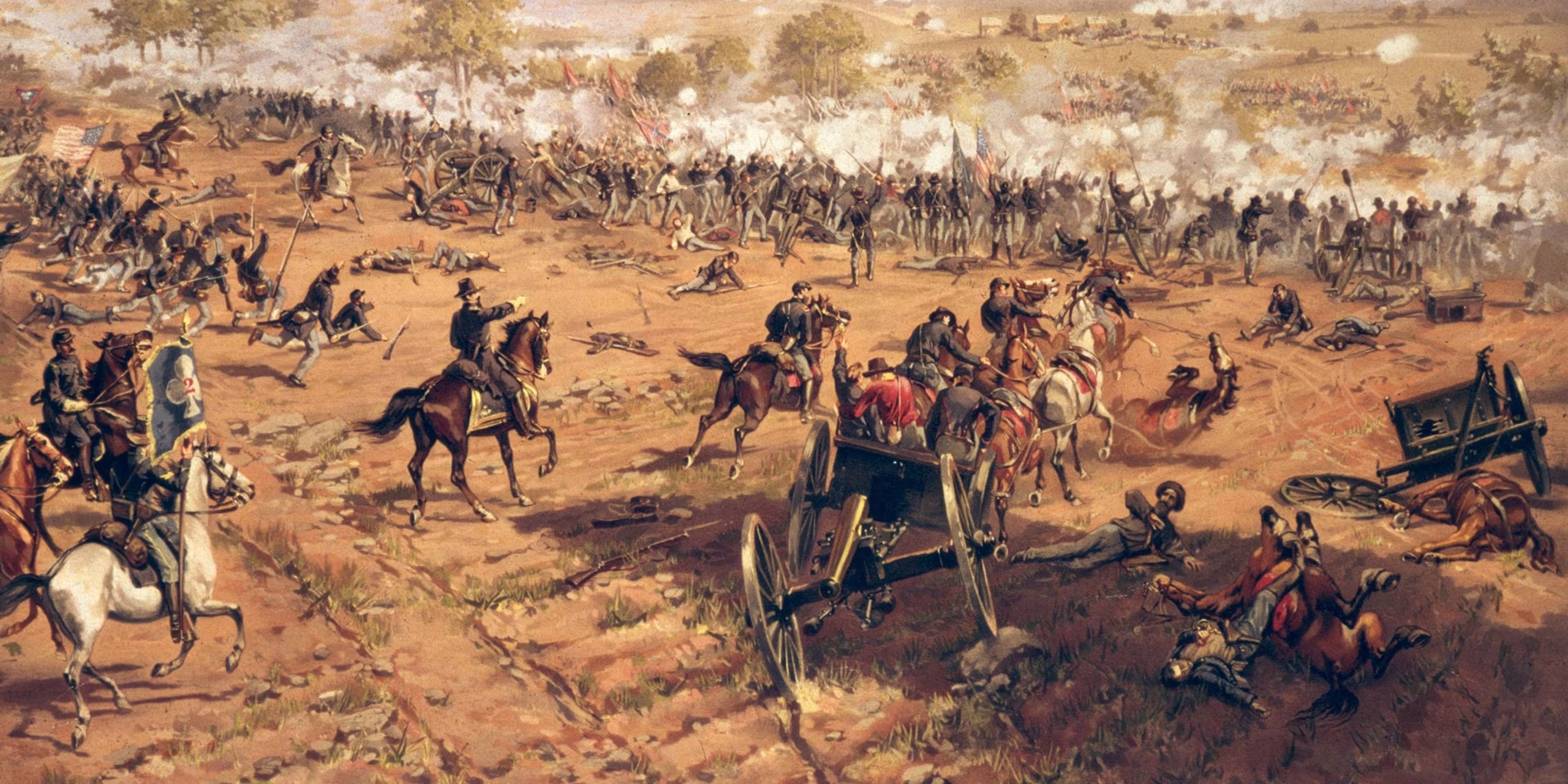
One of the Confederacy’s most important diplomatic goals was to win formal recognition from Britain and France. Both European powers depended heavily on Southern cotton for their textile industries.
Lee’s invasion of the North was partly designed to deliver the kind of overwhelming victory that would make European recognition politically inevitable. Gettysburg ended that possibility completely.
After the Union victory, British and French leaders concluded that the Confederacy could not win the war. European suppliers also began pulling back the support they had quietly been providing to the South. The Confederacy was now diplomatically isolated at the moment it could least afford to be.
It Revived Union Morale at a Critical Moment
The Northern public had grown weary of the war by the summer of 1863. The string of Union defeats had created real doubt about whether the war could be won at all.
Gettysburg changed the national mood overnight. Newspapers in Philadelphia described the battle as comparable to Waterloo — the battle that ended Napoleon’s empire and reshaped European history. That comparison alone tells you how the North felt about what had just happened.
For the first time since the war began, ordinary Northern citizens genuinely believed the Union could and would win. That renewed confidence was not just emotional — it had real political consequences for Lincoln’s ability to continue prosecuting the war.
It Coincided with the Fall of Vicksburg
On July 4, 1863 — the very day Lee began his retreat from Gettysburg — General Ulysses S. Grant completed his capture of Vicksburg, Mississippi. This gave the Union complete control of the Mississippi River.
Together, Gettysburg and Vicksburg created a decisive double blow. The Confederacy had now lost both its ability to invade the North and its control of the vital western river artery.
Lincoln described it as the Father of Waters going unvexed to the sea. The two simultaneous victories left no serious doubt about the ultimate outcome of the war — only its duration remained uncertain.
The Three Days of Battle: What Happened and Why It Mattered
Day One — July 1, 1863: The Accidental Opening
The battle began as an accident. A Confederate division under Major General Henry Heth marched toward Gettysburg early on July 1 looking for shoes and supplies, not a major engagement.
Union cavalry under Brigadier General John Buford encountered them west of town. Buford made a critical decision — he dismounted his cavalry and held the Confederate advance long enough for Union infantry under General John Reynolds to arrive. Reynolds was killed in action almost immediately.
By afternoon, 40,000 troops were engaged. Confederate reinforcements under A.P. Hill and Richard Ewell pushed the outnumbered Union forces back through the town. The Federals retreated to Cemetery Hill south of Gettysburg, where their artillery halted the Confederate advance. That high ground would prove decisive.
Day Two — July 2, 1863: The Struggle for High Ground
The second day was one of the bloodiest days of the entire war. Lee ordered massive assaults on both sides of the Union fishhook-shaped defensive line.
The battles for Little Round Top, Devil’s Den, the Wheatfield, and the Peach Orchard became legendary. Colonel Joshua Chamberlain and the 20th Maine Infantry held Little Round Top — the far left anchor of the entire Union line — against overwhelming Confederate pressure, eventually conducting a bayonet charge when their ammunition ran out.
Had the Confederates taken Little Round Top, they could have positioned artillery to fire the length of the entire Union line. The Union defense held, but the cost in lives was immense. Over 20,000 soldiers became casualties on Day Two alone.
Day Three — July 3, 1863: Pickett’s Charge and the High Watermark
On the third day, Lee made his most fateful decision. He ordered a massive frontal assault against the center of the Union position on Cemetery Ridge — a mile-long open-field march by approximately 12,000 to 12,500 Confederate soldiers.
This assault is remembered as Pickett’s Charge, named for Major General George Pickett, whose Virginia division made up roughly half the attacking force. It was one of the most dramatic and costly military gambles in American military history.
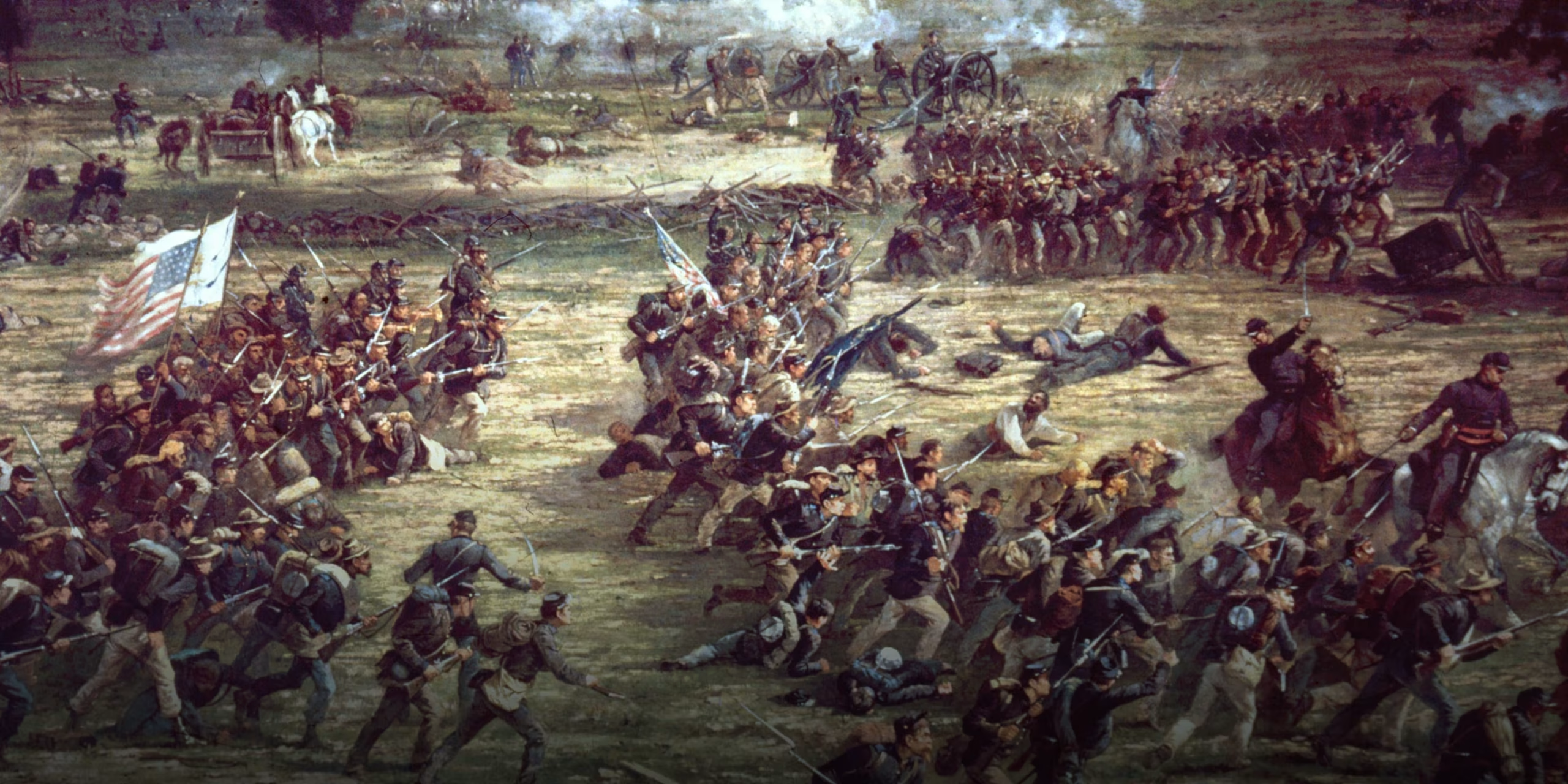
The Union artillery and rifle fire tore the advancing Confederate lines apart. Only a small number of Confederates briefly reached the Union line at a point called The Angle — forever known as the High Watermark of the Confederacy. The charge failed catastrophically, with Confederate casualties approaching 60 percent.
When Lee ordered Pickett to reform his division after the disaster, Pickett reportedly replied: I have no division. Lee withdrew his shattered army from Gettysburg on the rainy afternoon of July 4.
The Gettysburg Address: Why It Matters as Much as the Battle
Lincoln’s 272-Word Speech That Redefined America
Four months after the battle ended, President Abraham Lincoln traveled to Gettysburg on November 19, 1863, to dedicate the Soldiers’ National Cemetery on the battlefield grounds.
The featured speaker that day was Edward Everett, a celebrated orator who delivered a two-hour address. Lincoln followed with a speech of just 272 words that lasted less than two minutes. History remembered Lincoln’s words. Everett’s two-hour oration is almost entirely forgotten.
Lincoln’s Gettysburg Address did something profound. He reframed the entire Civil War not merely as a fight to preserve the Union — which many Northerners had grown tired of — but as a struggle to ensure that a government of the people, by the people, for the people, shall not perish from the earth.
How the Address Changed the War’s Purpose
Before Gettysburg, the war was primarily about reunion. Lincoln’s address made it explicitly about something larger — the survival of democratic self-government and the principle that all men are created equal.
The Emancipation Proclamation had been issued in January 1863. By November, Lincoln used the Gettysburg Address to fuse the military mission with a moral one. The war was now both about saving the Union and ending slavery.
This reframing had lasting consequences for how Americans understood their own national identity. The speech connected the Civil War directly to the Declaration of Independence, creating a moral continuity that shaped American political thought for generations.
The Legacy of Gettysburg: Why It Still Matters in 2026
It Preserved the United States as One Nation
The most fundamental reason why the Battle of Gettysburg was important is simple: a Confederate victory would likely have ended the United States as a unified country.
If Lee had won at Gettysburg, the peace movement in the North would have gained enormous power. Lincoln’s political position would have become extremely difficult to sustain. A negotiated peace granting Confederate independence was a genuine possibility.
Had that happened, North America would have developed as two rival nations — one slave, one free — with ongoing territorial tensions and inevitable future conflicts. Instead, the Union survived, slavery was abolished, and the country emerged as a single nation with a new commitment to equality.
It Ended Slavery Across the Continent
A Confederate victory at Gettysburg would have delayed the abolition of slavery by decades or indefinitely. Four million enslaved people in the 1860s would have remained in bondage with no near-term prospect of freedom.
The Union victory at Gettysburg kept alive the possibility of emancipation that the Emancipation Proclamation had promised. The war’s continuation, sustained in part by the momentum from Gettysburg, ultimately led to the 13th Amendment abolishing slavery throughout the United States in 1865.
No single battle in American history had more direct consequences for human freedom.
It Made the Gettysburg Battlefield a National Sacred Site
Today, Gettysburg National Military Park draws approximately 1.5 million visitors every year. The battlefield is preserved with more than 1,300 monuments, memorials, and markers in stone, iron, and bronze.
It is the largest outdoor sculpture collection in the world dedicated to a single battle. Generations have come to walk the ground where soldiers fought and died, to stand on Little Round Top, to walk the field of Pickett’s Charge, to read the names on the monuments.
Joshua Chamberlain, hero of Little Round Top, said after the war that generations that know us not and that we know not of, heart-drawn to see where and by whom great things were suffered and done for them, shall come to this deathless field. He was right. They still come.
Key Figures at Gettysburg
| Person | Side | Role | Significance |
|---|---|---|---|
| General George G. Meade | Union | Army commander | Won the battle despite commanding for only 3 days |
| General Robert E. Lee | Confederate | Army commander | Made the fatal decision to order Pickett’s Charge |
| General John Buford | Union | Cavalry commander | Bought critical time on Day 1 |
| General George Pickett | Confederate | Led Pickett’s Charge | His name defines the war’s most famous failed assault |
| Colonel Joshua Chamberlain | Union | Commanded 20th Maine | Saved Little Round Top with a bayonet charge |
| General James Longstreet | Confederate | Senior corps commander | Opposed Pickett’s Charge, was overruled |
| General Winfield Scott Hancock | Union | Corps commander | Rallied Union troops at Cemetery Ridge |
| President Abraham Lincoln | Union | Commander in Chief | Delivered the Gettysburg Address four months later |
What If the Confederacy Had Won at Gettysburg?
Historians and scholars have long debated what a Confederate victory at Gettysburg might have meant. The honest answer is: the consequences would have been enormous.
A Confederate win would have opened the road to Harrisburg and potentially Philadelphia. The political shock in the North would have been severe. Peace Democrats would have gained major leverage. Lincoln’s reelection in 1864 — already uncertain — would have become highly doubtful.
Foreign recognition from Britain and France would have become far more likely. Confederate independence might have become a reality. And four million enslaved Americans would have had no near-term path to freedom.
That none of those things happened is directly because of what Union soldiers accomplished on that Pennsylvania ground in the first three days of July 1863.
Frequently Asked Questions (FAQs)
Why was the Battle of Gettysburg important to the Civil War?
Gettysburg was the turning point that stopped Lee’s invasion of the North, shattered Confederate offensive power, and shifted the momentum of the entire war permanently to the Union.
How many people died at the Battle of Gettysburg?
Between 46,000 and 51,000 soldiers from both sides were killed, wounded, captured, or listed as missing — making it the bloodiest battle ever fought on American soil.
Why did Lee invade Pennsylvania before Gettysburg?
Lee wanted to win a decisive battle on Northern soil to force peace negotiations, relieve war pressure on Virginia, and convince Britain and France to recognize Confederate independence.
What was Pickett’s Charge and why did it fail?
Pickett’s Charge was a July 3 frontal assault by ~12,500 Confederate troops across an open mile of ground. It failed because Union artillery and rifle fire devastated the attackers, with nearly 60% becoming casualties.
What was the significance of the Gettysburg Address?
Lincoln’s 272-word speech redefined the war’s purpose from saving the Union to ensuring democratic government and human equality, connecting the Civil War to the Declaration of Independence.
Did the Battle of Gettysburg end the Civil War?
No. The war continued until April 1865. But Gettysburg destroyed Confederate offensive capability and made ultimate Union victory, as Britannica noted, only a matter of time.
Why was the high ground at Gettysburg so important?
Control of Cemetery Ridge, Little Round Top, and Cemetery Hill gave Union forces a defensive advantage where artillery and rifle fire could devastate attacking Confederate troops in the open.
How did Gettysburg affect European recognition of the Confederacy?
The Union victory proved the Confederacy could not win, causing Britain and France to abandon serious consideration of recognizing Confederate independence and withdraw quiet material support.
Who were the key Union heroes at Gettysburg?
General Meade commanded the overall victory, John Buford bought critical time on Day 1, Joshua Chamberlain saved Little Round Top on Day 2, and Winfield Hancock rallied the line on Day 3.
Why do historians call Gettysburg the High Watermark of the Confederacy?
The farthest point reached by Pickett’s Charge on Cemetery Ridge is called the High Watermark — the moment the Confederacy came closest to a Northern victory. After that moment, the tide permanently turned.
Conclusion
Why was the Battle of Gettysburg important is answered in full by looking at what the world would have become without that Union victory.
Fought across three brutal summer days in July 1863, Gettysburg stopped Robert E. Lee’s most ambitious invasion of the North, killed the Confederacy’s hope of European recognition, restored Union morale at its lowest point, and set the stage for the war’s inevitable Union conclusion.
The sacrifice of more than 50,000 soldiers on that Pennsylvania ground preserved the United States as a single nation and kept alive the promise of emancipation for four million enslaved people.
Four months later, Lincoln stood at the cemetery built on that same ground and gave democracy its most enduring definition.
In 2026, over 160 years later, Gettysburg still stands as the moment that decided what kind of country America would become — and the answer still matters.
