

Why is Gary, Indiana so dangerous is one of the most searched questions about any American city, and the answer goes far deeper than just crime numbers.
Gary, Indiana has earned the grim title of “Murder Capital of the World,” and decades of industrial collapse, racial inequality, deep poverty, and neglect turned a once-thriving steel city into one of America’s most dangerous places.
The Rise and Fall of Gary, Indiana
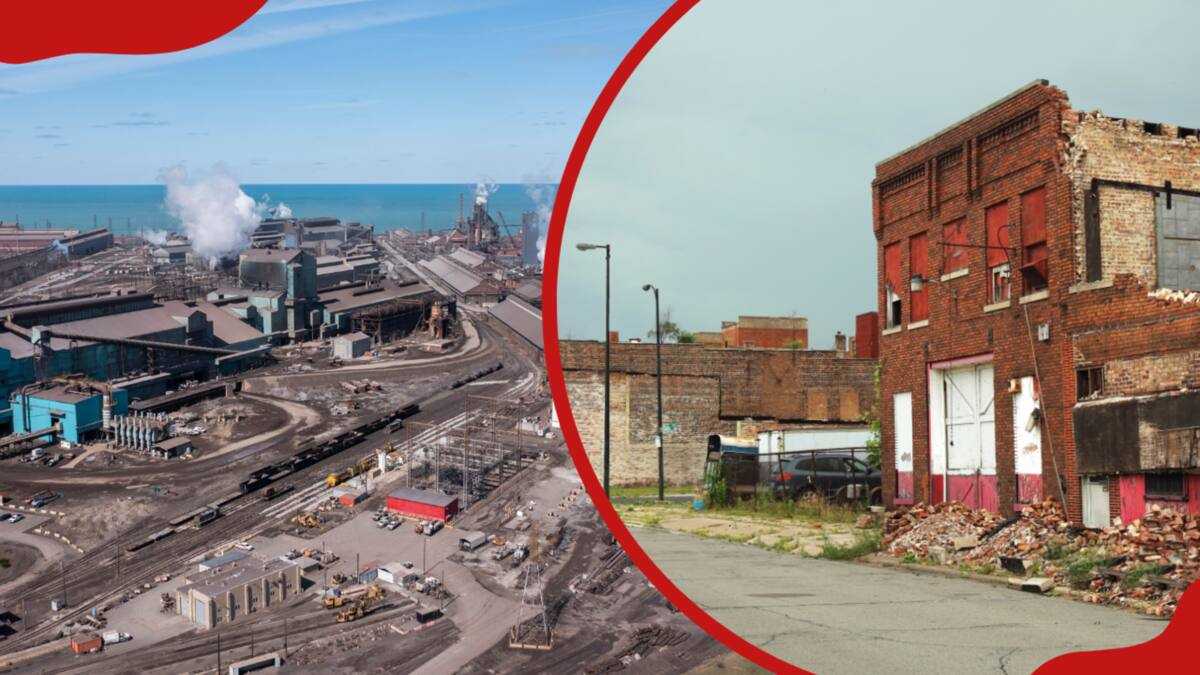
Gary, Indiana was founded in 1906 by U.S. Steel Corporation as a company town built around the Gary Works steel mill, the largest steel complex in North America.
By the 1950s, the city was booming with over 200,000 residents. Jobs were plentiful, neighborhoods were alive, and the city proudly carried the nickname “The Magic City.”
Then everything collapsed. Globalization reshaped the steel market. Automation replaced workers. By the 1970s and 1980s, factory closures left tens of thousands unemployed and the city’s economy was in freefall.
The Steel Industry Collapse: Root Cause of Gary’s Danger
When U.S. Steel downsized its Gary Works operations through the late 1970s and 1980s, the ripple effect was devastating.
Tens of thousands of steel jobs vanished almost overnight. Families who had built their lives around the mill suddenly had no income and no alternative employers nearby.
This single event triggered a chain reaction — businesses closed, tax revenue dried up, residents fled, and the city fell into a cycle of poverty it has never fully escaped.
| Decade | Key Event | Impact |
|---|---|---|
| 1950s | Steel industry peak | 200,000+ residents, thriving economy |
| 1970s | Globalization begins | Layoffs begin, population starts declining |
| 1980s | Mass factory closures | Unemployment surges, businesses close |
| 1990s | Crime peak | Gary labeled “Murder Capital of the USA” |
| 2000s | White flight complete | Population drops below 100,000 |
| 2020s | Slow recovery | Homicides at 50-year low by 2025 |
Gary, Indiana Crime Rate: The Hard Numbers
The crime statistics for Gary are among the most alarming of any American city. Here is what the data shows right now.
According to NeighborhoodScout, Gary’s crime rate sits at 34 per 1,000 residents, which is 242% above the national average. Your chance of becoming a crime victim in Gary is 1 in 30.
Within Indiana, more than 98% of all communities have a lower crime rate than Gary. That is not a ranking any city wants to hold.
The overall crime rate per 100,000 people in Gary is 3,726.5. The violent crime rate per 100,000 is 898.3. The property crime rate per 100,000 is 2,828.2. Overall, crime in Gary runs 75.84% above the national average.
How Gary Became the “Murder Capital of the World”
The question “why is Gary, Indiana so dangerous” became national news in the early 1990s when the city earned its most infamous title.
In 1993, Gary recorded 110 murders among a population of just over 100,000 people. That murder rate was three times higher than Chicago’s at the same time.
By 1994 and 1995, Gary officially ranked as the most dangerous city in the entire United States. In 1995 alone, with a population of 115,269, the city reported over 3,000 crimes including 129 murders.
That number — 129 murders in a single year — remains one of the most shocking statistics in American urban history for a city of that size.
Poverty and Unemployment: The Engine Behind Gary’s Crime
Crime does not exist in a vacuum. In Gary, it is directly fueled by decades of economic destruction.
The unemployment rate in Gary currently stands at 13.0%. The poverty rate is a staggering 32.9%, meaning nearly one in three residents lives below the poverty line.
When a third of a city’s population cannot meet basic needs, crime becomes a survival mechanism for many. Illegal economies — drug markets, theft networks, gang operations — fill the void left by legitimate employers.
Gary’s collapsing tax base also starved its public services. Police departments were understaffed. Schools were underfunded. Social safety nets frayed to nothing.
Racial Inequality and White Flight
Understanding why Gary Indiana is so dangerous also requires understanding the role of race in the city’s decline.
Gary was one of the most racially segregated cities in America. As Black families moved into Gary during the Great Migration, white residents and businesses fled to the suburbs in what became known as “white flight.”
This mass exodus drained Gary’s tax base. Investment followed white residents out of the city. Black residents, who had far fewer options due to systemic discrimination, were left behind in a city that was rapidly losing resources.
Systemic racism, combined with industrial decline, created conditions perfectly designed to breed poverty and crime.
Gang Activity and Drug Markets in Gary
As legitimate jobs disappeared, illegal economies moved in to fill the gap.
Drug markets took root in Gary’s emptied neighborhoods. Gang territory disputes became a regular feature of city life. Illegal firearms flooded the streets as currency in this underground economy.
The connection between drug markets, gang control, and gun violence became the defining feature of Gary, Indiana crime for decades.
A low clearance rate for violent crimes meant few murders and assaults were ever solved. When criminals face little accountability, violence escalates. This cycle plagued Gary for decades.
Population Collapse and Abandoned Buildings
Gary’s population tells a story of mass exodus driven by fear, poverty, and hopelessness.
| Year | Population |
|---|---|
| 1960 | ~178,000 |
| 1980 | ~151,000 |
| 2000 | ~102,000 |
| 2010 | ~80,000 |
| 2020 | ~69,093 |
| 2026 (est.) | ~66,942 |
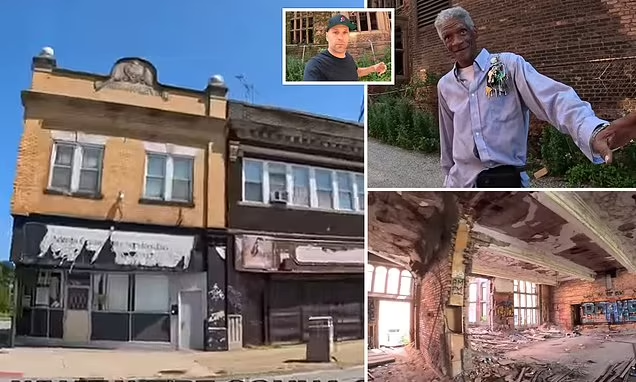
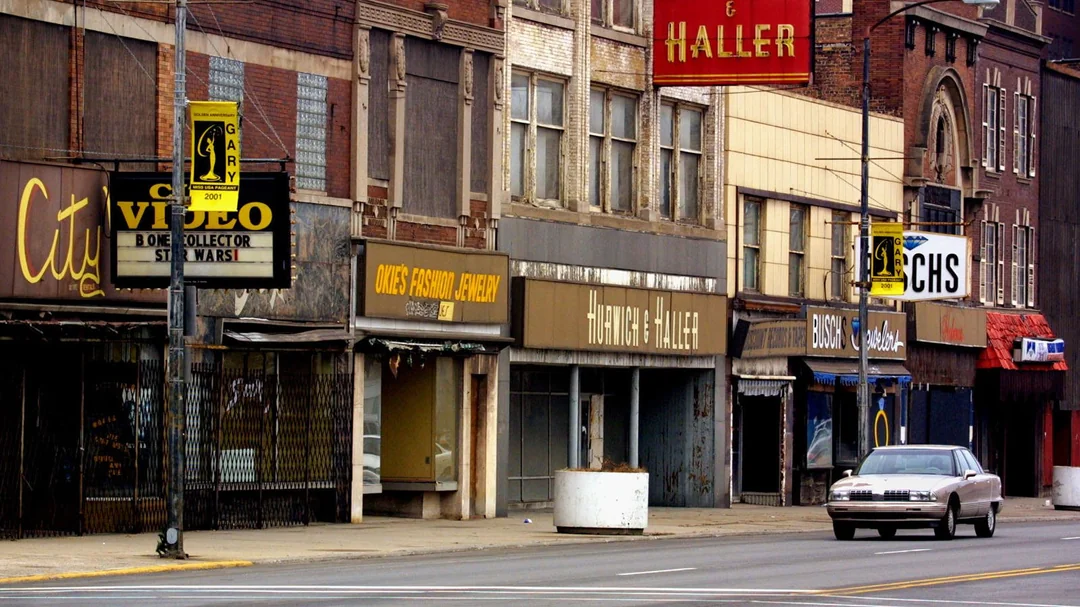
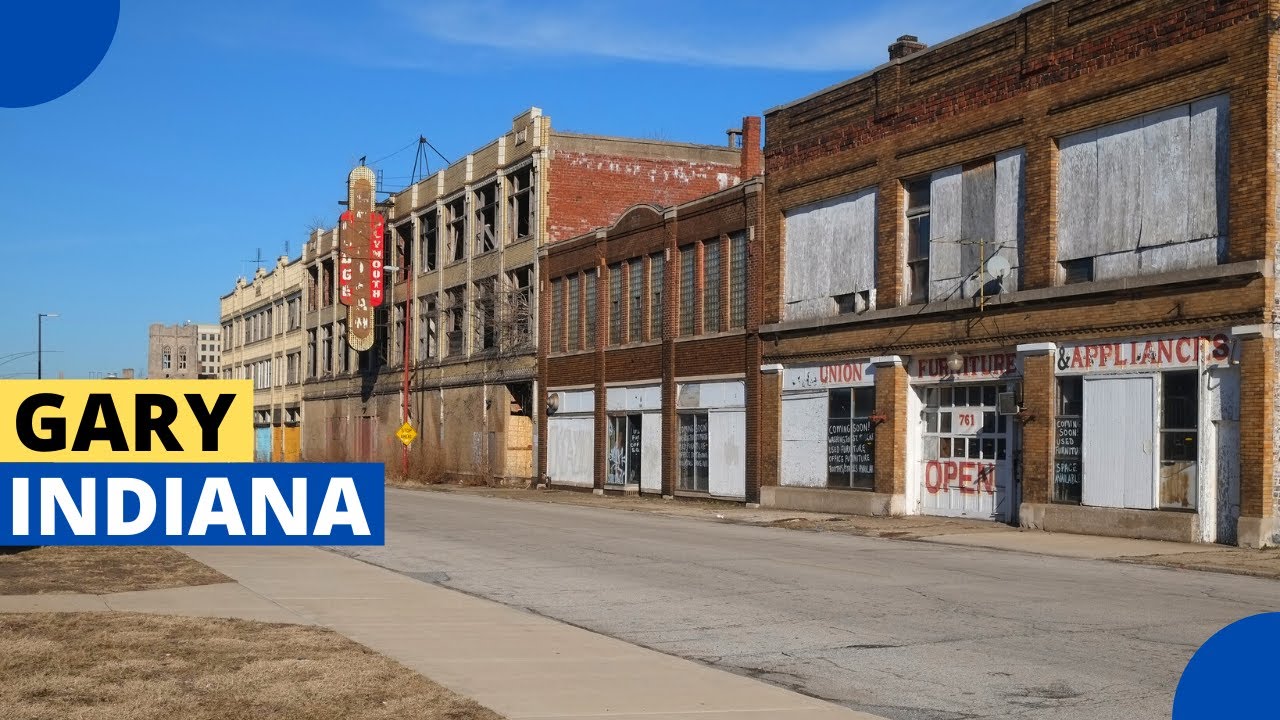
As people left, they abandoned their homes and businesses. Today, Gary has more than 13,000 abandoned structures. Entire city blocks sit empty. Historic buildings like the City Methodist Church have crumbled into ruins.
This urban decay is both a symptom and a cause of ongoing danger. Abandoned properties attract criminal activity, lower property values, reduce tax revenue, and send a signal that no one is watching.
The Most Dangerous Neighborhoods in Gary
Not all of Gary is equally dangerous. Crime is heavily concentrated in specific areas.
The eastern sections of the city consistently show the highest crime concentration. According to CrimeGrade data, your chance of being a crime victim in the most dangerous east neighborhoods is 1 in 14.
In contrast, safer areas like Miller Beach on the easternmost edge near Indiana Dunes, and parts of the Glen Park neighborhood on the south side, offer a more stable residential environment. In these areas, the risk improves to around 1 in 23.
Understanding this neighborhood-by-neighborhood reality matters because citywide averages can mask both the worst and the best parts of Gary’s story.
Underfunded Police and Public Services
Gary’s crime problem was made worse by its inability to fund the public services needed to fight crime.
As businesses closed and residents left, the city’s tax revenue collapsed. With less money coming in, the city had to cut spending everywhere, including on police.
In 2015, Gary had 269 full-time law enforcement employees. By 2024, that number had dropped to just 176, a significant reduction in an already high-crime city.
Underfunded police forces struggle to respond to crime effectively. When patrol coverage is thin and investigations are under-resourced, clearance rates for violent crimes drop, emboldening repeat offenders.
The Cost of Crime in Gary
Crime does not just cost lives. It costs money in ways that trap communities in cycles of poverty.
According to CrimeGrade, the total projected cost of crime in Gary in 2025 was $79,330,422. That translates to approximately $1,151 per resident or $2,953 per household every single year.
When intangible costs like pain, suffering, and trauma are added using research-based methodologies, the true cost of crime in Gary rises far above that already staggering figure.
This financial burden makes it harder for residents and businesses to invest in the city, creating a loop that is difficult to break.
Gary, Indiana in 2026: Is It Still That Dangerous?
Here is where the narrative gets more nuanced, and more hopeful.
Gary is no longer consistently ranked as Indiana’s most dangerous city. Recent analyses have placed South Bend at the top of Indiana’s most dangerous cities list. Terre Haute and Evansville also rank high. Gary still ranks near the top for violent crime per capita, but it no longer dominates every list the way it did in the 1990s.
More importantly, the trajectory is improving.
Signs of Progress: Crime Declining in Gary
The Gary Police Department’s 2024 Public Safety Report delivered some genuinely positive numbers.
Non-fatal shootings dropped to 132 incidents in 2024, a 10% decrease from the 147 the year before. Homicides fell from 52 in 2023 to 40 in 2024, the lowest number recorded since 2018. The department’s homicide closure rate reached 74%, surpassing the national average of 57.8%.
Then in 2025, the progress accelerated. Non-fatal shootings dropped a further 22.8%, falling from 123 incidents to just 95. Gary recorded only 24 homicides in 2025, the lowest annual total since at least 1970, down from 38 the previous year, and a staggering drop from the 129 recorded in 1995.
Authorities seized 369 firearms in 2025, a 41.4% increase over the previous year. Federal prosecutions of violent offenders rose by 25%.
| Year | Homicides | Change |
|---|---|---|
| 1995 | 129 | Peak year |
| 2023 | 52 | High but declining |
| 2024 | 40 | Lowest since 2018 |
| 2025 | 24 | 50-year low |
What Is Being Done to Make Gary Safer?
Multiple strategies are now producing real results in Gary.
The Gary Police Department has built partnerships with the ATF, the U.S. Attorney’s Office, the Indiana State Police, and the Lake County Prosecutor’s Office. This multi-agency collaboration focuses on repeat violent offenders and illegal gun activity, targeting the people who drive the most violence.
A dedicated Homicide Task Force formed in 2023 has improved both clearance rates and conviction rates, creating real accountability where little existed before.
Extra patrols and premise checks more than doubled from 4,507 in 2023 to 9,809 in 2024, a 118% rise, reflecting a genuine commitment to proactive crime prevention rather than just reactive response.
Economic Revitalization Efforts
Law enforcement alone cannot fix Gary. Economic investment is essential.
The Hard Rock Casino opened in Gary and has brought new investment and employment to the area. It represents the kind of major anchor development that can begin to shift the economic foundation of a struggling city.
Local leaders and state initiatives have also focused on environmental cleanup of brownfield sites left behind by the steel industry. Improvements to the South Shore Line connecting Gary to Chicago have improved transportation access, making the city more viable for commuters.
Nonprofits and entrepreneurs are investing in affordable housing, solar energy projects, and educational programs. These are long-term plays, but they matter.
Gary, Indiana vs. Other Dangerous Cities
Gary’s story is not unique. It follows a pattern seen in other American cities that lost their industrial base.
Detroit, Flint, and East St. Louis all followed similar trajectories — deindustrialization met systemic inequality with no adequate policy response, and crime filled the economic void.
The difference between Gary and some of these cities is that Gary’s decline happened to a relatively small population in a very concentrated geographic area, which made the impact per resident even more severe.
| City | Peak Issue | Current Status |
|---|---|---|
| Gary, IN | Steel collapse + murder capital | Recovering, homicides at 50-year low |
| Detroit, MI | Auto industry collapse | Ongoing recovery, population stabilizing |
| Flint, MI | Manufacturing loss + water crisis | Still struggling |
| East St. Louis, IL | Industrial decline | One of Illinois’ most dangerous cities |
Michael Jackson’s Gary, Indiana
One of the most striking contrasts in Gary’s story is that this deeply troubled city was the birthplace of Michael Jackson, one of the most famous entertainers in human history.
Jackson grew up at 2300 Jackson Street in Gary. He left as soon as he could, and the city he left behind continued its downward spiral long after the Jackson 5 became famous.
Today, Gary’s connection to Michael Jackson is a point of local pride and a tourism draw. The family home has become a pilgrimage site for fans from around the world. It is one of the few things that puts Gary on the map for positive reasons.
Is It Safe to Visit Gary, Indiana in 2026?
This is a fair question and deserves an honest answer.
Gary has real danger. The crime rate is genuinely high. Certain neighborhoods carry serious risk, particularly in the eastern sections of the city.
At the same time, people live and work in Gary every day. Thousands of residents navigate the city safely. Miller Beach is a genuine destination. The Hard Rock Casino attracts visitors regularly. Urban exploration of Gary’s abandoned buildings has become a niche tourism category.
If you visit Gary, stay in well-trafficked areas, go during daylight hours, be aware of your surroundings, and avoid eastern neighborhoods unless you have a specific local contact. Do not treat the entire city as equally dangerous, because it is not.
The Future of Gary, Indiana
Gary does not need to be written off. It needs the same kind of sustained investment and policy attention that built it in 1906.
The homicide numbers in 2025 reached their lowest point in over 50 years. Federal enforcement partnerships are producing documented results. The Hard Rock Casino represents real private investment. Community organizations are working every day.
But the structural problems — deep poverty, a massive abandoned housing stock, a depleted tax base, low educational attainment, and a population that is still declining — do not disappear quickly. Recovery from this depth of decline takes decades.
Gary’s people, Black, working-class, and resilient, have never stopped fighting for their community. The city’s story is not finished. And the latest chapter is, for the first time in a long time, pointing in the right direction.
Frequently Asked Questions (FAQs)
Why is Gary, Indiana so dangerous?
Gary’s danger stems from the collapse of its steel industry in the 1970s-80s, which triggered mass unemployment, poverty, population loss, and underfunded public services that allowed crime to take root and grow for decades.
Was Gary, Indiana really the murder capital of the world?
Yes. In 1993 and 1994, Gary recorded over 110 murders among a population of just over 100,000, earning the official designation as the murder capital of the United States, with a rate three times higher than Chicago’s at the time.
What is Gary, Indiana’s crime rate in 2026?
Gary’s crime rate stands at 34 per 1,000 residents, which is 242% above the national average, with a 1 in 30 chance of becoming a victim of violent or property crime.
Is Gary, Indiana still the most dangerous city in Indiana?
No. As of recent 2026 rankings, South Bend has taken the top spot in Indiana. Gary still ranks near the top per capita for violent crime but no longer dominates every state-level dangerous city list.
How many murders did Gary, Indiana have in 2025?
Gary recorded 24 homicides in 2025, the lowest annual total since at least 1970 and a dramatic drop from the 129 murders recorded in 1995 at the city’s crime peak.
What caused Gary, Indiana’s decline?
The collapse of U.S. Steel’s Gary Works operations in the 1970s-80s eliminated tens of thousands of jobs, triggering white flight, mass business closures, poverty, population loss, and urban decay that created conditions ideal for high crime.
What is the poverty rate in Gary, Indiana?
Gary’s poverty rate is 32.9%, meaning nearly one in three residents lives below the poverty line. The unemployment rate is 13.0%, both figures far above state and national averages.
Is it safe to visit Gary, Indiana?
Parts of Gary, such as Miller Beach and the Hard Rock Casino area, are relatively accessible for visitors. The eastern neighborhoods carry higher risk. Visiting during daylight, staying aware of surroundings, and avoiding isolated areas significantly reduces risk.
What is being done to reduce crime in Gary, Indiana?
The Gary Police Department has partnered with the ATF, U.S. Attorney’s Office, and Indiana State Police to target repeat offenders and illegal firearms. In 2025, 369 guns were seized and federal prosecutions of violent offenders rose 25%.
Is Gary, Indiana worth visiting?
Gary has genuine points of interest including Michael Jackson’s childhood home, the abandoned City Methodist Church for urban explorers, and the Indiana Dunes via Miller Beach. With caution and planning, a focused visit to specific sites is manageable.
Conclusion
Why is Gary, Indiana so dangerous comes down to one core truth: the city was built for one industry, stripped of that industry, abandoned by investment, burdened by systemic racial inequality, and left to survive without the economic foundation that made it possible to maintain safety and order. Crime was not the cause of Gary’s decline. It was the symptom.
The encouraging reality in 2026 is that Gary is moving in the right direction. Homicides hit a 50-year low in 2025. Federal law enforcement partnerships are working. New investment is arriving.
The city’s residents have shown extraordinary resilience through decades of suffering. Gary’s full recovery will take years and require sustained commitment from state and federal government, private investors, and the community itself. But the shocking truth about Gary, Indiana in 2026 is that its darkest days may finally be behind it.
