

Why are flies so annoying is a question almost every person on the planet has asked mid-swat.
These tiny, buzzing insects seem to exist purely to ruin your picnic, contaminate your food, and dodge every attempt to smack them.
But there is real science behind their maddening behavior.
Entomologists and pest control experts have studied fly biology for decades, and their findings reveal that flies are not trying to annoy you on purpose.
They are just doing what their survival instincts demand, and those instincts happen to make them one of the most irritating creatures alive.
Why Are Flies So Annoying?
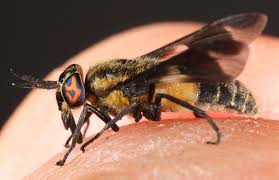
Flies are not singling you out personally. They are hardwired to detect resources, and your body is a walking buffet. Every signal your body sends, from warmth to breath to sweat, broadcasts a welcome invitation to nearby flies.
Understanding this behavior is the first step to managing it. The more you know about what draws them in, the better equipped you are to push them away.
You Are a Walking Buffet for Flies
Your body constantly emits chemical signals that flies can detect from a surprising distance. Sweat contains carbohydrates, amino acids, and salts that serve as nutrients for flies. Natural skin oils and dead skin cells add even more edible material.
Flies use specialized receptors on their antennae to pick up these chemical cues. According to experts at the University of Kentucky, flies are literally tracking your “cloud of effervescence,” a cocktail of body odors, moisture, and carbon dioxide. You smell like food to them.
Carbon Dioxide: The Invisible Fly Magnet
Every time you exhale, you release carbon dioxide. Flies and mosquitoes are highly sensitive to CO2 and use it as a navigation beacon to locate warm-blooded animals. The closer they get, the more signals they pick up, guiding them right toward your face and hands.
This is why flies always seem to buzz near your head. Your face releases the most CO2, and the skin around your eyes, nose, and mouth is often exposed and moist. That combination is irresistible to flies looking for a meal.
Body Heat and Moisture Attract Flies
Flies prefer warm environments. Your body temperature of around 37°C (98.6°F) makes you stand out in a cooler room like a warm lamp on a cold night. Warm, moist surfaces are perfect feeding and breeding environments for flies.
Professor Theo Evans from the University of Western Australia described humans as “mobile water drinking fountains” for flies. When flies arrive in dry or hot conditions, they actively seek out humans as a source of moisture, salt, and warmth all in one.
Sweat and Skin Secretions Are Fly Food
Flies taste with their feet before they eat. Tiny sensory receptors on their legs can detect sugars, salts, fats, and proteins on any surface they land on. When a fly lands on your arm, it is actively tasting your skin to evaluate its nutritional value.
This explains why flies keep landing on you even after you shoo them away. They found something worth tasting and they are not giving up easily. Your skin constantly replenishes its oils and salts through sweat, so you remain a fresh food source throughout the day.
The Disgustingly Gross Reality of How Flies Eat
Here is the part that makes most people shudder. Flies cannot chew solid food. When they land on your sandwich or your arm, they regurgitate a mix of digestive enzymes onto the surface to partially dissolve it, then suck up the resulting liquid with their sponge-like mouthparts.
Jonathan Larson, an entomologist at the University of Kentucky, put it bluntly: “They land on poop. They get their feet all dirty. They don’t wash their hands, and then they come and they throw up on your sandwich.” That process happens in milliseconds, often before you even notice the fly has landed.
Why Flies Land on Your Face Specifically
Your face is ground zero for fly activity because it offers the most of everything flies want. You breathe out CO2 continuously. The skin around your eyes produces secretions called rheum. Your lips are moist. Your nose releases warm, humid air. All of these combine into a concentrated hotspot.
Flies that seek moisture, salt, and protein find everything they need on a human face. This is especially true for bush flies and non-biting house flies, which are not after blood but are after the same secretions your skin naturally produces throughout the day.
Why Flies Are So Hard to Swat
This is one of the most frustrating aspects of fly behavior. You can bring your hand down at full speed and still miss. It feels personal. But it is actually a product of extraordinary fly biology that puts human reflexes to shame.
Compound Eyes That See in Near-Slow Motion
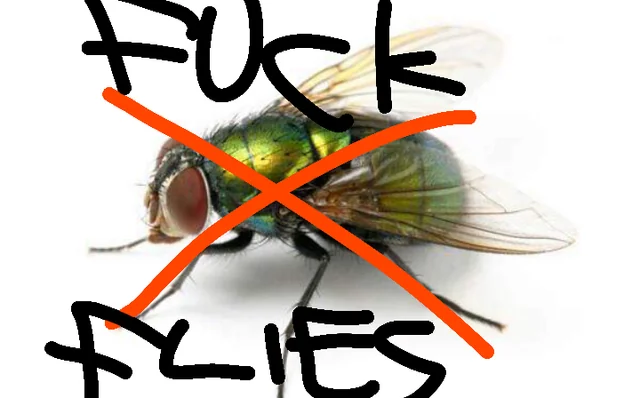
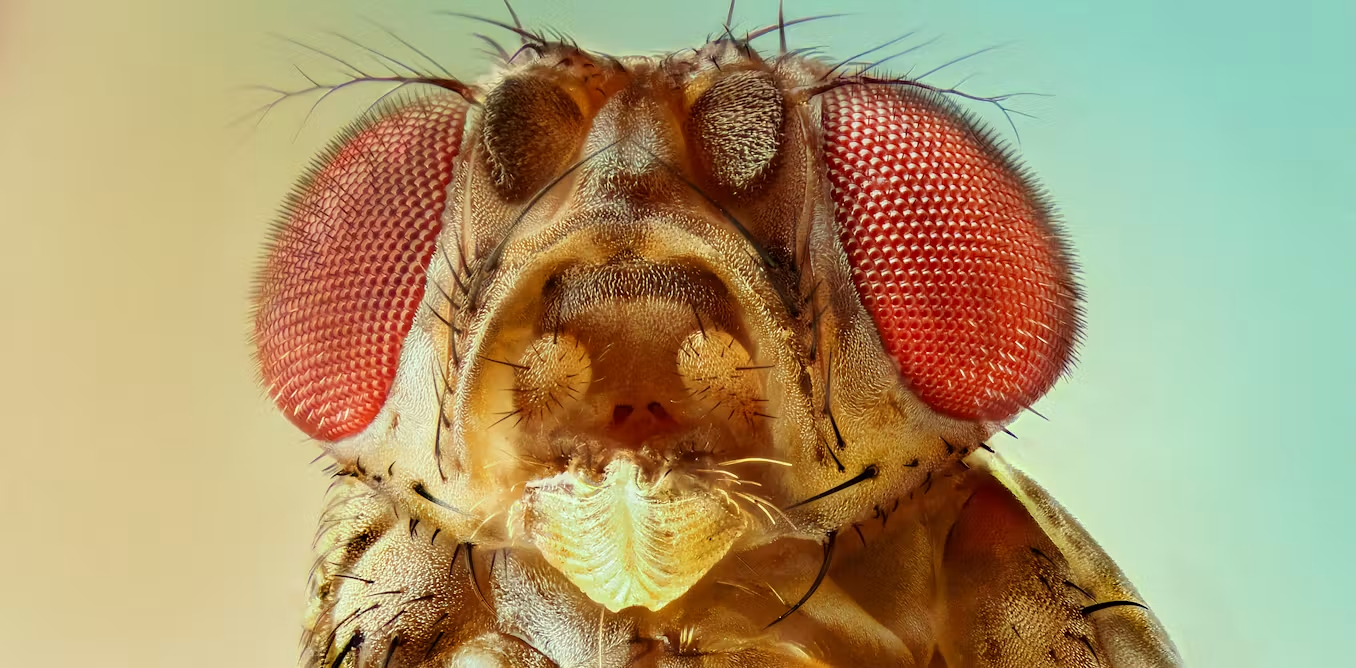
Flies have compound eyes made up of hundreds to thousands of individual lenses. These eyes give them an almost 360-degree field of vision with no blind spots. While humans process visual information at around 60 frames per second, flies process it at over 200 frames per second.
From a fly’s perspective, your hand is moving in slow motion. By the time your swat arrives, the fly has already detected the incoming threat, calculated an escape route, and taken off. Research by Michael Dickinson at Caltech showed that flies can reposition their legs and wings in around 200 milliseconds to prepare for the optimal escape direction before even taking flight.
Their Bodies Are Wired to Escape
It is not just their eyes. Tiny hairs on a fly’s body called mechanoreceptors can detect changes in air pressure and movement. When you raise your hand to swat, the air displacement created by the movement warns the fly before your hand even gets close.
The fly’s nervous system processes this information and activates a pre-programmed escape response. Studies show flies can be airborne and traveling in the right escape direction within 100 milliseconds of detecting a threat. If you want to improve your swatting success rate, aim where the fly is likely to escape to, not where it is currently sitting.
How to Swat a Fly More Effectively
Research suggests that aiming ahead of the fly’s position, targeting its likely escape route rather than its current location, gives you a better chance. Slower, wider sweeping motions are often more effective than fast direct strikes. Coming from below can also work since flies most commonly escape upward or forward.
Why Flies Seem to Follow You Everywhere
Once a fly locks onto you, it is hard to shake. Flies are naturally curious insects. Experts describe them as having a back-and-forth behavior pattern where their attraction to a resource competes with their awareness of movement as a potential threat. They approach, detect danger, back off, and try again. Over and over.
This persistent behavior is not targeted harassment. It is a survival loop. The smell of food (you) keeps pulling them back, even as the danger signal (your movement) pushes them away temporarily. You are simply the most interesting resource in their immediate environment.
Flies Carry Diseases That Make Them More Than Just Annoying
Beyond irritation, flies pose a genuine health risk. House flies are believed to carry at least 65 different diseases. They pick up bacteria, viruses, and parasites from every surface they land on, including garbage, feces, and rotting matter, then transfer those pathogens to your food and skin.
A 2017 study from Penn State’s Eberly College of Science confirmed that house flies and blowflies carry hundreds of different bacteria on their bodies. When a fly lands on your food and regurgitates digestive enzymes, it can deposit a cocktail of harmful microbes in the process. Foodborne illnesses like salmonella, E. coli infections, and dysentery have all been linked to fly contamination.
The Fly Lifecycle: Why Infestations Grow So Fast
Understanding why fly problems escalate so quickly comes down to their reproductive speed. A female house fly can lay up to 500 eggs during her lifespan of 15 to 30 days. Under warm conditions, those eggs can hatch into larvae and develop into adult flies in less than a week.
One fly entering your home is not a crisis. A breeding population is. Any overlooked source of decaying organic matter, whether food scraps, garbage, or pet waste, can become a breeding ground that produces dozens of new flies in days.
| Fly Lifecycle Stage | Duration (Warm Conditions) |
|---|---|
| Egg | 8 – 20 hours |
| Larva (Maggot) | 3 – 5 days |
| Pupa | 3 – 6 days |
| Adult | 15 – 30 days |
| Eggs per female | Up to 500 total |
Different Types of Flies and How They Annoy You Differently
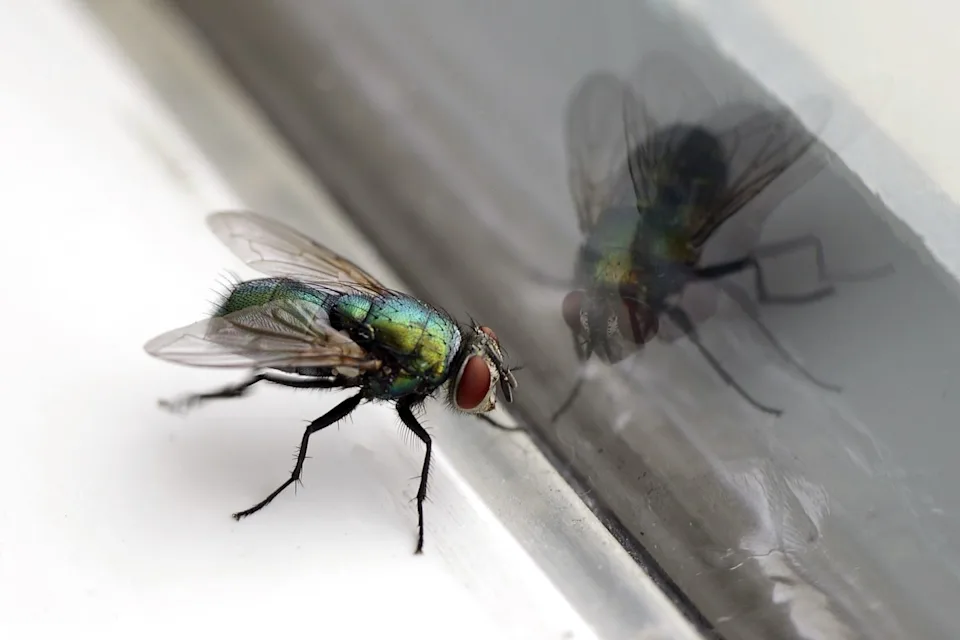
Not every fly that bothers you is a common house fly. Different species have different feeding strategies and different reasons for getting close to humans.
House Flies (Musca domestica)
The most common indoor pest. House flies are attracted to food, garbage, animal waste, and human secretions. They do not bite but contaminate everything they touch. They use sponging mouthparts and regurgitate digestive fluid before feeding.
Fruit Flies (Drosophila)
Fruit flies swarm overripe produce and sugary residues. They are smaller than house flies and less likely to land on you directly, but they colonize kitchens rapidly. A forgotten piece of fruit or a damp drain can produce clouds of fruit flies within days.
Horse Flies and Deer Flies
These are the biters. Horse flies use a slash-and-suck feeding method, cutting the skin and lapping up blood. Their bites are painful and slow to heal. They are attracted to large, warm-blooded animals and are particularly active on hot, sunny days near water.
Mosquitoes (Technically Flies)
Mosquitoes belong to the order Diptera, making them true flies. Female mosquitoes require a blood meal to develop their eggs and use CO2, body heat, and lactic acid from sweat to locate hosts. Some people attract more mosquitoes than others due to differences in skin microbiome, blood type, and metabolic rate.
Bush Flies (Musca vetustissima)
Common in Australia, bush flies are relentless non-biters that seek moisture from eyes, nose, and mouth. They are attracted to the same sweat and secretions as house flies and are notorious for swarming human faces in outdoor settings.
Why Flies Are Worse in Summer
Flies are cold-blooded insects, meaning their activity and reproduction rate are directly tied to ambient temperature. Warm summer weather accelerates every stage of their lifecycle, from egg to adult, dramatically increasing fly populations. Higher temperatures also increase human sweat production, which means more of the chemical signals that attract flies in the first place.
Additionally, summer means more outdoor activities, more food left out, more open windows, and more opportunities for flies to enter homes and multiply. Strong winds can carry flies dozens of kilometers from their breeding sites, spreading infestations across wide areas.
Why Some People Attract More Flies Than Others
If you feel like flies always zero in on you while ignoring the person next to you, you may not be imagining it. Individual differences in body chemistry genuinely affect how attractive you are to flies and other insects.
People who sweat more produce more of the amino acids and salts that flies find appealing. Higher body temperature, certain skin microbiome compositions, and even the type of perfume or lotion you wear can all influence fly attraction. Wearing brightly colored clothing, especially yellow and white, can also attract more flies compared to darker or neutral tones.
Do Flies Serve Any Purpose Beyond Annoying Humans?
It is tempting to write flies off as completely useless, but ecologists would disagree. Flies play important roles in several natural processes. Many species are pollinators, second only to bees in some ecosystems. Flies are also decomposers, breaking down organic matter and recycling nutrients back into the soil.
Blowflies and carrion flies are essential in forensic science, where the stages of fly larvae development help determine time of death. Flies are also an important food source for birds, bats, reptiles, and other insects. Removing flies from an ecosystem would have significant cascading effects on the food web. Their annoyance is a side effect of their ecological utility.
How to Repel Flies: Science-Backed Methods That Work
Now that you understand why flies are so annoying and what drives their behavior, you can use that knowledge to make yourself and your home less attractive to them.
Keep Your Environment Clean and Dry
Flies breed in decaying organic matter. Eliminating their breeding sites is the single most effective long-term strategy. Take out garbage frequently, clean up food spills immediately, keep drains clear of organic buildup, and store food in sealed containers.
Use Natural Scent Repellents
Flies dislike several strong plant-based scents. Essential oils made from lavender, eucalyptus, peppermint, and lemon are effective at deterring flies. Mix a few drops with water in a spray bottle and apply near entry points, windows, and kitchen surfaces.
Planting basil, mint, rosemary, or bay leaves near doors and windows creates a natural fly barrier. Citrus peels placed near windowsills also help, as the oils in the peel are unpleasant to flies.
DIY Fly Traps That Actually Work
An apple cider vinegar trap is one of the most effective and low-cost solutions. Mix a few tablespoons of apple cider vinegar with a few drops of dish soap in a bowl or cup. The vinegar attracts flies, and the soap breaks surface tension so they sink. Cover with plastic wrap and poke small holes for entry.
A similar trap can be made using overripe fruit covered with plastic wrap and small holes. Flies enter easily but cannot find their way out.
Fans, Screens, and Physical Barriers
Flies prefer to fly in calm air. A fan running near a patio or outdoor dining area creates enough air turbulence to deter most flies. Window screens and door screens are the simplest and most reliable way to keep flies out of the home.
DEET and Commercial Repellents
For outdoor activities in areas with heavy fly pressure, DEET-based repellents and oil of lemon eucalyptus are effective at reducing fly and mosquito contact on exposed skin. Wearing long-sleeved clothing reduces the amount of exposed skin that flies can land on and taste.
Quick Reference: What Attracts Flies vs. What Repels Them
| What Attracts Flies | What Repels Flies |
|---|---|
| Sweat and body odor | Lavender and peppermint essential oils |
| Carbon dioxide (exhaled breath) | Basil, mint, rosemary plants |
| Body heat and moisture | Citrus peels and clove-studded lemons |
| Decaying food and garbage | Apple cider vinegar traps |
| Animal waste and feces | Fans creating air movement |
| Open drains and standing water | Sealed garbage and food containers |
| Bright colors (yellow, white) | DEET repellent on exposed skin |
Frequently Asked Questions (FAQs)
Why do flies keep landing on me no matter what I do?
Flies are attracted to your sweat, body heat, and the carbon dioxide you exhale. Your body constantly signals “food” to nearby flies, so they keep returning even after being shooed away.
Why is it so hard to swat a fly?
Flies process visual information at over 200 frames per second compared to 60 for humans. They see your swat coming in slow motion and take off before your hand arrives.
Do flies actually serve any purpose?
Yes. Flies are pollinators, decomposers, and a food source for many animals. They play a significant ecological role despite being deeply annoying to humans.
Why do flies always go near my face?
Your face releases the most CO2, moisture, and skin secretions. The area around your eyes, nose, and mouth is the richest concentration of the nutrients flies want.
Are flies actually dangerous, or just annoying?
They are both. House flies carry at least 65 diseases and transfer bacteria to food and surfaces every time they land, making them a genuine health hazard beyond just a nuisance.
Why are there more flies in summer?
Warmer temperatures speed up the fly lifecycle dramatically and increase sweat production in humans. More heat means faster breeding, more flies, and more of the chemical signals that attract them.
What smell keeps flies away most effectively?
Lavender, eucalyptus, peppermint, and citrus scents are among the most effective natural fly deterrents. Flies find these aromas unpleasant and tend to avoid areas where they are present.
Why do flies keep coming back after I chase them away?
Flies operate on a resource-seeking loop. The smell of food or sweat keeps pulling them back toward you even after the threat of your movement temporarily drives them away.
Can flies transmit diseases to humans directly through landing?
Yes. Flies transfer bacteria and pathogens from their feet and through regurgitation every time they land on food or skin. They are a documented vector for salmonella, E. coli, and dysentery.
How do I stop a fly infestation at home?
Remove breeding sources by keeping garbage sealed, cleaning up food spills, and maintaining clear drains. Use vinegar traps, essential oil sprays, and physical barriers like window screens to reduce fly entry and population.
Conclusion
Why are flies so annoying comes down to one simple fact: they are not trying to annoy you, they are trying to survive, and you happen to be an ideal resource.
Your body warmth, sweat, carbon dioxide, and skin secretions broadcast a continuous welcome signal to every fly within range.
Their near-360-degree vision, lightning-fast neural processing, and persistent curiosity make them extraordinarily difficult to deter once they have locked onto you.
The good news is that understanding fly biology gives you real power to reduce the problem.
Eliminating breeding sites, using natural scent deterrents, setting up simple traps, and creating physical barriers can dramatically cut down the fly pressure in your home and outdoor spaces.
Flies will never completely disappear from your life, but knowing why they do what they do makes it much easier to outsmart them.
In 2026, you no longer have to just put up with the buzz. You have the science to fight back.
