


Meaning of “The Devil’s Advocate”
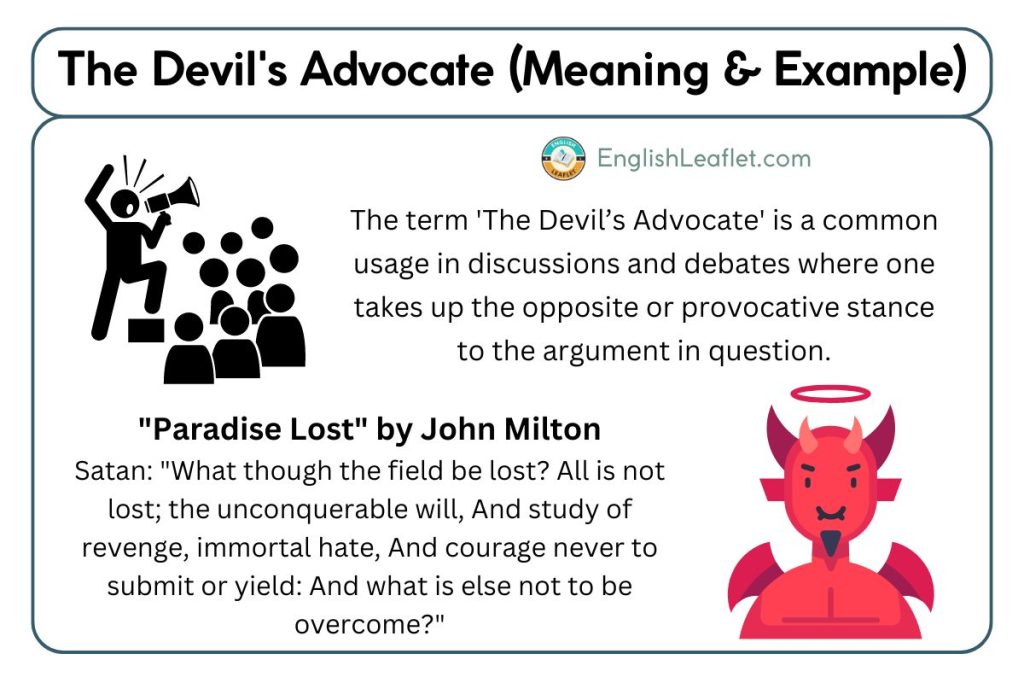
The term ‘The Devil’s Advocate’ is a common usage in discussions and debates where one takes up the opposite or provocative stance to the argument in question. This role is not always an expression of the individual’s own opinions or stand, but rather it is employed to challenge the logic of the arguments and discover possible weaknesses or to encourage further analysis. Through advocating a counter opinion to the majority decision or the so called right thing to do, a Devil’s Advocate promotes analysis of issues in detail.
In a general sense, being a Devil’s Advocate entails challenging beliefs, thinking through hypothetical situations, and offering other perspectives. For example, when a group of colleagues is in the process of planning the next step of the marketing campaign, someone may raise an issue like this, “Let me be the devil’s advocate here”, what if this approach will not be effective and turn people away, thus decreasing our engagement?’. The role is beneficial in most cases, as it helps to foster critical thinking and prevent groupthink by ensuring that many perspectives are considered.
Origin of “The Devil’s Advocate”
The phrase comes from the official position of the Devil’s Advocate in the Catholic Church. From 1587 until 1983, in the course of the canonization of saints, there was a certain church officer called the Promoter of the Faith (later the Devil’s Advocate) to speak against the sanctity of the sainthood.
Their role was to question, to complain and to find the pitfalls and the risks that should be avoided. It served to give the ‘devil’s advocate’ view, a fairly unique position as an adversarial one, where canonizations where vetted strictly before being endorsed.
Although the position was eliminated in 1983, the notion of ‘arguing the other side’ or ‘arguing for the devil’ is still in colloquial use today.
Examples of “The Devil’s Advocate” in Literature
The phrase “Devil’s Advocate” has been prevalent in literature for centuries. The term is employed to justify opposition, trigger reflection and question the current order of things. The phrase has been written in different contexts – from philosophical to realistic works, to convey profound messages and engage the readers’ intellects.
nd power and that the society needs opposition to lead the individuals to make better and ethic decisions.
Example#1
“Paradise Lost” by John Milton
The poem “Paradise Lost” is another example of the literature, that is based on the elements of the Devil’s Advocate. The poem narrates the biblical story of the fall of man and sin in the Garden of Eden, which unfolds the themes of temptation, the existence of free will, and the struggle between the good and evil.
In this poem, there is even the devil that appears to be a kind of Devil’s Advocate and to question the divineness of God and to give reasons for rebellion and individual liberty.
In one of the most famous passages of the poem, Satan delivers a speech to his followers, arguing for their right to defy God and assert their own autonomy:
Satan: “What though the field be lost? All is not lost; the unconquerable will, And study of revenge, immortal hate, And courage never to submit or yield: And what is else not to be overcome?”
Satan becomes the Devil’s advocate through challenging the existence of God’s authority by urging people to fight against tyranny. The arguments are cogent and passionate, and they work to subvert the reader’s idea of obedience, authority and freedom.
The use of Satan as a Devil’s Advocate, Milton is liberating in showing that decisions can be multi-faceted and one must look at all sides. Through the use of a sympathetic character and detailed arguments of Satan, Milton raises various troubling questions regarding the notions of good and evil, the significance of free will, and the role and importance of disobedience.
Example#2
“The Devil’s Advocate” by Morris West
In this novel, the author directly engages the concept of the Devil’s Advocate with reference to a canonization case. It is an anti-utopian novel which describes the post atomic war experienced by the main character – Monsignor Blaise Meredith who is sent to Italy, to a village, in order to discover the life of a man Giacomo Nerone who is to be canonized.
It is now Meredith’s role to play the devil’s advocate, find anything which points to a potential moral weakness in Nerone or even doubt the authenticity of the miracles associated with him.
As for Meredith, he himself has a number of agonizing dilemmas, both regarding the holiness of Nerone and doubts with regard to faith in God. While he is on his job, he learns that there are many mysteries and enmities embedded in diverse stories and various people’s statements that confront his beliefs and prejudices.
In one passage, Meredith reflects on his role as the Devil’s Advocate:
“I am the Devil’s Advocate,” he thought, “sent here to challenge and question, to doubt and disbelieve. But what if, in my skepticism, I overlook the truth? What if, in my search for flaws, I fail to see the good?”
Here, Meredith’s inner turmoil exemplifies the dilemmas of being the Devil’s Advocate and the struggle to be both the doubting and the receptive. The Devil’s Advocate employed to explain that faith and doubt are bound in human nature and the truth is gray and ambiguous.
Hence, “The Devil’s Advocate” is a powerful exploration that shows the place of dissonance and the value of questioning when it comes to seeking the truth and the need to hear the second opinion.
See also: The Cat’s Pajamas
Use of “The Devil’s Advocate” in Contemporary Literature
In modern writing, the term “The Devil’s Advocate” is used and works well to find out elements of disagreement, disbelief, and questioning. The idea has been featured in novels, short stories, and essays by contemporary authors who employ the concept to subvert the reader’s expectations.
“Nineteen Minutes” by Jodi Picoult
For example, in (2007), the phrase is used to describe a character who takes on a dissenting viewpoint in a discussion about school shootings and gun control:
“Peter always played the Devil’s Advocate in class discussions, arguing against the majority opinion, not because he necessarily believed what he was saying, but because he wanted to make people think.”
In this regard, the Devil’s Advocate is meant to stimulate constructive thinking and see things with open mindedness in light of what is often a sensitive issue. Picoult adopted the term with the meaning of exploring the different points of view and doubtful one’s own opinions in order to find the truth.
Cultural Impact and Modern Usage
The phrase “The Devil’s Advocate” has earned its place among the most recognized idioms in the contemporary world and can be used in a variety of settings to refer to the person who questions the received paradigms. Besides literature, the given phrase has also been actively used in media and political discourses, as well as in business contexts, to recall the importance of dissident discussion.
1- Media and Journalism
In media and journalism, the Devil’s Advocate is a position that can be taken by commentators, journalists and interviewers to counter-balance the claims of the public figures. These people attempt to give a better and clearer overview of the various matters by challenging the ideas and offering counterarguments. This approach avoids prejudice and makes sure that all the factors of an issue are discussed.
2- Business and Professional Environments
In a business or a profession, there is a practice known as the Devil’s Advocate where the idea, strategy or plan is put to the test. This is because by having someone defend a decision that an organization is about to make, the organization is in a position to unearth some of the possible flaws, the weaknesses and the risks that may be associated with the decision in question.
This practice assists in averting groupthink tendencies, encourages innovation, and assures that decisions made are made with apprehension of the implication.
Example Sentences of “The Devils’ Advocate”
- I decided to play a devil’s advocate in the meeting by arguing against the proposed policy, even though I actually agreed with it.
- She always takes on the role of a devil’s advocate during discussions at book club, critiquing the author’s narrative choices.
- Let me be a devil’s advocate for a moment and suggest we reconsider this plan from all angles before moving forward.
- He enjoyed being a devil’s advocate and debating controversial issues using reasoning against the prevailing public sentiment.
- The professor challenged students to argue as a devil’s advocate against their own positions to strengthen critical thinking skills.
- I don’t mean to be a devil’s advocate, but should we examine potential flaws in this strategy before presenting it to the board?
- She played a devil’s advocate, questioning each assertion to ensure the scientific theory could withstand rigorous scrutiny.
- As an exercise, the debate team randomly assigned a devil’s advocate role to critique the week’s resolution from the opposite stance.
- He decided to be a devil’s advocate and argue for stricter internet regulations, even though he was privately against increased censorship.
- Let me play a devil’s advocate for a moment, to make certain we have considered all perspectives before finalizing the plans.
