

Introduction to “She Walks in Beauty”
The poem “She Walks in Beauty” written by Lord Byron explains the timeless and appealing nature of the beauty. The poem was written in 1814. This lyric piece of work is considered among the masterpieces which are famous for their great imagery and deep feelings. The poem is based on a real-life event and beauty, which brings out the internal and external characteristics of the subject. It was due to these ideals that Byron applied the romantic approach to his work, thus portraying the nature as intertwined with people’s feelings.
The poem comprises three six-line verses, wherein the themes of beauty have been described in detail. The metrical pattern and the contrasting images emphasize the subject’s admiration and reverence. Thus, the poem tells about the capturing of the tender moment when a man meets a woman who possesses the perfect combination of outer and inner attractiveness.
Themes in “She Walks in Beauty”
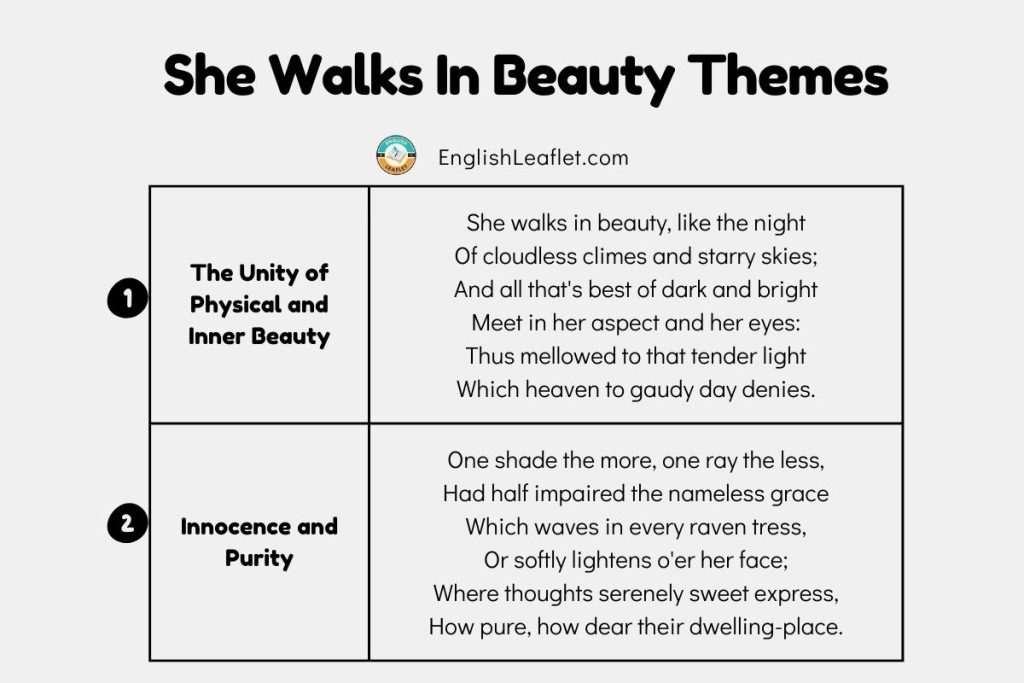
Theme#1
The Unity of Physical and Inner Beauty
She walks in beauty, like the night
Of cloudless climes and starry skies;
And all that’s best of dark and bright
Meet in her aspect and her eyes:
Thus mellowed to that tender light
Which heaven to gaudy day denies.
In the first stanza of the poem, Byron hails the idea of the harmonious combination of external and internal appearance. The woman he describes is indeed beautiful as she moves “in beauty” meaning that she has natural beauty and style.
The phrase “as the night / Of cloudless climes and starry skies” create a comparison that revises the image of the night and introduces a positive connotation of it, making it seem as if it is the perfect time and setting.
The combination explores the balanced beauty, whereby the two extremes of the dark and bright are both incorporated. The poet is able to describe in the woman’s aspect and her eyes the best of both worlds, that which can only be seen during the golden hours of the day. This imagery also contributes to the general idea of the novel that real beauty is a combination of the outward appearances and inner virtues.
Theme#2
Innocence and Purity
One shade the more, one ray the less,
Had half impaired the nameless grace
Which waves in every raven tress,
Or softly lightens o’er her face;
Where thoughts serenely sweet express,
How pure, how dear their dwelling-place.
In second stanza of the poem, the theme of purity has been focused. Byron describes the balance of the woman’s beauty and how the minute change can decrease her ‘nameless grace’. He then goes on to describe her hair or ‘raven tress’ and the light, which seems to fall on her elegantly. The poet describes that she can remain expressionless because her thoughts are ‘serenely sweet’, which shows her purity.
The focus on the her beauty and the purity of her thoughts explains a deep admiration for her innocence. This theme is a living testimony to the fact that, Byron admired beauty not merely in physical features, but in all aspects which give the body beauty, moral and spiritual features included.
Theme#3
Tranquility and Serenity
And on that cheek, and o’er that brow,
So soft, so calm, yet eloquent,
The smiles that win, the tints that glow,
But tell of days in goodness spent,
A mind at peace with all below,
A heart whose love is innocent!
The final lyrics of the poem are characterized by the themes of ‘tranquil’ as well as ‘serenity’. He notices the lady cheek and brow and describes that they are soft and so calm, yet filled with eloquence. Here, the author uses lexical choice such as soft, calm and eloquence to depict the beauty of the lady’s face and personality. They look like she has spent her productive years doing that which is right and proper in the sight of God.
Byron sums up by saying that her tranquil mind and pure affection tell more eloquently about her beauty than all the embellishments, which are in fact ‘nothing’. This stillness and calmness are not only good but also necessary for the poet when he has a vision of the highest type of beauty.
Poetic Devices in “She Walks in Beauty”
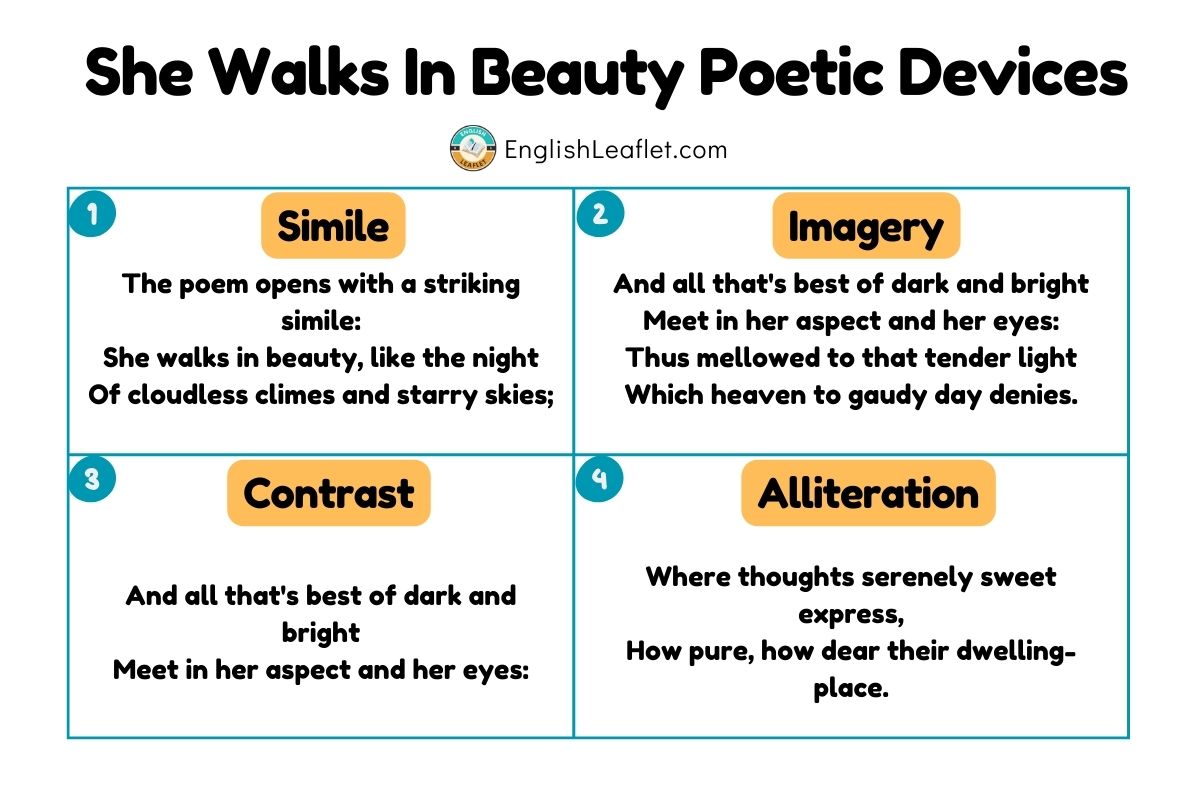
1- Simile
The poem opens with a striking simile:
She walks in beauty, like the night
Of cloudless climes and starry skies;
Byron uses the comparison of the beauty of woman with the sky, filled with stars at night. This comparison yields a vivid picture practically in an instant, and the image one gets is one of calm and glowing splendor. The term” like the night” thus suggests a delicate kind of beauty, not as severe as day light kind of beauty.
2- Imagery
Throughout the poem, Byron employs evocative imagery to portray a picture of the woman’s beauty:
And all that’s best of dark and bright
Meet in her aspect and her eyes:
Thus mellowed to that tender light
Which heaven to gaudy day denies.
The imagery of ‘dark and bright’ entities in her appearance creates the balance of the two opposites while at the same time adding to the general beauty of the woman. The bright light of heaven rising so tender and so pure that it cannot illuminate the brash gaudy day refers to a soft pleasant glow and once again describes the woman as pure, gentle and beautiful.
3- Contrast
Byron uses variance to indicate the balance and harmony in the beauty of woman:
And all that’s best of dark and bright
Meet in her aspect and her eyes:
The juxtaposition of ‘dark and bright’ entities emphasizes the theme of unity in diversity. It reflects her beauty surrounding through a range of external and internal quality. This contrast forms a sense of perfection and completeness.
4- Alliteration
Alliteration has been used in the poem to increase the musical effect of the poem:
Where thoughts serenely sweet express,
How pure, how dear their dwelling-place.
The repetition of ‘s’ sound in ‘serenely sweet’ and ‘their dwelling place’ gives the lines a smooth flow and describes the tranquil character of the woman.
5- Hyperbole
Hyperbole has been employed by the author to underscore the extraordinary nature of the woman’s beauty:
Had half impaired the nameless grace
Which waves in every raven tress,
Or softly lightens o’er her face;
This claim that a slight change would ‘half impair’ her grace means just that a beauty as perfect as hers is delicate. This is a hyperbolical expression to stress the attitude of the poet which is admiration, and even awe.
6- Repetition
Repetition is a significant quality in the poem:
How pure, how dear their dwelling-place.
The repetition of “how” emphasizes the purity and dearness of the woman’s thoughts, reinforcing the admiration the poet feels. This device also contributes to the rhythmic and lyrical quality of the poem.

Summary of “She Walks in Beauty”
”She Walks in Beauty” is a lyrical poem that speaks about the beauty of a woman. This poem is made up of three six-line stanzas and the first line of the poem compares the woman to the beauty of a star-lit night. This imagery depicts her as having both the light and the dark side of her, the outward beauty, and the inner beauty as well.
The same concept is elaborated in the second stanza, as Byron reveals that even a minor alteration might ‘lessen that fair nameless grace’ which he appreciates in her; her noble and pure thoughts are mirrored in her face. The final stanza shows her calm and and articulate speech; implying that the subject led a good life filled with innocent love.
In conclusion, the poem presents beauty as a holistic concept that includes the physical appearance of a person along with his/her virtues. Thus, the vivid imagery, contrasts and the lyrical rhythm of the poem make the poem a beautiful and inspiring piece of work dedicated to the woman Byron appreciates.
