

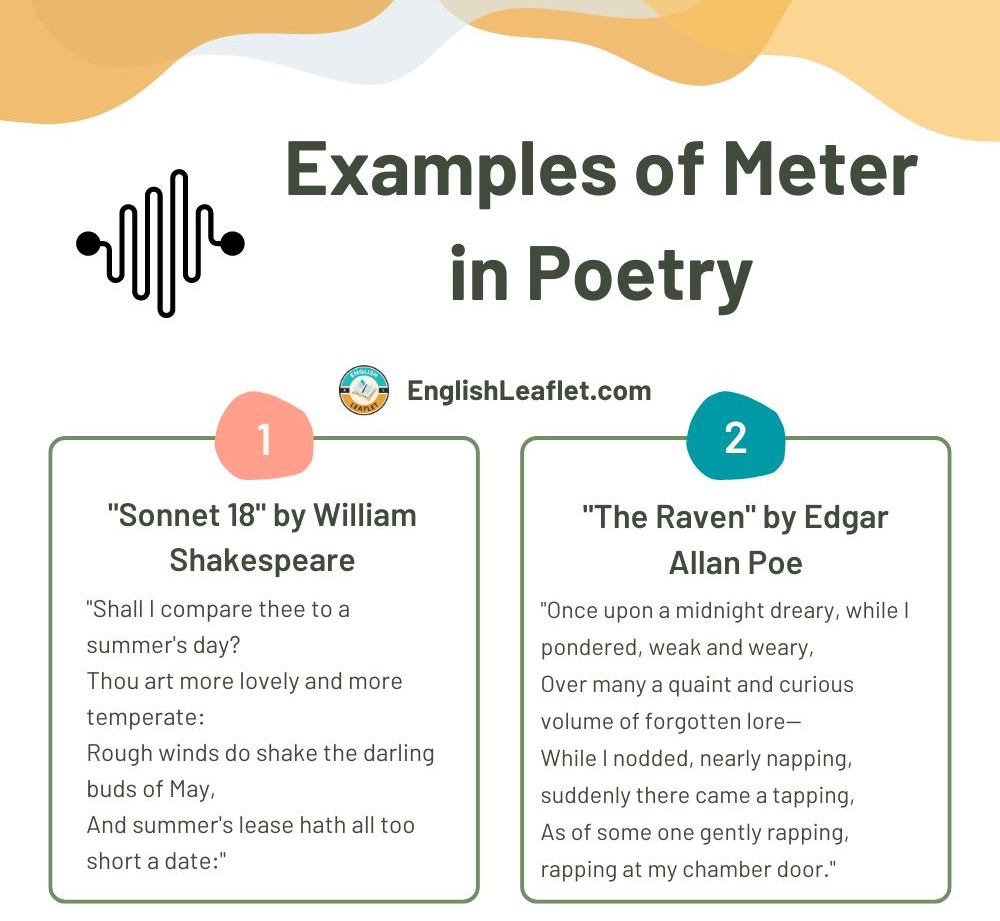
Example of a meter in literature reveals the rhythmic pulse that brings poetry to life, structuring words into patterns that captivate readers.
Meter refers to the organized arrangement of stressed and unstressed syllables in a line of poetry, creating a musical cadence that enhances meaning and emotion.
From Shakespeare’s iambic pentameter to the playful anapestic rhythms of Dr. Seuss, metrical patterns define a poem’s flow.
What is a Meter in Literary Terms?
Meter in literary terms is the systematic pattern of stressed (emphasized) and unstressed (unemphasized) syllables in a line of poetry. It acts as the backbone of a poem’s rhythm, providing a predictable structure that guides how the poem is read aloud.

Unlike rhythm, which encompasses the overall flow including pauses and pacing, meter is specifically about syllable stress patterns, measured in units called feet.
- Key Components:
- Syllable Stress: Words have natural stresses (e.g., “AP-ple” vs. “ap-PLE”).
- Foot: A unit of meter, typically two or three syllables, like an iamb (unstressed-stressed).
- Line Length: Measured by the number of feet, such as pentameter (5 feet).
- Purpose: Enhances musicality, reinforces meaning, and creates emotional impact.
- Example: “Shall I com-PARE thee TO a SUM-mer’s DAY?” (Shakespeare, Sonnet 18).
Types of Meter in Poetry
Understanding the types of meter in poetry is essential for appreciating how poets craft their work. Each type of metrical foot creates a distinct rhythm, influencing the poem’s tone and mood. Below are the most common meter types, with examples of poetic meter to illustrate their effect.
1. Iambic Meter
An iamb consists of an unstressed syllable followed by a stressed syllable (da-DUM). It’s the most common meter in English poetry, mimicking natural speech.
- Iambic Pentameter Examples:
- “My MIST-ress’ EYES are NOTH-ing LIKE the SUN” (Shakespeare, Sonnet 130).
- 5 iambs per line create a flowing, conversational rhythm.
- Best For: Love sonnets, dramatic monologues, and narrative poetry.
- Example Poem: Robert Frost’s “The Road Not Taken” uses iambic tetrameter (4 iambs):
- “Two ROADS di-VERGED in a YEL-low WOOD.”
2. Trochaic Meter
A trochee is a stressed syllable followed by an unstressed syllable (DUM-da). It creates a bold, marching rhythm.
- Example: “DOU-ble, DOU-ble TOIL and TROU-ble” (Shakespeare, Macbeth).
- Trochaic Tetrameter: 4 trochees per line, as in Henry Wadsworth Longfellow’s “Hiawatha”:
- “BY the SHORES of GIT-chee GU-mee.”
- Best For: Chanting, incantatory, or energetic poetry.
3. Anapestic Meter
An anapest has two unstressed syllables followed by a stressed syllable (da-da-DUM), creating a galloping rhythm.
- Example: “Twas the NIGHT before CHRIST-mas and ALL through the HOUSE” (Clement Clarke Moore).
- Anapestic Tetrameter: 4 anapests per line, common in light, playful poetry.
- Best For: Humorous or narrative poems, like Dr. Seuss’s works.
4. Dactylic Meter
A dactyl is a stressed syllable followed by two unstressed syllables (DUM-da-da), evoking a waltz-like rhythm.
- Example: “THIS is the FOR-est prim-E-val” (Longfellow, Evangeline).
- Dactylic Hexameter: 6 dactyls per line, often used in epic poetry.
- Best For: Grand, epic, or solemn poems.
5. Spondaic Meter
A spondee consists of two stressed syllables (DUM-DUM), used sparingly for emphasis.
- Example: “BREAK, BREAK” (Alfred Tennyson, Break, Break, Break).
- Best For: Highlighting dramatic moments within other meters.
6. Pyrrhic Meter
A pyrrhic foot has two unstressed syllables (da-da), often used as a variation within other meters.
- Example: “And the SHEEN of their SPEARS” (Lord Byron, The Destruction of Sennacherib).
- Best For: Creating contrast in metrical patterns.
Common Meter in Literature
Common meter in literature refers to frequently used metrical patterns that balance accessibility and artistry. These meters are prevalent in English poetry due to their alignment with natural speech rhythms.
- Iambic Pentameter: The gold standard, used by Shakespeare and Milton.
- Example: “When I do COUNT the CLOCK that TELLS the TIME” (Shakespeare, Sonnet 12).
- Common Meter: Alternates iambic tetrameter (4 iambs) and iambic trimeter (3 iambs), often rhymed (ABAB).
- Example: Emily Dickinson’s “Because I could not stop for Death”:
- “Be-CAUSE I COULD not STOP for DEATH.”
- Example: Emily Dickinson’s “Because I could not stop for Death”:
- Ballad Meter: Similar to common meter, typically with a narrative tone.
- Example: Samuel Taylor Coleridge’s The Rime of the Ancient Mariner.
Examples of Poetic Meter in Classic and Modern Works

To illustrate examples of poetic meter, here are detailed analyses of famous poems across different types of meter.
1. Shakespeare’s Sonnet 18 (Iambic Pentameter)
- Line: “Shall I com-PARE thee TO a SUM-mer’s DAY?”
- Meter: 5 iambs per line, creating a smooth, lyrical flow.
- Effect: The iambic pentameter mirrors heartfelt speech, ideal for love poetry.
- Analysis: Each line’s 10 syllables (5 unstressed, 5 stressed) maintain a steady rhythm, enhancing the poem’s romantic tone.
2. Edgar Allan Poe’s “The Raven” (Trochaic Octameter)
- Line: “ONCE up-ON a MID-night DREA-ry, WHILE I POND-ered WEAK and WEA-ry.”
- Meter: 8 trochees per line, creating a haunting, relentless pace.
- Effect: The trochaic rhythm drives the narrative, amplifying the poem’s eerie mood.
- Analysis: The stressed-unstressed pattern mimics a heartbeat, intensifying the speaker’s despair.
3. Dr. Seuss’s The Cat in the Hat (Anapestic Tetrameter)
- Line: “And he SAID to us WHY do you SIT there like THAT?”
- Meter: 4 anapests per line, creating a bouncy, playful rhythm.
- Effect: The anapestic meter suits children’s poetry, making it fun to read aloud.
- Analysis: The two unstressed syllables build anticipation, leading to a stressed climax.
4. Longfellow’s Evangeline (Dactylic Hexameter)
- Line: “THIS is the FOR-est prim-E-val, the MUR-muring PINES and the HEM-locks.”
- Meter: 6 dactyls per line, evoking a grand, flowing rhythm.
- Effect: The dactylic meter creates a sweeping, epic tone suitable for storytelling.
- Analysis: The stressed-unstressed-unstressed pattern mimics a waltz, enhancing the poem’s narrative scope.
5. Emily Dickinson’s “I’m Nobody! Who are you?” (Common Meter)
- Line: “I’m NO-bo-DY! WHO are YOU?”
- Meter: Alternates iambic tetrameter and trimeter (ABAB rhyme).
- Effect: The common meter creates a conversational, sing-song quality.
- Analysis: The alternating 4 and 3 iambs make the poem accessible and hymn-like.
Difference Between Meter and Rhythm
Understanding the difference between meter and rhythm is crucial for analyzing poetry. While both contribute to a poem’s musicality, they serve distinct roles.
- Meter:
- A fixed, measurable pattern of stressed and unstressed syllables.
- Examples: Iambic pentameter, trochaic tetrameter.
- Purpose: Provides a structured backbone for the poem.
- Rhythm:
- The overall flow of the poem, including meter, pauses, and pacing.
- Influenced by line breaks, enjambment, and word choice.
- Example: A poem may have iambic meter but vary its rhythm with caesuras (pauses).
- Key Difference: Meter is a specific, repeating pattern; rhythm is the broader, more flexible sound experience.
How to Identify Meter in a Poem

How to identify meter in poetry involves analyzing syllable patterns and listening to the poem’s natural flow. Follow these steps to uncover a poem’s metrical structure:
- Read Aloud: Speak the poem to hear natural stresses. For example, in “The ROAD not TAK-en” (Frost), stress falls on “ROAD” and “TAK.”
- Mark Syllables: Divide lines into syllables, noting stressed (/) and unstressed (˘) syllables.
- Example: “Shall I / com-PARE / thee TO / a SUM- / mer’s DAY?” (5 iambs).
- Identify the Foot: Determine the pattern (e.g., iamb: ˘/, trochee: /˘).
- Count Feet: Calculate the number of feet per line (e.g., pentameter: 5 feet).
- Check Variations: Note deviations like spondees or pyrrhics for emphasis.
- Use Scansion: Write out the meter with symbols (e.g., ˘/ ˘/ for iambs).
- Compare to Known Meters: Match the pattern to iambic, trochaic, etc.
- Example Scansion: William Blake’s “The Tyger”:
- “TY-ger / TY-ger / BURN-ing / BRIGHT” (trochaic tetrameter, 4 trochees).
Examples of Iambic Pentameter in Literature
Examples of iambic pentameter are abundant in English poetry, particularly in Shakespeare’s works and other classics. This meter, with 5 iambs per line (10 syllables), creates a natural, speech-like rhythm.
- William Shakespeare, Sonnet 116:
- “Let ME / not TO / the MAR- / riage OF / true MINDS.”
- Effect: The steady iambic rhythm underscores the poem’s theme of enduring love.
- John Milton, Paradise Lost:
- “Of MAN’S / first DIS- / o-BED- / ience AND / the FRUIT.”
- Effect: The pentameter lends grandeur to the epic narrative.
- William Wordsworth, “Tintern Abbey”:
- “Five YEARS / have PASSED; / five SUM- / mers, WITH / the LENGTH.”
- Effect: The rhythm mirrors reflective thought, enhancing introspection.
Rhythm and Meter in Poetry Examples
Rhythm and meter in poetry work together to create a poem’s auditory experience. While meter provides structure, rhythm adds variation through pauses, enjambment, and word choice.
- Example 1: John Keats, “Ode to a Nightingale”:
- Meter: Iambic pentameter.
- Rhythm: Varies with enjambment, as in “My HEART / aches, AND / a DROW- / sy NUMB- / ness PAINS.”
- Effect: The iambic base is softened by flowing lines, creating a dreamy rhythm.
- Example 2: Robert Browning, “My Last Duchess”:
- Meter: Iambic pentameter.
- Rhythm: Conversational pauses, like “That’s MY / last DUCH- / ess PAINT- / ed ON / the WALL.”
- Effect: The rhythm mimics a duke’s calculated speech, enhancing drama.
- Example 3: Langston Hughes, “The Negro Speaks of Rivers”:
- Meter: Free verse with occasional iambic patterns.
- Rhythm: Fluid, with varied line lengths, creating a river-like flow.
- Effect: The loose rhythm reflects the poem’s timeless, flowing theme.
Stressed and Unstressed Syllables in Poetry
Stressed and unstressed syllables in poetry form the building blocks of meter. A stressed syllable carries emphasis, while an unstressed syllable is softer, creating the poem’s cadence.
- How to Identify:
- Stressed: Louder, longer, or higher-pitched (e.g., “BOLD” in “be-BOLD”).
- Unstressed: Softer, quicker (e.g., “be” in “be-BOLD”).
- Example Analysis:
- Poem: Lord Byron’s “She Walks in Beauty”:
- “She WALKS / in BEAU- / ty, LIKE / the NIGHT.”
- Pattern: Iambic tetrameter (˘/ ˘/ ˘/ ˘/).
- Effect: The iambic flow enhances the poem’s graceful tone.
- Poem: Lord Byron’s “She Walks in Beauty”:
- Practice Tip: Read lines aloud, tapping your foot on stressed syllables to feel the rhythm.
Literary Devices: Meter Examples
Literary devices meter examples show how meter interacts with other poetic elements like rhyme, alliteration, and enjambment to enhance meaning.
- Alliteration with Meter:
- Example: “The WIND / was WHIST- / ling THROUGH / the WOODS” (iambic tetrameter).
- Effect: Alliteration reinforces the iambic rhythm, mimicking wind’s sound.
- Enjambment with Meter:
- Example: John Donne’s “Death Be Not Proud”:
- “Death BE / not PROUD, / though SOME / have CALL- / ed THEE / Might-Y / and DREAD- / ful, FOR / thou ART / not SO.”
- Effect: Enjambment breaks the iambic pentameter, creating urgency.
- Example: John Donne’s “Death Be Not Proud”:
- Rhyme with Meter:
- Example: Emily Dickinson’s “Hope is the thing with feathers”:
- “Hope IS / the THING / with FEATH- / ers THAT / PERCH-es IN / the SOUL.”
- Effect: The common meter pairs with rhyme, creating a hymn-like quality.
- Example: Emily Dickinson’s “Hope is the thing with feathers”:
How to Analyze Meter in Modern Poetry
Modern poetry often blends traditional meter with free verse, making how to identify meter a valuable skill. Poets like Seamus Heaney and Maya Angelou use meter selectively for effect.
- Example: Seamus Heaney, “Digging”:
- Line: “Un-DER / my WIN- / dow, a / CLEAN / rasp-ING / sound.”
- Meter: Mixes iambic and trochaic patterns.
- Effect: The varied meter mirrors the physical act of digging.
- Steps for Analysis:
- Read the poem multiple times aloud to detect patterns.
- Mark stressed and unstressed syllables using scansion.
- Note irregularities, such as extra syllables or substituted feet.
- Consider how meter supports the poem’s theme or mood.
Table: Common Types of Meter and Examples
| Meter Type | Foot Pattern | Syllable Count | Example Line | Poet/Work |
|---|---|---|---|---|
| Iambic Pentameter | ˘/ (5 feet) | 10 | “Shall I / com-PARE / thee TO / a SUM- / mer’s DAY?” | Shakespeare, Sonnet 18 |
| Trochaic Tetrameter | /˘ (4 feet) | 8 | “DOU-ble, / DOU-ble / TOIL and / TROU-ble” | Shakespeare, Macbeth |
| Anapestic Tetrameter | ˘˘/ (4 feet) | 12 | “Twas the NIGHT / before CHRIST- / mas and ALL / through the HOUSE” | Moore, A Visit from St. Nicholas |
| Dactylic Hexameter | /˘˘ (6 feet) | 18 | “THIS is the / FOR-est prim- / E-val, the / MUR-muring / PINES and the / HEM-locks” | Longfellow, Evangeline |
| Common Meter | ˘/ (4, 3 feet) | 8, 6 | “Be-CAUSE / I COULD / not STOP / for DEATH” | Dickinson, “Because I could not stop” |
FAQs About Example of a Meter in Literature
What is a meter in literary terms?
Meter is the pattern of stressed and unstressed syllables in a poem, such as iambic pentameter, creating a rhythmic structure.
What are the types of meter in poetry?
Common types of meter include iambic, trochaic, anapestic, dactylic, spondaic, and pyrrhic, each with distinct syllable patterns.
Can you provide examples of iambic pentameter?
Shakespeare’s “Shall I compare thee to a summer’s day?” and Milton’s Paradise Lost use iambic pentameter with 5 iambs per line.
What is the difference between meter and rhythm?
Meter is the fixed pattern of stressed and unstressed syllables, while rhythm includes broader elements like pauses and pacing.
How do I identify meter in a poem?
Read aloud, mark stressed and unstressed syllables, identify the foot type, and count feet per line using scansion.
What are some examples of poetic meter in modern poetry?
Seamus Heaney’s “Digging” mixes iambic and trochaic patterns, while Maya Angelou’s works often use iambic elements in free verse.
Why is meter important in literature?
Meter enhances musicality, reinforces meaning, and creates emotional impact, making poetry more engaging and memorable.
Conclusion of Example of a Meter in Literature
An example of a meter in literature, such as iambic pentameter or trochaic tetrameter, showcases the rhythmic artistry that defines poetry. From Shakespeare’s sonnets to Dickinson’s common meter, metrical patterns shape how words resonate with readers.
By understanding types of meter, stressed and unstressed syllables, and how to identify meter, you can unlock the musicality of poems. Whether analyzing classics or modern works, meter remains a vital literary device, weaving rhythm and meaning into unforgettable verses. Dive into poetry’s heartbeat and discover its timeless beauty.
