

Flying through a shopping mall, talking to someone who’s been gone for years, showing up to work without pants and not thinking twice about it. Dreams pull off things your waking mind never would, and there’s a real reason why.
Why Are Dreams So Weird? Dreams feel weird because the brain’s logic and self-awareness centers quiet down during REM sleep, while the emotional and visual centers stay highly active. This mismatch produces vivid, illogical experiences your waking brain would never accept.
Why Are Dreams So Weird? The Brain Science Behind Weird Dreams

The Logic Center Goes Quiet
The dorsolateral prefrontal cortex handles reasoning, critical thinking, and self-awareness while you’re awake. During REM sleep, this region becomes significantly less active.
Without this area working normally, your brain doesn’t flag impossible situations as impossible. That’s why you can breathe underwater or hold a conversation with someone who’s passed away, without ever questioning it.
Emotional and Visual Centers Stay Active
While logic quiets down, the limbic system, which handles emotion, and the visual processing areas stay highly active during REM sleep. This combination produces experiences that feel vivid and emotionally intense but disconnected from reality.
Dreams Get Weirder Later in the Night
REM periods grow longer as the night goes on, and dreams sampled later in sleep tend to be more bizarre, longer, and more emotionally charged. This is one reason early-morning dreams often feel the most surreal.
Leading Theories on Why Dreams Are So Bizarre
The Overfitting Hypothesis
Neuroscientist Erik Hoel proposed that dreams function like corrupted training data for the brain, similar to a technique used in machine learning to prevent a system from over-memorizing patterns. Under this theory, the strangeness of dreams keeps your brain flexible rather than rigidly locked into daily routines.
The Emotional Processing Theory
Some researchers believe dreams help process unresolved emotions from waking life. Since the logical brain is offline, emotional content gets expressed through strange, symbolic scenarios instead of literal memories.
The Threat Simulation Theory
An evolutionary view suggests dreams historically rehearsed threatening scenarios, helping early humans practice responses to danger in a low-risk setting. This may explain why anxiety dreams and chase scenes are so common.
The Random Activation Theory
An older model proposes that dreams result from the brain interpreting essentially random neural signals during sleep. Under this view, the brain does its best to stitch together a narrative from largely arbitrary activity.
What Makes Dream Content Especially Bizarre

| Factor | Effect on Dreams |
|---|---|
| Deactivated prefrontal cortex | Removes logical filtering, allowing impossible scenarios |
| Active limbic system | Produces strong emotional intensity |
| High cortisol from stress | Fragments memory recall into disjointed scenes |
| Serotonin-affecting medications | Can shift REM timing and intensity |
| Late REM cycles | Dreams become longer and more surreal near morning |
Everyday Factors That Make Dreams Weirder
Several common daily habits and life circumstances can intensify how strange your dreams feel. None of these are cause for concern on their own.
- High stress or anxiety levels, which raise cortisol and fragment dream recall
- Starting or stopping certain medications that affect serotonin
- Eating a heavy or late meal close to bedtime
- Alcohol withdrawal, which can cause REM sleep to rebound intensely
- Pregnancy, which increases how often vivid dreams are remembered
- Illness or fever, which can produce especially bizarre dream content
Common Dream Myths vs. What Science Says
| Myth | What Research Shows |
|---|---|
| Spicy food directly causes weird dreams | Evidence for this popular belief is thin and largely anecdotal |
| Weird dreams mean something is psychologically wrong | Bizarre dreams are a normal feature of healthy REM sleep |
| Dreams always have hidden symbolic meaning | Some theories support emotional processing, but literal interpretation isn’t well supported |
| Only stressed people have weird dreams | Vivid, strange dreams have also been linked to markers of overall wellness and better sleep |
How to Track and Understand Your Dreams
If you’re curious about your own dream patterns, a simple, consistent approach works best. This won’t stop weird dreams, but it can help you notice patterns over time.
- Keep a notebook or app by your bed for immediate recall upon waking.
- Write down key images, emotions, and any dialogue you remember first.
- Note recent stress levels, meals, or medication changes from the day before.
- Review entries weekly to spot recurring themes or triggers.
- Avoid overanalyzing single dreams; look for patterns across many entries instead.
Best Practices for More Restful Sleep
While weird dreams themselves are normal, these habits support healthier sleep overall and can reduce especially disruptive or distressing dreams.
- Keep a consistent sleep and wake schedule, even on weekends
- Avoid heavy meals or alcohol close to bedtime
- Manage stress through relaxation techniques before sleep
- Limit screen exposure in the hour before bed
- Talk to a doctor about any medication that seems to be affecting your dreams
When Weird Dreams Might Signal Something Else
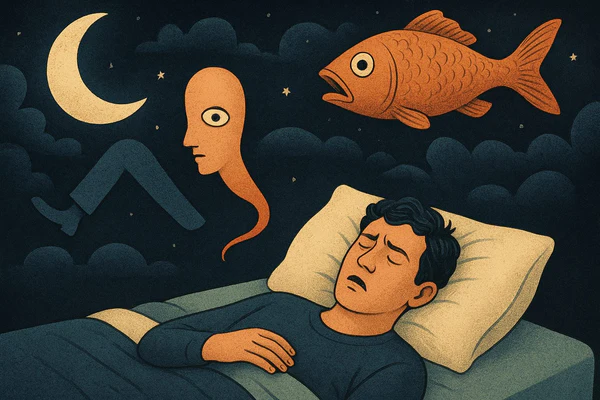
Occasional bizarre dreams are completely normal and not a cause for concern. But certain patterns are worth mentioning to a doctor or sleep specialist.
- Frequent nightmares that disrupt sleep multiple nights a week
- Dreams that consistently cause significant distress upon waking
- Sudden, unexplained changes in dream intensity alongside other symptoms
- Acting out dreams physically during sleep
- Dreams tied to a recent traumatic event that interfere with daily functioning
Key Takeaways
- Dreams feel weird because the brain’s logic center quiets down during REM sleep while emotional and visual centers stay highly active.
- Leading theories suggest dream strangeness may help the brain stay flexible, process emotion, or rehearse threat responses.
- Stress, certain medications, late meals, and pregnancy can all intensify how bizarre dreams feel.
- Occasional weird dreams are a normal, healthy part of sleep, though frequent distressing nightmares are worth discussing with a doctor.

Frequently Asked Questions (FAQs)
Why do dreams feel so illogical compared to real life?
The brain’s logic center, the prefrontal cortex, becomes far less active during REM sleep, removing the filter that normally flags impossible scenarios.
Is it normal to have really bizarre dreams often?
Yes, bizarre dreams are a normal feature of healthy REM sleep and aren’t inherently a sign of a problem.
Why do dreams get weirder later in the night?
REM periods lengthen as sleep progresses, and research shows dreams sampled later in the night tend to be longer, stranger, and more emotionally intense.
Can stress make my dreams weirder?
Yes, elevated cortisol from stress can fragment memory processing during sleep, producing more disjointed and bizarre dream content.
Do dreams have hidden meanings?
Some theories link dream content to emotional processing, but the idea that specific symbols have universal hidden meanings isn’t strongly supported by research.
Why can I fly or breathe underwater in dreams without questioning it?
With the brain’s logical reasoning center quiet during REM sleep, impossible scenarios aren’t flagged as wrong the way they would be while awake.
Does eating before bed cause weird dreams?
Heavy or late meals can delay deep sleep and fragment REM cycles, which may contribute to more vivid or disjointed dreams, though the specific “spicy food” myth has limited scientific support.
Can medication affect how weird my dreams are?
Yes, medications that alter serotonin signaling can shift REM timing and intensity, often changing dream vividness or strangeness.
Why are pregnancy dreams often described as weirder?
Pregnant individuals tend to wake more often and remember more dreams overall, including the naturally strange ones that would usually be forgotten.
What is the overfitting theory of dreams?
It’s a hypothesis suggesting dreams act like intentionally distorted training data, helping the brain stay adaptable rather than becoming too rigidly fixed on daily patterns.
Can alcohol affect dream weirdness?
Yes, especially during withdrawal, when REM sleep can rebound intensely and produce unusually vivid or bizarre dreams.
Are nightmares the same as weird dreams?
Not exactly. Weird dreams are simply bizarre or illogical, while nightmares specifically involve strong negative emotions like fear or distress.
Why do I remember some weird dreams and not others?
Dreams are more likely to be remembered if you wake up during or shortly after REM sleep, which is why later-night dreams are recalled more often.
Can fever cause unusually strange dreams?
Yes, illness and fever are commonly associated with especially vivid and bizarre dream content, likely tied to disrupted sleep architecture.
Is dream journaling helpful for understanding weird dreams?
Yes, consistent dream journaling can help identify patterns and triggers over time, even though it won’t explain every individual dream.
Do all animals have weird dreams like humans?
Research suggests other mammals also experience REM sleep and dream-like brain activity, though we can’t know the subjective content of their dreams.
Why do dreams sometimes feel more real than memories?
The heightened emotional and sensory activity during REM sleep can make dream experiences feel unusually vivid, sometimes rivaling the intensity of real memories.
Can lack of sleep make dreams weirder?
Sleep deprivation can lead to REM rebound once you do sleep, often resulting in longer, more intense, and more bizarre dreams.
Should I be worried if my dreams are extremely bizarre every night?
Occasional bizarre dreams are normal, but if they’re paired with significant distress or sleep disruption, it’s worth discussing with a doctor or sleep specialist.
Can weird dreams be a sign of good sleep quality?
Some research links vivid dream recall to markers of overall wellness, including better sleep quality and a healthier diet.
Conclusion
Weird dreams aren’t a glitch; they’re a natural result of how the brain operates during REM sleep, with logic quieted down and emotion turned up. Leading theories suggest this strangeness may even serve a purpose, helping the brain stay flexible and process emotional experience.
If your dreams start causing real distress or disrupting your sleep on a regular basis, it’s worth mentioning to a doctor. For most people, though, a wildly bizarre dream is simply a normal, healthy part of a good night’s sleep.
