

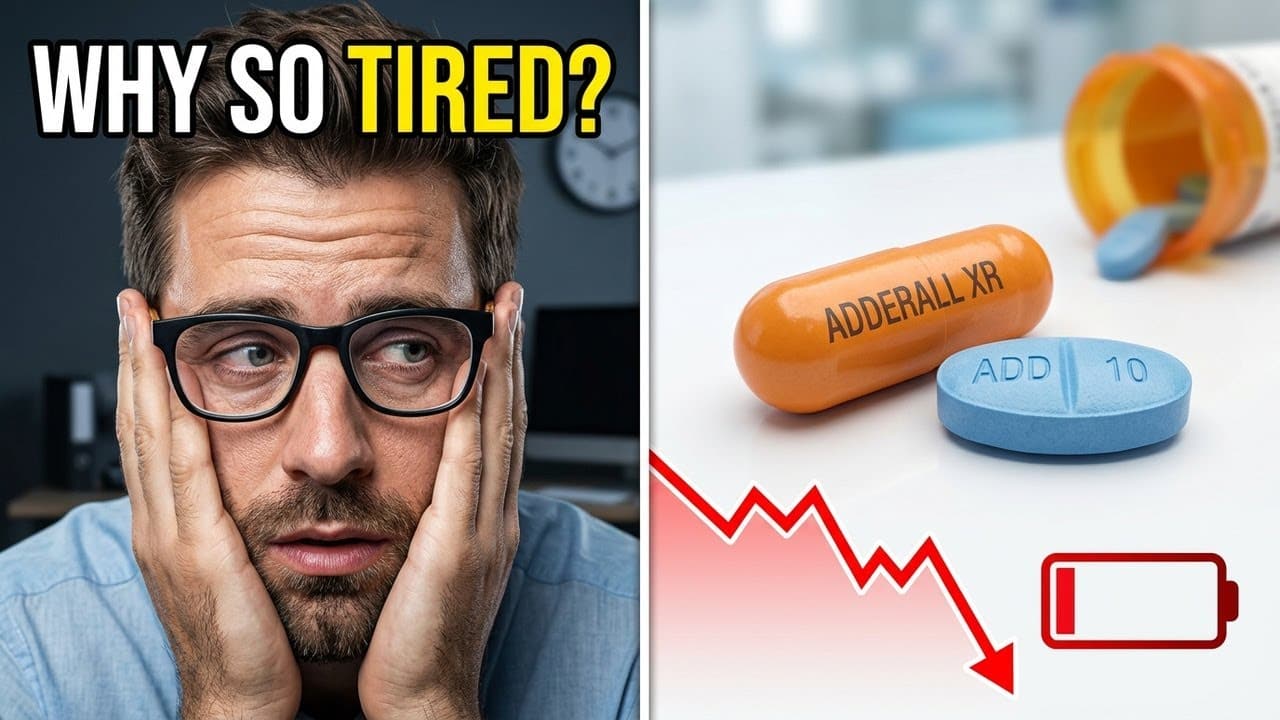
Why does Adderall make me tired when it is supposed to do the exact opposite? If you have ever swallowed a stimulant pill and ended up yawning on the couch an hour later, you are not imagining things.
This paradoxical reaction is a real, documented neurobiological response that affects a measurable percentage of Adderall users.
It is not a sign you are broken or that your diagnosis is wrong.
What Is Adderall and How Is It Supposed to Work?

Adderall is a prescription central nervous system stimulant made from a combination of amphetamine salts — specifically amphetamine and dextroamphetamine. It is primarily prescribed to treat Attention Deficit Hyperactivity Disorder (ADHD) and narcolepsy.
It works by increasing the activity of two key brain chemicals: dopamine and norepinephrine. Dopamine drives motivation, reward, and focus. Norepinephrine handles alertness, attention, and the body’s arousal response.
In a typical brain, this surge of dopamine and norepinephrine creates increased focus, energy, and alertness. In an ADHD brain, the result is often calming and organizing rather than stimulating — which is why the drug works as a treatment.
So Why Does Adderall Make Me Tired?
The short answer: Adderall does not work the same way in every brain. Your brain chemistry, dosage, timing, sleep, diet, and underlying health conditions all interact with the medication in ways that can flip the expected outcome from energizing to exhausting.
There is not just one cause. There are at least eight well-documented reasons why Adderall makes people tired instead of awake. Understanding which one applies to you is the first step toward fixing it.
Reason 1: The Paradoxical Calming Effect in ADHD Brains
This is the most important and most misunderstood reason. People with ADHD often have chronically low levels of dopamine and norepinephrine. Their brains have been running in a state of low-stimulation overload for years — essentially working harder than everyone else just to maintain basic function.
When Adderall raises dopamine to a normal baseline level, the ADHD brain finally gets to rest. The constant mental noise quiets down. That sudden quiet — that neurological calm — can feel like sleepiness to a brain that has never experienced it before.
Think of it like this: if a loud machine in your head has been running nonstop for years, and Adderall finally turns it off, the silence might feel like exhaustion. It is not exhaustion. It is regulation. But your nervous system is not used to it yet.
Reason 2: Wrong Dosage — Too Low or Too High
Dosage is one of the most common and most correctable causes of Adderall fatigue. Both underdosing and overdosing can make you tired — through completely different mechanisms.
Too low a dose: The brain does not receive enough stimulation to manage ADHD symptoms. Without enough dopamine and norepinephrine activation, focus remains scattered and energy stays low. The medication is technically on board but not doing its job.
Too high a dose: The nervous system gets overstimulated. After an intense spike in neurotransmitter activity, the brain essentially crashes. This produces exhaustion, brain fog, emotional flatness, and physical fatigue. It is the neurological equivalent of a power surge followed by a blackout.
Standard starting doses for adults range from 5 to 10 mg, adjusted based on age, body weight, and symptom severity. Finding the right dose often takes several adjustments over weeks or months.
Reason 3: The Adderall Crash — Rebound Fatigue Explained
The Adderall crash is one of the most talked-about causes of medication fatigue. As the drug wears off, dopamine and norepinephrine levels do not just return to baseline — they can temporarily drop below it.
This sub-baseline dip is what causes the crash. During this window, which typically lasts one to two hours after the dose wears off, people report feeling low energy, emotionally flat, irritable, sad, and unusually hungry. It can feel like a minor emotional hangover.
The crash is more intense with immediate-release (IR) Adderall because the drug releases all at once and drops off sharply. Extended-release (XR) Adderall is designed to smooth this curve out over 8 to 12 hours, but a crash can still happen when XR wears off in the afternoon or evening.
Adderall Crash Timeline
| Phase | Timing | Common Symptoms |
|---|---|---|
| Crash onset | 6–8 hours after last dose (IR) | Fatigue, irritability, mood dip |
| Acute crash | Hours 1–3 of coming down | Low energy, emotional flatness, hunger |
| Short recovery | 1–3 days | Improved energy, lingering mood changes |
| Full recovery | 1–3 weeks (if stopping) | Normal baseline energy returns |
Reason 4: Immediate Release vs. Extended Release Timing
Not all Adderall is the same. The two main forms behave very differently in your body, and using the wrong one for your schedule can cause fatigue even when the dose is technically correct.
Adderall IR (Immediate Release) releases its full dose quickly and lasts approximately 4 to 6 hours. This can cause a noticeable energy spike followed by a crash when it wears off. People who take IR often experience that afternoon wall of exhaustion.
Adderall XR (Extended Release) spreads the dose over 8 to 12 hours using a bead system — roughly 50% releases immediately and 50% releases four hours later. This creates a smoother curve and reduces the severity of the crash, but it also means taking it too late in the day can disrupt nighttime sleep.
Poor nighttime sleep caused by late Adderall dosing then creates next-day fatigue. This is a very common cycle that is easy to miss: the medication itself causes sleep disruption, and the sleep disruption causes the tiredness you feel the next day on the medication.
Reason 5: Sleep Deprivation and Accumulated Sleep Debt
This is a cause that gets overlooked constantly. Adderall cannot override chronic sleep deprivation. It is a stimulant, not a replacement for sleep. If you are running on five or six hours of sleep a night, even a well-dosed Adderall will struggle to compensate.
Adults with ADHD are at particularly high risk for sleep problems. ADHD itself interferes with the ability to wind down at night. Adderall can also suppress the brain’s signals to sleep, especially when taken in the afternoon. The result is a cycle:
Adderall disrupts sleep → poor sleep creates fatigue → fatigue makes Adderall feel ineffective → the tiredness is blamed on the medication.
Breaking this cycle requires addressing the sleep problem directly, not just adjusting the medication.
Reason 6: Dehydration and Poor Nutrition
Many Adderall users forget to eat or drink water because the drug suppresses appetite. Dopamine boosted by Adderall convinces the brain it is not hungry — sometimes causing people to skip one or more meals without noticing.
This is a serious problem for energy levels. When the brain runs low on glucose and the body runs low on electrolytes, fatigue sets in hard. Adderall then gets blamed for a tiredness that is actually caused by skipping lunch.
Dehydration makes the situation worse. The stimulant effects of Adderall increase heart rate, breathing rate, and sweating — all of which accelerate fluid loss. Without enough water, the body experiences physiological stress that amplifies fatigue.
Foods and Habits That Impact Adderall Fatigue
| Factor | Effect on Adderall Fatigue | Recommendation |
|---|---|---|
| Skipping meals | Accelerates crash, causes blood sugar drop | Eat every 3–4 hours |
| Dehydration | Amplifies stimulant-related fatigue | Drink 8–10 glasses of water daily |
| High-vitamin C foods/drinks | Reduces Adderall absorption | Avoid citrus juice near dose time |
| Protein-rich breakfast | Stabilizes energy and extends effectiveness | Eat protein before or with morning dose |
| Caffeine | Can worsen crash or overstimulation | Use cautiously, avoid in afternoon |
Reason 7: Underlying Medical Conditions

Sometimes Adderall fatigue is not about the medication at all. It is about an underlying health condition that has not yet been diagnosed or treated. Several conditions mimic ADHD symptoms and also cause fatigue that Adderall cannot fix.
Hypothyroidism is a major one. An underactive thyroid causes low energy, difficulty concentrating, and brain fog — symptoms that look exactly like ADHD. If you have both ADHD and undiagnosed hypothyroidism, Adderall will not fully work and may feel like it is making you tired.
Sleep apnea is another common culprit. Adults with ADHD have a significantly higher rate of undiagnosed sleep apnea. If you stop breathing repeatedly during the night, no amount of Adderall can fix the exhaustion that results.
Anxiety and depression also co-occur with ADHD at high rates. Both conditions cause fatigue as a primary symptom. When Adderall raises dopamine and norepinephrine, it can temporarily reduce anxiety or depression — but then as it wears off, the rebound of those mood symptoms feels like medication-induced fatigue.
Medical Conditions That Can Cause Adderall-Related Fatigue
| Condition | How It Mimics Adderall Fatigue | What to Do |
|---|---|---|
| Hypothyroidism | Low energy, brain fog, difficulty focusing | Request thyroid panel from doctor |
| Sleep apnea | Daytime exhaustion despite sleep | Sleep study referral |
| Anemia | Low energy, difficulty concentrating | Blood test for iron and CBC |
| Anxiety disorder | Emotional crash after stimulant wears off | Mental health evaluation |
| Depression | Fatigue, low motivation, brain fog | Combined treatment approach |
Reason 8: Comorbid Anxiety and Emotional Over-Regulation
When Adderall works on an anxious brain, something unexpected can happen. The stimulant temporarily suppresses the emotional hyperactivity that drives anxiety. For a few hours, the person feels unusually calm and even — perhaps calmer than they have ever felt. This calm can register as fatigue.
Then, when the medication wears off, the anxiety rebounds. The contrast between medicated calm and unmedicated anxiety feels like an energy crash, even though it is really just the return of a baseline that was already exhausting.
This is why co-treating ADHD and anxiety often leads to better outcomes on Adderall. Addressing the anxiety separately — through therapy, lifestyle, or non-stimulant medication — can dramatically reduce the perceived fatigue from Adderall.
How ADHD Brains Experience Adderall Differently Than Neurotypical Brains
Stimulants affect ADHD and neurotypical brains in fundamentally different ways. In neurotypical people, Adderall causes a significant increase in energy, alertness, and even euphoria — because their baseline dopamine levels are already adequate and the drug pushes them well above it.
In ADHD brains, dopamine is chronically low. Adderall raises it toward normal, not above normal. The result is regulation, not stimulation. That is why so many ADHD patients describe Adderall as feeling like “finally being able to think clearly” rather than “feeling energetic.” And for some, that regulated state is so different from their hyperactive norm that it reads as tiredness.
This is not a malfunction. It is the medication working as intended. But it does mean that the ADHD experience of Adderall is fundamentally different from what non-ADHD people expect based on stimulant descriptions.
Adderall IR vs. XR: Which One Causes More Fatigue?
| Feature | Adderall IR | Adderall XR |
|---|---|---|
| Release mechanism | All at once | 50% immediate, 50% delayed |
| Duration | 4–6 hours | 8–12 hours |
| Crash severity | Higher — sharper drop-off | Lower — smoother decline |
| Best for | Flexible scheduling, top-up dosing | All-day coverage, fewer crashes |
| Fatigue risk | Higher rebound fatigue | Higher sleep disruption if taken late |
How to Fix Adderall Fatigue — Practical Steps
Knowing the cause is half the battle. Here are the most effective, evidence-backed strategies for reducing or eliminating Adderall-related fatigue.
Talk to Your Doctor About Your Dose
Never adjust your Adderall dose on your own. But do track your symptoms carefully and report them. Your doctor can lower the dose to reduce over-stimulation crashes, raise it to address under-stimulation fatigue, switch from IR to XR for a smoother profile, or add a small afternoon booster dose to prevent the late-day crash.
Take Adderall at the Right Time
Timing is a powerful variable that many people underestimate. Taking your dose as early as possible in the morning — ideally before 9 AM — reduces the chance of it disrupting nighttime sleep. Better nighttime sleep means less next-day fatigue.
If you are taking XR, remember it can stay active until early evening. A 7 AM dose of XR may not fully clear your system until 7 PM. If you are trying to sleep at 10 PM, that leaves only three hours of wind-down time.
Eat and Drink Water on a Schedule
Do not wait to feel hungry or thirsty on Adderall — by then, your blood sugar and hydration are already low. Set reminders to eat a balanced meal every 3 to 4 hours and to drink a glass of water every hour.
Prioritize protein in your morning meal. Protein slows the absorption of the drug into the bloodstream, which helps prevent the spike-and-crash cycle. Avoid high-vitamin-C foods and drinks like orange juice near dosing time, as vitamin C can reduce how much of the drug is absorbed.
Fix Your Sleep First
This step is non-negotiable. Before any medication adjustment is going to work, your sleep has to be addressed. Aim for 7 to 9 hours of sleep in a consistent window every night. Keep screens out of the bedroom. Set a wind-down routine that starts at the same time each evening.
If you suspect sleep apnea or another sleep disorder, tell your doctor and request a sleep study. This is especially important for adults with ADHD, who have a statistically higher rate of undiagnosed sleep disorders.
Consider Non-Stimulant Alternatives
If fatigue persists despite every adjustment, your doctor may recommend switching to a non-stimulant ADHD medication. Options include Strattera (atomoxetine), which selectively inhibits norepinephrine reuptake without the dopamine spike-and-crash cycle, and Qelbree (viloxazine), a newer non-stimulant that works on both norepinephrine and serotonin pathways.
Methylphenidate-based medications like Ritalin and Concerta work through slightly different mechanisms than Adderall and may cause less fatigue for some people. Switching medication class — not just adjusting dose — is sometimes the right answer.
When Should You Call Your Doctor About Adderall Fatigue?
Some fatigue in the first few weeks of Adderall is normal as your body adjusts. But certain signs mean you should reach out to your prescribing doctor without waiting.
Call your doctor if: fatigue is so severe it interferes with daily function, the tiredness does not improve after 2 to 4 weeks, you also experience chest discomfort or rapid heart rate, you feel emotionally flat or depressed most of the day, or you are sleeping significantly more than usual.
Extreme or persistent fatigue is not a normal side effect. It is a signal that something in your treatment plan needs to change — not something to push through indefinitely.
Stats and Numbers: How Common Is Adderall Fatigue?

The numbers help frame how widespread this issue actually is.
| Population | Rate of Fatigue on Adderall |
|---|---|
| Children in clinical trials | 2%–4% |
| Adults in clinical trials | ~6% |
| Adults with comorbid anxiety | Higher than average |
| People using incorrect dose | Significantly higher |
| People with poor sleep habits | Significantly higher |
Fatigue is one of the recognized but less common side effects of Adderall. It is worth noting that these clinical trial numbers likely underrepresent real-world rates because they do not account for dosing errors, lifestyle factors, or undiagnosed comorbidities.
Adderall Fatigue vs. Adderall Crash — What Is the Difference?
These two terms describe related but distinct experiences that are often confused.
Adderall fatigue refers to tiredness that occurs while the medication is still active in your system. It happens during the medicated period itself and suggests the drug is not working as expected — possibly due to paradoxical reaction, wrong dose, or lifestyle factors.
Adderall crash refers to the rebound fatigue that occurs as the medication wears off. It is a predictable physiological event caused by the temporary sub-baseline drop in dopamine and norepinephrine after stimulation ends.
Understanding which one you are experiencing helps you and your doctor identify the right solution. Fatigue during the dose suggests a dose or brain chemistry issue. Fatigue after the dose wears off suggests a timing, formulation, or lifestyle issue.
Does Adderall Fatigue Go Away Over Time?
For many people, yes — with the right adjustments. The body does adapt to ADHD stimulants over time. Initial side effects, including some forms of fatigue, often improve or disappear within the first two to four weeks as your nervous system calibrates to the new baseline.
However, if fatigue persists beyond the first month or returns after initially resolving, it is not something to wait out. Persistent fatigue is a signal to re-evaluate. It does not go away on its own — it requires an active adjustment to dosage, timing, lifestyle, or medication type.
Summary: All the Reasons Adderall Makes You Tired
| Cause | Explanation | Most Likely Fix |
|---|---|---|
| Paradoxical ADHD response | Brain calms down — feels like sleep | Give it 2–4 weeks; reassess with doctor |
| Dose too low | Not enough stimulation to stay alert | Dose increase under doctor supervision |
| Dose too high | Overstimulation leads to crash | Dose reduction |
| Adderall crash (rebound) | Sub-baseline dopamine after wear-off | Switch to XR or adjust timing |
| Sleep deprivation | Stimulant cannot override sleep debt | Fix sleep hygiene first |
| Dehydration and skipped meals | Energy drops fuel the crash | Eat and drink on schedule |
| Underlying medical conditions | Thyroid, sleep apnea, anemia | Get tested, treat root cause |
| Anxiety or depression rebound | Emotional crash as dose wears off | Treat comorbidities alongside ADHD |
Frequently Asked Questions (FAQs)
Why does Adderall make me tired instead of energetic?
Adderall can cause a paradoxical calming effect in ADHD brains, bring dopamine to a regulated baseline that feels like rest, or trigger a crash as it wears off — all of which produce tiredness instead of the expected energy boost.
Is it normal to feel tired on Adderall?
It is uncommon but documented — about 2% to 4% of children and up to 6% of adults in clinical trials reported fatigue on Adderall. If it happens to you, it is a real physiological response, not a personal failure.
Does Adderall fatigue mean my dose is wrong?
Not necessarily. A wrong dose is one possible cause, but fatigue can also stem from the paradoxical ADHD brain response, poor sleep, dehydration, skipped meals, or an underlying medical condition like hypothyroidism or sleep apnea.
How long does the Adderall crash last?
A typical Adderall crash lasts one to three hours for the initial rebound period, with lingering fatigue and mood changes potentially lasting one to three days depending on dose, frequency of use, and individual metabolism.
Should I take a higher dose if Adderall makes me tired?
Not without talking to your doctor first. Both too low and too high a dose can cause fatigue through different mechanisms — increasing the dose on your own could make things significantly worse. Always adjust with medical supervision.
Does Adderall XR cause less fatigue than IR?
Adderall XR typically produces a smoother energy curve with less severe crashes due to its gradual release mechanism. However, it can still disrupt sleep if taken too late in the day, which creates its own cycle of fatigue.
Can skipping meals cause Adderall to make me tired?
Yes. Adderall suppresses appetite, which can cause people to skip meals without noticing. Low blood sugar and dehydration accelerate the energy crash and are a very common and easily fixed cause of Adderall fatigue.
Can anxiety make Adderall fatigue worse?
Yes. When Adderall temporarily suppresses anxiety symptoms and then wears off, the returning anxiety feels like an energy crash. Treating anxiety as a separate condition alongside ADHD often significantly reduces this cycle.
Is there a medication that works like Adderall but without the fatigue?
Yes. Non-stimulant options like Strattera (atomoxetine) and Qelbree (viloxazine) avoid the dopamine spike-and-crash cycle. Methylphenidate-based medications like Ritalin may also cause less fatigue for some patients. Discuss options with your prescriber.
When should I see a doctor about Adderall fatigue?
See your doctor if fatigue is severe or ongoing after 2 to 4 weeks, if it is interfering with daily function, or if it is accompanied by emotional flatness, chest discomfort, or unusual mood changes. Persistent fatigue is not a side effect to push through.
Conclusion
Why does Adderall make me tired? The honest answer is that it depends — on your brain, your dose, your sleep, your diet, and your underlying health.
For people with ADHD, the calming effect of dopamine regulation can feel like drowsiness when it is actually the brain finally functioning at baseline.
For others, the crash after the dose wears off is the real culprit. Dehydration, skipped meals, poor sleep, and undiagnosed conditions like thyroid disorders or sleep apnea can all amplify the effect.
The good news is that Adderall fatigue is almost always fixable. Whether the solution is a dose adjustment, a timing change, switching from IR to XR, eating on a schedule, or treating a comorbid condition, there is a clear path forward. You do not have to accept exhaustion as a permanent side effect.
Work closely with your prescribing doctor, track your symptoms, and address lifestyle factors alongside your medication. With the right plan in place, most people find a version of Adderall treatment that supports energy, focus, and well-being without the unwanted crash.
