

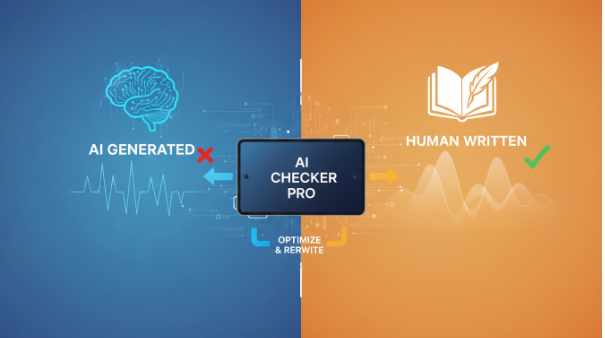
AI makes writing faster, but speed often hides a new kind of friction. Drafts look finished long before they feel trustworthy. Writers reread, hesitate, and sense that something is slightly off—too balanced, too smooth, too predictable. Dechecker is built for that moment. It helps writers test how their text reads to others and reshape it until it sounds deliberate, human, and ready to stand on its own.
When Writing Feels Polished but Not Convincing
The Quiet Gap Between Draft and Approval
Many AI-assisted drafts fail silently. They are not rejected outright; they simply stall. A manager asks for “one more pass.” An editor flags tone without specifics. A teacher requests clarification that the writer thought was already there.
This gap is where an AI Checker becomes relevant. It gives writers an external signal before real reviewers weigh in, revealing whether hesitation is likely to appear.
Why Intuition Alone No Longer Scales
Experienced writers trust their instincts, but AI introduces unfamiliar patterns. Sentence rhythm becomes uniform. Transitions smooth over uncertainty instead of exploring it. Intuition still matters, but it needs calibration.
Dechecker provides that calibration by showing how text behaves under analysis rather than assumption.
Detection as a Reading Simulation
The value of checking is not the score itself. It is the simulation of a skeptical reader. Writers see where attention might drift or doubt might form, and they can respond before the text leaves their hands.
Writing First, Correcting Second
Letting the Draft Breathe
Strong workflows do not begin with checking. Writers start by getting ideas down quickly, often using AI to outline or expand. The goal is momentum, not perfection.
Only after the draft exists does evaluation begin. This separation keeps creativity intact and prevents premature self-editing.
Reading With Distance
Running text through an AI Checker creates distance. Writers stop defending sentences and start observing them. Patterns emerge that were invisible during drafting.
That distance turns revision into analysis rather than anxiety.
Learning Without Memorizing Rules
There is no checklist to follow. Over time, writers notice which phrasing styles consistently raise signals. They adjust naturally, without memorizing artificial rules.
Judgment develops through repetition, not instruction.
Editing That Respects the Original Idea
Fixing Texture, Not Meaning
Most AI-assisted text does not need new ideas. It needs texture. Slight irregularities, moments of emphasis, or a clearer stance often resolve issues faster than wholesale rewrites.
Dechecker highlights where texture is missing so writers can intervene selectively.
Where Human Voice Actually Shows Up
Voice is not decoration. It appears in choices—what to expand, what to skip, where to slow down. AI tends to flatten those decisions.
By revising with intent, writers restore the small asymmetries that signal human authorship.
Humanization Without Overcorrection
Heavy rewriting often creates new problems. Overly casual phrasing or forced quirks can feel artificial in their own way.
The AI Humanizer supports controlled adjustment. Writers refine cadence and tone while keeping the original structure and argument intact.
Academic Work Under Scrutiny
Students Using AI as a Starting Point
Most students use AI to get unstuck, not to bypass thinking. They generate drafts quickly, then struggle to make the work feel like their own.
An AI Checker allows them to compare the draft against expectations before submission and revise consciously.
Revision as Part of Understanding
When students rework AI-generated explanations, they engage with the material. They add examples, clarify steps, and correct assumptions.
The process reinforces learning instead of replacing it.
Reducing Risk Without Increasing Stress
Uncertainty leads to last-minute decisions. Early feedback reduces that pressure. Students submit with confidence rather than hope, knowing how the text is likely to be received.
Content Teams and Repetition at Scale
When Volume Reveals Patterns
One article rarely raises alarms. Fifty written the same way do. At scale, AI tendencies become obvious, even if each piece looks fine alone.
An AI Checker helps teams identify structural repetition before readers or algorithms do.
Editors Regain Focus
When drafts arrive already calibrated, editors spend less time on tone corrections and more time on substance. Conversations shift back to ideas, clarity, and usefulness.
That change improves both output quality and team morale.
Authority Comes From Specificity
Generic smoothness weakens authority. Readers trust writing that commits to a point of view and moves forward.
By trimming excess balance and filler, writers sound more confident and credible.
Professional Documents Where Decisions Matter
Writing That Represents a Group
Reports, proposals, and policies speak for more than one person. A single automated-sounding section can undermine trust in the whole document.
Checking before circulation protects collective credibility.
Fewer Revisions, Faster Decisions
Review cycles slow down when reviewers hesitate. Not because content is wrong, but because tone feels uncertain.
Dechecker reduces that hesitation early, shortening approval loops.
Responsible AI Use Is Now Visible
Organizations increasingly need to show how AI is used responsibly. Dechecker supports transparent workflows where AI assists but does not replace human judgment.
That balance matters to stakeholders.
Developing Long-Term Writing Judgment
Feedback Shapes Future Drafts
Writers who regularly check their work begin drafting differently. They vary sentence length instinctively and take clearer positions.
The AI Checker becomes a background reference rather than an active step.
Confidence Replaces Guessing
Knowing how text performs removes guesswork. Writers revise with purpose and submit without second-guessing.
That confidence carries into new projects.
Writing That Holds Up Under Reading
The goal is not to hide AI involvement. It is to produce writing that survives real reading—by teachers, editors, clients, or peers.
Dechecker helps writers reach that standard by returning judgment to the center of the process.
Moving From Fast Drafts to Trusted Writing
AI accelerates the start of writing. What defines quality is what happens next. Dechecker creates space for reflection where writers test, adjust, and decide.
With an AI Checker guiding revision, drafts stop feeling generated and start feeling chosen. Writers spend less time defending how they wrote and more time advancing what they want to say.
In environments where credibility decides outcomes, that difference keeps work moving forward.
