

Five letter words with 3 vowels are essential tools for word game enthusiasts and language learners alike.
Whether you’re tackling Wordle puzzles, competing in Scrabble matches, or simply expanding your vocabulary, understanding these vowel-rich words can give you a significant advantage.
In this comprehensive guide, we’ll explore over 300 five-letter words containing three vowels, complete with meanings, strategic usage tips, and practical examples.
From common words like “house” and “alone” to rare gems like “ouija” and “adieu,” you’ll discover everything you need to master these versatile linguistic combinations.
What Are Vowels?
Vowels are the foundation of spoken language, representing sounds produced when air flows freely from the mouth without obstruction. In English, the primary vowels are A, E, I, O, and U, with Y sometimes functioning as a vowel.
Unlike consonants, which require blocking or redirecting airflow with the tongue, lips, or teeth, vowels create open, resonant sounds. These letters form the core of syllables and give words their rhythm and melody.
The English alphabet contains only five standard vowel letters, but they combine to create up to 16 distinct vowel sounds in American English and even more in British and Australian English. This versatility makes vowels crucial for effective communication and word formation.
Understanding Vowel Sounds
Vowels are categorized into two main types: short vowels and long vowels. Short vowels produce quick, clipped sounds like the “a” in “cat” or the “i” in “bit.” Long vowels sound like the letter name itself, such as the “a” in “cape” or the “e” in “Pete.”
Five letter words with 3 vowels often contain both short and long vowel sounds, creating diverse pronunciation patterns. Words like “audio” feature multiple vowel sounds that flow together, while words like “abuse” combine different vowel types.
Understanding these sound patterns helps you identify potential word solutions in puzzles and improves your overall language comprehension. The combination of three vowels in a five-letter word creates unique phonetic possibilities that don’t exist in words with fewer vowels.
Complete List of Five Letter Words With 3 Vowels
Below is an extensive alphabetical list of five letter words containing exactly three vowels. This comprehensive collection includes common everyday words as well as specialized and rare terms.
A Words: Abide, Abies, Abode, Abore, About, Above, Abune, Abuse, Acute, Adieu, Adobe, Adore, Adoze, Aeons, Aerie, Aeros, Afire, Afore, Agile, Agone, Agued, Agues, Aided, Aider, Aides, Aiery, Ailed, Aimed, Aimer, Ainee, Aired, Airer, Aisle, Alien, Alike, Aline, Alive, Aloed, Aloes, Alone, Aloud, Alowe, Alure, Amice, Amide, Amies, Amine, Amole, Amour, Amove, Amuse, Anime, Anole, Apode, Aquae, Argue, Ariel, Arise, Arose, Aside, Aspie, Atone, Audio, Audit, Auger, Aures, Autos, Avoid, Avine, Avise, Awoke, Axile, Axite, Axone, Azine, Azure
B Words: Baize, Beaus, Beaut, Bayou, Bigae, Bijou, Biome, Bogie, Bogue, Bohea, Bonie, Bouge, Boule, Bouse, Bowie
C Words: Cadie, Cameo, Canoe, Cause, Cavie, Ceiba, Ceria, Coate, Cogie, Comae, Coqui, Cosie, Coude, Coupe, Coure, Couta, Coxae, Curie, Curio, Cutie
D Words: Daine, Daube, Deair, Diane, Diode, Dobie, Dogie, Douar, Douce, Doula, Douma, Doura, Douse, Dovie, Dowie, Doxie, Duomi
E Words: Eidos, Elain, Eliad, Eloin, Email, Emoji, Eniac, Ennui, Enoki, Entia, Envoi, Eosin, Equal, Equid, Equip, Erbia, Erica, Erugo, Etuis, Eupad, Euros, Eusol
F Words: Faine, Fakie, Fauve, Feria, Feuar, Fique, Fogie, Folie, Fouat, Fouer, Fouet, Foule, Fovea, Foxie, Fuero, Fugie
G Words: Gauge, Gauje, Gauze, Genoa, Genua, Geoid, Gigue, Gouge, Goura, Guaco, Guano, Guide, Guile, Guiro, Guise
H Words: Haole, Hause, Haute, Helio, Hoise, Homie, Houri, House, Hovea
I Words: Ideal, Ideas, Ileac, Ileal, Ileum, Image, Imbue, Inane, Indue, Inure, Irade, Irate, Irone, Issue
J Words: Jaxie, Joual, Joule, Juice, Juvie
K Words: Kaies, Kehua, Kiore, Koine, Koura
L Words: Laevo, Lehua, Leuco, Liane, Loave, Locie, Logie, Looie, Louie, Louis, Louma, Loupe, Loure, Louse, Lovie, Lutea
M Words: Mahoe, Maile, Maire, Maise, Maize, Mamie, Mauve, Mavie, Media, Meous, Miaou, Mimeo, Mobie, Mohua, Moile, Moire, Monie, Morae, Moues, Mouse, Movie, Moxie, Mulie
N Words: Naevi, Naive, Noise, Noule, Novae, Noyau, Nudie, Nugae
O Words: Oaked, Oaken, Oaker, Oakum, Oared, Oases, Oasis, Oaten, Oater, Oaves, Obeah, Ocean, Ocrea, Odeum, Odium, Offie, Ogive, Oiled, Oiler, Ojime, Oldie, Oleic, Olein, Oleum, Olive, Ollie, Omega, Onium, Oorie, Opera, Opine, Opium, Orate, Oread, Orgue, Oriel, Osier, Otaku, Oubit, Ouija, Oumas, Ounce, Oupas, Ouped, Ourie, Ousel, Outed, Outer, Outre, Outta, Ouzel, Ovate, Ovine, Ovule, Owies, Oxide, Oxies, Oxime
P Words: Paedo, Paeon, Paire, Paise, Pareo, Pareu, Paseo, Patio, Pause, Pelau, Perai, Pieta, Piezo, Pilea, Pious, Pique, Poilu, Poise, Pokie, Porae, Potae, Pouke, Poule, Poupe, Pulao, Pumie, Pupae
Q Words: Quail, Quake, Quale, Quare, Quate, Quean, Quena, Quiet, Quine, Quino, Quipo, Quire, Quite, Quoad, Quoif, Quoin, Quoit, Quota, Quote
R Words: Raile, Raine, Raise, Ramie, Raupo, Reais, Realo, Redia, Reoil, Retia, Rimae, Roate, Rogue, Roque, Rouen, Roues, Rouge, Roule, Rouse, Route, Rowie, Rudie, Rueda, Rugae
S Words: Saice, Saine, Salue, Sauce, Saute, Seiza, Sepia, Serai, Sieur, Soare, Soave, Solei, Souce, Souse, Stoae, Suave, Suite
T Words: Tatie, Tatou, Taube, Tauon, Taupe, Tawie, Tegua, Telia, Tinea, Toaze, Toeas, Togae, Togue, Toile, Toise, Toque, Touse, Touze, Towie, Tozie, Tubae, Tuile
U Words: Ukase, Ulema, Ulnae, Ulyie, Ulzie, Umpie, Union, Unite, Untie, Uptie, Uraei, Uraos, Urare, Urase, Urate, Ureal, Ureas, Uredo, Ureic, Urena, Urine, Urite, Ursae, Usage, Usnea, Uteri, Utile, Uveal, Uveas
V Words: Vague, Vaire, Value, Vaute, Venue, Video, Viola, Vireo, Vitae, Voema, Vogie, Vogue, Voice, Voile, Volae, Vouge
W Words: Waide, Waite, Waive, Walie
X Words: Xenia
Y Words: Youse, Yowie
Z Words: Zaire, Zoaea, Zoeae, Zoeal, Zoeas, Zonae, Zooea, Zowie
Common Five Letter Words With 3 Vowels and Their Meanings
Understanding word meanings enhances your vocabulary and helps you use these words effectively in everyday communication and games.
About: Concerning or regarding a particular subject. Example: “The book is about ancient civilizations.”
Above: At a higher level or position than something else. Example: “The airplane flew above the clouds.”
Abuse: To use something incorrectly or treat someone with cruelty. Example: “Animal abuse is strictly prohibited by law.”
Acute: Sharp, severe, or having a sharp angle less than 90 degrees. Example: “She experienced acute pain in her shoulder.”
Adieu: A farewell expression meaning goodbye. Example: “He bid adieu to his friends before leaving.”
Adobe: Sun-dried brick made from clay and straw, or a building constructed from such materials. Example: “The ancient adobe structures still stand today.”
Adore: To love and respect someone or something deeply. Example: “Children adore their favorite cartoon characters.”
Afire: Burning or ablaze with flames or passion. Example: “The forest was afire during the dry season.”
Agile: Able to move quickly and easily with grace. Example: “The gymnast’s agile movements impressed the judges.”
Aisle: A passage between rows of seats or shelves. Example: “The bride walked down the aisle confidently.”
Alien: From another world or foreign to a particular environment. Example: “Scientists search for alien life forms in space.”
Alike: Similar or resembling each other. Example: “The twin sisters looked exactly alike.”
Alive: Living and not dead; full of energy. Example: “The garden comes alive in spring.”
Alone: Without others; solitary. Example: “She preferred spending time alone reading books.”
Aloud: In a voice that can be heard; not silently. Example: “Please read the passage aloud to the class.”
Amuse: To entertain or make someone laugh. Example: “The comedian’s jokes amuse audiences worldwide.”
Anime: Japanese animated productions featuring colorful graphics. Example: “Anime has gained popularity across the globe.”
Argue: To give reasons for or against something; to dispute. Example: “They often argue about political issues.”
Arise: To emerge or come into existence. Example: “Problems may arise during the project.”
Arose: Past tense of arise; came into being. Example: “A new opportunity arose unexpectedly.”
Aside: To one side; away from the main topic. Example: “He pulled her aside to speak privately.”
Atone: To make amends for wrongdoing. Example: “He tried to atone for his mistakes.”
Audio: Related to sound or the reproduction of sound. Example: “The audio quality of the recording is excellent.”
Audit: An official examination of accounts or records. Example: “The company underwent a financial audit.”
Avoid: To keep away from or prevent from happening. Example: “Try to avoid eating too much sugar.”
Awoke: Past tense of awake; stopped sleeping. Example: “She awoke to the sound of birds singing.”
Azure: A bright blue color like a cloudless sky. Example: “The azure waters looked inviting.”
Cause: The reason something happens; to make something occur. Example: “Poor maintenance was the cause of the accident.”
Email: Electronic mail sent through computer networks. Example: “Please send me an email with the details.”
Equal: The same in quantity, size, or value. Example: “All participants have equal chances of winning.”
Gauge: To estimate or measure something. Example: “It’s difficult to gauge his true intentions.”
Guide: A person who shows the way or provides advice. Example: “The tour guide explained the historical significance.”
House: A building for human habitation. Example: “They bought a beautiful house in the countryside.”
Ideal: Perfect or most suitable. Example: “This location is ideal for a picnic.”
Image: A visual representation or mental picture. Example: “The image captured the sunset perfectly.”
Irate: Extremely angry or furious. Example: “The irate customer demanded a refund.”
Issue: An important topic or problem for debate. Example: “Climate change is a pressing global issue.”
Juice: Liquid extracted from fruits or vegetables. Example: “Fresh orange juice is nutritious and delicious.”
Media: Mass communication channels like television and internet. Example: “Social media influences modern society significantly.”
Mouse: A small rodent or computer pointing device. Example: “The mouse scurried across the kitchen floor.”
Movie: A film or motion picture for entertainment. Example: “We watched an exciting movie last night.”
Naive: Lacking experience or showing innocent simplicity. Example: “His naive approach led to unexpected problems.”
Noise: Unwanted or disturbing sound. Example: “The construction noise disrupted the neighborhood.”
Ocean: A vast body of salt water covering Earth. Example: “The ocean contains incredible biodiversity.”
Opera: A theatrical work combining music and drama. Example: “The opera performance received standing ovations.”
Pause: A temporary stop or break. Example: “Let’s pause for a moment to review.”
Piano: A musical keyboard instrument. Example: “She plays the piano beautifully.”
Pious: Devoutly religious or showing reverence. Example: “The pious monk dedicated his life to prayer.”
Quiet: Making little or no noise; peaceful. Example: “The library remained quiet throughout the day.”
Quota: A limited quantity or fixed share. Example: “Each team must meet their sales quota.”
Quote: To repeat someone else’s words; a price estimate. Example: “She likes to quote famous philosophers.”
Radio: A device for receiving broadcast signals. Example: “They listened to music on the radio.”
Raise: To lift upward or increase in amount. Example: “The company decided to raise employee salaries.”
Sauce: A liquid or semi-liquid condiment for food. Example: “The pasta sauce had a rich, savory flavor.”
Suite: A set of connected rooms or furniture pieces. Example: “They booked a luxurious hotel suite.”
Union: The action of joining or state of being united. Example: “The union negotiated better working conditions.”
Unite: To come or bring together for a common purpose. Example: “Communities must unite against injustice.”
Usage: The way something is used; customary practice. Example: “Proper word usage improves communication skills.”
Value: The importance, worth, or usefulness of something. Example: “Honesty is a value we all should cherish.”
Venue: The location where an event takes place. Example: “The concert venue holds thousands of people.”
Video: Moving visual images, typically with sound. Example: “The promotional video went viral online.”
Voice: The sound produced by speaking or singing. Example: “Her voice echoed through the empty hall.”
Waive: To refrain from insisting on or give up a right. Example: “The company agreed to waive the late fee.”
Best Five Letter Words With 3 Vowels for Wordle
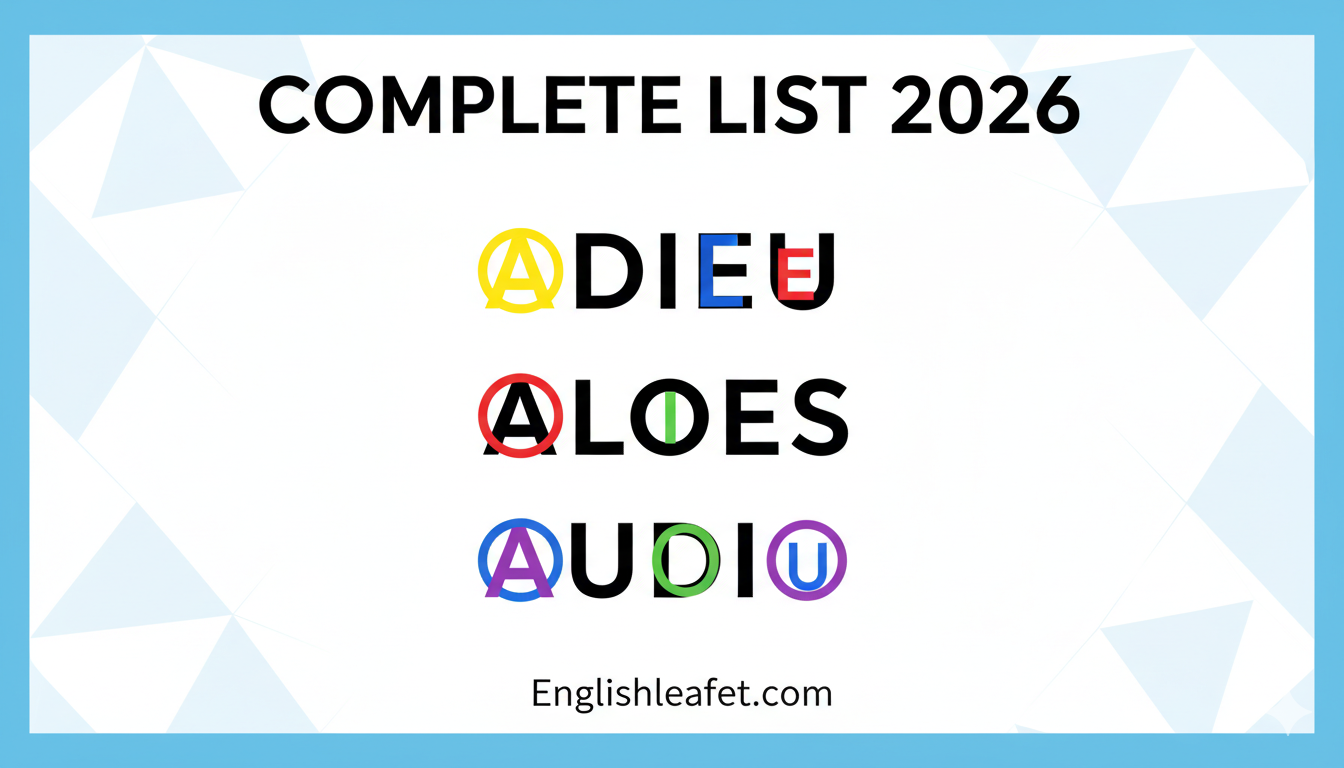
Wordle players constantly seek optimal starting words that maximize vowel coverage while including common consonants. Five letter words with 3 vowels strike the perfect balance for this popular puzzle game.
The ideal Wordle starting word contains three vowels in common positions along with frequently used consonants. Research shows that the most common letters in Wordle answers are E, A, R, O, T, L, I, S, N, and C.
IRATE ranks among the best starting words because it includes three vowels (I, A, E) positioned where they commonly appear in answers. The consonants R and T are also extremely frequent in English words.
RAISE provides another excellent option, covering three vowels (A, I, E) while testing the common consonants R and S. This word helps eliminate or confirm multiple possibilities in your first guess.
AUDIO maximizes vowel coverage with four vowels (A, U, I, O), though technically it includes only three unique vowel letters when considering U and I. The D provides a solid consonant check.
ADORE combines three vowels (A, O, E) with the valuable consonants D and R. This word tests multiple common letter positions effectively.
ARISE mirrors RAISE but with letters in different positions, making it valuable if you prefer testing alternate vowel placements. The S at the end is particularly useful for plural possibilities.
ALONE offers three vowels (A, O, E) with the common consonants L and N. This word works well as a second guess after gathering initial information.
ATONE provides similar vowel coverage to ALONE but with the common T consonant. Use this when you’ve already eliminated L or N.
ABOUT includes three vowels (A, O, U) with the frequently appearing consonants B and T. This word tests less common vowel combinations.
HOUSE combines three vowels (O, U, E) with the valuable consonants H and S. It’s particularly effective when you suspect the answer contains U.
QUOTE features three vowels (U, O, E) along with the common consonants Q, T, and silent E. This word helps when testing Q-words.
Strategic Usage in Word Games
Five letter words with 3 vowels excel in various word games beyond Wordle. Understanding how to deploy these words strategically enhances your competitive edge.
In Scrabble, vowel-heavy words help clear your rack of difficult-to-use letters. Words like AUDIO, ADIEU, and OUIJA can earn respectable points while freeing up space for higher-scoring consonant combinations.
Scrabble players should focus on words that use common letter tiles efficiently. RAISE scores well due to common letter frequency, while AZURE benefits from the high-value Z tile.
For Words With Friends, similar strategies apply. Target words that maximize point values while managing your vowel-to-consonant ratio effectively.EQUIP and QUIET work well when you draw Q without U combinations.
Crossword puzzles often require five letter words with 3 vowels to complete intersecting entries. Familiarizing yourself with common patterns helps solve puzzles faster. Words ending in -OUSE (HOUSE, MOUSE, ROUSE) or -AISE (RAISE, PRAISE) appear frequently.
In competitive word games, knowing obscure three-vowel words provides significant advantages. Terms like URAEI (plural of uraeus), ZONAE (plural of zona), or TOGAE (plural of toga) can catch opponents off guard.
Vowel Combination Patterns
Understanding common vowel patterns in five letter words with 3 vowels helps predict word possibilities and improves your linguistic intuition.
A-E-I Combinations: Words like RAISE, FAIRE, and AISLE demonstrate this popular pattern. The A and I often appear in the middle positions, with E at the end.
A-E-O Combinations: ADOBE, ATONE, and PAREO showcase this versatile pattern. These words frequently place O in the middle or second position.
A-I-O Combinations: RADIO, PATIO, and RATIO exemplify this arrangement. The I typically falls between A and O in these formations.
A-E-U Combinations: CAUSE, SAUCE, and GAUGE demonstrate this less common but valuable pattern. The U usually appears in the third or fourth position.
E-I-O Combinations: VIDEO, SERIO, and POISE show this melodious vowel arrangement. These words often have E at the start or end.
E-O-U Combinations: ROGUE, VOGUE, and ROUGE illustrate this sophisticated pattern. The O and U typically occupy central positions.
I-O-U Combinations: PIOUS, BIJOU, and BAYOU demonstrate rare triple-vowel sequences. These words often have unique pronunciations and origins.
A-I-E with Silent E: ALIVE, AMUSE, and ARISE show this common English pattern where the final E is silent but creates a long vowel sound.
O-U-E Pattern: HOUSE, MOUSE, and ROUSE utilize this frequent ending. The U and E work together to create specific vowel sounds.
Diphthongs: Words like NOISE, VOICE, and POISE contain vowel pairs that blend into single sounds, creating unique phonetic properties.
Etymology and Word Origins
Many five letter words with 3 vowels have fascinating linguistic histories that reveal the rich tapestry of English language development.
ADIEU comes from French, literally meaning “to God,” and entered English as a formal farewell expression. Its four vowels make it memorable despite having only five letters total.
ANIME derives from Japanese animation and represents a relatively recent addition to English vocabulary, reflecting cultural globalization and modern entertainment influences.
AUDIO originates from Latin “audire,” meaning “to hear.” This root appears in numerous English words related to sound and hearing.
BAYOU entered English from Louisiana French, ultimately deriving from Choctaw “bayuk,” meaning a marshy outlet of a lake or river. It reflects American regional linguistic diversity.
CANOE came to English from Spanish “canoa,” which originated from Arawakan languages of the Caribbean, demonstrating the impact of exploration and indigenous languages.
GAUGE evolved from Old North French “gauger,” related to measuring and standardization. Its unusual spelling preserves historical pronunciation patterns.
GUANO derives from Spanish, originating from Quechua “wanu,” meaning fertilizer. This word shows how agricultural trade introduced specialized terms into English.
NAIVE entered English from French “naïve,” ultimately from Latin “nativus,” meaning natural or innate. The diaeresis (two dots) is often dropped in English spelling.
OUIJA represents a trademarked name combining French “oui” (yes) and German “ja” (yes), created for the spiritual board game in the 19th century.
PIANO shortened from Italian “pianoforte,” meaning “soft-loud,” describing the instrument’s dynamic range. Musical terminology contributed many words to English.
QUOTA comes from Medieval Latin “quota pars,” meaning “how large a part,” and entered English through commercial and administrative contexts.
SAUTE borrowed from French “sauté,” meaning “jumped,” describes the cooking technique where ingredients jump in the pan. Culinary terms enriched English vocabulary substantially.
Regional and Specialized Vocabulary
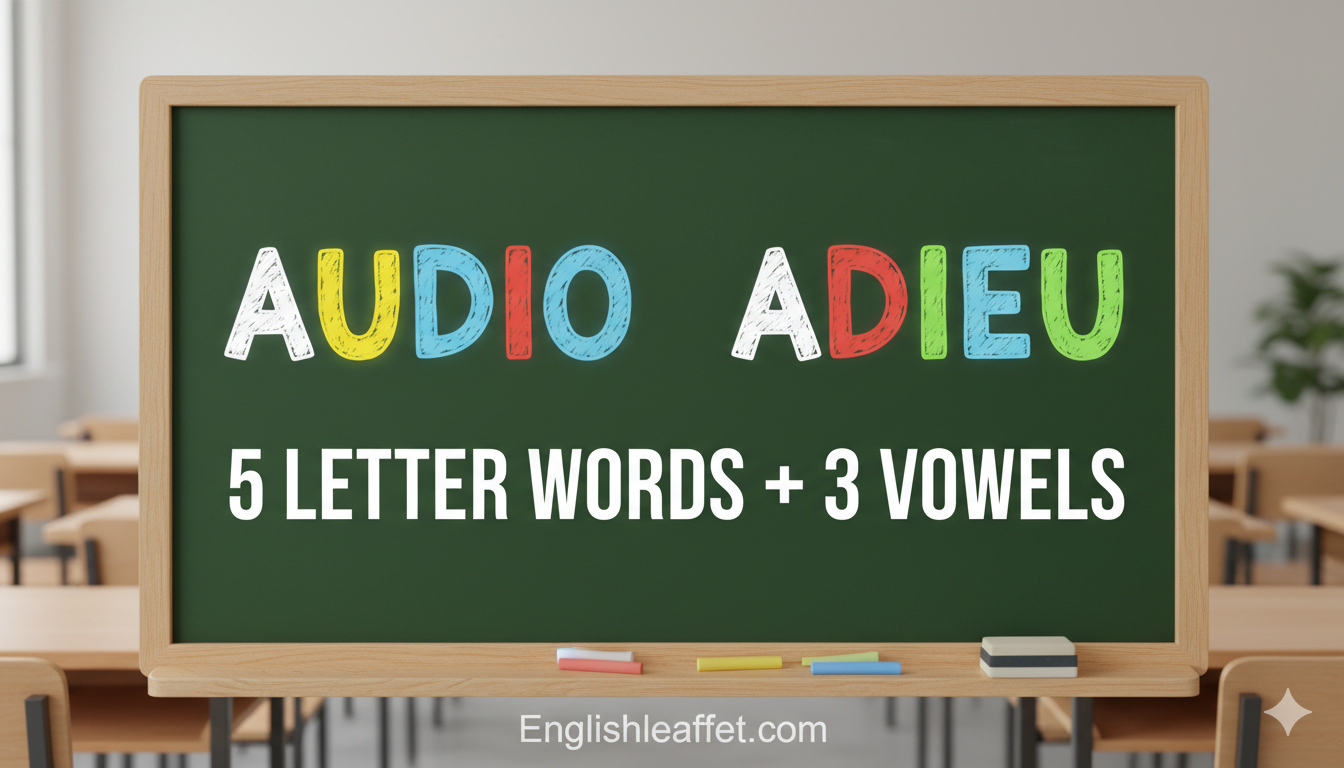
Some five letter words with 3 vowels belong to specialized fields or regional dialects, adding diversity to English language usage.
Medical Terms: AURAL (relating to hearing), UVEAL (relating to the uvea of the eye), and TENIA (anatomical term) demonstrate scientific precision in language.
Musical Vocabulary: OPERA, PIANO, and AUDIO relate directly to musical production and appreciation, showing how arts influence everyday language.
Geographical Terms: BAYOU (Southern U.S. waterway), OASIS (desert water source), and ATOLL (coral island) describe specific natural features with precise meanings.
Botanical Words: ALGAE, OAKUM (loose fiber), and VIOLA (flowering plant) show how nature study contributes specialized vocabulary.
Cultural Terms: ANIME (Japanese animation), TOILE (decorative fabric), and SAREE (traditional garment) reflect global cultural exchanges.
Technical Jargon: EMAIL, MEDIA, and VIDEO represent modern technological terminology that has become mainstream within decades.
Archaic Usage: Words like OLDEN, OAKEN, and OLDIE preserve older English forms, though some remain in common use with evolved meanings.
Legal Language: WAIVE (relinquish rights) and INURE (take effect) demonstrate how legal precision requires specific terminology.
Culinary Terms: SAUTE, SAUCE, and JUICE show how food preparation and consumption drive linguistic development across cultures.
Maritime Vocabulary: CANOE, KAYAK (though only four letters), and OCEAN relate to water-based activities and exploration history.
Pronunciation Guide for Tricky Words
Some five letter words with 3 vowels present pronunciation challenges due to silent letters, unusual vowel combinations, or foreign origins.
ADIEU (ah-DYOO): The final U creates a unique sound, and the EU combination is pronounced as a long U.
BAYOU (BUY-oo): The AY creates a long I sound, followed by an OO sound, reflecting French Louisiana pronunciation.
GAUGE (GAYJ): The AU creates a long A sound, while the UE is silent, making pronunciation counterintuitive to spelling.
NAIVE (nah-EEV): The AI creates an AH sound, and the final E is pronounced as a long E, following French origins.
QUEUE (KYOO): Despite having four vowels, this word is pronounced as a single syllable with a long U sound.
OUIJA (WEE-jah): The OU creates a W sound, making this word’s pronunciation entirely different from its spelling appearance.
SAUTE (saw-TAY): The AU creates an AW sound, and the E adds an AY ending, following French pronunciation rules.
PIOUS (PY-us): The I creates a long I sound, making this a two-syllable word despite its compact spelling.
AUDIO (AW-dee-oh): Each vowel maintains distinct pronunciation, creating three clear syllables.
LIAISE (lee-AYZ): Though six letters, this word shows how multiple vowels interact in modern English borrowings from French.
Five Letter Words With 3 Vowels in Literature
These vowel-rich words appear frequently in literature, journalism, and creative writing, serving various stylistic and functional purposes.
Classic literature employs words like AROSE, ALONE, and ABUSE to convey emotional depth and narrative progression. Jane Austen frequently used ABOUT in her social commentaries and character descriptions.
Modern journalism relies on words like MEDIA, VIDEO, and AUDIO to describe contemporary communication methods. These terms have become indispensable in 21st-century writing.
Poetry benefits from the melodious quality of three-vowel words. AZURE, AGILE, and ALIVE create pleasing rhythmic patterns that enhance verse structure and flow.
Technical writing incorporates specialized terms like GAUGE, RATIO, and AUDIT to maintain precision. These words convey specific meanings essential for clear communication.
Children’s literature uses simple three-vowel words like HOUSE, MOUSE, and NOISE to build early reading skills. The vowel repetition aids phonetic learning.
Learning and Memory Techniques
Mastering five letter words with 3 vowels requires effective study strategies and memory aids that enhance retention and recall.
Categorization Method: Group words by vowel combinations (A-E-I, A-E-O, E-I-O) to recognize patterns. This systematic approach helps predict spellings and improves recall speed.
Flashcard Practice: Create digital or physical flashcards with the word on one side and definition plus example sentence on the other. Review regularly for reinforcement.
Mnemonic Devices: Develop memory tricks for difficult spellings. For GAUGE, remember “Generally Accurate Useful Gauging Equipment.”
Word Association: Connect new words to familiar concepts. Link ADOBE with “a dwelling of brick and earth” to remember both meaning and spelling.
Contextual Learning: Study words in sentences rather than isolation. “The IRATE customer demanded immediate AUDIO evidence” uses both words meaningfully.
Spaced Repetition: Review words at increasing intervals (one day, three days, one week, two weeks) to move information into long-term memory.
Pronunciation Practice: Say words aloud to reinforce auditory memory. The connection between sound and spelling strengthens overall word recognition.
Writing Exercises: Incorporate new words into your daily writing. Practical application solidifies understanding better than passive study.
Word Games: Play Wordle, Scrabble, or crossword puzzles regularly. Game-based learning makes vocabulary building enjoyable and sustainable.
Etymology Exploration: Study word origins to understand why they’re spelled certain ways. Historical context makes spellings more logical and memorable.
Common Mistakes to Avoid
Understanding frequent errors when using five letter words with 3 vowels helps prevent communication mishaps and improves writing accuracy.
Spelling Confusions: GAUGE vs GUAGE is a common error. Remember the A comes before U in GAUGE. Similarly, NAIVE often loses its diaeresis in English but maintains the AI sequence.
Pronunciation Errors: SUITE is often mispronounced as “suit” instead of “sweet.” PIOUS should be two syllables (PY-us), not three.
Vowel Position Mistakes: When writing RAISE, ensure I comes before the final E. ARISE follows the same pattern but starts with A.
Homophone Confusion: PAUSE (stop) vs PAWS (animal feet) sound similar but have completely different meanings and spellings.
Silent Letter Oversight: GAUGE has a silent U that many forget when spelling. QUEUE contains four vowels but only the first two contribute to pronunciation.
Plural Formation Errors: Some words form unusual plurals. MOUSE becomes MICE, not MOUSES. QUOTA becomes QUOTAS regularly.
Context Misuse: WAIVE (relinquish) vs WAVE (hand gesture or ocean motion) requires attention to context despite similar pronunciation.
Apostrophe Mistakes: IT’S vs ITS confusion affects many three-vowel words. Remember IT’S means “it is” while ITS is possessive.
Capitalization Errors: OUIJA should be capitalized as a proper noun when referring to the brand name board game.
Tense Formation: ARISE becomes AROSE (not ARISED) in past tense. Irregular verbs require memorization rather than rule application.
Frequently Asked Questions
What are five letter words with 3 vowels?
Five letter words with 3 vowels are words containing exactly three vowel letters (A, E, I, O, U) and two consonants. Examples include AUDIO, HOUSE, RAISE, ADORE, and MEDIA.
How many five letter words contain exactly three vowels?
There are over 300 common five letter words containing exactly three vowels in English. This includes everyday words like ABOUT and ALONE, as well as specialized terms like OUIJA and URAEI.
What is the best five letter word with 3 vowels for Wordle?
IRATE, RAISE, and AUDIO are excellent Wordle starting words with three vowels. They test common vowel positions while including frequently used consonants like R, T, and S that appear in many answers.
Can you name five letter words with three vowels in alphabetical order?
Words with vowels in alphabetical order include CANOE (A-E-O), CAUSE (A-E-U), and ADIEU (A-E-I-U). These words contain vowels that appear in standard alphabetical sequence.
What five letter words have all different vowels?
ADIEU and AUDIO contain four different vowels in five letters. However, for exactly three different vowels, words like RAISE (A-I-E), HOUSE (O-U-E), and MEDIA (E-I-A) work perfectly.
Are there five letter words with three consecutive vowels?
Yes, words like QUEUE (UEUE pattern), though it has four vowels total. For exactly three consecutive vowels, consider LOOIE or specialized terms from other languages adopted into English.
Which five letter words with 3 vowels score highest in Scrabble?
AZURE (with the high-value Z) scores 14 points. EQUIP and QUIET both score well due to the Q tile. OXIDE, GAUZE, and FROZE also provide good point opportunities.
What are common ending patterns for five letter words with 3 vowels?
Common endings include -OUSE (HOUSE, MOUSE, ROUSE), -AISE (RAISE, PRAISE), -OICE (VOICE, CHOICE), and -AGUE (VAGUE, LEAGUE). These patterns appear frequently in English.
How do you improve at finding five letter words with 3 vowels?
Practice word games like Wordle and Scrabble regularly. Study vowel combination patterns (A-E-I, E-I-O, A-O-U). Use flashcards for memorization and read extensively to encounter words naturally in context.
What percentage of five letter words contain three vowels?
Approximately 15-20% of five letter words contain exactly three vowels. This makes them common enough for practical use but rare enough to be strategically valuable in word games and puzzles.
Conclusion
Five letter words with 3 vowels represent a fascinating and practical subset of English vocabulary that serves multiple purposes for language enthusiasts, students, and game players.
Throughout this comprehensive guide, we’ve explored over 300 words, from everyday terms like HOUSE and ABOUT to specialized vocabulary like URAEI and TOGAE.
These vowel-rich words offer strategic advantages in Wordle, Scrabble, and crossword puzzles while simultaneously expanding your linguistic repertoire.
Understanding vowel combinations, pronunciation patterns, and etymological origins enriches your appreciation for language complexity and evolution.
