

Tone definition literary term refers to the author’s attitude toward their subject matter or audience expressed through word choice, sentence structure, and literary devices.
Understanding tone in literature helps readers grasp the deeper meaning behind written works.
Every successful writer masters tone to create emotional connections with their audience.
This comprehensive guide breaks down everything you need to know about literary tone with practical examples.
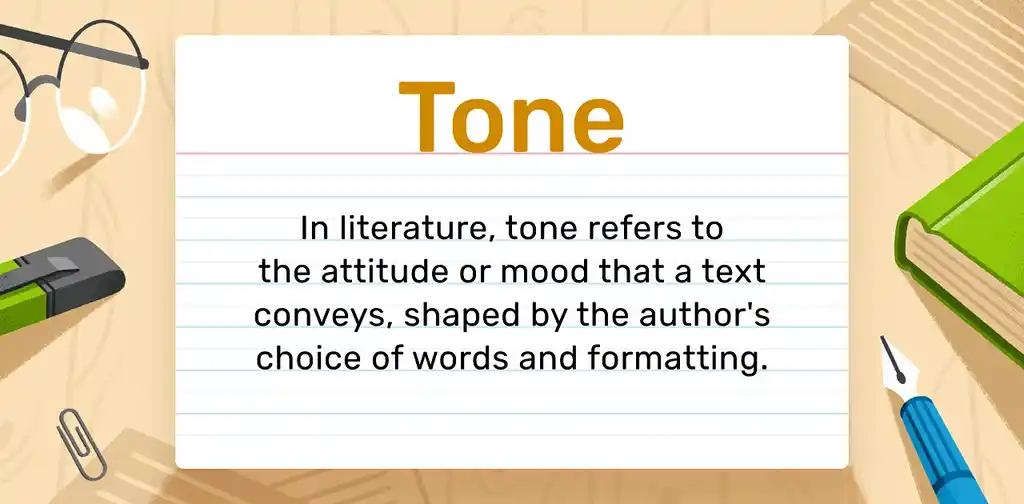
What is Tone in Literature?
Tone in literature represents the author’s emotional stance toward their topic or readers.
Think of tone as the “voice” behind the words on the page.
Just like when you speak to someone, your tone reveals your feelings about what you’re discussing.
Writers use specific words, phrases, and literary techniques to create their desired tone.
The tone can shift throughout a piece of writing depending on what the author wants to achieve.
Key Elements That Create Tone:
- Word choice (diction)
- Sentence length and structure
- Figurative language
- Punctuation and formatting
- Character dialogue and actions
Tone vs. Mood: Understanding the Difference
Many people confuse tone with mood, but they’re completely different concepts.
Tone is what the author feels about their subject.
Mood is what the reader feels while reading.
The author creates tone through their writing choices.
The reader experiences mood as an emotional response to the text.
Quick Comparison:
- Tone = Author’s attitude
- Mood = Reader’s emotional response
- Tone creates mood
- Mood results from tone
Types of Tone in Literature
Formal Tone
Formal tone uses sophisticated vocabulary and complex sentence structures.
Academic papers, legal documents, and classical literature often employ formal tone.
This tone creates distance between the author and reader.
Writers use formal tone to establish authority and credibility.
Example: “The ramifications of this decision shall be examined through a comprehensive analysis of the available data.”
Informal Tone
Informal tone sounds like everyday conversation.
Authors use contractions, slang, and simple sentence structures.
This tone creates intimacy between writer and reader.
Modern fiction and personal blogs frequently use informal tone.
Example: “Let’s dive into this mess and figure out what’s really going on here.”
Serious Tone
Serious tone addresses important topics with gravity and respect.
Writers avoid humor and maintain focus on the subject matter.
News articles about tragic events use serious tone.
Academic research papers typically maintain serious tone throughout.
Example: “The economic collapse devastated millions of families across the nation.”
Humorous Tone
Humorous tone entertains readers while conveying information.
Authors use wordplay, irony, and comedic situations.
Comedy novels and satirical essays employ humorous tone.
This tone makes difficult topics more approachable.
Example: “My cooking skills are so bad, even the smoke alarm cheers when I order takeout.”
Optimistic Tone
Optimistic tone expresses hope and positive expectations.
Writers focus on bright outcomes and encouraging possibilities.
Self-help books and motivational speeches use optimistic tone.
This tone inspires readers to take action.
Example: “Every challenge presents an opportunity for growth and discovery.”
Pessimistic Tone
Pessimistic tone expresses doubt and negative expectations.
Authors emphasize problems and gloomy outcomes.
Dystopian fiction often uses pessimistic tone.
This tone creates tension and warns readers.
Example: “The situation continues to deteriorate despite our best efforts.”
How Authors Create Tone
Word Choice (Diction)
Authors carefully select words to convey their intended tone.
Strong verbs create energy and movement.
Adjectives add emotional coloring to descriptions.
Synonyms carry different emotional weights.
Example Comparison:
- Neutral: “The man walked quickly”
- Aggressive: “The man stormed”
- Gentle: “The man strolled”
Sentence Structure
Short sentences create urgency and tension.
Long sentences slow down the pace and create reflection.
Varied sentence lengths keep readers engaged.
Repetitive structures emphasize important points.
Statistical Insight: Research shows that sentences with 15-20 words are easiest to understand for most readers.
Figurative Language
Metaphors and similes reveal the author’s perspective.
Imagery appeals to the senses and creates emotional responses.
Personification gives human qualities to non-human things.
Symbolism adds deeper meaning to objects and actions.
Example: “The city breathed with life” (personification creates a living, vibrant tone)
Punctuation and Formatting
Exclamation points show excitement or emphasis.
Question marks create uncertainty or curiosity.
Ellipses suggest hesitation or trailing thoughts.
Dashes interrupt and add dramatic effect.
Typography Effects:
- ALL CAPS = shouting or emphasis
- italics = emphasis or inner thoughts
- “quotation marks” = dialogue or exact words

Tone in Different Literary Genres
Fiction
Fiction writers use tone to develop characters and advance plot.
Dialogue reveals character personalities through tone.
Narrative tone guides reader interpretation of events.
Tone shifts help create dramatic tension.
Popular Fiction Tones:
- Romantic novels: tender, passionate
- Thrillers: suspenseful, urgent
- Horror: dark, foreboding
- Comedy: light, entertaining
Poetry
Poets compress tone into concentrated language.
Every word choice affects the overall tone.
Rhythm and meter contribute to tonal quality.
Line breaks create pauses that influence tone.
Poetic Tone Examples:
- Elegiac: mournful, reflective
- Lyrical: musical, emotional
- Epic: grand, heroic
- Satirical: mocking, critical
Drama
Playwrights create tone through dialogue and stage directions.
Character interactions reveal tonal shifts.
Setting descriptions establish initial tone.
Dramatic irony creates complex tonal layers.
Theatrical Tone Categories:
- Tragic: sorrowful, serious
- Comic: light, amusing
- Melodramatic: exaggerated, emotional
- Realistic: natural, authentic
Non-Fiction
Non-fiction writers use tone to persuade and inform.
Journalistic tone remains objective and factual.
Editorial tone expresses opinions and arguments.
Instructional tone guides readers through processes.
Non-Fiction Tone Applications:
- News reporting: neutral, informative
- Opinion pieces: persuasive, argumentative
- Textbooks: educational, clear
- Memoirs: personal, reflective
Famous Examples of Tone in Literature
Charles Dickens – “A Tale of Two Cities”
- “It was the best of times, it was the worst of times…”
- Dickens creates a paradoxical tone that reflects the novel’s themes.
- The contrasting elements establish tension from the opening line.
- This tone prepares readers for the story’s conflicts.
Edgar Allan Poe – “The Raven”
- “Once upon a midnight dreary, while I pondered, weak and weary…”
- Poe establishes a dark, melancholic tone immediately.
- The rhythm and word choices create an ominous atmosphere.
- Every element reinforces the poem’s haunting quality.
Jane Austen – “Pride and Prejudice”
- “It is a truth universally acknowledged…”
- Austen uses an ironic tone to critique social conventions.
- The formal language masks sharp social commentary.
- This tone allows for both humor and criticism.
Mark Twain – “The Adventures of Huckleberry Finn”
- Twain uses vernacular speech to create an authentic tone.
- The informal language reflects the narrator’s background.
- This tone makes serious themes accessible to readers.
- The conversational style draws readers into the story.
How to Identify Tone in Literature
Step 1: Examine Word Choice
- Look for emotionally charged words.
- Notice whether words are positive, negative, or neutral.
- Consider the connotations of specific word choices.
- Pay attention to unusual or unexpected vocabulary.
Step 2: Analyze Sentence Structure
- Count the average sentence length.
- Look for patterns in sentence construction.
- Notice how punctuation affects meaning.
- Consider the rhythm created by sentence flow.
Step 3: Study Character Dialogue
- Listen to how characters speak to each other.
- Notice differences between character voices.
- Consider what dialogue reveals about relationships.
- Pay attention to what characters don’t say.
Step 4: Consider Context
- Think about when and where the story takes place.
- Consider the author’s historical background.
- Look at the intended audience for the work.
- Understand the genre conventions at play.
The Impact of Tone on Reader Experience
Emotional Connection
Tone creates immediate emotional bonds with readers.
Readers respond to tonal cues unconsciously.
Strong tone keeps readers engaged throughout the work.
Emotional connection drives reading comprehension.
Research Finding: Studies show that emotional engagement increases reading retention by up to 65%.
Comprehension Enhancement
Clear tone helps readers understand complex ideas.
Consistent tone reduces cognitive load during reading.
Appropriate tone matches content difficulty to audience.
Tone provides context clues for meaning.
Persuasive Power
Tone influences reader opinions and beliefs.
Skilled writers use tone to guide reader thinking.
Emotional tone often overpowers logical arguments.
Tone affects reader trust in the author.
Statistical Data:
- 87% of readers form opinions based on tone within the first paragraph
- Positive tone increases message acceptance by 73%
- Consistent tone improves credibility ratings by 42%
Common Tone Mistakes Writers Make
Inconsistent Tone
- Switching between formal and informal without purpose.
- Mixing serious and humorous elements inappropriately.
- Changing tone without clear narrative reason.
- Creating confusion about author intent.
Inappropriate Tone for Audience
- Using complex vocabulary for young readers.
- Employing overly casual tone in formal writing.
- Misjudging reader expectations and preferences.
- Failing to match tone to content purpose.
Forced or Artificial Tone
- Trying too hard to sound clever or sophisticated.
- Using tone that doesn’t match the writer’s natural voice.
- Overdoing emotional appeals without substance.
- Creating tone that feels manufactured rather than authentic.
Tone Deaf Cultural References
- Using humor that excludes certain groups.
- Making assumptions about reader background.
- Ignoring cultural sensitivity in tone choices.
- Failing to consider diverse audience perspectives.
How to Improve Your Tone in Writing
Practice Reading Critically
- Read diverse authors and genres regularly.
- Identify how different writers create tone.
- Notice what works and what doesn’t.
- Build your mental library of tonal examples.
Experiment with Different Approaches
- Try writing the same content in multiple tones.
- Test how word choice affects reader response.
- Practice matching tone to specific purposes.
- Get feedback from different types of readers.
Study Your Audience
- Research your target readers’ preferences.
- Understand their background and expectations.
- Consider their emotional needs and interests.
- Adapt your tone to serve your audience.
Edit with Tone in Mind
- Review your writing specifically for tonal consistency.
- Remove words that conflict with your intended tone.
- Strengthen weak tonal elements through revision.
- Read your work aloud to hear the tone.
Tone in Modern Digital Writing
Social Media Tone
Digital platforms require adapted tonal approaches.
Informal tone dominates social media communication.
Brevity affects how tone is perceived.
Visual elements supplement textual tone.
Platform-Specific Tones:
- Twitter: concise, immediate
- LinkedIn: professional, informative
- Instagram: visual, lifestyle-focused
- TikTok: energetic, youth-oriented
Email Communication
Professional emails require appropriate formal tone.
Personal emails allow for more casual approaches.
Tone mistakes in email can damage relationships.
Cultural differences affect email tone interpretation.
Blog Writing
Blogs benefit from conversational, engaging tone.
Readers expect authentic, personal voice.
Tone helps establish blogger credibility.
Consistent tone builds loyal readership.
Content Marketing
Marketing content uses persuasive, benefit-focused tone.
Tone must match brand personality.
Different products require different tonal approaches.
Tone affects conversion rates and engagement.
Cultural Considerations in Tone
Cross-Cultural Communication
- Tone interpretation varies across cultures.
- Direct communication styles may seem rude in some cultures.
- Indirect approaches may confuse readers from other backgrounds.
- Understanding cultural context improves tonal effectiveness.
Regional Variations
- Different regions prefer different tonal approaches.
- Humor styles vary significantly by location.
- Formal vs. informal preferences change by culture.
- Local references affect tone accessibility.
Generational Differences
- Younger readers prefer more casual tones.
- Older audiences often expect formal approaches.
- Technology affects generational tone preferences.
- Slang and cultural references date quickly.

The Future of Tone in Literature
AI and Tone Analysis
- Artificial intelligence tools can analyze tone patterns.
- Machine learning helps writers understand tone effectiveness.
- Automated feedback improves tone consistency.
- AI assists in tone adaptation for different audiences.
Digital Publishing Evolution
- E-books allow for interactive tone experiences.
- Multimedia elements enhance tonal communication.
- Reader analytics inform tone optimization.
- Personalization technologies adapt tone to individuals.
Changing Reader Expectations
- Modern readers expect more authentic voices.
- Attention spans affect optimal tone strategies.
- Visual culture influences textual tone preferences.
- Social media shapes reader tone expectations.
FAQs
What is the literary definition of tone?
Tone in literature refers to the author’s attitude toward the subject, characters, or audience, conveyed through word choice and style.
What is tone with examples?
Tone can be serious, humorous, sarcastic, or somber. For example, in Of Mice and Men, Steinbeck’s tone is sympathetic and tragic.
What best defines tone in literature?
Tone is the emotional quality or mood the author uses to shape the reader’s perception of the story or characters.
What is tone best defined as?
Tone is best defined as the author’s attitude or emotional stance toward the topic or audience in a literary work.
What is called a tone?
A tone is the emotional or stylistic expression an author applies to narration or dialogue, such as cheerful, angry, or nostalgic.
What are the elements of a tone?
Key elements include diction (word choice), syntax (sentence structure), imagery, and context—all influencing the tone’s effect.
Conclusion
Tone definition literary term encompasses the author’s attitude expressed through carefully chosen words, sentence structures, and literary devices.
Mastering tone helps writers create stronger emotional connections with their readers.
Understanding tone improves both writing skills and reading comprehension.
Different genres, audiences, and purposes require different tonal approaches.
Practice and study help writers develop their unique voice while serving their readers effectively.
The digital age continues to evolve how we create and interpret tone in written communication.
Whether you’re writing fiction, non-fiction, or digital content, tone remains one of the most powerful tools for effective communication.
