

Why do cats sleep at your feet is a question nearly every cat owner has asked at least once. You settle into bed, pull up the blanket, and within minutes your cat has claimed the foot of the bed as their personal territory.
It happens so consistently it almost feels intentional — and it is. Cats are calculated sleepers. Every position they choose has a reason behind it.
From survival instincts passed down through generations to a quiet expression of love and trust, the spot at your feet tells a surprisingly deep story about your bond with your feline companion.
8 Real Reasons Why do cats sleep at your feet?
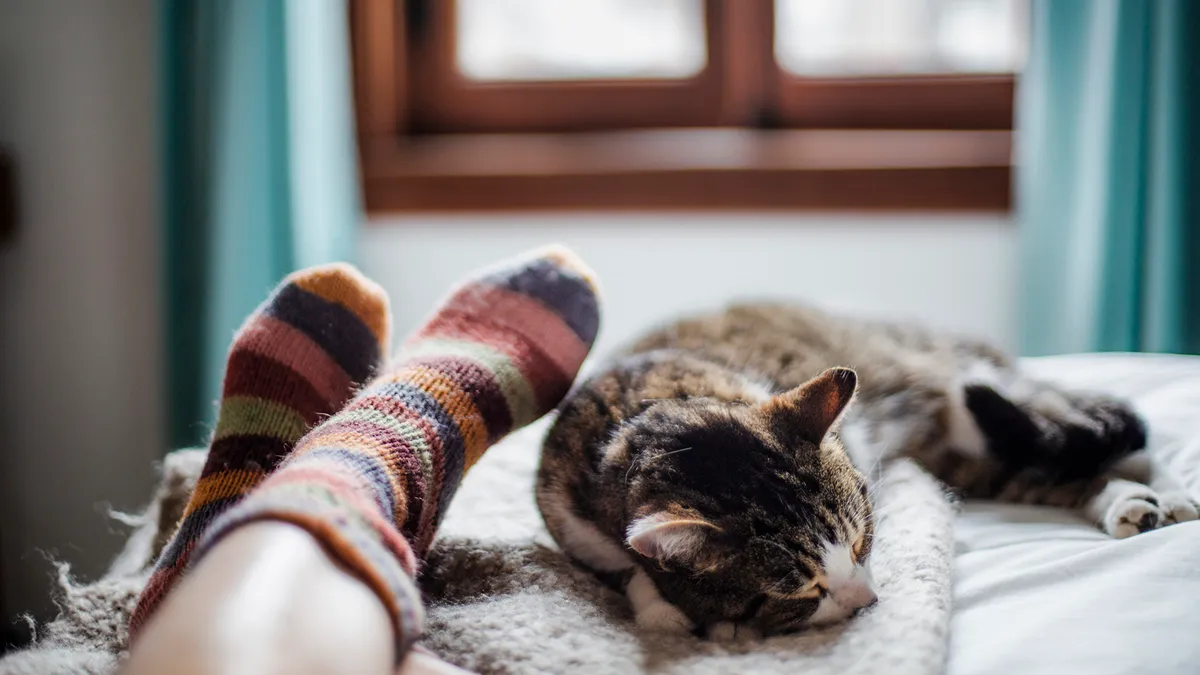
Cats are deliberate. When your cat curls up at your feet night after night, it is not random. Behind that behavior sits a layered mix of instinct, emotion, temperature regulation, and trust. Let us break down each reason in detail so you finally understand what your cat is silently communicating.
1. Survival Instinct — They Need an Escape Route
Cats are both predators and prey animals. Even after thousands of years of domestication, their wild instincts remain deeply wired into their behavior.
The foot of the bed sits closest to the bedroom door in most room layouts. This gives your cat a clear exit path if anything feels threatening during the night. Sleeping near your head or torso leaves them more trapped — at your feet, they are one leap away from freedom.
This instinct is not about distrust. It is pure biological programming. A cat that sleeps at your feet has actually made a calculated decision to be near you while still keeping its survival options open.
2. Your Feet Are the Perfect Temperature
Cats run hotter than humans. Their average body temperature sits between 100.5°F and 102.5°F (38°C and 39.2°C). To maintain that warmth without overheating, they seek out heat sources that are not too intense.
Your core body generates the most heat — near your head, chest, and abdomen — making those zones too warm for comfortable feline sleep. Your feet, however, radiate a steadier, more moderate warmth. It is the sweet spot your cat instinctively identifies.
On colder nights, you may notice your cat shifting slightly closer toward your legs. On warmer nights, they may move further away. They are simply regulating their own temperature using your body as a thermostat.
3. They Feel Safe Enough to Sleep Near You
Sleep is a vulnerable state for any animal. In the wild, a sleeping cat is an easy target. The fact that your cat chooses to sleep near you at all is a significant expression of trust.
By choosing your feet specifically, they are close enough to feel secure in your presence but positioned where they will not be accidentally pinned or rolled onto. It is the ideal balance between companionship and self-preservation.
If your cat sleeps at your feet every night, consider it a compliment. They have decided you are trustworthy enough to be their sleeping companion — and that is not something cats hand out freely.
4. Your Feet Move Less While You Sleep
Upper body movement during sleep is significantly greater than lower body movement. When you shift position, rearrange pillows, or roll over, most of that motion happens in your top half.
Your legs and feet tend to stay relatively still through the night. Cats are light sleepers and highly sensitive to disturbance. Parking themselves at the foot of the bed minimizes the chance your movements will interrupt their rest cycle.
This is a purely practical decision. Your cat has likely observed your sleeping patterns and identified the calmest zone on the bed. Feet win every time.
5. It Is a Sign of Affection and Bonding
Many people assume cats are aloof and indifferent to their owners. The reality is far more nuanced. Cats express affection differently than dogs — and sleeping at your feet is one of their quiet, understated love languages.
When your cat chooses to sleep near you, they are choosing closeness without demanding attention. It is their way of saying “I want to be near you” without surrendering their independence. This balance is central to feline behavior.
Cats that sleep at their owner’s feet regularly also tend to show other signs of attachment — like slow blinking, kneading, or following you from room to room. It is all part of the same emotional bond.
6. Territorial Claiming — You Belong to Them
Cats are deeply territorial animals. That territory includes you. When your cat sleeps at your feet, part of the behavior is a scent-marking exercise disguised as a nap.
Your cat has scent glands on their paws and body. By sleeping on or near you, they are leaving their scent, reinforcing that you are part of their social territory. In their mind, they are not just resting — they are claiming their human.
This is not aggressive or controlling behavior. It is an expression of attachment and social bonding that comes naturally to feline species. You are their safe zone, and they want the world to know it.
7. They Are Watching Over You
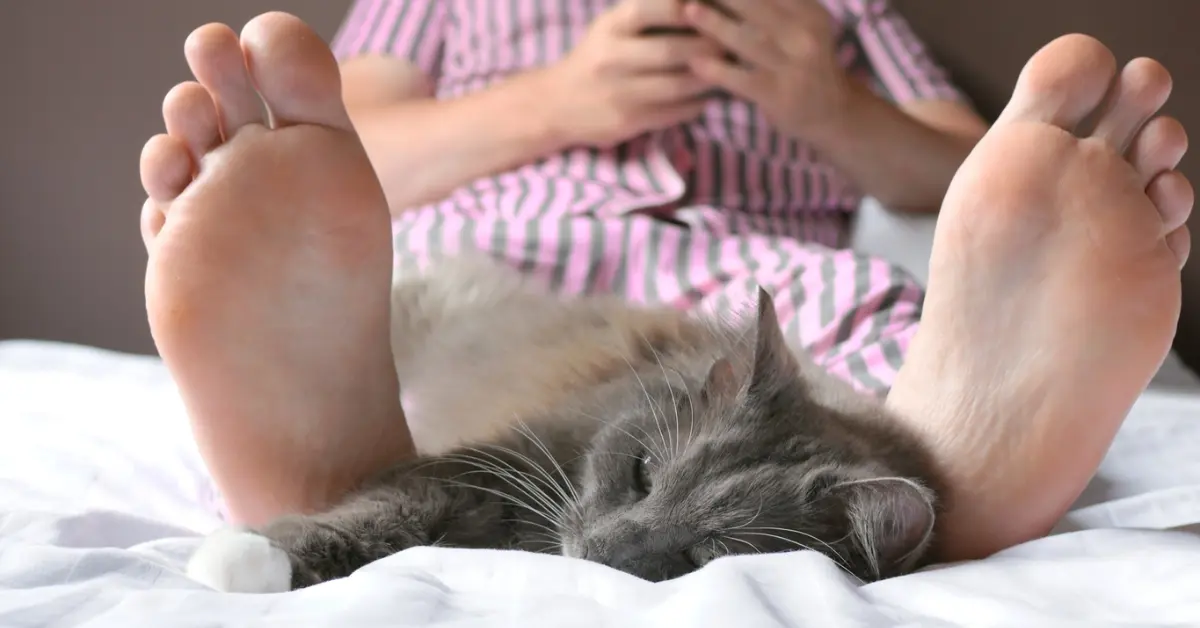
Cats are naturally alert animals, even during sleep. Their ears continue scanning for sounds and their senses remain partially active during rest cycles. Sleeping at your feet places them in an ideal guard position.
From this spot, your cat can monitor the bedroom door, the windows, and any unusual sounds or movements in the room. If something seems off, they are positioned to react quickly — either to flee or to alert you.
Several veterinary behaviorists have noted that cats often see themselves as protectors of their home and human companions. Sleeping at your feet is their quiet version of keeping watch.
8. Habit and Routine — They Found What Works
Cats are creatures of routine. Once your cat discovers that sleeping at your feet is warm, safe, and comfortable, that location becomes their permanent default.
Feline behavior research consistently shows that cats prefer predictable, familiar environments. Once a sleep location is established and rewarded with comfort, they repeat it. Night after night, the same spot, same time, same position.
This is why your cat returns to your feet even after you have moved them multiple times. They are not stubborn — they are simply loyal to what they know works.
What Your Cat’s Sleep Position Actually Tells You
Different sleeping locations on or around your body carry different meanings. Here is a quick reference:
| Sleep Position | What It Likely Means |
|---|---|
| At your feet | Trust, survival instinct, moderate warmth, independence |
| Between your legs | Deep comfort, security, strong bond |
| On your chest | Intense attachment, drawn to heartbeat and breathing |
| Near your head/pillow | Attracted to your scent, very strong trust |
| In another room | Independent personality, rotating territory |
| On top of your feet | Seeking direct warmth, strong territorial claim |
Cat Sleeping Behavior at Night — A Closer Look
Cats are crepuscular by nature, meaning they are most active during dawn and dusk. This means their nighttime sleep pattern is not identical to ours. They may sleep deeply for portions of the night, wake up to roam, eat, or use the litter box, and then return.
You might notice your cat is at your feet when you fall asleep, disappears at 3 AM, and then reappears before your alarm goes off. This is completely normal crepuscular behavior. The feet position is their go-to resting spot, not their only resting spot.
Their internal clock also means they will often be most active just as you are trying to wind down. Creating a calm bedtime routine — feeding them before bed, dimming lights, reducing noise — can help your cat settle into a more compatible sleep rhythm with yours.
Why Some Cats Never Sleep at Your Feet
Not all cats share a bed or sleep near their owners. This does not mean they are less bonded or less affectionate. Some cats simply prefer solitude during sleep. Others may have had negative experiences associated with shared sleeping in the past.
Independent breeds like the Russian Blue or Norwegian Forest Cat tend to be more reserved about shared sleeping. Affectionate breeds like the Ragdoll or Burmese are more likely to be foot-of-the-bed regulars.
Age also plays a role. Senior cats may prefer sleeping in lower, more accessible spots due to joint discomfort. Kittens often move around unpredictably as they explore their environment. Middle-aged adult cats are most likely to establish consistent sleeping routines with their owners.
Should You Let Your Cat Sleep at Your Feet?
This is a practical question with no universal answer. For most cat owners, there is no health concern. However, there are a few things worth considering.
If your sleep quality is affected — if the cat’s movements, weight, or warmth are waking you up repeatedly — it may be worth setting up a comfortable alternative nearby. A warm, padded cat bed placed at the foot of your bed on the floor can often satisfy your cat’s desire for closeness without disrupting your rest.
If you have allergies, asthma, or a compromised immune system, sleeping with a cat may not be advisable regardless of where they position themselves.
For most healthy adults with healthy cats, allowing this behavior is harmless and even emotionally beneficial. Studies have shown that owning and interacting with cats can reduce cortisol (stress hormone) levels and promote the release of oxytocin.
How to Discourage Foot Sleeping Without Damaging the Bond
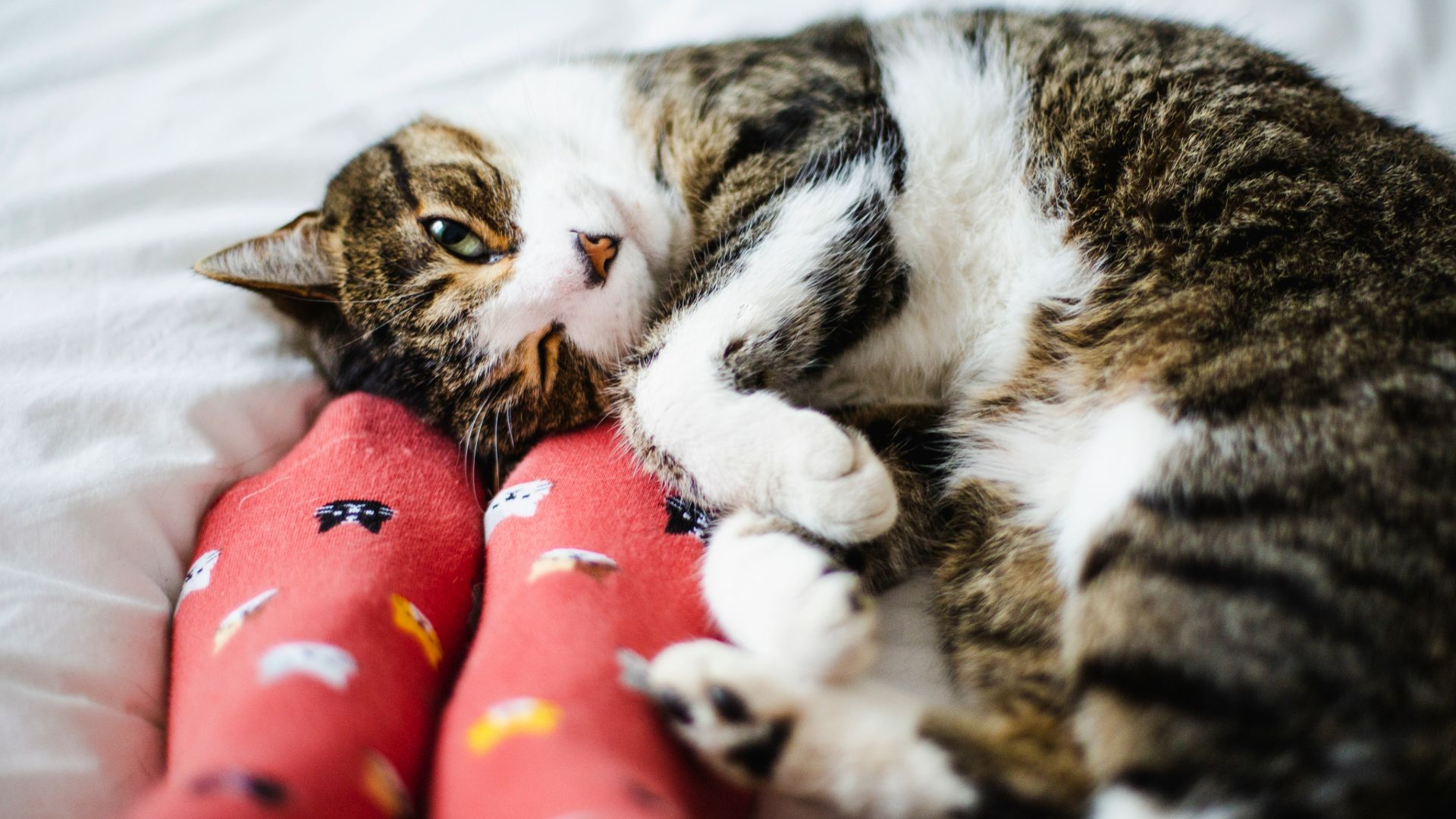
If you need to train your cat out of sleeping at your feet, the key is redirection rather than punishment. Cats do not respond well to negative reinforcement and will simply find another way to get what they want.
Place a cat bed near your feet but outside the human sleeping area. Warm it slightly with a heating pad set to low (cat-safe only) to mimic the warmth they seek from you. Reward your cat with treats or attention when they use the alternative bed.
Consistency matters. Mixed signals — sometimes allowing them on the bed, sometimes pushing them off — will prolong the transition. Decide on a clear rule and stick to it every single night.
Spiritual Meaning of a Cat Sleeping at Your Feet
Some pet owners are curious about the symbolic or spiritual interpretation of this behavior. In various folk traditions, cats are considered protective spiritual companions. A cat sleeping at your feet has sometimes been interpreted as a sign of guardianship — that your cat is watching over your energy or aura while you sleep.
While this interpretation lacks scientific grounding, it resonates with what we do know behaviorally: cats at your feet are alert, protective, and choosing to stay close to you during your most vulnerable hours. Whether you read that as behavioral biology or spiritual symbolism, the conclusion is the same — your cat is choosing you.
Cat Bonding Signs Beyond Sleeping Location
Sleeping at your feet is one of many bonding signals cats display. If your cat is genuinely attached to you, you will likely notice several of these behaviors together:
- Slow blinking (the “cat kiss”) when they look at you
- Head bunting — pressing their head or chin against you
- Kneading on soft surfaces near you
- Following you from room to room
- Chirping or trilling as a greeting
- Bringing you gifts (yes, even dead ones — it is love)
- Sitting close without necessarily touching
- Grooming you or licking your hand
Each of these behaviors, combined with their choice to sleep at your feet, paints a picture of a cat that is genuinely bonded to you and considers you a core part of their social world.
When Changes in Sleeping Location Signal a Problem
A sudden change in where your cat sleeps can sometimes indicate a health concern. If a cat that normally sleeps at your feet suddenly avoids you entirely, sleeps in unusual cold spots, hides under furniture, or seems lethargic, it may be worth a veterinary check-up.
Cats tend to hide discomfort or illness. Behavioral changes — including changes in sleep location — are often the first visible sign that something is physically wrong. Trust your instincts as a pet owner. If the change seems significant or is accompanied by reduced eating, unusual vocalizations, or changes in litter box habits, contact your vet promptly.
Quick Reference — Reasons and What They Mean
| Reason | Core Motivation |
|---|---|
| Escape route access | Survival instinct |
| Temperature regulation | Biological need |
| Trust and safety | Emotional bond |
| Less movement disruption | Comfort preference |
| Affection and bonding | Social behavior |
| Territorial claiming | Instinctive marking |
| Guarding you | Protective behavior |
| Habit and routine | Behavioral conditioning |
Frequently Asked Questions (FAQs)
Why does my cat sleep at my feet and not near my head?
Your feet move less during sleep and radiate moderate warmth without being too hot. Cats choose feet for comfort and practicality, not rejection of your face.
Is it safe to let my cat sleep at my feet every night?
Yes, for most healthy adults and healthy cats it is safe. Exceptions apply if you have allergies, asthma, or a weakened immune system — consult your doctor if unsure.
Does my cat sleeping at my feet mean they love me?
Yes, it is a genuine sign of affection. Cats only sleep near people they trust and feel safe with — choosing your feet means you are their chosen safe zone.
Why does my cat sleep on my feet instead of next to them?
Sleeping directly on your feet indicates your cat is seeking your warmth and reinforcing territorial connection. It is a stronger, more direct expression of closeness and ownership.
What does it mean when a cat sleeps between your legs?
It means your cat feels deeply secure and comfortable with you. Your legs form a natural enclosure that cats find especially warm, protected, and nest-like.
Why does my cat suddenly sleep at my feet when they never used to?
Behavioral changes like this often signal a shift in your cat’s comfort level or health. It could be they trust you more now — or occasionally it can reflect anxiety or a mild illness worth monitoring.
Do cats sleep at your feet to protect you?
Cats are naturally alert sleepers and do monitor their environment at night. Sleeping at your feet places them in a vantage position to detect threats, so there is a protective element to this behavior.
Should I move my cat if they sleep at my feet and wake me up?
If their presence disrupts your sleep consistently, gently redirecting them to a cat bed nearby is fine. Use warmth and treats to make the alternative appealing rather than simply removing them.
Why does my cat only sleep at my feet and not my partner’s?
Cats tend to bond more strongly with one person in a household — typically the one who feeds them, interacts with them most, or whose temperament they find most calming. It is a selective trust signal.
Can kittens sleep at your feet safely?
Yes, but with care. Very young kittens should not share a bed with humans due to the risk of being rolled onto during sleep. Once a kitten is older and more aware, foot-of-the-bed sleeping becomes safe and common.
Conclusion
Why do cats sleep at your feet is one of those questions that seems simple until you start pulling it apart. The answer is a beautiful combination of evolutionary instinct, emotional intelligence, and practical comfort-seeking.
Your cat is not just occupying space — they are expressing trust, claiming their territory, regulating their temperature, guarding their sleep environment, and quietly choosing you as their safe place in the world.
Every night your cat settles at the foot of your bed, they are making a deliberate decision. Among every corner, every chair, and every cool surface in your home, they pick you.
That is not accidental. That is attachment. Understanding the reasons behind this behavior helps you read your cat better, respond to their needs more effectively, and appreciate the subtle but powerful ways cats show love. The next time you feel that warm, familiar weight settle at your feet, you will know exactly what it means.
