

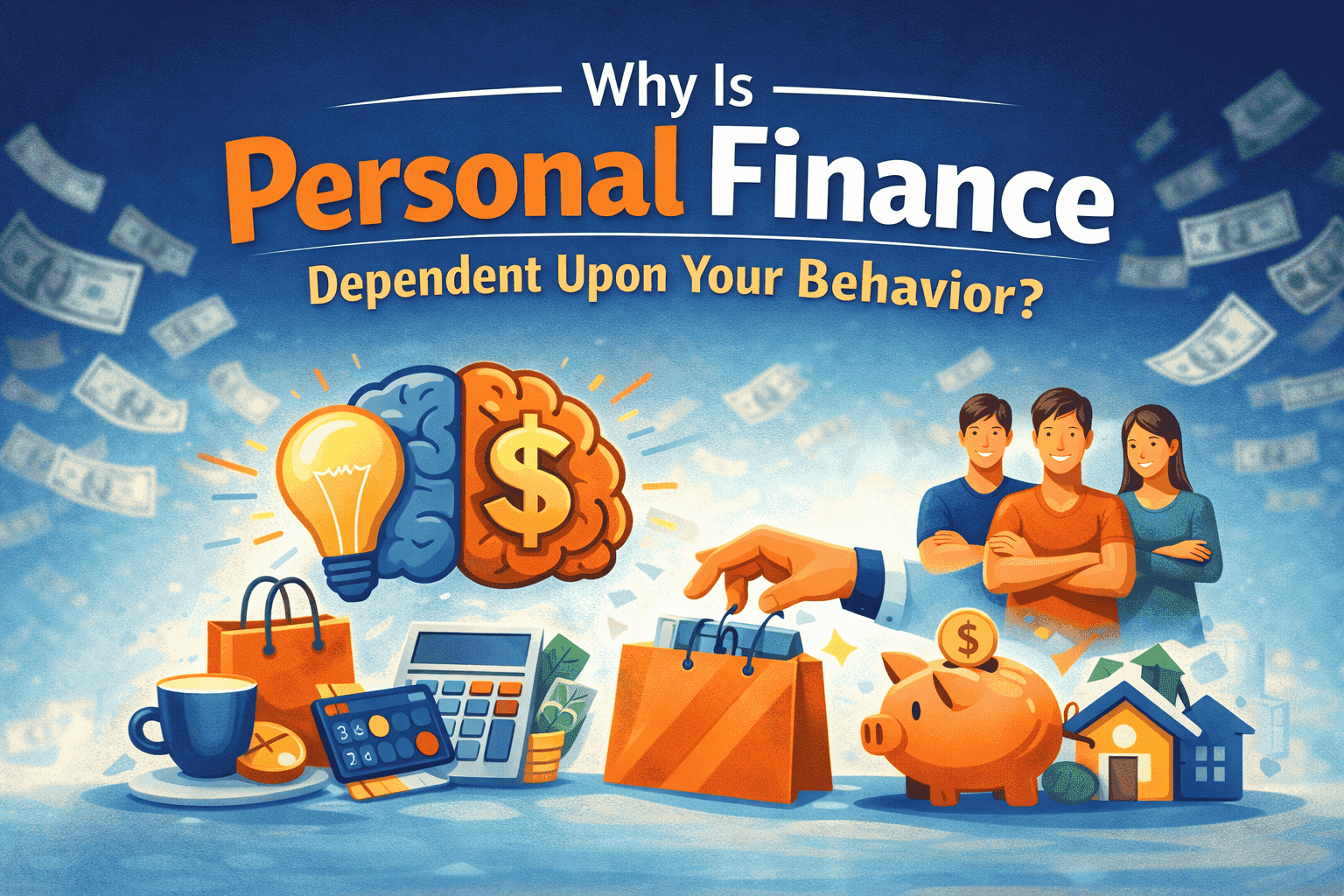
Why is personal finance dependent upon your behavior? Because every financial outcome in your life — from debt to wealth — begins with a decision, and every decision is driven by your psychology.
Personal finance is not a math problem. It is a behavior problem.
You can know every rule in the book about saving, budgeting, and investing, yet still fail financially if your habits and mindset work against you.
In 2026, with economic pressure rising globally, understanding the deep link between behavior and money has never been more urgent.
Keyword Variations Used by Competitors

- why is personal finance dependent on your behavior
- personal finance is dependent upon your behavior
- how behavior affects personal finance
- why personal finance depends on behavior
- behavioral finance and personal decisions
- psychology of money and financial behavior
- how psychology impacts financial decisions
- financial behavior and wealth building
- money habits and financial success
- why money management is a behavior issue
The Real Reason Personal Finance Is a Behavior Problem
Personal finance is dependent upon your behavior because knowledge alone does not build wealth — action does. Over 66% of Americans live paycheck to paycheck despite having access to free financial education online. The gap is not information. It is behavior.
Dave Ramsey stated it plainly: “Personal finance is only 20% head knowledge. The other 80% is behavior.” This is not motivational fluff — it is backed by decades of behavioral economics research.
Your income creates potential. Your behavior converts that potential into actual wealth or actual debt.
What Is Behavioral Finance?
Behavioral finance is the study of how psychology, emotions, cognitive biases, and social pressure influence financial decisions. It emerged as a response to the flawed idea that humans are always rational economic actors.
Traditional finance assumed people make perfect, logical money decisions. Behavioral finance proved that assumption wrong. People panic-sell investments, overspend when stressed, and avoid saving because it feels overwhelming — none of which is rational.
Understanding behavioral finance helps you see why you make certain money choices — and more importantly, how to change them.
The Psychology of Money: How Your Mind Controls Your Wallet
Your relationship with money starts in childhood. The financial behaviors modeled by your parents, the beliefs you absorbed about wealth and scarcity, and early experiences with money all shape your adult financial behavior.
Research from financial psychology shows that trauma, stress, and emotional triggers play a massive role in how people handle money. Someone who grew up in scarcity may hoard money anxiously. Someone who grew up with financial abundance may overspend without awareness.
This is why two people with the same income can have drastically different financial outcomes.
How Emotions Drive Poor Financial Decisions
Emotions are one of the biggest reasons why personal finance is dependent upon your behavior. Fear, stress, excitement, and anxiety all push you toward irrational money choices.
Fear causes panic-selling of investments during market drops — locking in losses instead of riding out the storm. Excitement causes impulse purchases and lifestyle upgrades that are not sustainable. Stress activates retail therapy — spending money to feel better in the short term.
Managing your emotional state is not optional. It is a core financial skill.
Major Cognitive Biases That Hurt Your Finances
Cognitive biases are mental shortcuts your brain uses to make quick decisions. Most of the time they are efficient — but in financial situations, they become costly traps.
| Cognitive Bias | How It Hurts Your Finances |
|---|---|
| Confirmation Bias | You only seek info that confirms your existing money beliefs |
| Loss Aversion | You fear losses 2x more than you value gains, leading to panic decisions |
| Present Bias | You prefer spending now over saving for the future |
| Anchoring Bias | You fixate on irrelevant reference points when making financial choices |
| Overconfidence Bias | You overestimate your investing skill, leading to risky decisions |
| Herding Bias | You follow the crowd into bad investments (crypto hype, etc.) |
| Status Quo Bias | You avoid changing financial habits even when change is needed |
Recognizing these biases is the first step toward making decisions based on logic rather than instinct.
Lifestyle Inflation: The Silent Wealth Killer
Lifestyle inflation is one of the most common behavioral traps in personal finance. As your income increases, your expenses increase to match it — keeping your savings rate at zero regardless of how much you earn.
Someone earning $40,000 and saving $300/month builds more wealth over time than someone earning $100,000 and spending $99,000. The numbers do not lie. Behavior drives the outcome — not the paycheck size.
Avoiding lifestyle inflation requires intentional behavior: automating savings before lifestyle expenses, setting spending limits, and maintaining financial goals tied to purpose — not status.
The Role of Daily Habits in Financial Outcomes

Your financial future is built one daily habit at a time. Small behaviors compound just like interest does. Missing one savings deposit seems harmless — but missing it for 20 years is a retirement crisis.
Positive financial habits that compound over time:
- Paying yourself first (automating savings before spending)
- Tracking expenses weekly to stay conscious of where money goes
- Reviewing financial goals monthly to stay aligned
- Avoiding impulse purchases with a 24-hour rule
- Investing consistently regardless of market conditions
Negative financial habits that also compound:
- Spending before saving (the “save what’s left” trap)
- Using credit cards emotionally without a payoff plan
- Avoiding budgeting because it feels restrictive
- Comparing your lifestyle to others on social media
- Delaying financial decisions due to fear or overwhelm
Impulse Spending and Behavioral Triggers
Impulse spending is a direct result of emotional and environmental triggers. Retail stores are designed to trigger impulsive behavior. Online shopping platforms use algorithms to surface items that exploit your past browsing behavior.
Understanding your personal spending triggers — stress, boredom, social comparison, fear of missing out — is essential for breaking impulse patterns. Behavioral research shows that creating friction between the urge and the purchase (like removing saved card info, adding items to cart but waiting 24 hours) dramatically reduces impulse buys.
Delayed Gratification: The Superpower of Wealthy People
The famous Stanford Marshmallow Study demonstrated that children who could delay gratification went on to have better academic, financial, and social outcomes in life. The ability to resist immediate pleasure in exchange for long-term gain is perhaps the most powerful financial behavior you can develop.
In personal finance, delayed gratification looks like:
- Driving an older car while your investments grow
- Renting while saving for a larger home deposit
- Skipping a vacation to build a 6-month emergency fund
- Staying in a lower lifestyle while building passive income streams
This is not deprivation. It is strategic patience.
Scarcity Mindset vs. Abundance Mindset in Personal Finance
Your money mindset — the core beliefs you hold about money — shapes every financial decision you make without your conscious awareness.
A scarcity mindset creates fear-based financial behavior: hoarding cash instead of investing, avoiding financial conversations, and making decisions from panic rather than planning. It can also lead to over-saving without purpose, missing opportunities for growth.
An abundance mindset creates confidence-based financial behavior: investing with long-term vision, taking calculated risks, and believing wealth is buildable regardless of starting point.
Neither mindset is automatically better. The key is a balanced, realistic money mindset grounded in evidence and action — not fear or fantasy.
Social Pressure, Peer Influence, and “Keeping Up With the Joneses”
Social behavior is a major driver of personal finance outcomes. Humans are wired for social comparison, and in 2026, social media amplifies this tendency to extreme levels.
Seeing peers buy luxury cars, take international vacations, and upgrade their homes creates psychological pressure to match that lifestyle — even when your financial foundation is not ready. This is called social proof spending, and it is responsible for billions in consumer debt annually.
Financial security requires separating your self-worth from your net worth, and your spending from your social identity.
Financial Self-Control: Building the Muscle
Self-control in finances is not about willpower alone — it is about system design. Behavioral economics shows that people who design their environment for financial success outperform those who rely on discipline alone.
Practical ways to build financial self-control through systems:
- Automate your savings so the decision is never left to willpower
- Use separate accounts for different financial goals
- Set up automatic investment contributions on payday
- Use spending tracking apps that give you weekly reports
- Create a “fun spending” budget so restrictions do not create rebellion spending
The Procrastination Trap in Financial Planning

Procrastination is one of the most financially damaging behaviors. Every year you delay starting your retirement fund costs you thousands in compound growth. Every month you delay paying off high-interest debt costs you hundreds in interest.
Behavioral research identifies two causes of financial procrastination: present bias (tomorrow feels easier than today) and decision paralysis (the options feel too complex to choose). The antidote to both is simplification — automate one financial action this week and build momentum from there.
How Money Personality Shapes Financial Behavior
In 2026, financial psychologists identify six core money personalities: the Spender, the Saver, the Avoider, the Worrier, the Risk-Taker, and the Planner. Most people are a blend of two or three.
| Money Personality | Core Financial Behavior | Main Risk |
|---|---|---|
| The Spender | Spends freely, lives in the moment | Debt, no savings |
| The Saver | Saves aggressively, avoids spending | Missed opportunities, anxiety |
| The Avoider | Ignores financial decisions entirely | Financial chaos, missed deadlines |
| The Worrier | Constantly anxious about money | Paralysis, over-conservative investing |
| The Risk-Taker | Seeks high returns, tolerates uncertainty | Over-leveraged, volatile portfolio |
| The Planner | Data-driven, goal-oriented | Rigidity, stress when plans change |
Identifying your dominant money personality helps you understand your default financial behaviors — and design systems to balance them.
Building Positive Financial Behavior: A Step-by-Step Framework
Changing financial behavior is not about motivation — it is about structure. Here is a behavior-change framework proven to work:
Step 1 – Awareness: Track every expense for 30 days without judgment. See exactly where money goes.
Step 2 – Identify Triggers: Notice which emotions or situations lead to poor financial choices.
Step 3 – Design Your Environment: Remove friction from good behaviors (automate savings) and add friction to bad behaviors (delete shopping apps).
Step 4 – Set Behavior-Based Goals: Instead of “save $10,000,” set “transfer $400 every payday automatically.”
Step 5 – Track and Celebrate: Small wins reinforce positive behavior loops. Celebrate every debt payoff, every savings milestone.
Step 6 – Review Monthly: Financial behavior drifts. Monthly reviews catch problems early and renew commitment.
The Compound Effect of Financial Behavior Over Time
Behavior does not just affect your finances today — it compounds over decades. Small consistent behaviors create dramatically different financial futures.
Consider two people both earning $60,000/year starting at age 25:
| Behavior | Person A | Person B |
|---|---|---|
| Monthly Savings | $600 (10%) | $0 |
| Investment Return | 8% annually | 0% |
| Lifestyle Inflation | Controlled | Unchecked |
| Net Worth at 55 | ~$815,000 | Near $0 |
| Retirement Security | High | None |
The difference is not income. It is behavior sustained over time.
Why Financial Education Alone Is Not Enough
Most financial education programs focus on what to do: budget, save, invest. They rarely address why people do not do it — which is always a behavioral, emotional, or psychological reason.
A person can learn how a Roth IRA works and still never open one because of procrastination. A person can understand compound interest and still spend everything because of emotional triggers. Knowledge without behavioral change produces no financial results.
This is why behavioral finance is now considered a core component of effective personal finance — not a supplement to it.
Practical Behavioral Strategies for Financial Success in 2026
Given everything above, here are the most impactful behavioral strategies for personal finance in 2026:
Automate Everything Possible: Savings, investments, bill payments. Remove willpower from the equation entirely.
Use the 24-Hour Rule for Non-Essential Purchases: Wait one day before buying anything over a set threshold (e.g., $50). Most impulse urges disappear.
Name Your Financial Goals: “Vacation fund,” “freedom account,” “kids’ education” — named goals create emotional connection and reduce spending from those accounts.
Detox Social Media Spending Triggers: Unfollow accounts that trigger lifestyle envy or impulse purchases.
Work with a Financial Accountability Partner: Behavioral research shows people are 65% more likely to achieve goals when they commit to someone else.
Practice Gratitude for Current Financial Position: Gratitude reduces scarcity-anxiety spending and improves financial decision quality.
Frequently Asked Questions (FAQs)
Why is personal finance dependent upon your behavior and not just your income?
Income creates financial potential, but behavior determines whether that potential becomes wealth or debt. A high earner with poor habits will always struggle more than a moderate earner with disciplined habits.
What is behavioral finance and why does it matter?
Behavioral finance studies how emotions and cognitive biases influence financial decisions. It matters because it explains the gap between what people know they should do financially and what they actually do.
What is the biggest behavioral mistake people make with money?
Lifestyle inflation — increasing spending as income increases — is the most common and damaging behavioral mistake. It keeps wealth-building permanently out of reach regardless of earnings.
How does loss aversion affect personal finance?
Loss aversion causes people to fear financial losses twice as much as they value equivalent gains. This leads to panic-selling investments, avoiding smart risks, and holding bad financial positions too long.
Can you change your financial behavior?
Yes, absolutely. Financial behavior is not fixed. Through awareness, environment design, habit systems, and consistent practice, anyone can develop healthier money behaviors regardless of past patterns.
What is present bias in personal finance?
Present bias is the psychological tendency to prefer immediate rewards over future benefits. It explains why saving for retirement feels less urgent than spending money today, even when the future stakes are far higher.
How does stress affect financial decision-making?
Stress activates emotional spending, impulsive decisions, and avoidance of financial planning. Managing stress levels directly improves financial decision quality and reduces harmful money behaviors.
What role does childhood play in adult financial behavior?
Early experiences with money — including parental modeling, financial stress, and beliefs absorbed in childhood — create deep behavioral patterns that persist into adulthood and shape every financial decision unconsciously.
How does social media influence financial behavior?
Social media amplifies social comparison, triggering lifestyle inflation and status spending. Seeing peers’ financial highlights creates psychological pressure to spend beyond your means to match a curated, unrealistic standard.
What is the most effective habit for improving personal finance behavior?
Automating savings before spending — paying yourself first — is consistently rated the single most effective financial behavior change. It removes the decision from willpower and makes saving the default, not the exception.
Conclusion
Why is personal finance dependent upon your behavior? Because every number in your financial life — your savings balance, your debt total, your investment portfolio, your net worth — is the direct result of thousands of behavioral decisions made over time.
None of it happened by accident, and none of it is beyond your control.
The research is clear: behavioral discipline matters more than income level.
Cognitive biases, emotional triggers, social pressure, and deeply ingrained money beliefs are the real obstacles standing between most people and financial security. Not lack of information.
In 2026, with rising costs and economic uncertainty shaping daily financial reality, the people who will build genuine wealth are not necessarily the highest earners.
They are the ones who master their money behavior — who automate their savings, delay gratification, design their environment for discipline, and consistently act in alignment with their long-term financial goals.
Start with one behavior change today. Automate one savings transfer.
Delete one shopping app. Track this week’s spending. Small behavioral shifts, sustained over time, build the financial future that no amount of passive reading ever will.
