

Jetton Games: A Vocabulary and Overview Guide to Every Game Type in the Catalogue
Understanding any subject begins with understanding its vocabulary. Casino gaming — and crypto casino gaming in particular — has developed a specific set of terms that describe how different game types work, what makes them distinct from each other, and what a player is actually doing when they press Play. For anyone approaching the Jetton game catalogue for the first time, the terminology is the entry point.
This guide explains each game type in the Jetton catalogue with the same approach used to explain any other category of knowledge: clear definitions, concrete examples, and the distinctions that matter. The full catalogue detail — including specific titles, RTP figures, and provider information — is covered in the jetton games overview and types on jetton-casino.ca. This article focuses on what the terms mean and what distinguishes one game type from another.
The Key Term: What “Provably Fair” Actually Means
Before explaining game types, one term that appears throughout Jetton’s in-house catalogue deserves its own definition: provably fair.
In conventional casino games, the player trusts that the operator has implemented the stated RTP honestly. There is no independent way for the player to verify an individual outcome. A licensed operator submits to third-party auditing, but the player never sees the underlying math for any specific round.
Provably fair is a cryptographic system that changes this. Before each round begins, the operator generates a server seed — a random string of characters — and commits to it by publishing a hash (a one-way mathematical fingerprint). The player provides a client seed. The round outcome is determined by combining both seeds with a round counter. After the round, the original server seed is revealed. The player can then verify, using standard hash functions, that the server seed matches the earlier commitment and that the outcome was not altered.
The significance: the player can confirm, after every round, that the result was predetermined before their bet was placed and was not modified afterward. This is a structural transparency feature that conventional online casinos do not offer. It is built into Jetton’s in-house crash games and mines titles.
Game Type One: Crash Games
Definition
A crash game is a real-time multiplier game in which the current payout multiplier begins at 1× and increases continuously from the moment a round starts. At a random point, the round crashes — the multiplier stops and resets to zero. Any player who has cashed out before the crash receives their stake multiplied by the value at which they exited. Any player who has not cashed out loses their stake.
The word crash is both literal and descriptive: the rising multiplier represents growing potential winnings; the crash is the moment that potential is extinguished for anyone still in the round.
How the Decision Works
The only decision the player makes is when to exit. This distinguishes crash games from almost every other casino format. There is no card to draw, no reel to spin, no tile to reveal. The player watches a number climb and decides at what point the risk of the round crashing outweighs the reward of waiting longer.
Key vocabulary for crash games:
-
Multiplier: the current payout factor, expressed as 1×, 2×, 5×, etc.
-
Cashout: the act of locking in winnings at the current multiplier before the crash.
-
Auto-cashout: a pre-set multiplier at which the game automatically cashes out on the player’s behalf.
-
RTP (Return to Player): the percentage of total wagered funds returned to players over time. Jetton Fly’s published RTP is 99%, meaning the house edge is 1%.
Jetton’s crash titles include Jetton Fly (flagship, 99% RTP), Space XY, and Chicken Road.
Game Type Two: Mines
Definition
A mines game presents the player with a grid of face-down tiles. A configurable number of tiles conceal mines; the rest are safe. The player reveals tiles one at a time. Each safe tile increases the current payout multiplier. If the player reveals a mine, the round ends and the stake is lost. The player can cash out at any point after revealing at least one safe tile.
Relationship to Crash Games
Mines is structurally a crash game variant with a different pacing. In a standard crash game, the multiplier increases continuously in real time, and the player decides when to exit against a ticking clock. In mines, each tile reveal is a discrete decision with no time pressure — the player chooses the pace. The core question is identical in both formats: at what point does the risk of continuing outweigh the reward of the current multiplier?
Key vocabulary for mines:
-
Mine count: the number of hidden mines on the grid. More mines means higher potential multipliers but greater per-tile risk.
-
Safe tiles: tiles that do not contain mines. Revealing one increases the multiplier.
-
Multiplier progression: the rate at which the payout grows with each safe tile reveal, determined by the mine count.
Game Type Three: Plinko
Plinko is a probability-based game in which a ball is dropped from the top of a peg-filled board. The ball bounces off pegs as it falls and lands in a slot at the bottom. Each slot corresponds to a fixed payout multiplier. The player selects a risk tier — low, medium, or high — before each drop.
Unlike crash games and mines, the player makes no in-round decisions: the ball falls according to physics and probability once released. The only strategic choice is the risk tier selection, which changes the payout distribution:
-
Low risk: many slots with similar, modest multipliers. Frequent small wins, very rare large wins.
-
Medium risk: wider payout range, balanced between frequency and potential upside.
-
High risk: most payout weight concentrated in a few extreme-multiplier slots. Rare large wins, frequent low-multiplier outcomes.
The term risk tier in Plinko is a precise example of a word doing real descriptive work: it names not just the level of danger but the entire shape of the probability distribution.
Game Type Four: Slots
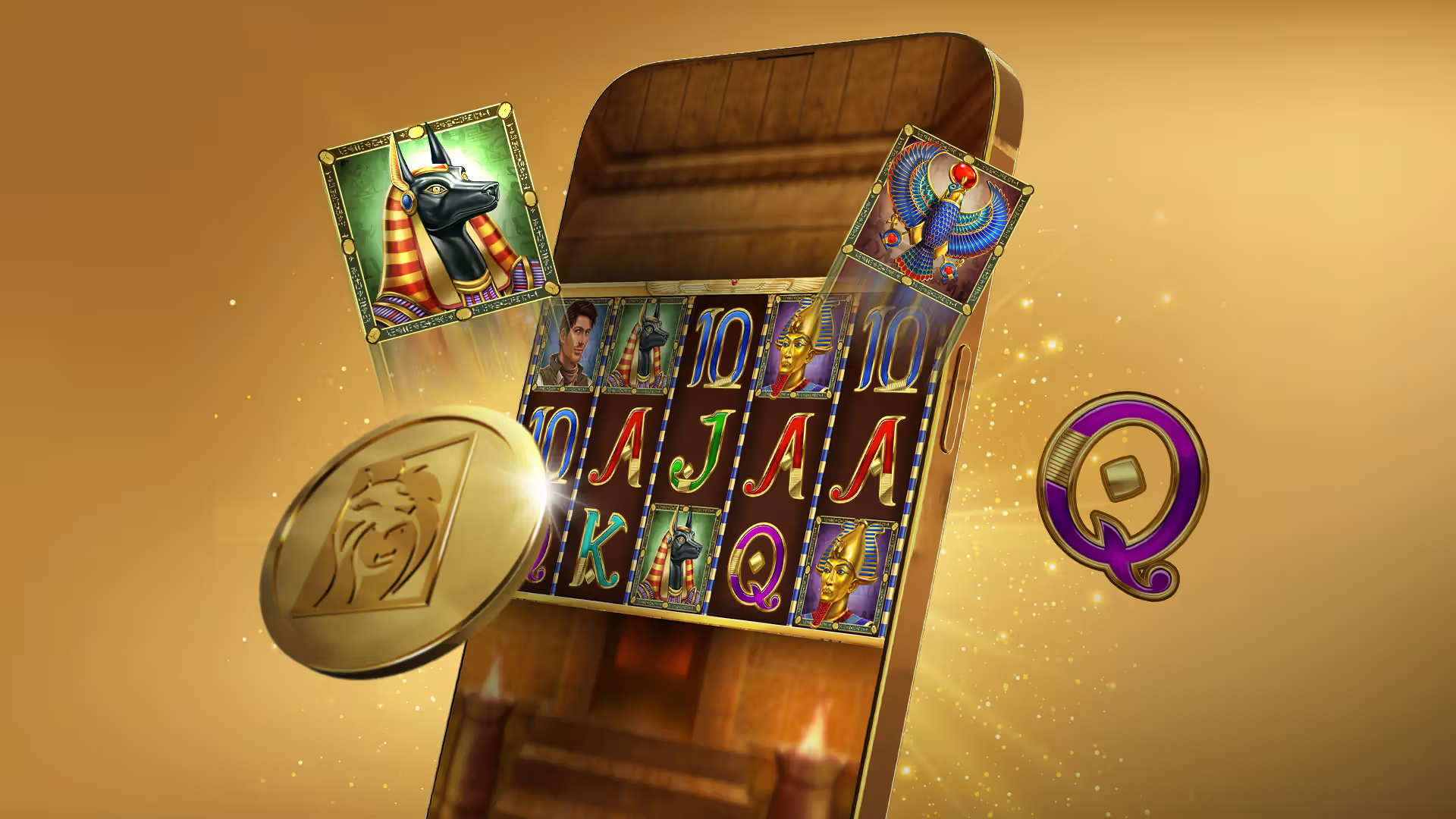
A slot is a game in which reels — vertical columns of symbols — spin and stop at random positions. A win occurs when a specified combination of symbols appears across a payline (a defined path across the reels). The player has no in-game decisions beyond setting stake size; outcome is determined entirely by the random number generator.
Key vocabulary for slots:
-
Reel: a vertical column of symbols. Standard slots have three to six reels.
-
Payline: a path across the reels. A win requires matching symbols on an active payline.
-
RTP: published for each slot title. Note that on Jetton, as on most platforms, third-party slot RTPs are operator-configurable within a range set by the studio. Always check the in-game info panel for the Jetton-specific figure.
-
Volatility: describes how a slot distributes its payouts. High-volatility slots pay rarely but in larger amounts; low-volatility slots pay more frequently at smaller amounts.
-
Bonus round: a secondary game mode triggered by specific symbol combinations. Often the source of a slot’s largest potential payouts.
Jetton offers both in-house original slots and third-party titles from Pragmatic Play, Hacksaw Gaming, Nolimit City, NetEnt, Red Tiger, BGaming, and others.
Game Type Five: Live Dealer Tables
Live dealer games are casino table games — primarily blackjack, roulette, and baccarat — streamed in real time from a studio with human dealers. Players place bets through an on-screen interface; the dealer conducts the physical game in view of the camera.
Key vocabulary:
-
Blackjack: a card game in which the player attempts to reach a hand value of 21 (or closer to 21 than the dealer) without exceeding it. Basic strategy — a mathematically optimal set of decisions for each possible hand — reduces the house edge to approximately 0.5%.
-
Roulette: a wheel game in which a ball lands on a numbered slot. European (single-zero) roulette has a house edge of 2.7%; American (double-zero) adds a second green slot, raising the edge to 5.26%.
-
Baccarat: a card game comparing two hands (Player and Banker). The bet on Banker carries the lowest house edge of the three main bets.
Summary Glossary
-
Crash game: real-time multiplier game; player cashes out before a random crash.
-
Mines: grid game; player reveals tiles to increase a multiplier while avoiding hidden mines.
-
Plinko: ball-drop probability game; player selects a risk tier before release.
-
Slot: reel-based random outcome game; no in-round decisions.
-
Live dealer: real-time streamed table game with human dealer.
-
Provably fair: cryptographic system allowing players to verify round outcomes independently.
-
RTP: Return to Player; the percentage of wagered funds returned over time.
-
Volatility: the distribution pattern of payouts — how often they occur and how large they tend to be.
-
House edge: the complement of RTP; the operator’s expected margin per unit wagered.
