


The Metamorphosis is a short novel written by Franz Kafka in 1915. The story explores deep questions about personal identity, loneliness, duty, liberty and human society. It does this through the strange central idea of a man who, for unexplained reasons, turns into an ugly bug. The disturbing tale of traveling salesman Gregor Samsa suddenly becoming an insect deals with complicated themes that reveal profound realities about the human experience.
Alienation permeates the text as Gregor finds himself exiled from humanity by his change in physical form, leading to an identity crisis marked by anguish. Within the Samsa family home, shifting dynamics reveal how conditional familial and societal bonds can be as Gregor is increasingly dehumanized. Broader themes related to the absurdity and anxieties of existence itself also course through the text as both Gregor and the reader confront the irrationality of life. Ultimately Gregor’s transformation results in profound personal, interpersonal, and social transformations across spheres.
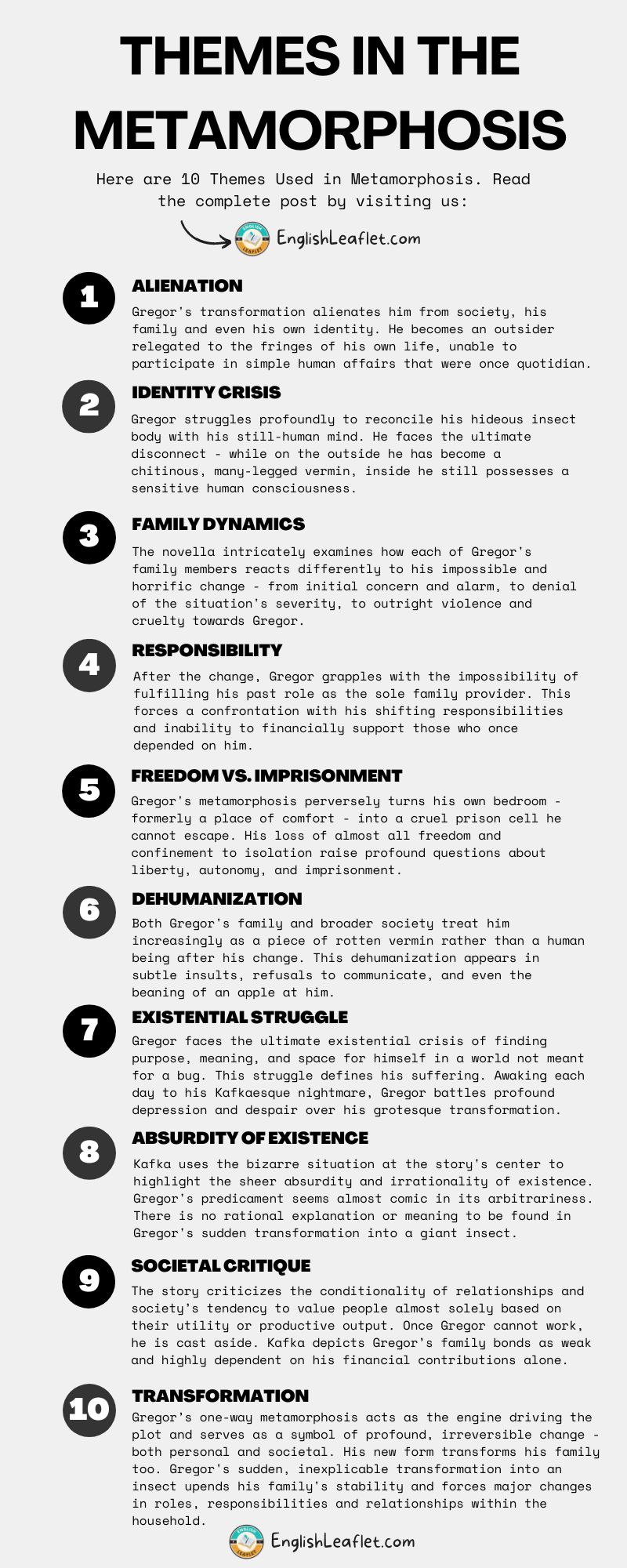
Themes In The Metamorphosis
Theme#1
Alienation
Gregor’s transformation alienates him from society, his family and even his own identity. He becomes an outsider relegated to the fringes of his own life, unable to participate in simple human affairs that were once quotidian.
Gregor finds himself confined both physically and psychologically – trapped in his small bedroom as well as his insect-like mind, which is increasingly alien even to himself. He loses his job, his humanity and any connection to the outside world. His isolation is near total.
Gregor is utterly alone behind the closed doors of his tiny bedroom, separated from any community. He is abandoned by society itself. Even within his own family, he becomes a shunned figure they try to erase and ignore. All his previous roles – as brother, son, provider – are voided. His loneliness is consuming since no one can relate to his Kafkaesque experience.
Theme#2
Identity Crisis
Gregor struggles profoundly to reconcile his hideous insect body with his still-human mind. He faces the ultimate disconnect – while on the outside he has become a chitinous, many-legged vermin, inside he still possesses a sensitive human consciousness.
This shocking incongruity between his external monstrous form and internal human thoughts leads Gregor into an agonizing existential identity crisis. He faces a rupture in his most basic integrity and coherence of self. Who is he now? Monster or man? His new material form clashes jarringly with memories and emotions from his human past causing intense philosophical confusion and angst.
Gregor’s very notion of his core identity is thrown into disarray as neither his human ego nor insect body allow him to understand himself holistically.
Trapped in a Kafkaesque reality not of his making, Gregor suffers profound anxiety about who and what he has become. This unrelenting tension between surface and depth; exoskeleton and psyche; insect and human; ultimately consumes Gregor psychologically
Theme#3
Family Dynamics
The novella intricately examines how each of Gregor’s family members reacts differently to his impossible and horrific change – from initial concern and alarm, to denial of the situation’s severity, to outright violence and cruelty towards Gregor.
First, Gregor’s sister Grete seems sympathetic, crying at the sight of his new grotesque form. His mother also appears worried for his sake rather than her own initially. But slowly their concern morphs into willful ignorance and denial that anything is deeply wrong with the situation as long as the family’s middle-class lifestyle remains intact. Gregor has fulfilled his duty by financing them thus far – so they ignore his suffering.
Underneath the surface, tension builds with these unaddressed tensions until a climatic scene where the once-beloved Gregor is severely injured. The fragility of even the closest family bonds reveals itself through the different phases of coping and cruelty Gregor’s transformation elicits.
The radical shifts in how each family member regards Gregor underscores the conditionality of their love – when he is no longer functioning in his breadwinning human role, their affection vanishes and underlying violence surfaces. They turn on him as soon as he metamorphosis into something not useful to them.
Theme#4
Responsibility
After the change, Gregor grapples with the impossibility of fulfilling his past role as the sole family provider. This forces a confrontation with his shifting responsibilities and inability to financially support those who once depended on him.
Gregor struggles deeply with feelings of uselessness and the burden he now feels he has become to his family. Though they continue providing food and minimal care for him out of a sense of obligation, he senses their growing resentment toward him as their circumstances worsen.
Gregor retreats further into himself, experiencing profound loneliness and alienation within his own home. His changed physical form is a constant reminder of how he can no longer connect with his family or the human world as he once did.
The loss of his human relationships and purpose plunges Gregor into a depression that slowly consumes what remains of his human self.
Theme#5
Freedom vs. Imprisonment
Gregor’s metamorphosis perversely turns his own bedroom – formerly a place of comfort – into a cruel prison cell he cannot escape. His loss of almost all freedom and confinement to isolation raise profound questions about liberty, autonomy, and imprisonment.
Trapped within four walls, Gregor struggles desperately to cling to his last vestiges of humanity and self-determination, but finds his room morphing into an alien landscape full of obstacles and dangers.
The familiar objects and furnishings of his old life now tower over and constrain his insect body. Gregor battles intense feelings of powerlessness and futility in the face of his involuntary confinement. His minimal communication with the outside world only highlights the profound isolation of his circumstance.
Over time, Gregor’s cramped quarters seem to shrink further as he psychologically withdraws into himself. The claustrophobic smallness of his existence wears on even the hardy vermin body that imprisons what is left of his human consciousness. His ongoing incarceration in an insect’s form raises troubling questions about the fragility of identity and meaning when freedom is lost.
Theme#6
Dehumanization
Both Gregor’s family and broader society treat him increasingly as a piece of rotten vermin rather than a human being after his change. This dehumanization appears in subtle insults, refusals to communicate, and even the beaning of an apple at him.
Gregor keenly feels his loss of standing within the household as his family members, who once respected him as the breadwinner, now regard him with disgust and fear. Their repulsion at his physical form overrides any memory of his past humanity and all he once provided.
Gregor desperately tries to cling to human behaviors and habits, as if maintaining traces of his former self. The final indignity comes when his father, in a burst of frustration, inflicts injury upon Gregor’s vermin body as if he were simply stamping on an offensive bug. This definitive act of dehumanization makes clear Gregor’s abject fall from human consideration.
Theme#7
Existential Struggle
Gregor faces the ultimate existential crisis of finding purpose, meaning, and space for himself in a world not meant for a bug. This struggle defines his suffering. Awaking each day to his Kafkaesque nightmare, Gregor battles profound depression and despair over his grotesque transformation.
Once taking pride in supporting his family through hard work, he now faces the futility of finding fulfillment when locked inside an impotent arthropod shell. All human ambition seems absurd and pointless given his current form. Gregor aimlessly crawls the walls and ceiling of his small bedroom in search of reason, routine, or relief – but all elude him.
The familiar spaces and objects of his former life now tower over him, constant reminders of how radically unsuited he is for this human environment. Alienated from human affairs, Gregor retreats into himself in hopes of psychologically maintaining some shred of his former identity.
Theme#8
Absurdity of Existence
Kafka uses the bizarre situation at the story’s center to highlight the sheer absurdity and irrationality of existence. Gregor’s predicament seems almost comic in its arbitrariness. There is no rational explanation or meaning to be found in Gregor’s sudden transformation into a giant insect.
He did not will it, deserve it, or bring it upon himself. Neither hard work, righteousness, nor good intentions spared him from an improbable fate that defies logical sense. Kafka constructs Gregor’s inexplicable metamorphosis to showcase the fundamental irrationality underpinning the human experience.
Through the lens of Gregor’s daily trials and tribulations in an ill-fitting insect body, Kafka presents the absurdity of all human striving and suffering. Gregor’s absurdist predicament becomes a microcosm reflecting the precariousness of all existence – no logic, reason or justice protects against an arbitrary fate.
Theme#9
Societal Critique
The story criticizes the conditionality of relationships and society’s tendency to value people almost solely based on their utility or productive output. Once Gregor cannot work, he is cast aside. Kafka depicts Gregor’s family bonds as weak and highly dependent on his financial contributions alone.
Despite years of self-sacrifice to support them, his family turns on Gregor swiftly when he is no longer able to provide or function at his demanding job. Their former affection and concern melt away, replaced by revulsion, impatience and resentment due to the burden his new insect form represents.
They isolate Gregor and offer only the minimal care needed to avoid pangs of guilt over discarding one of their own kin. Through this emotional abandonment, Kafka suggests that even intimate familial ties can quickly fray when a person loses economic value according to capitalistic norms.
Similarly, Gregor’s manager and employer immediately write him off as soon as his productivity and reliability as an employee falter. No matter how diligently he worked for years to build their prosperity through his labor, the company cannot discard him quickly enough once he is no longer profitable.
Through this corporate callousness, Kafka warns of the dehumanizing dangers inherent when societies place monetary output and human worth in the same calculation. As the story bears out through ultimate tragedy, those deemed useless by prevailing social systems stand to suffer great cruelty and alienation.
Theme#10
Transformation
Gregor’s one-way metamorphosis acts as the engine driving the plot and serves as a symbol of profound, irreversible change – both personal and societal.
His new form transforms his family too. Gregor’s sudden, inexplicable transformation into an insect upends his family’s stability and forces major changes in roles, responsibilities and relationships within the household.
As the family revolves around the crisis of Gregor’s altered state, longstanding tensions and dysfunctions bubble up, driving wedges between various members.
With Gregor unable to work, his father must find employment after years of dependence on his son’s income, while Gregor’s sister, Grete, must grow up quickly to manage the domestic duties her brother once performed. The mother’s chronic anxiety worsens, catalyzing conflicts with the others.
Under this stress, family bonds fray and reknit in different patterns. Where Gregor once centered the family, he now repels them and becomes utterly isolated. The unit seems to almost strengthen and carry on without him. Through these reverberating changes catalyzed by Gregor’s metamorphosis, Kafka implies that personal transformations, especially those beyond one’s control, often spur inescapable and widening societal changes as well.
Read also:
