


Introduction to “Acquainted with the Night”
Robert Frost’s poem “Acquainted with the Night” is a melancholic piece that explores the theme of isolation, loneliness and the nature of people’s experience of traversing the dark elements of the life.
This poem has been written in first person and the speaker walks alone at night, which reflects his confrontation with sorrow, loneliness or an existential feeling of isolation. This poem is famous for the simplicity of its language while at the same time it uses imagery to describe feelings. Thus, Frost depicts the most common human struggle of dealing with one’s adverse side while seeming to be completely composed.
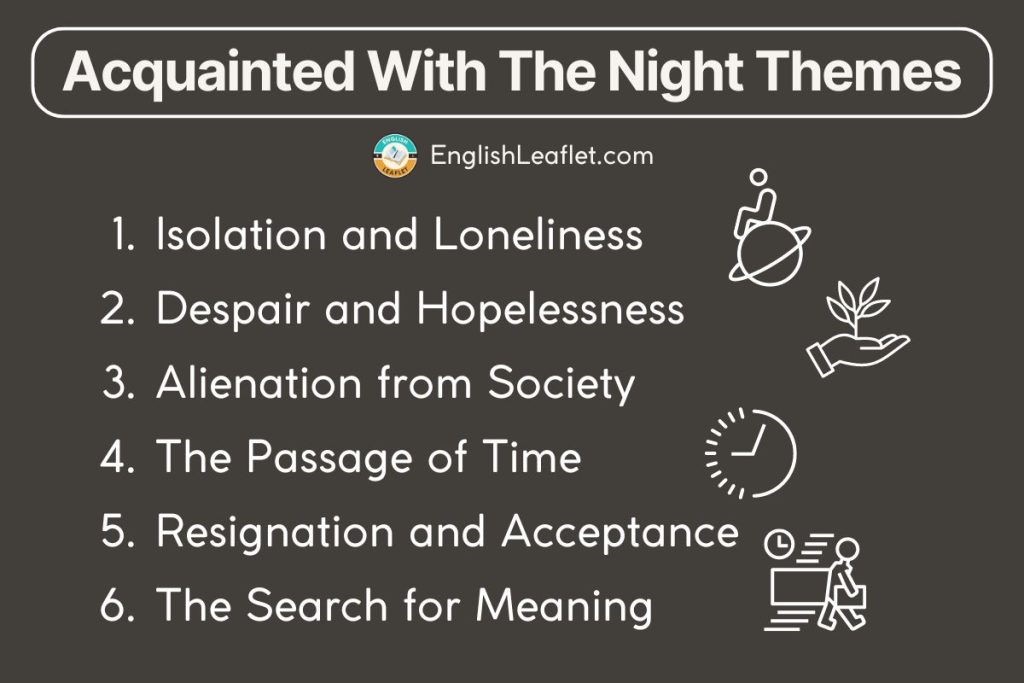
Themes in “Acquainted with the Night”
Theme#1
Isolation and Loneliness
The most prominent theme in the poem is of isolation and loneliness. The author demonstrates his experience of walking through the city at night when he is completely alone and disconnected from the world around him:
“I have walked out in rain—and back in rain.
I have outwalked the furthest city light.”
Here, the speaker underlines his detachment from the society. He emphasizes his loneliness indicating how he has to walk “out in rain” and “back in rain” without any fellowship .
The exposure to rain might literally mean that he is confined to his space and it is rainy outside and this regularity/prosaically conveys the tedium of the isolation he is experiencing.
They fact that he has “outwalked the furthest city light” reflects his separation from the warmth and life of the city. Here, the city light indicates a symbol of unity and belonging, but the speaker has proceeded beyond it, into a space of complete loneliness.
This theme of isolation refers to the internal condition of the speaker whose psychological condition effectively excludes him from the community.
Theme#2
Despair and Hopelessness
Despair and hoplessness are main themes of the poem. The speaker’s movements through the night are not only physical, but symbolical as well. The night represents a time of darkness and uncertainty, mirroring the speaker’s internal feelings of despair:
“I have looked down the saddest city lane.”
The line presents the frustration as well as hopelessness of the speaker. The “saddest city lane” means that the speaker has set a negative staining on the reality of his or her environment. The word ‘saddest’ directly shows that the speaker has a high level of self-consciousness about his/her sadness while attributing that to the surroundings.
Despair is another theme that spreads through a poem and is underlined by the frequent references to blackness and void, which confirm the subject’s feeling of being enclosed in a vicious cycle.
There is a helpless tone in the poem that reflects the speaker’s inability to find a way out of the despair as the night deepens on their his lonely walk.
Theme#3
Alienation from Society
The alienation from the society is considered another key theme in ‘Acquainted with the Night’. The poem appropriately reveals the themes of alienation from people and the surrounding world. The speaker’s encounters with others are marked by a profound sense of distance and disengagement:
“I have passed by the watchman on his beat
And dropped my eyes, unwilling to explain.”
In this passage, the act of not being able to look directly at the face of the watchman whom the speaker passes on the stairs also depicts a fear of power, or the structured society of which the speaker is an outcast. The refusal or inability to look at the watchman when they ‘drop’ their eyes shows that there is a much deeper estrangement from the society and its norms.
The speaker also avoided any further explanation as a sign of the self-perceived isolation as he or she does not feel that anything they are dealing with or feeling is comprehensible to others. Hence, the theme of alienation in this case depicts the mentality of the speaker who is trying to find his or her way in an unresponsive society.
Theme#4
The Passage of Time
The poem touches on the idea of time as an ongoing and unchanging force that contributes to the speaker’s sense of loneliness and despair. The speaker’s walk through the night is marked by an awareness of time passing, yet it feels stagnant and unyielding:
“One luminary clock against the sky
Proclaimed the time was neither wrong nor right.”
In these lines, “luminary clock” stands for time as something impersonal and unconcerned with the lives of the individuals. The fact that the clock speaks each time informing that it is neither wrong nor right has somewhat a meaning that implies hopelessness in the passing of time. The night for the speaker is without end and is a cyclical process, and time is not a healer in this case.
This theme suggests a person’s existentialist problem: the speaker is in pain, but the world will never give him relief nor the truth. Another aspect of the night that the speaker is said to be “known to” is time – another reference to being close acquaintances with the feeling of hopelessness and loneliness associated with the night.
Theme#5
Resignation and Acceptance
Another theme in “Acquainted with the Night” is the speaker’s resignation and acceptance of their circumstances. Throughout the poem, the speaker does not express anger or rebellion against their situation; instead, there is a quiet acceptance of the loneliness and darkness that they encounter:
“I have been one acquainted with the night.”
This repeated line indicates the speaker’s comfort ing the night, which indicates that he has accepted the darkness and loneliness in his life. The fact that the subjects have claimed to become ‘acquainted’ with their current status suggests that they have come to accept their state of affairs, how optimal or otherwise it may be.
This theme of resignation represents the passive acceptance of life’s tribulations which is indicated by the speaker’s acceptance of loneliness. Vulnerability of the Angels is obvious and the poem describes the possibility to endure the night with dignity and without questioning the predominant darkness.
Theme#6
The Search for Meaning
The theme of the search for meaning is delicately intertwined throughout the poem. The speaker’s journey through the night can be seen as a metaphorical search for understanding in a world that often feels empty or indifferent:
“I have stood still and stopped the sound of feet
When far away an interrupted cry
Came over houses from another street,”
In these lines, the poet halts in his walking and hears an ‘interrupted cry’ from a certain distance. This moment of stillness indicates what may be the individual’s conscious search for some form of purpose or interaction in the surrounding environment. However, the cry is far away and “interrupted”, leaving the speaking unsure and without clear answers.
The theme of the search for meaning reveals the perpetual home for people in their pursuit for purpose in life regardless of the shroud of darkness that surrounds them. Thus, the speaker’s unlimited wandering through the night is described as the ongoing search for solutions though the answers are still timeless.
This theme encompasses the pursuit for a life’s purpose and meaning in a world that can be perceived as indifferent and unhearing.
Summary of “acquainted with the night”
The speaker expresses the walking alone through a dark and lonely city at night. They seem to be grappling with depression, loneliness and inner disorder. In the first stanza, the speaker sets the dark scene, walking alone down sad, empty streets late at night.
They portray how they have “outwalked the furthest city light” propounding how far they have wandered away from other people and activity.
The second stanza reveals the city is lifeless even at the peak time of “midnight.” The speaker passes by a clock that seems to judge them, reinforcing their solitude.
In the third stanza, the speaker meets a watchman on his rounds. Even this authority figure only gives a small greeting, which emphasizes the speaker’s sense of separateness and anonymity.
The fourth stanza finds the speaker walking through the districts of crying, rage and hidden sorrow, hinting at a deeply troubled state of mind.
They seem numb to the cold rain falling. In the last lines, the speaker confirms they will continue walking this solitary way of darkness into the future. There is a sense of both acceptance and departure.
Overall, the poem uses the setting of a desolate nighttime walk to reveal the inner sorrow, loneliness and separation from the society. The speaker is intimately acquainted with darkness, both around and within.
Poetic Devices Used in “Acquainted with the Night”
- Symbolism – The nighttime setting is a symbolism of depression, loneliness and sorrow. Darkness reflects the speaker’s internal confusion.
- Metaphor – Walking alone at night indicates as a metaphor for struggling with isolation and inner agony.
- Repetition – The word “night” has been repeated numerous times. It emphasizes the poem’s dark tone and themes.
- Imagery – Visual descriptions like the “saddest city lane” invoke the setting vividly. Readers can imagine the empty streets.
- Alliteration – The phrases, such as “furthest city light” employ alliteration (repeating consonant sounds) to create flow.
- Rhyme – While not strict, slant rhymes like “rain/lane” create musicality.
- Iambic pentameter – The rhythmic da-DUM da-DUM 5-beat line structure adds to the melancholic atmosphere.
- Enjambment – The lines break mid-clause for continuity, which reflects the speaker’s underway walk.
- Consonance – The repetition of consonant sounds in words like “lonely” “only” and “crying” create cohesion.
- Tone – The poem has a deeply solemn, contemplative, resigned tone colored by sadness and isolation.
