

Introduction to The Iliad
The Iliad is one of the earliest and certainly the most famous works of Greek literature written by Homer. It was possibly written in the 8th century BCE, it is an epic poem that tells the story of the Trojan War which is said to have been a war between the Greeks (Achaeans) and the Trojans.
The main theme of the poem “Iliad” is the Greek hero, Achilles, and his anger – which plays an important role in the events that are described in the poem. The action of The Iliad takes place during the last weeks of the ten-year siege of Troy and raises many important themes which have always been topical.
Themes In The Iliad
Theme#1
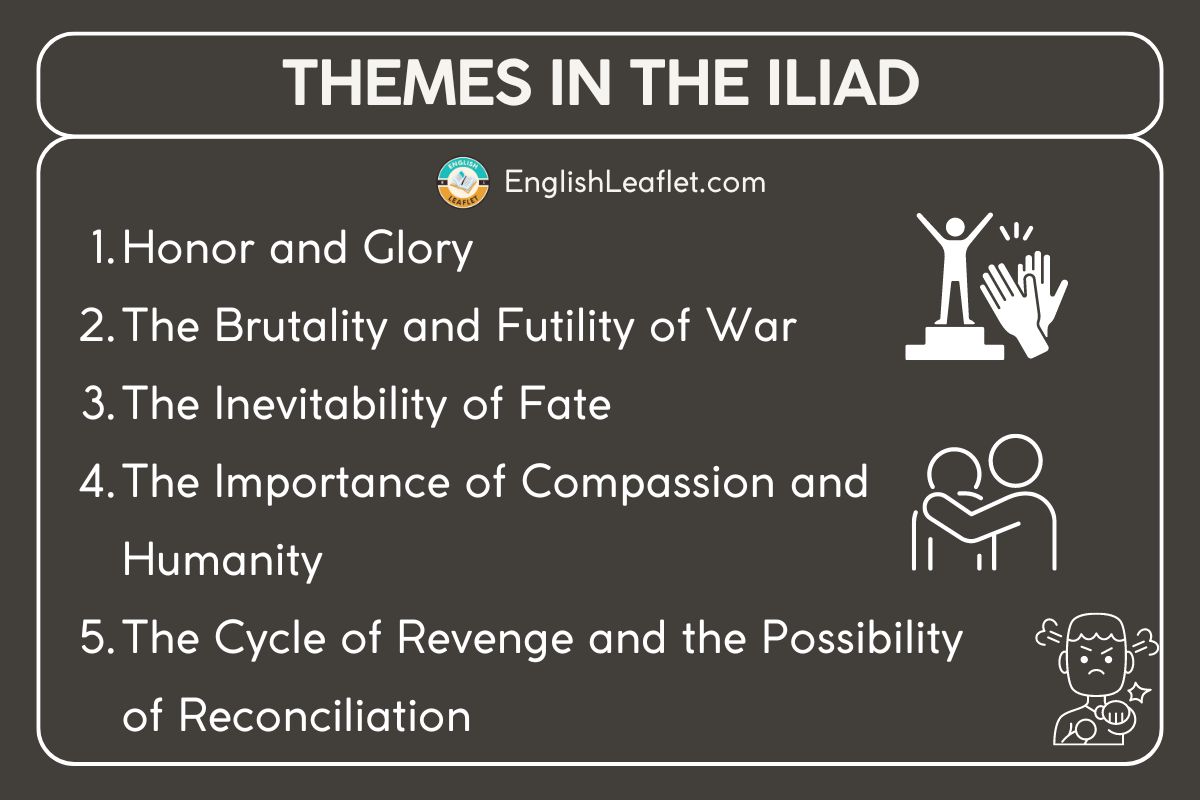
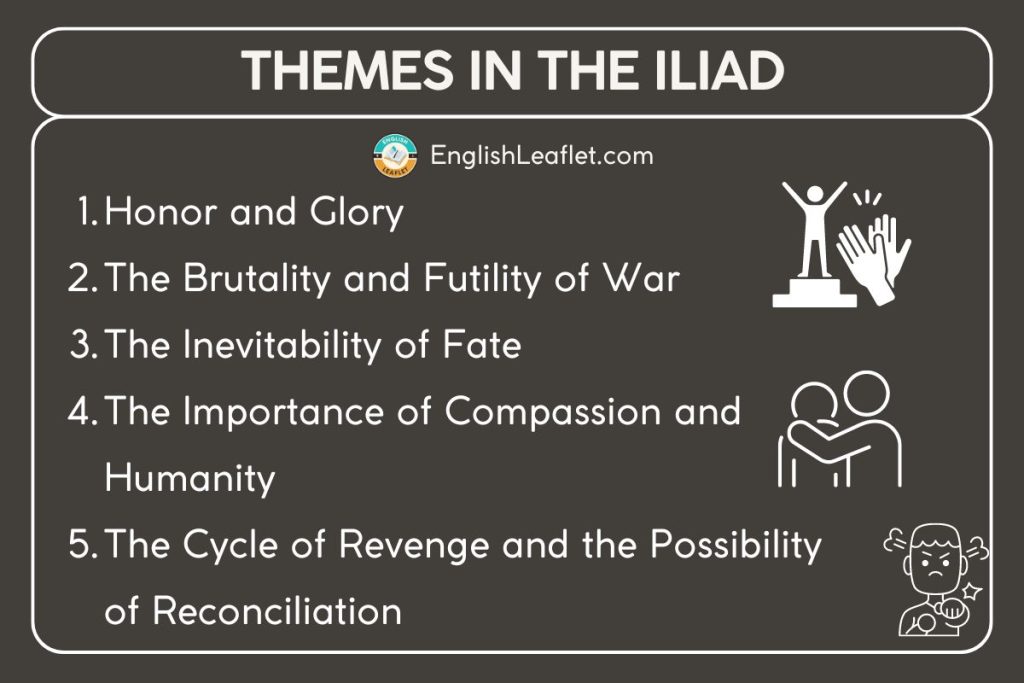
Honor and Glory
The major theme of the poem is the idea of honor and glory. It is the force that influences many characters most of all Achilles. In the culture of ancient Greeks, honor was one that a warrior strived to get by fighting courageously in battle to sustain his status.
The principal hero of the Iliad, the foremost warrior of the Greeks, Achilles, is obsessed with his posthumous glory. His wrath is directed at Agamemnon the commander of the Greek army because the latter has taken away his prize – the wife of the captured Trojan, Briseis. This action provokes Achilles’ anger and this becomes one of the themes in the poem.
An example of the theme of honor and glory has been discussed in Achilles’ speech to Agamemnon in Book 1:
“I, for my part, did not come here for the sake of the Trojan spearmen to fight against them, since to me they have done nothing. Never yet have they driven away my cattle or my horses, never in Phthia, the deep-soiled land where the ground nurtures heroes, have they spoiled my harvest, since indeed there is much that lies between us, the shadowy mountains and the echoing sea. But you, O great shamelessness, we followed, to do you favor, you with the dog’s eyes, to win your honor and Menelaos’ from the Trojans. You forget all this or else you care nothing.” (Book 1, Lines 152-160)
Achilles in this passage gives an account of the selflessness that he has made to join the war and fight for Agamemnon and Menelaus. The phrase : ‘to win your honor’ emphasizes the role of honor in the characters’ actions and desires.
This is because his efforts in the war are not properly appreciated, thus he decides to withdraw from the war and stop fighting, a decision which becomes disastrous to the Greek forces.
Theme#2
The Brutality and Futility of War
The Iliad does not turn its back to the realities of the warfare while presenting it in its dramatic setting. The poem contains rather sharp images of the war and killing, which gave a picture of how gruesome a warzone must look like.
War is depicted by Homer in an appalling light whereby it always ushers suffering to the winners as much as it does to the losers. Even though warriors chase after glory, the poem also shows that the war is unavailing because it causes the loss of many lives and leaves behind a path of destruction.
A stirring instance of this theme has been floated in the description of the death of Sarpedon, a Lycian ally of the Trojans, in Book 16:
“So he spoke, and Patroklos obeyed his beloved companion. Then, going back again, he stood, a man like Ares, who had the heart beyond measure. He let fly a spear in the middle of the battle, and there Sarpedon, a leader of the Lykians, was hit in the heart by the throwing of Patroklos. The son of Zeus groaned terribly as the spear was driven deep in his heart, and he grasped it as life left him, like a lion overpowered by men in a close fight. As he falls in the mountains, heavy is his spirit. His life is poured out in the dust.” (Book 16, Lines 480-487)
The death of Sarpedon also underlines the fact that the war is ruthless. Sarpedon may be a brother of the gods but he is as fated on the field of battle as any man. The comparison of his death to the lion defeated by men indicates the harsh nature of the war, where the powerful can be defeated.
The image reflecting that the life of Samson was “poured out in the dust” can even be interpreted as complete futility of the war to which references to the momentary glory and an inevitable death can be applied.
See also: Themes in “A Dream Within A Dream”
Theme#3
The Inevitability of Fate
In The Iliad, the theme of fate is very vital. Characters are overbearingly conscious of the destiny that awaits them, while they continue to perform in ways that lead up to that destiny.
The idea of fate in the poem is closely connected to the free will of gods, who are presented as constantly interfering in the lives of mortals in order to make their fate unfold.
Achilles’ fate is essential in the entire story. He is aware that he has a choice between two destinies: a life that is long and boring or a life that is short but full of honors. Yet, despite the knowledge that he is going to die because of his pursuit of glory, Achilles agrees to the latter willingly.
This theme has been vividly described in Achilles’ communication with his mother, Thetis, in Book 18:
“Mother, I must choose: to stay here and fight beside the ships and lose my life in glorious battle, or return home, to the love of my father, and live to old age. My fate is to be cut short; I cannot have both.” (Book 18, Lines 87-90)
The predictability of the death of the great Greek warrior underlines the role of fate in ‘The Iliad’. He is aware that he cannot avoid whatever has been written for him, therefore, chooses to die fighting for glory.
The position of acceptance of fate which the poem brings to the reader is usual as characters accept their fates and their inability to change anything regarding that.
Theme#4
The Role of the Gods
The gods are depicted in The Iliad as vengeful and fickle beings who are often meddlesome with the affairs of men. They are one of the key factors of the development of the Trojan War and acting for mostly selfish reasons and as enemies.
The relation of the gods with people portrayed in the poem resembles the concept of the Greece deities interfering with the day-to-day lives of their human subjects, which is typical in the Greek literature.
The connection of gods in the war is obvious in various examples, such as when Zeus chooses to tip the scales of battle in favor of the Trojans in Book 8:
“Zeus held out his sacred golden scales. In them he set two fates of death that lays men low— one for the Trojan horsemen, one for the Argives armed in bronze. He held the beam by the middle, and down went the day of doom for the Argives. The Achaeans’ fate sank down to the house of Death, and the fate of the Trojans rose toward the heavens.” (Book 8, Lines 68-72)
In the passage, Zeus weighed the fates of the Greeks and Trojans, determining the result of the battle. The reference of scales underscores the power of gods to decide the course of human events.
The Greeks’ destiny has been seen as being changeable; it is all in the hands of the gods. This element of fate also leads to the theme of intervention, where mortals are helpless in the face of gods and also attributing the results of man’s actions to the gods.
Theme#5
The Importance of Compassion and Humanity
The novel is not limited to portray the war only but also exposes the acts of savagery and ruthlessness along with kindness. War is brutal, and people’s actions are often led by animal instinct; however, there are occasional episodes when warfare participants remember that the enemy is people too.
The most touching example is the confrontation between Priam – the king of Troy and Achilles in the Book 24. Priam weeping for the death of his son Hector by the hands of Achilles goes to the Greek camp to plead for the corpse of Hector. When, for instance, Achilles touched by Priam’s grief, he feels compassion and agrees to returns Hector’s body to him for burial.
The scene has been beautifully explained in the following passage:
“And both were taken by the remembrance of their sorrow. Priam, lying at Achilles’ feet, wept for Hector, and Achilles wept for his father and for Patroklos, and the sound of their lamentation filled the house.” (Book 24, Lines 507-510)
The moment of bereavement between two sworn foes indicates the theme of compassion and the recognition of common humanity. Despite the enmity between the Greeks and Trojans, Achilles and Priam are capable to connect on a deep emotional level, rising above the hatred that has shaped their relationship. The tears they shed reflect the shared experience of loss and the ability for affinity, even during the war.
Theme#6
The Cycle of Revenge and the Possibility of Reconciliation
The poem also deals with the problem of revenge, as well as the possibility of reconciliation. The cycle of revenge produces the conflict in the poem, as the characters want to avenge their kin or defend their dignity. However, there is also an understanding in the poem that it is possible to be reconciled, even if you are bitter enemies.
The longing for revenge for Patroclus’ death and the dishonor of Hector is one of the main motifs of the novel: He is a man of revenge, who does not spare the enemy even after the war and kills Hector in a violent battle. But the poem also holds out the hope of forgiveness as for instance when Achilles decides to return Hector’s body to Priam.
The theme of revenge and reconciliation has been expressed in Achilles’ words to Priam:
“No more, old man, do not provoke me further. I myself am minded to give Hector back to you. For Zeus has sent me a messenger, the mother who bore me, the daughter of the Old Man of the Sea, and I know, O Priam, that you do not come with an evil purpose to the ships of the Achaeans, but with an intention to ransom your son, led by the will of the gods.” (Book 24, Lines 560-565)
The decision which the hero Achilles makes to return the corpse of Hector to Priam and the king’s son is one of the examples of the reconciliation. This action has the effect of halting the chain of revenge and gives the characters a chance to breath even though it is short-lived.
The concept of reconciliation in the poem implies that, in the world of the epic hero, who is driven by the thirst for blood and revenge there is always a chance for reason and compromise.
See also: How Does The Frame-Story Structure Create Tension?
