

Introduction to “Let America Be America Again“
Let America Be America Again is one the most powerful poems written by Langston Hughes, a key figure of the Harlem Renaissance. It was published in 1936, which captures Hughes’ anger towards the American dream and the life of Americans during the Great Depression.
In his work, Hughes seems to agree with the American Dream that guarantees freedom, equality, and prosperity for all; however, the author shows that these virtues are still a dream for many people in the United States, especially the black people, the native American Indians, immigrants, and the working class. The poem is a critique of America and an anthemic appeal to the nation to reclaim its ideals.
The themes of the poem are based on the idea of the failure of the American Dream, the experience of the oppressed and discriminated people, the fight for liberation and the hope for change. Hughes employs many features which include the use of imagery and informal language to address the reader in a very simple manner.
Themes in “Let America Be America Again“
Theme#1
The Illusion of the American Dream
It is one of the significant themes in the poem. The author criticizes the concept that America has always been a home of freedom and equal opportunities. He proclaims that the American dream simply does not exist for most people. He considers the American Dream as a fairy tale and the promise which has not been fulfilled.
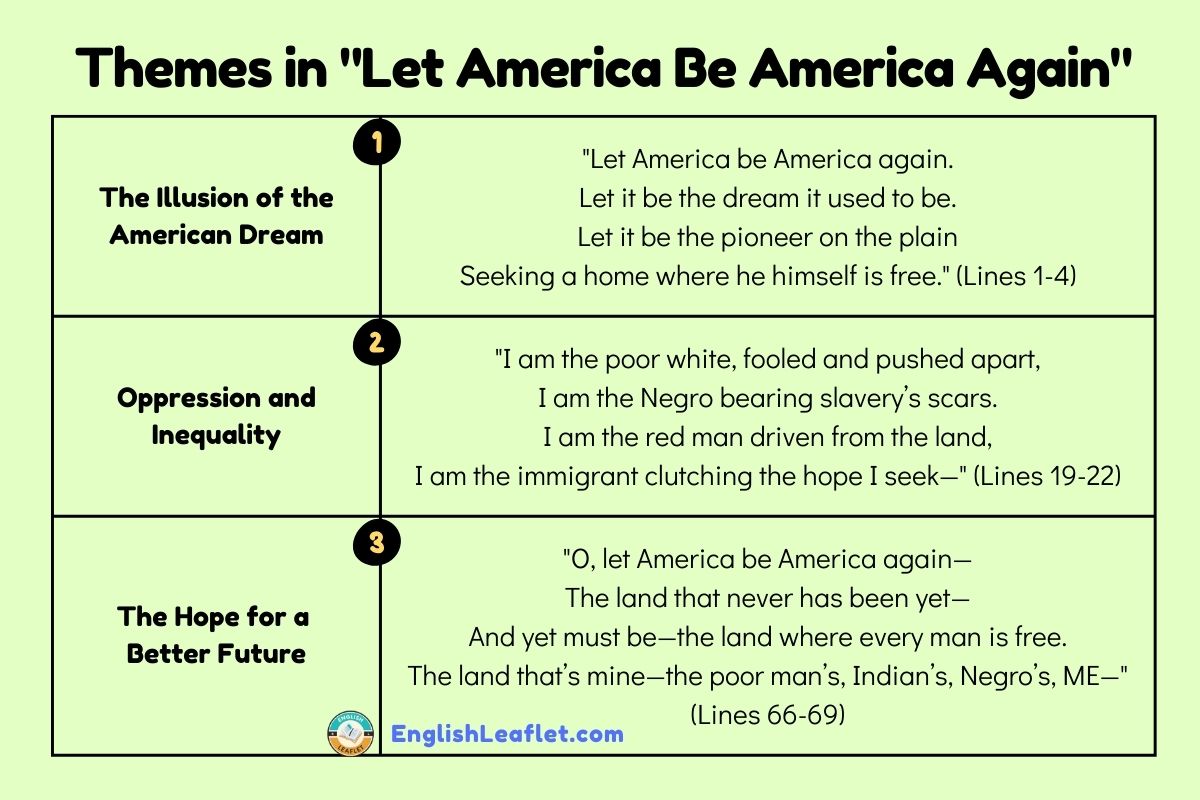
Hughes presents this theme in the beginning of the poem with the following lines:
“Let America be America again.
Let it be the dream it used to be.
Let it be the pioneer on the plain
Seeking a home where he himself is free.” (Lines 1-4)
In these lines, Hughes refers to the conception of the America as the land of opportunity. However, he quickly undermine this ideal with a parenthetical aside:
“(America never was America to me.)” (Line 5)
This line sharply contrasts the preceding hopeful statements, but at the same time, it expresses the speaker’s disappointment.
Hughes maintains that the ‘American Dream’ has always been mirage for the natives like the American black, Native American peoples, immigrants and working poor. Under that perspective, the poem retains the discussion on how the dream of prosperity and freedom has been suppressed to these groups.
Theme#2
Oppression and Inequality
Hughes paints a picture of oppression and inequality in the poem. He indicates how the black man and other groups have been denied the American dream. The poem deals with the question of oppression that African Americans, Native Americans, immigrants and the working people had to endure in the past and now.
This theme has been powerfully described in the following stanza:
“I am the poor white, fooled and pushed apart,
I am the Negro bearing slavery’s scars.
I am the red man driven from the land,
I am the immigrant clutching the hope I seek—” (Lines 19-22)
In this stanza, Hughes tells the various groups of America that have been oppressed. He considers himself as one of the suffering minorities to emphasize how different people of the world are all the same and related.
The poem also calls the attention of the reader to the fact that these groups of people in America have not received their liberty and have not prospered as the country promised they would.
See also: Themes in Invisible Man
Theme#3
The Struggle for Freedom and Justice
The theme of struggle for freedom and justice pervades throughout the poem. Hughes reminds the readers that the rights of the African Americans and other minorities have never been attained easily – it is a battle that one has to win.
This theme is related to the theme of oppression as usually, the oppressed are the ones who will be at the forefront of bringing change.
In the following lines, the authors indicates the prevailing struggle for freedom:
“I am the man who never got ahead,
The poorest worker bartered through the years.
Yet I’m the one who dreamt our basic dream
In the Old World while still a serf of kings,
Who dreamt a dream so strong, so brave, so true,
That even yet its mighty daring sings
In every brick and stone, in every furrow turned
That’s made America the land it has become.” (Lines 25-32)
These lines highlight the fact that freedom and justice are basic to the American’s identity, however, many people have never experienced it.
Hughes also notes that the dream is cherished and preserved by the protagonists of the story—those who are exploited and deprived of their rights—because it belongs to the oppressed who never stop fighting. Freedom has been explored as both an individual pursuit and the fight of the society, which requires determination and courage.
See also: Slaughterhouse Five Themes
Theme#4
The Hope for a Better Future
‘Let America Be America Again’ is a poem of hope despite the fact that it spells out oppression and inequality all over. Hughes also has a profound desire of waiting for the day when America would embody democracy as it should be – a country of real equality for Blacks and other people.
The theme of hope is interwoven throughout the poem, in relation to many themes with reference to disillusionment and oppression.
The hope for a better future has been clearly depicted in the following lines:
“O, let America be America again—
The land that never has been yet—
And yet must be—the land where every man is free.
The land that’s mine—the poor man’s, Indian’s, Negro’s, ME—” (Lines 66-69)
In these lines, Hughes dreams that America executes its promise of freedom and equality for all its citizens. He concedes that although the dream has not been fully realized, but he believes that it can be achieved in future.
The phrase “let America be America again” is repeated throughout the poem, which is both a criticism as well as a demand on the nation to do better.

Theme#5
The Collective Voice of the Oppressed
There is another important theme in this poem – the collective voice of the oppressed. In the poem, Hughes raises voice for himself as well as for the people who have been oppressed in American society. He describes their efforts and desires, which create a strong message of determination and hope.
This collective voice is evinces in the following lines:
“We, the people, must redeem
The land, the mines, the plants, the rivers.
The mountains and the endless plain—
All, all the stretch of these great green states—
And make America again!” (Lines 74-78)
In the ending lines of the poem, the writer invokes by saying “we, the people” to take action and retrieve the American Dream. The common use of ‘we’ reinforces the notion that the struggle for justice and parity is a social endeavor.
It also emphasizes the importance of the unification and synergy of the oppressed, reaffirms the idea how the change can only be achieved through the mutual effort.
Poetic Devices Used in “Let America Be America Again”
In the poem “Let America Be America Again” by Langston Hughes, the author uses several features of poetry to bring out the emotion and properly address the issues of the poem. Below are some of the key poetic devices used in the poem:
1- Repetition
The phrase ‘Let America be America again’ has been repeatedly used in the poem. The constant use of this phrase makes it vivid for the speaker to wish that America would be true to its word concerning freedom and equality. It also emphasizes the difference between the idealized vision of America and the reality faced by the underrepresented communities.
2- Alliteration
In the line, “The land that never has been yet—And yet must be”, there is a repetition of “l” and “b” sounds, which creates a melodic quality and draws attention to the optimistic message that America can still become what it was meant to be.
See also: What is alliteration in literature?
3- Anaphora
“I am the poor white, fooled and pushed apart, I am the Negro bearing slavery’s scars. I am the red man driven from the land, I am the immigrant clutching the hope I seek—”. The repetition of “I am” at the start of successive lines creates a rhythmic pattern and fortifies the universality of the identification of the speaker, which represents many marginalized communities.
See also: Anaphora Examples
4- Imagery
“Out of the rack and ruin of our gangland wars, The rape and rot of graft, and stealth, and lies”. Here, the writer employs evocative imagery to draw a picture of the corruption and violence that have impaired the American’s history. This imagery helps to convey the sense of disenchantment and deception felt by the speaker.
5-Personification
“Let America be the dream the dreamers dreamed—”. Here, by referring to America as something people’ve dreaming, Hughes postulated that America is in effect a dream – an illusion. This device highlights the discrepancy between the two; the expectations of America and the reality of it.
6- Metaphor
“I am the man who never got ahead, / The poorest worker bartered through the years”. Hughes by using the metaphor expresses the exploitation of the working class. The concept of being “bartered’ means the workers themselves are mere items, which further aggravates their sense of powerlessness and objectification.
See also: Personification in poetry
7- Enjambment
“And who are you that draws your veil across the stars?”. Enjambment where the line runs on to the next line adds to the poem the speed and continuity. This has the ability to mirror some of the issues being debated and thus is not fully resolved.
8- Rhetorical Question
“Who said the free? Not me?”. Here, the use of rhetorical questions is to make the reader to ask himself who gains from the freedoms offered by America. It raises questions on the rights of freedom and the real situations of various communities in the society.
See also: Themes in King Lear
