

Why does my heel hurt so bad — this is one of the most common questions doctors hear every single day. Heel pain can stop you from walking, working, exercising, and living your normal life.
Whether the pain is sharp in the morning, dull after long hours on your feet, or throbbing at the back of your ankle, there is always a reason behind it.
What Is Heel Pain and Why Is It So Common?
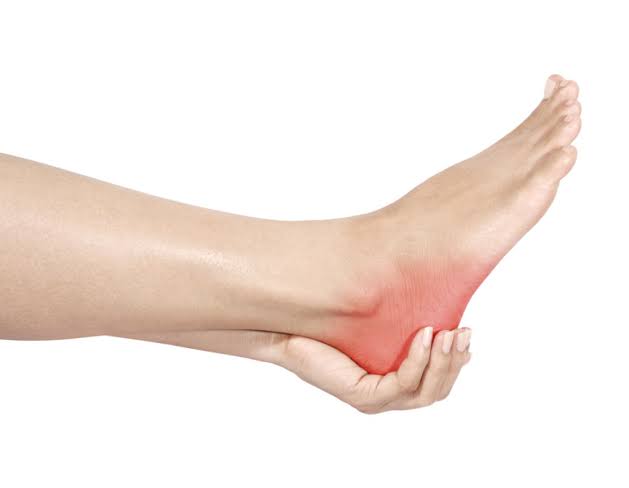
Heel pain is not a diagnosis — it is a symptom. Your heel bone (calcaneus) is the largest bone in your foot, and it absorbs massive impact every time you take a step.
When the tissues around it get inflamed, torn, or compressed, the result is that sharp, stabbing, or aching pain you feel.
Studies show that more than 10% of the world’s population will experience significant heel pain at some point in their life. It affects runners, office workers, teachers, parents, and athletes equally.
Why Does My Heel Hurt So Bad — The Real Causes
There are multiple reasons your heel can hurt badly. The location of the pain is the biggest clue. Here is a breakdown of all major causes, where they hurt, and what they feel like.
Plantar Fasciitis — The #1 Reason Your Heel Hurts
Plantar fasciitis is the single most common cause of heel pain worldwide. It affects over 2 million people in the United States every year.
The plantar fascia is a thick band of tissue that runs along the bottom of your foot, connecting your heel bone to your toes. When this band becomes inflamed or develops micro-tears from overuse, it causes intense stabbing pain at the bottom of your heel.
How Plantar Fasciitis Pain Feels
The classic sign is sharp heel pain with the first steps in the morning. The pain can be so severe it makes you limp out of bed.
After walking for a few minutes, it usually eases up. But it often returns after long periods of standing or sitting.
Who Gets Plantar Fasciitis?
| Risk Factor | Why It Increases Risk |
|---|---|
| Flat feet or high arches | Abnormal stress on the fascia |
| Obesity or excess weight | Extra load on heel tissues |
| Long hours of standing | Repetitive strain on the plantar fascia |
| Running on hard surfaces | Impact trauma |
| Tight calf muscles | Pulls the fascia tighter |
| Poor footwear | No arch support, increased strain |
| Age 40–60 | Tissue elasticity decreases |
How Plantar Fasciitis Is Treated
Rest is step one. Reducing activities that caused the problem gives inflamed tissue time to heal.
Stretching the plantar fascia and calf muscles daily is one of the most evidence-backed treatments available. Doing them before your first morning step can significantly reduce that stabbing pain.
Ice packs applied for 20 minutes, three times a day, reduce inflammation effectively. Supportive footwear with proper arch support is essential — avoid going barefoot at home.
Over-the-counter anti-inflammatory medications like ibuprofen can help during flare-ups. Heel cushion inserts and night splints are also widely recommended by podiatrists.
In more resistant cases, a doctor may suggest corticosteroid injections or physical therapy. Surgery is very rare and only considered after all conservative options fail.
Achilles Tendinitis — Pain at the Back of Your Heel
If your heel hurts at the back, not the bottom, Achilles tendinitis is likely the cause. The Achilles tendon connects your calf muscles to your heel bone. It is the longest and strongest tendon in the body.
When this tendon becomes inflamed from overuse or a sudden increase in physical activity, it produces pain, stiffness, and swelling right above the heel.
Achilles Tendinitis Symptoms
Pain above the back of the heel, especially during and after exercise, is the hallmark sign. Morning stiffness and tenderness when you press on the tendon are also very common.
The pain usually eases after warming up but returns worse after intense activity. Runners and basketball players are especially prone to this condition.
Treatment for Achilles Tendinitis
Rest and activity modification are the primary treatments. Eccentric heel-drop exercises (slowly lowering your heel off a step) are among the most effective therapies for this condition.
Physical therapy, supportive footwear with a slight heel lift, and ice are standard care. In cases with small tendon tears, a boot or brace may be needed to rest the tendon fully.
Heel Spurs — Are They Really the Problem?
A heel spur is a bony outgrowth that forms on the underside of the calcaneus bone. Many people believe heel spurs cause their pain, but here is the truth most doctors will tell you: more than 15% of the general population has a heel spur on X-ray and feels no pain at all.
Heel spurs typically form as a reaction to the stress and inflammation already caused by plantar fasciitis. In most cases, the plantar fasciitis is the real problem — not the spur.
Treatment for painful heel spurs is essentially the same as for plantar fasciitis: rest, orthotics, stretching, and anti-inflammatory care.
Stress Fractures of the Heel Bone
A calcaneal stress fracture is a small crack in the heel bone caused by repetitive force. It is less common but far more serious than soft-tissue conditions.
Unlike plantar fasciitis, which is worst in the morning, stress fracture pain gets worse with continued activity and may not ease up with rest.
How to Tell If It Might Be a Stress Fracture
Squeeze your heel from both sides (between your thumb and fingers on the inside and outside of the heel). If this causes significant pain, that is a warning sign of a stress fracture.
Stress fractures require imaging — X-rays or MRI — to confirm. Treatment involves complete rest, often in a walking boot, for 6 to 8 weeks.
Bursitis — Fluid-Filled Sacs Causing Heel Pain
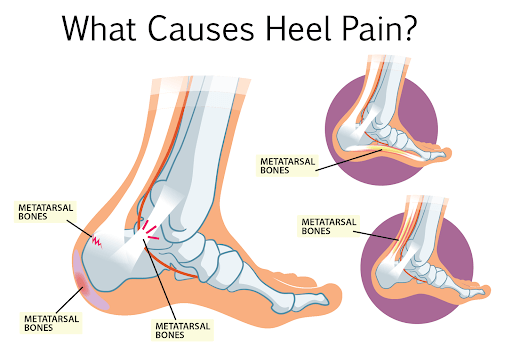
Bursae are small fluid-filled sacs that cushion the joints and reduce friction. Two bursae sit near your heel — one between the Achilles tendon and the skin, and one between the Achilles tendon and the heel bone.
When these sacs become inflamed (bursitis), they cause pain, tenderness, and a puffy, bruised-like feeling at the back of the heel.
Prolonged time on your feet, ill-fitting shoes, and conditions like Haglund’s deformity can all trigger heel bursitis.
Haglund’s Deformity — The “Pump Bump”
Haglund’s deformity is a bony enlargement that develops on the back of the heel where the Achilles tendon attaches. It is nicknamed the “pump bump” because it commonly develops in people who wear rigid-backed shoes like high heels, dress shoes, or ice skates.
The bump itself causes irritation and can compress the Achilles tendon and nearby bursae. Symptoms include a visible or palpable lump at the back of the heel, pain with shoe wear, redness, and swelling.
Switching to open-backed shoes, using heel pads, and anti-inflammatory medications usually manage symptoms well. Severe cases may require surgery to shave down the bony growth.
Tarsal Tunnel Syndrome — Nerve Pain in the Heel
Tarsal tunnel syndrome occurs when the tibial nerve gets compressed as it passes through the tarsal tunnel — a narrow passageway on the inside of the ankle. This produces burning, shooting, or tingling pain that radiates into the heel and arch.
The pain often gets worse at night or after prolonged standing. It can mimic plantar fasciitis but usually feels more like an electric shock or numbness than a sharp stab.
Diagnosis requires nerve conduction studies in some cases. Treatment ranges from orthotics and anti-inflammatory medications to corticosteroid injections or surgical nerve release.
Heel Fat Pad Syndrome — A Less-Known Cause
The fat pad under your heel acts like a natural shock absorber. With age, repeated cortisone injections, or significant impact trauma, this fat pad can thin out or shift out of place.
When this happens, you feel pain in the center of the heel — a deep, bruised ache — rather than at the front edge like plantar fasciitis. Cushioned insoles and supportive footwear are the primary treatment for this condition.
When to See a Doctor for Heel Pain
Not all heel pain needs immediate medical attention. But certain signs mean you should see a podiatrist or orthopedic specialist promptly.
| Warning Sign | Possible Cause |
|---|---|
| Pain persists more than 1 week | Plantar fasciitis, tendinitis |
| Severe swelling or bruising | Stress fracture, rupture |
| Pain after a fall or injury | Fracture |
| Numbness or tingling | Tarsal tunnel syndrome, nerve issue |
| Pain that disrupts sleep | Infection, inflammatory arthritis |
| No improvement after 2 weeks of home care | Needs professional evaluation |
How Doctors Diagnose Heel Pain
A doctor will start with a detailed history and physical examination. They will press on specific areas of the heel to identify the source of pain.
Imaging tests used for heel pain diagnosis include:
X-rays detect heel spurs, stress fractures, and bone tumors.
Ultrasound confirms plantar fasciitis, tendon thickening, or fat pad atrophy.
MRI is used when a stress fracture, tendon tear, or nerve issue is suspected and X-rays are inconclusive.
Effective Home Treatments for Heel Pain
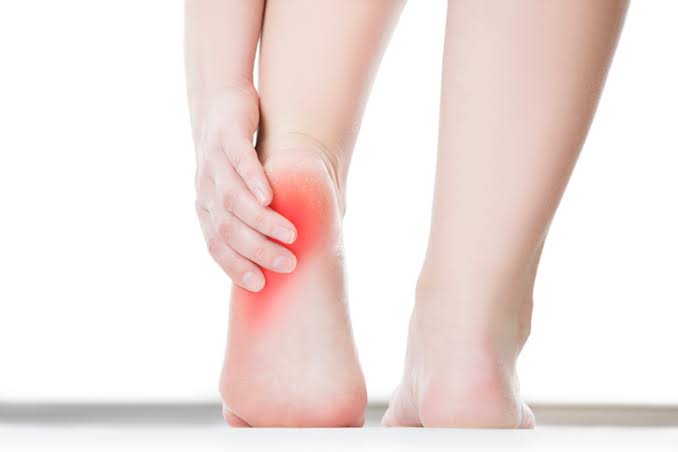
Most heel pain conditions respond very well to conservative home care, especially when started early. Here are the most proven approaches:
Stretching Exercises
The plantar fascia stretch is done by pulling your toes back toward your shin before putting your foot on the floor. Hold for 30 seconds and repeat 3 times each morning.
The calf stretch involves standing at a wall with one foot back, pressing the heel into the floor. Tight calves are a major driver of plantar fasciitis and Achilles problems.
Towel curls and marble pickups with your toes strengthen the small intrinsic foot muscles that support the arch.
Footwear Changes
Wearing supportive shoes with cushioned arch support is one of the most impactful changes you can make. Avoid flat sandals, flip flops, and walking barefoot on hard floors — especially first thing in the morning.
Motion-control running shoes with extra arch support are often recommended by podiatrists for people with flat feet.
Ice and Heat Therapy
Ice reduces acute inflammation. Apply for 20 minutes, three times daily. A frozen water bottle rolled under the foot works well for plantar fasciitis.
Heat therapy (warm foot soaks) relaxes tight calf and foot muscles and can be helpful before stretching.
Over-the-Counter Options
NSAIDs (ibuprofen, naproxen) reduce pain and inflammation. Heel cups and cushioned insoles (over-the-counter orthotics) reduce impact stress on the heel.
Night splints hold the plantar fascia in a gently stretched position while you sleep, preventing the tightening that causes that terrible first-step morning pain.
Medical and Advanced Treatments for Stubborn Heel Pain
When home care is not enough, doctors have several effective options.
Corticosteroid Injections
A corticosteroid injection delivers a powerful anti-inflammatory directly into the inflamed tissue. It can provide significant relief for several months. However, repeated injections can weaken the plantar fascia and thin the heel fat pad, so they are used sparingly.
Physical Therapy
A licensed physical therapist can design a structured program of strengthening, stretching, and manual therapy that addresses the root cause — not just the symptoms.
Extracorporeal Shockwave Therapy (ESWT)
Shockwave therapy delivers acoustic waves to the heel, stimulating tissue healing. It is FDA-cleared and widely used for chronic plantar fasciitis that has not responded to other treatments. Studies show good success rates with minimal side effects.
Platelet-Rich Plasma (PRP) Injections
PRP uses the patient’s own blood, processed to concentrate growth factors, and injects it into damaged tissue to accelerate healing. It is increasingly used for chronic plantar fasciitis and Achilles tendinopathy.
Surgery
Surgery for heel pain is rare. When needed, a partial plantar fascia release (cutting a portion of the fascia to reduce tension) or Achilles tendon debridement are the most common procedures. Most patients never need to reach this stage.
Heel Pain Comparison Table — Causes at a Glance
| Condition | Pain Location | Worst When | Key Feature |
|---|---|---|---|
| Plantar Fasciitis | Bottom of heel | Morning, after rest | Stabbing first step pain |
| Achilles Tendinitis | Back of heel/ankle | During/after exercise | Stiffness above heel |
| Heel Spur | Bottom of heel | Walking | Visible on X-ray |
| Stress Fracture | Anywhere on heel | During activity | Worsens with use |
| Bursitis | Back of heel | Pressure/shoe contact | Puffy, bruised feeling |
| Haglund’s Deformity | Back of heel bone | Shoe wear | Visible bony bump |
| Tarsal Tunnel Syndrome | Inside ankle/heel | Night, standing | Burning or numbness |
| Fat Pad Atrophy | Center of heel | Weight bearing | Deep bruised ache |
How Long Does Heel Pain Last?
Recovery time depends entirely on the cause and how early treatment is started.
Plantar fasciitis typically takes 6 to 18 months to resolve fully without treatment. With consistent stretching, proper footwear, and early care, most people see significant improvement within 6 to 8 weeks.
Achilles tendinitis can take 3 to 6 months to heal. Stress fractures require 6 to 8 weeks of activity restriction.
The key message: do not ignore heel pain. Untreated heel conditions become chronic and much harder to treat over time.
Prevention Tips — Stop Heel Pain Before It Starts
Wearing shoes with adequate arch support and cushioning is the single best prevention strategy.
Replacing running shoes every 400 to 500 miles prevents the loss of cushioning that leads to overuse injuries.
Maintaining a healthy weight reduces the load placed on the heel with every step. Stretching your calves and plantar fascia daily — especially before morning walks or exercise — dramatically reduces injury risk.
Gradually increasing activity intensity rather than sudden spikes prevents both tendinitis and stress fractures.
Frequently Asked Questions (FAQs)
Why does my heel hurt so bad in the morning?
The plantar fascia tightens during sleep. Those first steps stretch it suddenly, causing that sharp stabbing pain — a hallmark of plantar fasciitis.
Can heel pain go away on its own?
Mild cases may improve with rest alone, but most heel pain conditions need active treatment like stretching and proper footwear to fully resolve.
Is walking good or bad for heel pain?
Light walking is generally fine and may help warm up the tissue. But prolonged walking or walking barefoot on hard floors worsens most heel conditions.
What does a stress fracture feel like compared to plantar fasciitis?
Plantar fasciitis is worst in the morning and eases with movement. Stress fracture pain gets worse with activity and does not ease up with rest.
Should I see a podiatrist or orthopedic doctor for heel pain?
Either can treat heel pain. Podiatrists specialize exclusively in foot and ankle conditions. An orthopedic surgeon is better for suspected fractures or surgical cases.
How do I know if my heel pain is serious?
Severe swelling, bruising, numbness, or pain after an injury are red flags. If pain persists beyond one week or gets worse despite home care, see a doctor.
Does heel pain mean I have a bone spur?
Not necessarily. Most bone spurs cause no pain. Heel pain is usually from soft-tissue inflammation like plantar fasciitis, not the spur itself.
What is the fastest way to relieve heel pain?
Resting the foot, applying ice for 20 minutes, taking ibuprofen, and doing plantar fascia stretches before getting out of bed provide the fastest relief.
Can tight calves cause heel pain?
Yes. Tight calf muscles increase tension on the plantar fascia and Achilles tendon, making them a major contributing factor to both plantar fasciitis and Achilles tendinitis.
When is surgery needed for heel pain?
Surgery is rarely needed — only when all conservative treatments fail after 6 to 12 months. Less than 5% of plantar fasciitis patients ever require surgical intervention.
Conclusion
Why does my heel hurt so bad — now you have a complete, doctor-backed answer. The most likely cause is plantar fasciitis, affecting millions each year with that distinctive stabbing pain on the first step of the morning.
But Achilles tendinitis, heel spurs, stress fractures, bursitis, tarsal tunnel syndrome, and fat pad atrophy are all real possibilities that require different approaches.
The good news is that the vast majority of heel pain — no matter how severe — responds very well to conservative treatment.
Consistent stretching, supportive footwear, ice therapy, rest, and early medical care are the foundation of recovery. Do not wait until the pain becomes chronic.
See a doctor if pain lasts more than one week, and start your stretching and footwear changes today. Your heels carry you through every single day — they deserve proper care.
