

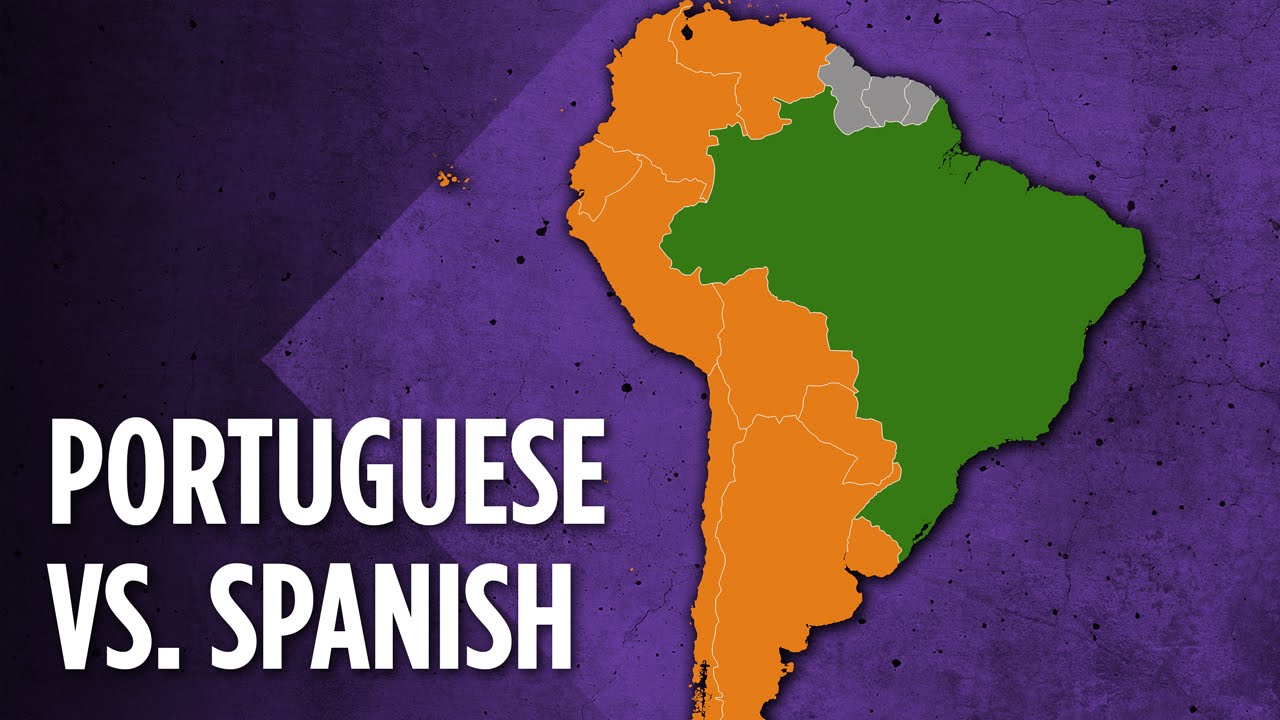
Why do Brazilians speak Portuguese when every other country in South America speaks Spanish? The answer lies deep in colonial history, a 1494 treaty that literally split the world in two, and centuries of Portuguese rule that reshaped an entire continent.
Brazil is the only nation in Latin America where Portuguese is the official language, making it a fascinating historical outlier.
The World Before Brazil Was “Discovered”
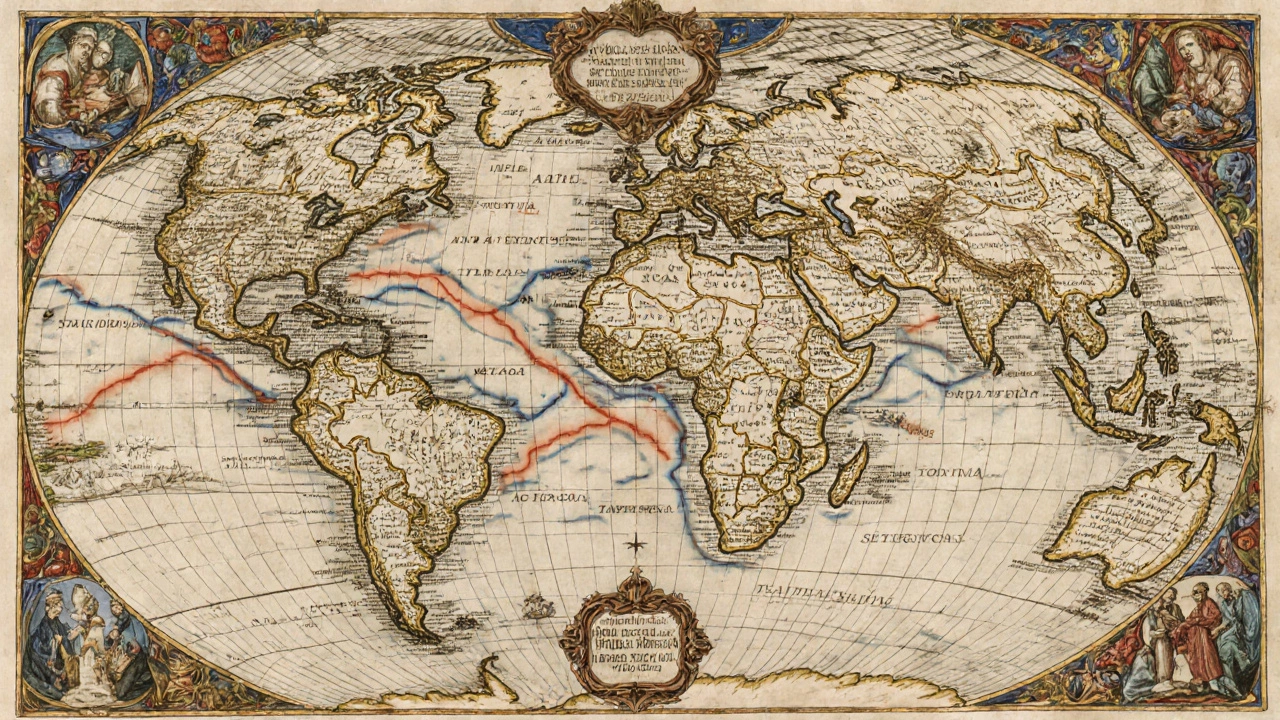
Before any European ship touched Brazilian shores, the land was home to millions of indigenous people.
Around six million indigenous people lived across the territory, speaking over 1,000 distinct languages. The Tupi people dominated the coastline and their language was the primary means of communication along the shore.
These were not primitive dialects. They were rich, complex language systems. Words like abacaxi (pineapple), piranha, caju (cashew), and tatu (armadillo) came from Tupi and would later enter Portuguese permanently.
The Age of Exploration and the Race for Territory
The late 1400s were a period of fierce maritime competition between Spain and Portugal.
Both nations were racing to find new sea routes and claim new lands. Spain funded Christopher Columbus, who reached the Caribbean in 1492. Portugal had already been exploring the African coast for decades.
When Columbus returned to Europe, he triggered an immediate diplomatic crisis. Spain and Portugal both wanted to claim the lands he had found — and they needed a way to divide the world without going to war.
The Role of Pope Alexander VI
The Catholic Church held enormous political power in 15th-century Europe. When Spain and Portugal could not agree, they turned to Pope Alexander VI.
In 1493, the Pope issued a series of decrees known as the Inter Caetera papal bulls. These documents attempted to divide the newly discovered lands between the two Catholic powers.
The Pope drew a line 100 leagues west of the Azores and Cape Verde Islands. Everything west went to Spain. Everything east went to Portugal. The problem? This line gave Portugal almost nothing of value in the Americas — just open ocean.
The Treaty of Tordesillas: The Line That Made Brazil Portuguese
Portugal’s King João II was deeply unhappy with the Pope’s arrangement. He pushed for renegotiation, and Spain agreed to meet.
On June 7, 1494, Spanish and Portuguese ambassadors signed the Treaty of Tordesillas in the town of Tordesillas, northwestern Spain. This document would change the course of history forever.
The new agreement moved the dividing line to 370 leagues west of the Cape Verde Islands — roughly 46°30′ West longitude. This shifted the boundary significantly further into the Atlantic.
| Detail | Information |
|---|---|
| Treaty Name | Treaty of Tordesillas |
| Signed | June 7, 1494 |
| Location | Tordesillas, Spain |
| Ratified by Spain | July 2, 1494 |
| Ratified by Portugal | September 5, 1494 |
| Papal Approval | Pope Julius II, 1506 |
| Dividing Line | 370 leagues west of Cape Verde Islands |
The crucial outcome: Brazil’s eastern bulge — its coastal “hump” — protruded east of that new line. This meant Brazil fell into Portuguese territory, not Spanish territory. One treaty, one line on a map, and the linguistic fate of 215 million people was set.
Pedro Álvares Cabral Arrives in 1500
The ink on the Treaty of Tordesillas was barely dry when Portugal moved to claim its territory.
On April 22, 1500, Portuguese navigator Pedro Álvares Cabral landed on the coast of what is now Brazil. He claimed the land for the Portuguese Crown, naming it Ilha de Vera Cruz (Island of the True Cross), later renamed Terra de Santa Cruz, and eventually Brazil after the valuable Brazilwood timber found there.
Portugal initially showed limited interest in the land. The early decades saw mostly trading posts and expeditions for brazilwood, not permanent settlements. That changed significantly after 1530.
How Portuguese Colonization Actually Worked
Portugal’s colonization of Brazil was gradual but systematic. Understanding this process explains why Portuguese — and not indigenous languages or any other tongue — became dominant.
The Captaincy System (1534)
In 1534, the Portuguese Crown divided Brazil into 15 hereditary captaincies — large strips of land granted to wealthy Portuguese nobles called donatários.
These nobles were responsible for funding colonization, building settlements, and converting indigenous people. They brought Portuguese settlers, Portuguese administrators, and crucially — the Portuguese language into every layer of governance.
The captaincy system embedded Portuguese-speaking power into the very structure of Brazilian society from its earliest colonial phase.
The Jesuits and Language Policy
The Jesuit missionaries who arrived in Brazil from 1549 onward played a complex and often contradictory role in the language story.
Initially, Jesuits learned and promoted Língua Geral — a simplified version of Tupi used as a trade language along the coast. For about 200 years, Língua Geral was arguably more widely spoken than Portuguese in large parts of Brazil.
However, in 1757, the Marquis of Pombal, Portugal’s powerful prime minister, issued a royal decree banning Língua Geral and all indigenous languages from official use. Portuguese became the only legal language for education, commerce, and public life.
This single political decision had enormous consequences. Within generations, Portuguese replaced indigenous languages across most of Brazil. The 1757 ban is one of the most decisive moments in Brazilian linguistic history.
The African Influence on Brazilian Portuguese
The Portuguese brought enslaved Africans to Brazil beginning in the 16th century, and this continued for over 300 years. Estimates suggest four to five million enslaved Africans were brought to Brazil — the largest number transported to any country in the Americas.
African languages — particularly from the Yoruba and Bantu language groups — left a permanent mark on Brazilian Portuguese. Words like samba, moqueca, quilombo, and capoeira all trace their roots to African languages.
The African influence gave Brazilian Portuguese a distinct rhythmic quality, vocabulary richness, and cultural depth that separates it clearly from European Portuguese spoken in Portugal today.
Why Did Portuguese Survive After Independence?
Brazil declared independence from Portugal on September 7, 1822. This raises a logical question: why didn’t Brazil abandon Portuguese after breaking free, the way some newly independent nations seek linguistic distance from former colonizers?
The answer lies in how Brazilian independence actually happened — it was uniquely tied to the Portuguese royal family itself.
The Royal Family Moves to Brazil (1808)
In 1807, Napoleon’s armies invaded Portugal. The Portuguese royal family — King João VI, his family, and thousands of courtiers — fled to Brazil. They set up court in Rio de Janeiro, making Brazil the temporary seat of the entire Portuguese Empire.
This unprecedented event transformed Brazil’s status. In 1815, Brazil was elevated to a Kingdom equal to Portugal, no longer a mere colony.
When João VI eventually returned to Portugal in 1821, his son Dom Pedro I stayed behind. Dom Pedro declared Brazilian independence in 1822 — but he was himself a Portuguese prince. The language of the new nation’s government, courts, literature, and education remained unambiguously Portuguese.
There was no political pressure to change it. The ruling class was Portuguese-speaking by identity and culture.
Immigration Waves Reinforced Portuguese
From the early 19th century onward, Brazil received massive waves of immigration that could theoretically have threatened Portuguese dominance.
| Immigrant Group | Approximate Numbers | Language Outcome |
|---|---|---|
| Germans (from 1824) | ~300,000 over 100 years | Maintained German longer; developed Brazilian Hunsrik dialect |
| Italians (from 1875) | ~1.5 million by WWII | Mostly assimilated; Talian dialect survived in the south |
| Japanese (from 1900s) | Significant community | ~425,000 speakers remain today |
| Spanish speakers | Large border communities | ~700,000 speakers today |
| Polish and Ukrainian | Smaller communities | Preserved in isolated southern communities |
Most immigrant groups assimilated into Portuguese-speaking society within two or three generations. Italian immigrant children attended public schools in Portuguese. Spanish speakers along the borders maintained their mother tongue but participated in Portuguese public life.
German communities in southern Brazil proved the exception, maintaining their language longer through private schools. But even they used Portuguese for broader participation in Brazilian society.
Portuguese was simply too dominant, too legally enforced, and too commercially necessary to be displaced.
How Brazilian Portuguese Differs From European Portuguese
Today, Brazilian Portuguese is not identical to the Portuguese spoken in Portugal. The two varieties are mutually intelligible — like American and British English — but noticeably different in accent, vocabulary, and some grammar.
Sound and Pronunciation
Brazilians speak with a more open mouth, enunciating sounds clearly from the front of the mouth. Portuguese speakers from Portugal speak with a more closed mouth and produce many compressed, nasal sounds.
A clear example: the word português (Portuguese). In Brazil, it is pronounced roughly as spelled. In Portugal, the final s sounds closer to sh, and several vowels are reduced or swallowed entirely.
Vocabulary: Tupi, African, and Immigrant Words
Brazilian Portuguese absorbed thousands of Tupi words for plants, animals, and geography. It also absorbed African words, Italian expressions from São Paulo immigrant communities, German influences in the south, and modern English loanwords.
Some common Tupi-origin words in Brazilian Portuguese today:
- abacaxi — pineapple
- pipoca — popcorn
- catapora — chickenpox
- jacaré — caiman (alligator)
- tucano — toucan
- mandioca — cassava
Thirteen of Brazil’s twenty-six state names also have indigenous Amerindian origins. The Tupi influence is woven into Brazilian geography and daily vocabulary at every level.
Grammar: “Você” vs “Tu”
One key grammatical difference: the word for “you.” In Portugal, people use tu informally in everyday speech. In Brazil, você is the standard everyday form — far more common in conversation.
Sentence construction and verb conjugation patterns also differ between the two varieties, though educated Brazilians and Portuguese speakers understand each other without significant difficulty.
Brazilian Portuguese by the Numbers (2026)
| Statistic | Figure |
|---|---|
| Brazil’s total population | ~215 million |
| Portuguese speakers in Brazil | ~99% of population |
| Brazilian Portuguese speakers globally | ~203 million |
| Indigenous languages still spoken in Brazil | ~202 languages |
| German speakers in Brazil | ~1.06 million |
| Spanish speakers in Brazil | ~700,000 |
| Japanese speakers in Brazil | ~425,000 |
| Italian speakers in Brazil | ~635,000 |
| English speakers in Brazil | ~10.9 million (including second-language speakers) |
Brazil is the world’s most populous Portuguese-speaking country by a vast margin. Portuguese is among the top ten most spoken languages on Earth, and Brazilian Portuguese accounts for the overwhelming majority of its global native speakers.
The Geopolitical Legacy of the Treaty of Tordesillas
It is almost impossible to overstate how much a single treaty signed in 1494 shaped the modern world.
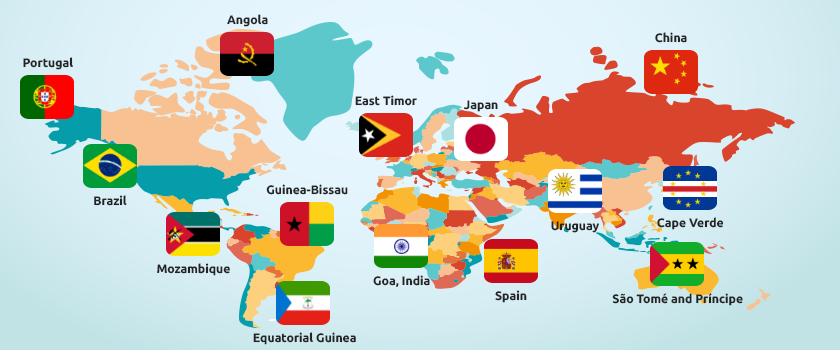
The Treaty of Tordesillas is the reason Brazil speaks Portuguese while all its neighbors speak Spanish. It is the reason the Portuguese-speaking world today spans Brazil, Portugal, Angola, Mozambique, Cape Verde, Guinea-Bissau, São Tomé and Príncipe, Equatorial Guinea, and East Timor.
One line on a map — drawn by two European kings who had never seen South America — determined the linguistic identity of 215 million people over five centuries later.
The Lasting Cultural Identity of Brazilian Portuguese
Brazilian Portuguese is not simply a colonial relic. It has evolved into a living, dynamic language that reflects Brazil’s extraordinary cultural diversity.
The language carries Tupi words from the Amazon, African rhythms from enslaved communities, Italian cadences from São Paulo, German vocabulary from the deep south, and now English tech and pop culture terms from the digital age.
This is why linguists describe Brazilian Portuguese as one of the most linguistically rich and layered varieties of any language in the world. It is simultaneously a product of conquest and a testimony to the resilience of the many cultures that survived and shaped it.
Regional Variations Within Brazilian Portuguese
Even within Brazil, Portuguese is not uniform. The country’s enormous size — nearly 8.5 million square kilometers — means that regional accents and dialects vary considerably.
The northeastern accent (nordestino) is often considered one of the most distinct, with vowels pronounced more openly and a vocabulary that retains older Portuguese forms. The São Paulo accent is associated with a more clipped, urban rhythm. The southern states near the Argentine and Uruguayan border show Spanish and German influences in vocabulary and intonation.
Despite these regional differences, all Brazilian Portuguese speakers are mutually intelligible. Standard Brazilian Portuguese, used in national media and education, acts as the common norm across all regions.
What Language Did Brazil Speak Before Portuguese?
Before Portuguese colonization, Brazil was linguistically diverse beyond imagination.
Over 1,000 indigenous languages were spoken across the territory. The Tupi-Guarani family of languages was dominant along the coast and served as a kind of shared communication system among different tribal groups.
The Jesuits formalized this into Língua Geral Paulista and Língua Geral Amazônica, which served as colonial trade languages for over two centuries. Even after the 1757 ban, indigenous words survived in place names, animal names, plant names, and everyday vocabulary.
Today, approximately 202 indigenous languages are still spoken in Brazil, mostly in northern regions and the Amazon basin. Around 40,000 to 50,000 Brazilians speak an indigenous language as their primary tongue. While small as a proportion of 215 million, these communities represent living continuity with Brazil’s pre-colonial linguistic heritage.
How the Portuguese Language Spread and Stayed
The spread of Portuguese in Brazil followed a clear pattern that is worth summarizing:
Phase 1 (1500–1549): Early exploration and trading posts. Portuguese is the language of sailors and merchants, not settlers.
Phase 2 (1549–1757): Jesuit missions, captaincy settlements, and the growth of sugar plantation society. Língua Geral coexists with Portuguese. African slaves bring new languages.
Phase 3 (1757–1822): Pombal’s decrees force Portuguese into all public life. Indigenous languages are legally suppressed. Portuguese spreads rapidly into the interior.
Phase 4 (1822–1889): Independence consolidates Portuguese as the national language of the Brazilian Empire. European immigration waves begin but assimilate linguistically.
Phase 5 (1889–present): Brazilian Republic enforces Portuguese through public education, media, and national identity. Brazilian Portuguese develops its own distinct standard, separate from European Portuguese.
Each phase reinforced what the Treaty of Tordesillas had set in motion in 1494.
Frequently Asked Questions (FAQs)
Why do Brazilians speak Portuguese and not Spanish?
Brazil was colonized by Portugal after the 1494 Treaty of Tordesillas assigned its territory to the Portuguese Crown, not Spain. This is why Brazil is the only Portuguese-speaking country in Latin America.
What is the Treaty of Tordesillas?
It was an agreement signed on June 7, 1494, between Spain and Portugal that divided newly discovered lands along a line 370 leagues west of Cape Verde. Brazil’s eastern coast fell on Portugal’s side of that line.
Who brought Portuguese to Brazil?
Portuguese navigator Pedro Álvares Cabral landed in Brazil on April 22, 1500, and claimed the territory for Portugal. Portuguese settlers, missionaries, and colonial administrators then spread the language over the following centuries.
What language did Brazilians speak before Portuguese?
Before colonization, over 1,000 indigenous languages were spoken in Brazil, with Tupi-Guarani being the dominant family along the coast. Língua Geral, a simplified Tupi-based trade language, was widely used even after colonization began.
Is Brazilian Portuguese different from Portugal Portuguese?
Yes. The two varieties differ in pronunciation, vocabulary, and some grammar — similar to American and British English. Brazilians speak with a more open mouth and use você instead of tu for “you.” Both varieties are mutually intelligible.
When did Portuguese become the official language of Brazil?
Portuguese became the dominant and enforced language from 1757 when the Marquis of Pombal banned indigenous languages. It became the official national language with Brazilian independence in 1822 and has remained so ever since.
Why didn’t Brazil speak Spanish after independence?
Brazil’s independence in 1822 was led by Dom Pedro I, a Portuguese prince, and the ruling class was already Portuguese-speaking by culture and education. There was no political motivation to switch languages after independence.
How many people in Brazil speak Portuguese?
Approximately 99% of Brazil’s population of around 215 million people speak Portuguese as their primary language, making Brazil the world’s most populous Portuguese-speaking nation.
Are there other languages spoken in Brazil today?
Yes. Brazil has around 202 still-spoken indigenous languages, plus significant communities speaking German (~1.06 million), Italian (~635,000), Spanish (~700,000), and Japanese (~425,000).
Why is Brazilian Portuguese important globally?
Brazil’s 203 million Portuguese speakers represent the vast majority of Portuguese speakers worldwide. Brazil is a top-ten global economy, making Brazilian Portuguese essential for international business, trade, diplomacy, and translation industries.
Conclusion
Why do Brazilians speak Portuguese? The short answer is: a 1494 treaty, 322 years of colonial rule, and a Portuguese prince who became Brazil’s first emperor.
The Treaty of Tordesillas drew a line through the Atlantic Ocean that placed Brazil’s eastern coast in Portuguese hands. Pedro Álvares Cabral arrived in 1500.
Portuguese settlers, Jesuit missionaries, enslaved Africans, and royal decrees spent the next three centuries embedding the language into every layer of Brazilian society. When independence came in 1822, Portuguese was not the colonizer’s tongue to be rejected — it was Brazil’s own national identity.
Today, Brazilian Portuguese is a rich, layered, living language that carries within it the voices of indigenous Amazonian peoples, West African communities, Italian immigrants, and a royal family that fled Napoleon.
It is simultaneously a product of colonial history and one of the world’s most vibrant and widely spoken languages.
