


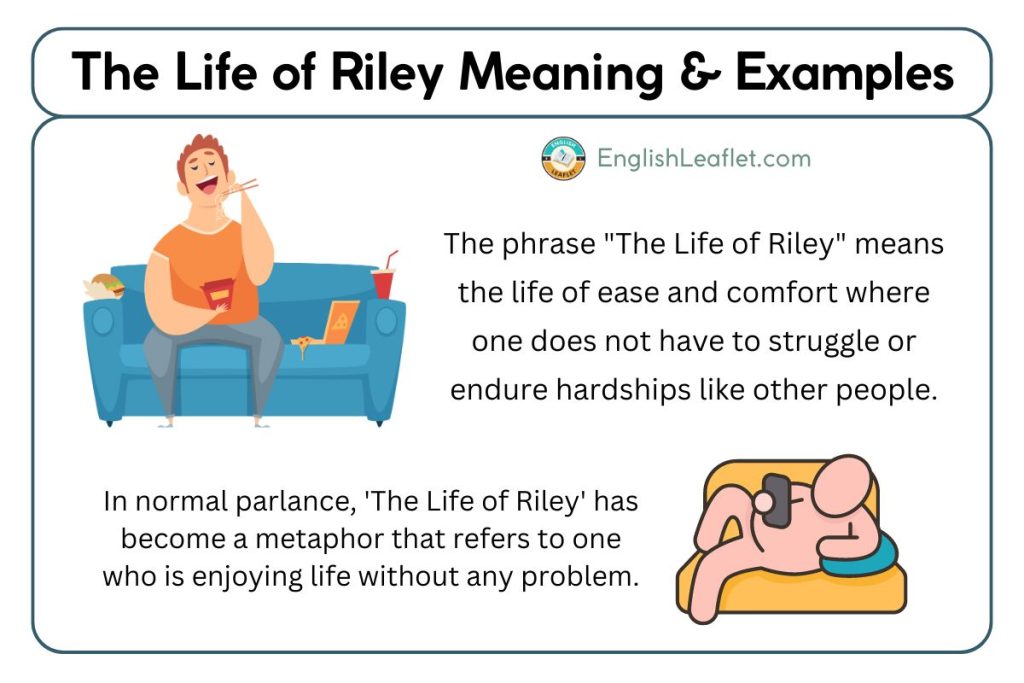
The phrase “The Life of Riley” means the life of ease and comfort where one does not have to struggle or endure hardships like other people. This expression was part of the early twentieth century American culture, and has thus been incorporated into the common language and literature to refer to individuals who live in comfort or idleness.
Meaning of “The Life of Riley”
The phrase “The Life of Riley” is an informal term which denotes the life of comfort, affluence and idleness. When people talk about someone “living the life of Riley”, it means that the person is living a comfortable and easy life, with no worries of doing work for food or any other necessity. The phrase is usually used to indicate that the person is living or is experiencing a smooth and easy life perhaps without having to work for it.
The phrase has a sense of luxury and sometimes a touch of jealousy or skepticism. It is often used to refer to situations where someone seems to be living a very comfortable life with every thing coming to them easily without having to struggle like other people.
The phrase contains a negative connotation and at times is provocative of jealousy or skepticism. It is often used to explain situations where something comes to a person easily and they live a comfortable life without the usual struggles that are part of life. However, it can also be used pejoratively, which means that the life of Riley is easy one that one gets without working for it.
Origin of “The Life of Riley”
The term “The life of Riley” was popular in the early twentieth century America and relates to an easy, wealthy lifestyle, which is usually obtained with little or no work. The origin of this phrase is not clear, however many sources attribute it to Irish-American songs and vaudeville acts of the late 1800s and early 1900s. It appears that the name “Riley” became linked with this carefree, comfortable lifestyle through these songs that portrayed the character as living a lavish lifestyle.
The phrase became very popular in the first quarter of the twentieth century, particularly after the World War-I, when American soldiers started using it to refer to a luxury life, in contrast to a life of war. It became a term to describe someone who is living the life of his dreams without having to exert much effort to get there. A song which helped promote the phrase was “Is That Mr. Reilly?”, wherein Reilly was depicted to be a rich man who is carefree.
The phrase was further popularized through the radio and television show “The Life of Riley” which was in motion between the 1940s and 1950s. The program had a character called Chester A. Riley, a working class man, who always got into funny predicaments. The paradox, however, arose from the fact that the title seemed to imply that Riley had an easy life, yet most of the humor stemmed from his difficulties. Today, “the life of Riley” is a well-known term to describe the life of comfort and relaxation.
Use of “The Life of Riley” in Literature
Example#1
“The Catcher in the Rye” by J.D. Salinger
“All you do is play your little records and dream you’re the life of Riley. All you do is sit on your ass.”
In this line, the character is being scolded for being lazy and not assuming his responsibility. The phrase ‘the life of Riley’ means that the person is living easily and not having to work, while everyone else is working hard.
Example#2
“Confessions of a Shopaholic” by Sophie Kinsella
“Honestly, I’d live the life of Riley if it wasn’t for my credit card bills. I’d be sitting on a beach somewhere, sipping piña coladas all day.”
The character pictured himself living the life of Riley where he does not have to work, and is not worried about money. The phrase is used to depict a free, lavish life style which one cannot afford due to factors such as debts.
Example#3
“Under the Volcano” by Malcolm Lowry
“While the consul rots in his agony, some people live the life of Riley in their own little worlds, untouched by grief.”
In the novel, the phrase is employed to give a comparison between the agony of the consul, the protagonist, and the prosperity of the other characters. Thus, it deals with the contrast between the people in need and those who do not suffer from the difficulties of life.
Example#4
“The Long Goodbye” by Raymond Chandler
“He was sitting pretty, living the life of Riley, while everyone else was trying to make ends meet.”
The author uses the phrase to refer to a character who is living the good life without worrying about the financial woes that so many people face in the society. It emphasizes the character’s privileged status as opposed to those around him, who are struggling to make ends meet.
Example#5
“Billy Liar” by Keith Waterhouse
“Billy fantasized about living the life of Riley, imagining a future where he wouldn’t have to deal with the dull grind of his current existence.”
In the line, the protagonist Billy imagines a more fun and fabulous life than the boring one he has to endure every day. The phrase “The life of Riley” means the kind of carefree and easy lifestyle that Billy wants to live, but his life is actually filled with dreams or goals which are unattained and routine duties.
See also: A Wild Goose Chase Meaning
Use of “The Life of Riley” in Modern Contexts
The phrase “The Life of Riley” is still popular and can be used to describe people or situations that seem to be unusually fortunate or easy. It’s use is common in the society and can be found in television, films, news and even in our everyday communication.
In Popular Culture
The phrase “The Life of Riley” is commonly used to refer to stars, millionaires or anyone who seems to be living the luxury life. It is also used in a playful or sarcastic manner, especially when talking about someone who seems to have it easy but actually has problems.
For example, a reality show that shows the lives of celebrities or the aristocrats use this phrase to enable the audience to believe that they are going to watch people living a luxury life. However, what these shows tend to portray is that, even the characters who appear to be living the dream life are not able to sort out their own problems.
In Journalism
In journalism, the phrase is occasionally used in the articles or headlines to refer to the situations when individuals or groups are thought to be enjoying comfortable and carefree lifestyles at the expense of others. For example, an investigative piece may employ the phrase to make criticism towards government authorities or company managers who are deemed to be living lavish lives as compare to their employees.
It can also be used to comment on social injustice, for example, to bring out the difference between the rich and the poor. In this case, “The Life of Riley” is used as a rhetoric to highlight the inequalities that exist in the society and the notion that some people have it so easy.
In Everyday Conversation
In normal parlance, ‘The Life of Riley’ has become a metaphor that refers to one who is enjoying life without any problem. It can be used in a playful manner to congratulate someone on something or to jokingly envy the other person’s life.
For example, if one says that, “He has been living the life of Riley ever since he got that new job”, which means that the man has been enjoying a better life since he got the new job. It is also used in a context where one person appears to be blessed and be able to get away with things easily as opposed to others.
See also: Straight and Narrow Meaning
