

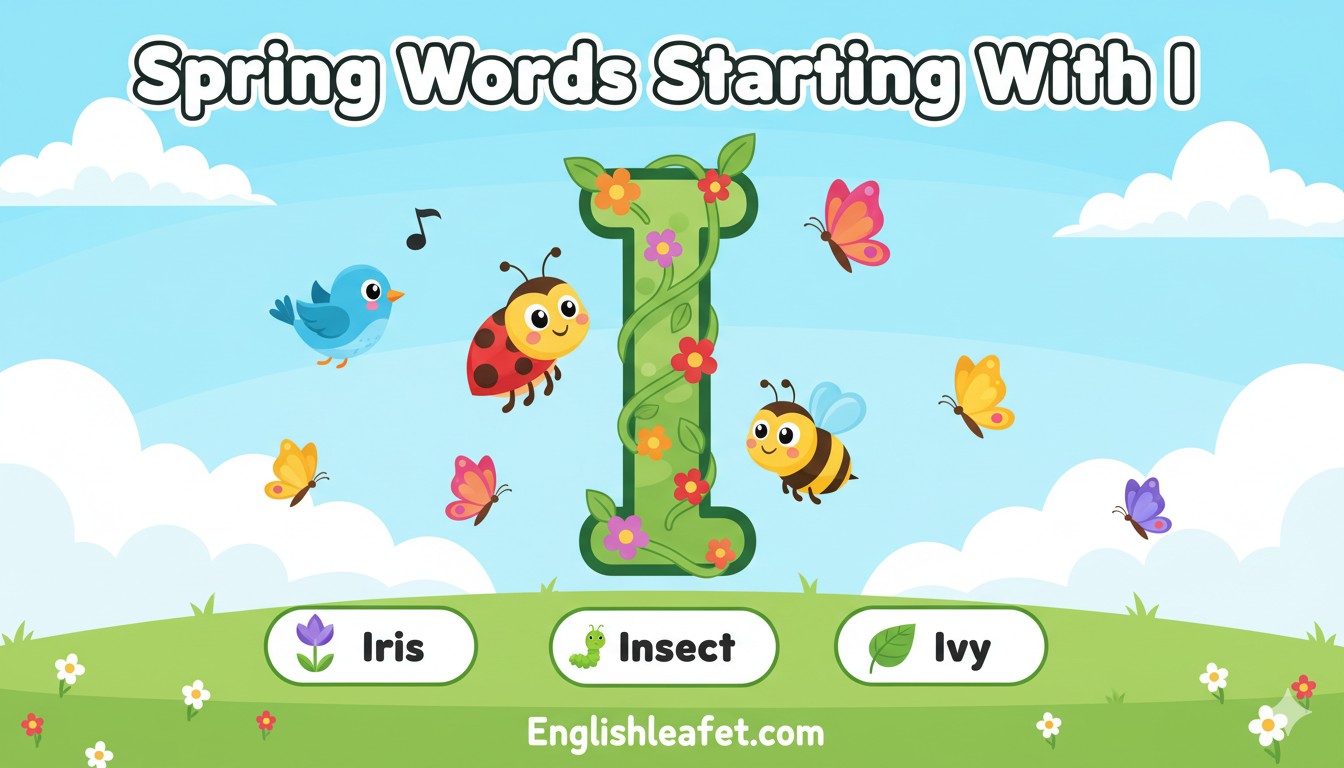
Spring words that start with I capture the essence of renewal, growth, and natural beauty that defines this vibrant season.
rom the stunning iris flowers blooming in gardens to the invigoration we feel with warmer weather, these I-words paint a picture of spring’s transformation.
Whether you’re a teacher creating seasonal lesson plans, a writer seeking descriptive vocabulary, or a parent helping children expand their language skills, this comprehensive list provides over 100 spring-related words beginning with I, complete with meanings and practical examples.
Complete List of Spring Words Starting With I
Flowers and Plants
Iris – A beautiful flowering plant with showy blooms in purple, blue, yellow, and white colors. Irises are one of spring’s signature flowers, often blooming from late March through May.
Example: “The purple irises bloomed along the garden fence, signaling that spring had truly arrived.”
Ivy – A climbing or trailing evergreen plant with glossy leaves. In spring, ivy produces new growth and sometimes small greenish flowers followed by black berries.
Example: “The ivy on the old brick wall showed vibrant new growth as spring temperatures warmed.”
Inflorescence – The complete flower head of a plant including stems, stalks, bracts, and flowers. This botanical term describes how flowers are arranged on a plant.
Example: “The cherry tree’s inflorescence created a stunning canopy of pink blossoms overhead.”
In bloom – The state of flowering or blossoming. This phrase describes plants actively producing flowers during spring.
Example: “By April, the entire garden was in bloom with tulips, daffodils, and hyacinths.”
Weather and Natural Phenomena
Ice – Frozen water that begins melting as spring temperatures rise. Late spring may still see ice in shaded areas or at higher elevations.
Example: “The last bits of ice on the pond melted away during the warm spring sunshine.”
Icicle – A hanging spike of ice formed by dripping water that freezes. Early spring mornings may still produce icicles before temperatures rise.
Example: “Icicles hung from the roof edge in the early morning but dripped away by afternoon as spring warmed the air.”
Illumination – The brightness and light that increases as days grow longer in spring. Spring equinox marks equal day and night, with daylight continuing to increase.
Example: “The increased illumination of spring days made evening walks possible without flashlights.”
Inclement – Unpleasant or harsh weather conditions. Spring can bring inclement weather including storms, heavy rain, and occasional late-season snow.
Example: “Despite the inclement weather on Monday, the rest of spring week brought sunshine and warmth.”
Animals and Insects
Insect – Small arthropods that emerge in large numbers during spring. Insects play crucial roles in pollination and the spring ecosystem.
Example: “Insects buzzed around the flowering fruit trees, pollinating blossoms that would become summer fruit.”
Inchworm – The caterpillar larva of geometer moths that moves by arching its body. These appear in spring on trees and plants.
Example: “Children watched the inchworm slowly make its way across the leaf, measuring its path.”
Incubation – The process of keeping eggs warm until they hatch. Spring is prime incubation season for birds and other egg-laying creatures.
Example: “The robin sat patiently during the incubation period, rarely leaving her nest of blue eggs.”
Descriptive Adjectives
Invigorating – Making one feel strong, healthy, and full of energy. Spring weather and fresh air have an invigorating effect on people.
Example: “The invigorating spring breeze made everyone want to exercise outdoors after months of winter confinement.”
Inspiring – Filling someone with the urge to do or feel something creative. Spring’s beauty naturally inspires art, poetry, and creativity.
Example: “The inspiring sight of cherry blossoms motivated the artist to paint a new spring landscape.”
Iridescent – Showing luminous colors that seem to change when seen from different angles. Spring brings iridescent beetles, butterflies, and bird feathers.
Example: “The iridescent wings of the butterfly shimmered with blues and greens in the spring sunlight.”
Immaculate – Perfectly clean and neat. Spring cleaning makes homes immaculate, while spring mornings bring immaculate clarity.
Example: “The immaculate morning sky showed not a single cloud after the spring rain washed the air clean.”
Inviting – Offering a pleasant or attractive experience. Spring weather and blooming gardens create inviting outdoor spaces.
Example: “The inviting warmth of the spring afternoon drew everyone to the park for picnics.”
Interesting – Arousing curiosity or attention. Spring brings interesting changes in nature that capture our attention.
Example: “The interesting behavior of birds building nests fascinated the students during their spring nature walk.”
Intense – Of extreme force, degree, or strength. Spring can bring intense thunderstorms, intense colors, and intense growth.
Example: “The intense green of new spring grass contrasted sharply with the brown earth of winter.”
Incredible – Impossible to believe or extraordinary. Spring transformations often seem incredible in their speed and beauty.
Example: “The incredible transformation from bare branches to full blossoms happened in just two weeks of warm spring weather.”
Spring Activities and Actions
Irrigation – The supply of water to land or crops to help growth. Spring is when farmers and gardeners begin irrigation for new plantings.
Example: “The farmer set up the irrigation system in early spring to ensure crops had adequate water.”
Inhale – To breathe in. Spring encourages people to inhale fresh air and floral fragrances.
Example: “She paused to inhale the sweet fragrance of the blooming lilac bush in her spring garden.”
Investigate – To carry out research or study. Children investigate spring nature, discovering new plants and animals.
Example: “The class went outside to investigate signs of spring, finding buds, sprouts, and returning birds.”
Imagine – To form a mental image or concept. Spring’s awakening helps us imagine new possibilities and fresh starts.
Example: “Looking at the garden beds, she could imagine how beautiful they would be when spring flowers bloomed.”
Implement – To put a plan or decision into effect. Gardeners implement spring planting plans as weather permits.
Example: “The community garden members met to implement their spring planting schedule.”
Improve – To make or become better. Spring is associated with improvement – of weather, nature, and personal habits.
Example: “The warm spring weather helped improve everyone’s mood after the long, cold winter.”
Increase – To become or make greater in size, amount, or degree. Spring sees increases in temperature, daylight, and plant growth.
Example: “Day length continues to increase throughout spring, providing more hours of sunshine.”
Initiate – To cause a process or action to begin. Spring rains initiate seed germination and plant growth.
Example: “The warm spring temperatures initiated the migration of birds returning from the south.”
Concepts and Ideas
Inspiration – The process of being mentally stimulated to do or feel something creative. Spring provides inspiration through beauty and renewal.
Example: “The poet found inspiration in the spring morning, writing verses about rebirth and hope.”
Imagery – Visually descriptive language. Spring poetry and writing often use rich imagery to describe the season.
Example: “The writer’s imagery captured spring perfectly – painting pictures of yellow daffodils dancing in the breeze.”
Impression – An idea, feeling, or opinion about something. Spring leaves lasting impressions of beauty and change.
Example: “The first impression of spring came when she noticed tiny green shoots pushing through the soil.”
Interaction – Communication or direct involvement with someone or something. Spring encourages interaction with nature and outdoor activities.
Example: “The children’s interaction with spring nature taught them about plant life cycles and ecosystems.”
Interconnection – The state of being connected with each other. Spring demonstrates nature’s interconnection through pollination and food webs.
Example: “The interconnection between bees and flowers becomes obvious during spring pollination.”
Intertwine – To twist or twine together. Spring vines intertwine as they climb, and ecosystems intertwine in complex ways.
Example: “The morning glory vines began to intertwine with the garden fence as spring progressed.”
Innovation – A new method, idea, or product. Spring represents nature’s innovation in creating new life and growth.
Example: “Nature’s innovation in spring seed dispersal methods amazes botanists every year.”
Additional Spring I-Words
Island – A piece of land surrounded by water. Spring transforms islands with blooming vegetation and returning wildlife.
Example: “The island in the lake became a nesting spot for dozens of bird species each spring.”
Idyllic – Extremely happy, peaceful, or picturesque. Spring days often feel idyllic with perfect weather and beautiful scenery.
Example: “The idyllic spring afternoon featured blue skies, warm breezes, and children playing in the park.”
Impulse – A sudden strong desire to do something. Spring weather creates impulses to garden, walk, and enjoy outdoors.
Example: “She felt the impulse to plant flowers when she saw the spring garden displays at the nursery.”
Indigenous – Originating or occurring naturally in a particular place. Spring is ideal for planting indigenous species.
Example: “The native plant garden featured indigenous wildflowers that bloomed throughout spring.”
Infant – A very young child or animal. Spring brings infant animals – chicks, ducklings, lambs, and fawns.
Example: “The farm welcomed infant lambs during the busy spring birthing season.”
Inform – To give someone facts or information. Spring nature walks inform children about seasonal changes.
Example: “The naturalist stopped to inform the group about the spring wildflowers they encountered.”
Inhabit – To live in or occupy a place. Many creatures inhabit gardens and parks during the active spring season.
Example: “Dozens of bird species inhabit the park during spring migration.”
Ink – Colored fluid used for writing or printing. Spring inspires people to put ink to paper, writing about the season.
Example: “The poet used green ink to write spring haikus celebrating nature’s renewal.”
Inner – Located inside or within. Spring awakens our inner joy and creativity.
Example: “The warm spring sunshine awakened her inner child, making her want to play outside.”
Innocence – Lack of guile or corruption. Spring lambs and baby animals symbolize innocence and purity.
Example: “The innocence of the newborn fawn touched everyone who spotted it in the spring meadow.”
Input – Contribution of information or resources. Gardeners increase input of water and fertilizer during spring planting.
Example: “Successful spring gardens require input of quality soil, water, and appropriate plants.”
Inquiry – An act of asking for information. Children make inquiries about spring phenomena they observe.
Example: “The student’s inquiry about why tulips close at night led to a lesson on nyctinasty.”
Insight – The capacity to gain accurate understanding. Nature study provides insight into seasonal cycles.
Example: “Observing the spring garden provided insight into how ecosystems support diverse life.”
Inspiration – Something that stimulates creative activity. Artists find inspiration in spring’s colors and forms.
Example: “The landscape painter found endless inspiration in the changing spring countryside.”
Installation – The action of installing something. Spring sees installation of bird houses, garden features, and outdoor decorations.
Example: “The installation of the new fountain in the garden was completed in early spring.”
Instant – Happening immediately. Some spring changes seem to happen in an instant after warm weather arrives.
Example: “The instant the temperature hit 70 degrees, flowers seemed to explode into bloom.”
Instinct – An innate pattern of behavior. Animals follow instinct during spring migration and nesting.
Example: “Birds follow instinct to return to the same nesting areas each spring.”
Instruction – Detailed information about how to do something. Spring gardening requires instruction for beginners.
Example: “The seed packets provided instruction on proper spring planting depth and spacing.”
Instrument – A tool or implement. Gardening instruments get heavy use during busy spring planting season.
Example: “She cleaned and sharpened every garden instrument before the spring planting rush began.”
Insulation – Material used to prevent heat loss. Spring is when many remove winter insulation from tender plants.
Example: “Gardeners removed the winter insulation from rose bushes once spring temperatures stabilized.”
Integration – The combining of different elements into a whole. Permaculture gardens emphasize integration of diverse spring plants.
Example: “The integration of flowers, vegetables, and herbs created a productive spring garden ecosystem.”
Integrity – The quality of being whole and undivided. Spring ecosystems demonstrate integrity through balanced relationships.
Example: “The forest’s ecological integrity was evident in the healthy spring wildflower display.”
Intelligence – The ability to acquire and apply knowledge. Spring migration demonstrates remarkable animal intelligence.
Example: “The intelligence of birds navigating thousands of miles during spring migration amazes scientists.”
Intention – A thing intended or planned. Gardeners plant with intention, choosing specific flowers for spring color.
Example: “Her intention was to create a spring garden that would attract butterflies and hummingbirds.”
Interest – The feeling of wanting to know about something. Spring nature awakens interest in biology and ecology.
Example: “The children showed great interest in the tadpoles developing in the spring pond.”
Interior – The inner part of something. Interior plant growth accelerates during spring’s longer days.
Example: “The interior portions of the hedge showed new spring growth despite the outer leaves blocking some light.”
Intermediate – Coming between two things in time, place, or character. Spring is the intermediate season between winter and summer.
Example: “The intermediate temperatures of spring allow both cool and warm-season plants to thrive briefly together.”
Interval – A pause or gap between events. Spring has intervals of rain and sunshine creating ideal growing conditions.
Example: “During the brief interval between spring showers, the gardener rushed to plant new seedlings.”
Intimacy – Close familiarity or friendship. Gardening creates intimacy with the natural world during spring.
Example: “The intimacy she developed with her spring garden came from daily observation and care.”
Intricate – Very complicated or detailed. Spring flowers display intricate structures designed for pollination.
Example: “The intricate patterns on the orchid petals evolved to attract specific spring pollinators.”
Introduction – The action of bringing something into use for the first time. Spring gardens benefit from introduction of beneficial insects.
Example: “The introduction of ladybugs in spring helped control aphids on the rose bushes.”
Intuition – The ability to understand immediately without conscious reasoning. Experienced gardeners use intuition to know when spring planting time arrives.
Example: “Her intuition told her it was finally safe to plant tomatoes despite the early spring date.”
Invasion – An instance of invading with armed forces, or an influx of large numbers. Spring sees invasions of insects and migrating birds.
Example: “The spring invasion of tent caterpillars required treatment to protect the apple trees.”
Invention – The action of creating something new. Gardeners show invention in solving spring planting challenges.
Example: “Her invention of a simple cold frame extended the spring growing season by several weeks.”
Investment – The action of investing money, effort, or time. Spring gardening requires investment of both time and resources.
Example: “The investment of hours preparing spring garden beds paid off in bountiful harvests.”
Invitation – A written or verbal request inviting someone somewhere. Spring weather feels like nature’s invitation to come outside.
Example: “The warm spring sunshine felt like an invitation to abandon indoor work and enjoy the garden.”
Spring Words That Start With I for Kids
These simple I-words are perfect for children learning about spring:
Ice – Frozen water that melts in spring. Kids love watching icicles drip and puddles form from melting ice.
Iris – A pretty spring flower. Many irises are purple, but they come in almost every color.
Ivy – A climbing plant with green leaves. Ivy grows up walls, fences, and trees.
Insect – Small bugs that come out in spring. Butterflies, bees, and ladybugs are friendly spring insects.
Icicle – A hanging piece of ice. Early spring mornings might still have icicles hanging from roofs.
Island – Land surrounded by water. Islands look especially pretty in spring when plants turn green.
Ink – Colored liquid for writing. You might use green ink to write about spring.
Itch – An uncomfortable feeling that makes you want to scratch. Spring allergies can make your nose itch.
Spring Adjectives Starting With I
Use these I-adjectives to describe spring in writing and conversation:
Invigorating – Energizing and refreshing. Spring air feels invigorating after being indoors all winter.
Inspiring – Causing creative feelings. Spring beauty is inspiring to artists, poets, and photographers.
Iridescent – Shimmering with rainbow colors. Many spring beetles and butterflies have iridescent wings.
Immaculate – Perfectly clean. Spring rain leaves the air feeling immaculate and fresh.
Inviting – Attractive and tempting. Spring gardens look inviting with colorful flowers blooming.
Impressive – Evoking admiration through size, quality, or skill. Cherry blossom displays create impressive spring landscapes.
Incredible – Hard to believe or extraordinary. The incredible speed of spring growth amazes observers.
Intense – Extreme in degree or strength. Spring can bring intense colors, storms, and growth.
Ideal – Perfect or most suitable. May offers ideal spring weather in many regions.
Idyllic – Extremely peaceful and happy. Picnics on idyllic spring days create lasting memories.
Spanish Spring Words Starting With I
For bilingual learners, here are Spanish spring words beginning with I:
Invierno – While this means “winter,” late winter transitions into spring in many Spanish-speaking regions.
Iris – The same word in Spanish for this spring flower.
Insecto – Insect in Spanish. Spring brings many insects.
Iluminación – Illumination or lighting. Spring brings increased iluminación with longer days.
Inspiración – Inspiration. Spring provides inspiración for creativity.
Interior – Interior or inside. Interior plants respond to spring’s longer daylight.
Instantáneo – Instantaneous or immediate. Some spring changes seem instantáneo.
Invitación – Invitation. Spring weather feels like an invitación to go outside.
Using Spring I-Words in Sentences
Here are examples of using spring I-words in complete sentences:
The iris flowers created a border of purple along the garden path each spring.
Children watched insects buzzing around the spring blossoms, collecting nectar and pollen.
The invigorating spring breeze made everyone want to open windows and go outside.
Spring rain provided natural irrigation for newly planted seeds and transplants.
The inspiring beauty of cherry blossoms motivated photographers to capture spring scenes.
Students went outside to investigate signs of spring in the school nature area.
The iridescent soap bubbles children blew reflected rainbow colors in the spring sunshine.
Early spring mornings still produced icicles on shaded eaves before midday warmth.
The immaculate spring morning featured crystal-clear blue skies after overnight rain.
Spring’s inviting warmth drew everyone to parks, gardens, and outdoor cafes.
Educational Activities With Spring I-Words
Vocabulary Building Games
Create spring word searches using I-words. Include iris, ivy, insect, ice, and other terms for students to find.
Make flashcards with spring I-words on one side and definitions or pictures on the other. Use these for matching games.
Play “I Spy” during spring nature walks using only words that start with I. “I spy something iridescent” might refer to a beetle.
Create spring bingo cards featuring I-words and pictures. Students mark words as teachers describe spring phenomena.
Writing Prompts
Write a spring poem using at least five I-words. Include descriptive words like inspiring, invigorating, and iridescent.
Create a spring story featuring iris flowers as the main setting. Include other I-words throughout the narrative.
Write journal entries observing spring changes using I-vocabulary. Describe insects, increasing daylight, and inspiring sights.
Compose spring haikus that include at least one I-word. Focus on imagery and sensory descriptions.
Art Projects
Paint iris flowers using watercolors. Label artwork with the word “iris” and other spring I-words.
Create insect illustrations showing spring butterflies, bees, and beetles. Label each insect species.
Make collages representing spring concepts like inspiration, interconnection, and increase. Use magazine pictures and nature items.
Design spring bookmarks featuring I-words and related illustrations. Laminate for durability.
Scientific Spring I-Words
Incubation – The process of keeping eggs warm until hatching. Bird incubation periods vary by species during spring nesting season.
Inflorescence – The flowering part of a plant. Botanists study inflorescence structures to identify and classify spring plants.
Insectivore – An animal that eats insects. Many spring migrants are insectivores, arriving when insects emerge.
Indigenous – Native to a particular region. Indigenous plants are well-adapted to local spring conditions.
Irradiance – The power of electromagnetic radiation per unit area. Increasing solar irradiance drives spring warming.
Isotope – Variants of chemical elements. Scientists use isotopes to study spring water sources and plant growth.
Inoculation – Introduction of microorganisms. Gardeners inoculate legume seeds with beneficial bacteria before spring planting.
Spring I-Words in Literature and Poetry
Spring literature frequently incorporates I-words to create vivid imagery:
Poets describe iris gardens painting landscapes with purple, blue, and yellow strokes.
Nature writers discuss insects emerging from dormancy as temperatures warm.
Authors use invigorating to capture the refreshing quality of spring mornings.
Illumination appears in poems about increasing daylight and spring’s brightness.
Inspiration frequently describes how spring beauty motivates creativity and renewal.
Intertwine illustrates how vines climb and ecosystems connect during spring.
Iridescent captures the shimmering quality of spring wings, petals, and morning dew.
Seasonal Comparisons Using I-Words
Spring differs from other seasons in these I-word ways:
Increase – Spring sees increases in temperature, daylight, and precipitation compared to winter.
Intensity – Spring color intensity surpasses winter’s muted tones but differs from summer’s harsh brightness.
Interaction – Spring encourages outdoor interaction with nature more than winter’s indoor focus.
Immigration – Many species immigrate (migrate in) during spring, unlike fall’s emigration patterns.
Initiation – Spring initiates growth cycles that continue through summer and culminate in fall.
Interval – Spring provides an interval of moderate temperatures between winter cold and summer heat.
Environmental Spring I-Words
Impact – Spring storms can impact ecosystems through flooding, wind damage, or beneficial rain.
Indicator – Certain plants serve as indicators of spring’s arrival, like crocuses and daffodils.
Infiltration – Water infiltration into soil increases during spring rains, recharging groundwater.
Influx – Spring brings an influx of migratory birds returning from winter ranges.
Infrastructure – Spring weather can test infrastructure through freeze-thaw cycles and heavy rains.
Inhabitant – Forest inhabitants become more visible and active during spring.
Inherent – Spring growth demonstrates inherent biological drives toward reproduction and expansion.
Cultural Spring I-Words
Independence – Spring holidays in some cultures celebrate independence and freedom.
Initiation – Spring festivals often include initiation ceremonies and coming-of-age traditions.
Identity – Spring cleaning and renewal activities reflect cultural identity in many societies.
Icon – Spring flowers like cherry blossoms become icons representing the season.
Ideal – Many cultures view spring as the ideal season for weddings and new beginnings.
Inheritance – Spring planting continues agricultural inheritance passed through generations.
Frequently Asked Questions (FAQs)
What are the most common spring words that start with I?
The most common spring words starting with I are iris (a spring flower), insect (bugs that emerge in spring), ivy (climbing plant), ice (melting frozen water), invigorating (refreshing spring feeling), and inspiring (motivating beauty of spring).
What does iris mean as a spring word?
Iris refers to a perennial flowering plant with showy blooms in purple, blue, yellow, white, or multi-colored varieties. Irises typically bloom from late March through May and are iconic spring garden flowers known for their distinctive three-petaled structure.
How do you use invigorating in a spring sentence?
Example: “The invigorating spring breeze energized everyone after months indoors during winter.” Invigorating describes the refreshing, energizing quality of spring weather, fresh air, and outdoor activities that make people feel revitalized and full of energy.
What insects are associated with spring?
Spring insects include butterflies, bees, ladybugs, aphids, caterpillars, moths, beetles, flies, mosquitoes, ants, and wasps. These insects emerge from dormancy or eggs as temperatures warm, playing crucial roles in pollination and ecosystem functions throughout the spring season.
What does irrigation mean in spring gardening?
Irrigation is the artificial application of water to soil or crops to help plant growth. In spring, gardeners and farmers set up irrigation systems to provide consistent water to newly planted seeds, transplants, and established plants, especially during dry periods when rainfall is insufficient.
What is an inflorescence in spring botany?
Inflorescence is the complete flowering structure of a plant, including all flowers, stems, stalks, and bracts. In spring, studying inflorescence helps identify plants and understand their reproductive strategies, as different species have characteristic inflorescence patterns like spikes, clusters, or solitary blooms.
How is inspiration connected to spring?
Inspiration during spring comes from nature’s beauty—blooming flowers, singing birds, longer days, and renewal of life. Spring inspires creativity in art, poetry, writing, music, and gardening. The season’s transformation from winter’s dormancy motivates people toward fresh starts and new projects.
What does iridescent mean when describing spring?
Iridescent describes surfaces that show luminous, rainbow-like colors that change when viewed from different angles. Spring features iridescent butterfly wings, beetle shells, bird feathers, soap bubbles, and water droplets that shimmer with multiple colors in sunlight, creating magical visual effects.
Are there spring words starting with I for kids?
Yes, kid-friendly spring I-words include iris (flower), ivy (plant), insect (bug), ice (melting frozen water), icicle (hanging ice), island (land in water), ink (for writing), and itch (from allergies). These simple words help children describe spring observations and expand seasonal vocabulary.
What does intertwine mean in spring nature?
Intertwine means to twist or weave together. In spring, vines intertwine with fences and trellises as they climb, tree branches intertwine forming canopies, and ecosystem elements intertwine through pollination, food webs, and symbiotic relationships, demonstrating nature’s interconnected complexity.
Conclusion
Spring words that start with I offer rich vocabulary for describing this transformative season’s beauty, energy, and renewal.
From the elegant iris blooming in gardens to the invigorating breeze that energizes us after winter, these I-words capture spring’s essence perfectly.
The comprehensive list includes flowers like iris and ivy, weather terms like ice and icicles, descriptive adjectives like inspiring and iridescent, and action words like irrigate and investigate.
Understanding these spring I-words enhances communication, enriches creative writing, supports educational activities, and deepens appreciation for seasonal changes.
Teachers can incorporate these words into lesson plans, vocabulary exercises, and nature studies. Writers gain descriptive language for poetry, stories, and articles about spring.
Parents can use these terms while exploring spring nature with children, building language skills through real-world observation.
