


Introduction
Language is not a lifeless structure, but a dynamic system that mirrors the richness of people’s lives. Phrases and idioms are easier to remember and convey a certain message in a powerful way. Sometimes, they are derived from certain historical or cultural events.
Out of them, one phrase is “Dock one’s pay”, which has been commonly used for many years in both informal and the formal language. It refers to the financial penalty imposed by an employer on the employee.
Meaning of “Dock One’s Pay”
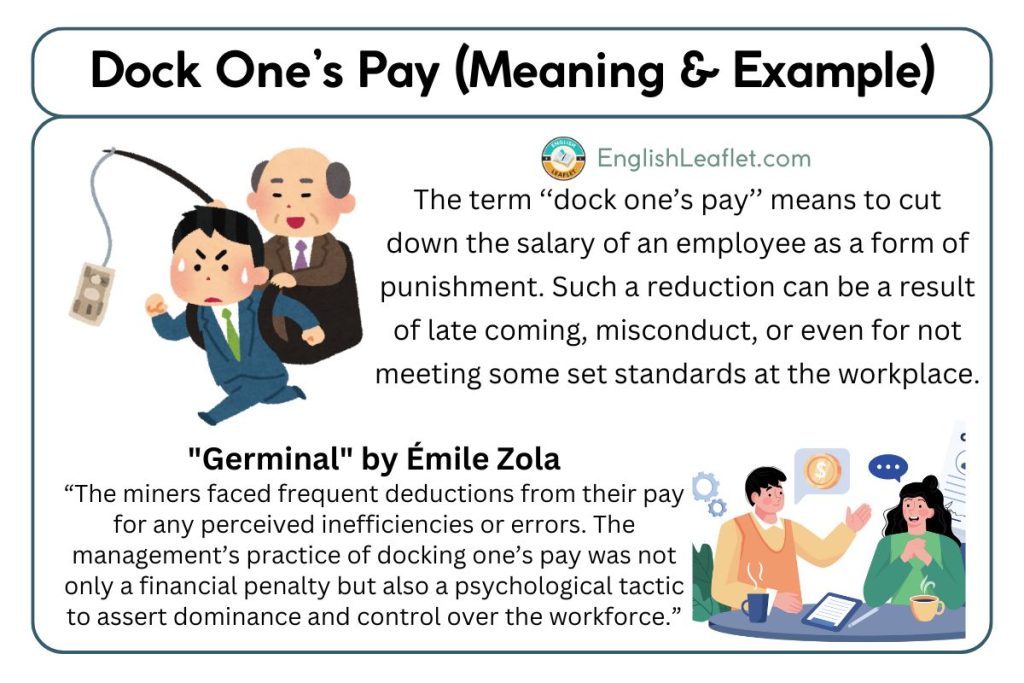
The term ‘‘dock one’s pay’’ means to cut down the salary of an employee as a form of punishment. Such a reduction can be a result of late coming, misconduct, or even for not meeting some set standards at the workplace.
In other words, when someone’s pay is ‘docked’, they are paid less than what they were supposed to be paid for, which is a form of punishment for his/her actions.
It has been mostly seen in employment situations where there are clear set of guidelines that are expected to be followed by the employees. In case of violation of these rules, docking pay is a direct punitive measure that may be taken.
The idea is similar to other disciplinary actions at workplaces including suspension or termination, but is not as severe as it does not involve the complete loss of job but rather a part of it through deduction of pay.
Origin of “Dock One’s Pay”
The origin of the phrase ‘dock one’s pay’ can be explained with reference to the early traditions of handling employees and their wages. This term “dock” comes from the Old English word ‘docc’ with the meaning of cutting or trimming.
The word “dock” changed its meaning overtime to refer to the process of deducting or taking away something for instance wages.
The concept of docking pay emerged in the course of the Industrial Revolution, when the legal framework of labor regulations was being established.
Factories and industries gave employment to the large number of people, and to ensure that these workers were in order and produced quality work, there was need to have some form of discipline.
Docking wages was a simple way in which employers could punish workers for not achieving set targets or for not following the set norms of the organization.
Examples of “Dock One’s Pay” in Literature
The phrase “dock one’s pay” can also be found in many literary works in which such phrase reflects socio-economic conditions and labor relations of the given period of time. Here are a few examples:
Example#1
“The Jungle” by Upton Sinclair
“The men were docked for every small infraction, and the deductions from their paychecks often left them barely able to afford the necessities of life. When Jurgis was docked for being late to work, he found himself in a precarious financial position, struggling to make ends meet.”
The novel describes the reality of life under severe conditions of industrial labour in early twentieth-century America. The phrase ‘docked for every small infraction’ emphasizes the general oppression of the workers.
Sinclair gives the example of docking wages by the employers to control the workers with the intention of punishing them, a factor that intensified their economic situation.
Example#2
“The Ragged-Trousered Philanthropists” by Robert Tressell
“The foreman would dock a worker’s pay for any minor mistake or perceived lack of effort, often with little regard for the actual circumstances. This practice of docking one’s pay was a common tool used to enforce compliance and keep the workers in line.”
The author reflects how docking pay was used as a tool of the labor control. Tressell shows his concern over the harsh practice used by the employers against their workers in early twentieth century Britain.
He demonstrates the financial punishment imposed by the employers upon their workers to maintain the power dynamics between them.
Example#3
“The Workingman’s Paradise: An Australian Labour Novel” by William Lane
“The employer’s policy of docking pay for minor infractions was a frequent point of contention among the workers. Each deduction, while seemingly small, accumulated to significant losses over time, contributing to the workers’ growing dissatisfaction with their conditions.”
The characters in this novel have been depicted as unhappy due to deductions in their wages. The phrase “docking pay for minor infractions” reflects that how the penalties were the major cause to unrest the labor and their dissatisfaction in Australia during the late nineteenth and at the beginning of the twentieth century.
Example#4
“Hard Times” by Charles Dickens
“In Mr. Gradgrind’s school, any student who failed to adhere to the rigid standards was met with a reduction in their wages, a practice that extended to the workers in his factories. The term ‘dock one’s pay’ was a constant threat hanging over them, designed to enforce obedience and productivity.”
Dickens incorporates the phrase “dock one’s pay” pointing at repressive practice of industrialists and educators of the epoch. This practice can be taken as an emblem of the problems of the society, which the writer draws attention to, such as the dehumanizing tendencies of strict discipline and the exploitation of workers.
Example#5
“Germinal” by Émile Zola
“The miners faced frequent deductions from their pay for any perceived inefficiencies or errors. The management’s practice of docking one’s pay was not only a financial penalty but also a psychological tactic to assert dominance and control over the workforce.”
The novel evinces the severe conditions experienced by the miners of 19th century in France. The phrase “docking one’s pay” illustrates the dual impact of financial penalties: they not only cut the workers’ wages and salaries but also used them to means to supervise and to maintain subjection of the workers.
Example Sentences of “Dock One’s Pay”
- The boss threatened to dock John’s pay if he continued to show up late to work.
- The company has a strict policy that they will dock your pay for any unapproved absences.
- Mary was upset when she realized her pay had been docked for the time she missed when her son was sick.
- The manager docked Jane’s pay for the cost of materials after she accidentally ruined several expensive machine parts.
- David’s pay was docked 30 minutes for every 5 minutes he was late arriving at the construction site.
- The employer docked everyone’s pay in the office by one hour when they failed to meet their sales quota for the month.
- After noticing accounting errors, the auditor recommended docking the accountant’s pay until the money was repaid.
- Several employees threatened to quit if the company continued to arbitrarily dock their pay for minor infractions.
- I reviewed my paystub carefully to make sure my boss did not dock my pay unfairly again this month.
- The football coach docked the pay of players who missed curfew the night before a big game as a disciplinary measure.
FAQs of “Dock One’s Pay”
Q: What does it mean to “dock someone’s pay”?
A: Docking someone’s pay means deducting pay or withholding wages from an employee’s paycheck, usually as a disciplinary measure.
Q: Is it legal for employers to dock someone’s pay?
A: In most cases, employers can legally dock exempt employees’ pay in full-day increments if they are absent or in violation of rules. For non exempt employees, pay deductions in increments less than a full day are generally not permitted.
Q: When can an employer dock an employee’s pay?
A: Common legal reasons include full-day disciplinary suspensions, full-day personal leave absences, using up paid time off, workplace rule violations, starting work late or leaving early, or recouping financial losses caused by the employee.
Q: Does docking pay have to align with written policy?
A: Yes, employers should have a clear written policy explaining reasons for pay deductions and procedures around docking pay. Deductions should not be arbitrary.
Q: What if an employer docked my pay unfairly?
A: Employees can file a wage claim with a state labor agency if pay was docked in violation of law or policy. Unlawful docking may qualify as wage theft.
Q: How can docking pay be challenged?
A: Beyond filing a wage claim, employees can submit a complaint to the company and cite relevant handbook policies or labor laws that were violated by unfair docking.
Q: When is it better to dock pay rather than terminate employment?
A: Docking pay can be preferable for minor first-time infractions when the goal is corrective action rather than punishing an otherwise good employee with job loss.
Q: What alternatives are there to docking an employee’s pay?
A: Warnings, retraining, probation, temporary demotion, counseling, assigning extra tasks, suspending bonuses, or revoking paid time off can be alternatives to docking pay.
Q: Is docking contractor pay different than employee pay?
A: Yes, different rules apply. Contract terms govern pay deductions, but contractors generally have more autonomy and fewer protections than employees.
Q: Does docking pay achieve the intended goals?
A: Docking pay risks decreasing confidence, productivity, loyalty and motivation. Positive reinforcement is often more effective at correcting issues than punitive pay cuts.
See also: Daylight Robbery Meaning & Examples
