


Introduction to The Aeneid
The Aeneid is a Latin epic, which was composed by the Roman poet Virgil in the last ten years of his life. It ranges from 29 to 19 BCE. Ordered by Augustus Caesar, the poem has two functions; one is to be the national epic of Rome and the second is to provide the origin of Rome through the Trojan hero Aeneas, which justifies the rule of Augustus. The story revolves around the hero Aeneas, a warrior of the Trojan War, who is to establish the future of Rome. While on his journey, Aeneas faces many challenges that are both mortal as well as divine in nature, which help in the formation of his character.
The story of Aeneas as recounted by Virgil in the Aeneid is replete with themes that are directed towards the understanding of the difficulties involved in the concept of duty, fate, divine control over human affairs, heroism and the sacrifices of heroism for the sake of the many. These themes are integrated in the plot of the epic and depict not only the sufferings of the protagonist but also the issues of the Roman society of the time of Virgil. The poem raises the issues that have been relevant for centuries and concern the characteristics of leadership, the costs of empire, the personal and collective responsibilities that come with great power.
themes in the aeneid
Theme#1
Duty and Piety (Pietas)
The most important concept of the work is pietas, the combination of the concepts of duty, fidelity, and religious devotion. Pietas is not only an ideal for Aeneas but a principle that governs his decisions in the course of the whole epic.
His sense of duty extends to his family, his people and the gods, which require him to sacrifice his own desires for the good cause. This theme is brought in the early part of the epic and is well sustained throughout the course of the epic.
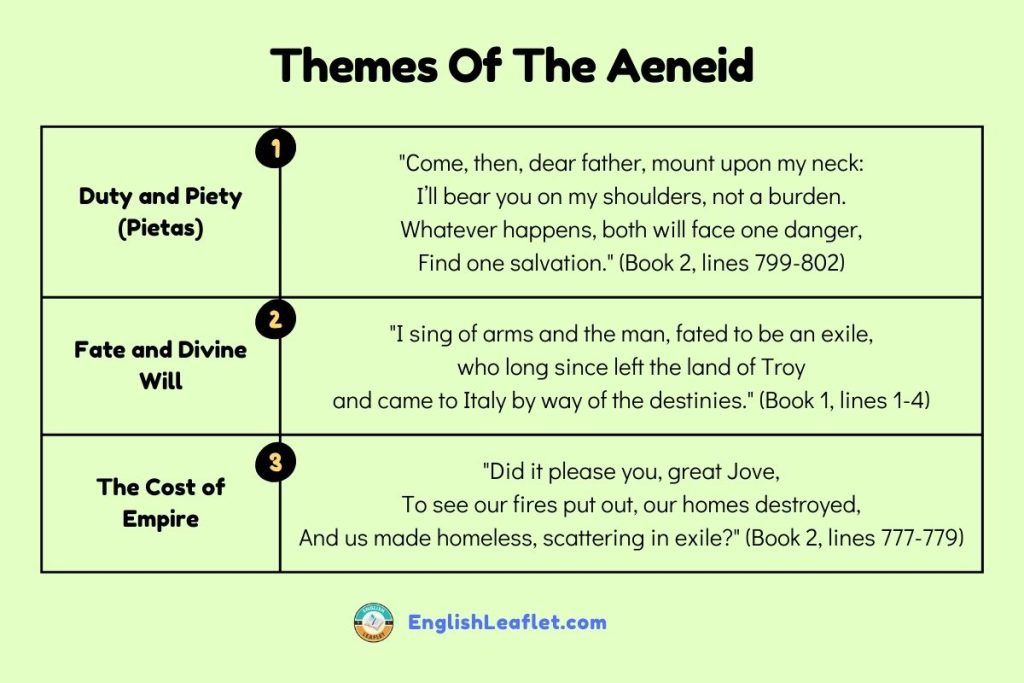
One of the best examples of Aeneas’ piety is reflected in Book 2 when the Trojans are attacked by the Greeks. Despite the chaos around him, Aeneas is determined to save his father Anchises, his son Ascanius, and the household gods, symbolizing his duty to his family, his lineage, and his religious obligations:
“Come, then, dear father, mount upon my neck:
I’ll bear you on my shoulders, not a burden.
Whatever happens, both will face one danger,
Find one salvation.” (Book 2, lines 799-802)
In this passage Aeneas quite figuratively and literally bears the responsibility of the role and that of a pietas. His decision to endanger his life for the sake of his family as well as the tradition is a depiction of the theme of duty in the epic. Several gestures made by Aeneas make him different from other characters, such as he prioritizes his obligations over personal safety.
In The Aeneid, Aeneas’ sense of duty often conflicts with what he wants. This is especially true in his relationship with Dido. His love for Dido is intense, but when the gods remind him of his destiny to found Rome, he chooses duty over love, leaving Dido heartbroken:
“I sail for Italy not of my own free will.” (Book 4, line 361)
This line expresses the dilemma that rises within the very hero of the poem – is he to remain loyal to Dido, the woman he loves or continue his duty as a Trojan and follow the divine instructions he has been given?
His desire to opt out is a perfect depiction of how the author is obsessed with the virtue of pietas regardless of life’s repercussions. Through the struggles of Aeneas, Virgil aims at emphasizing the role of duty in the life of a leader or a hero.
Theme#2
Fate and Divine Will
Despite its historical framework, the theme of fate and divine dominates in “The Aeneid”, as they shape the destinies of an individual or the whole nation. Aeneas is constantly told his mission to found Rome, which is his predetermine fate by gods. This makes readers wonder if people really control their lives or if fate decides everything.
In the opening lines of the epic, Virgil sets the tone by describing that Aeneas is driven by fate:
“I sing of arms and the man, fated to be an exile,
who long since left the land of Troy
and came to Italy by way of the destinies.” (Book 1, lines 1-4)
These lines introduce Aeneas, who is a man of destiny, thereby underlining the fact that he is but an instrument of destiny and that his movements and utterances are governed by destiny. In the epic, Aeneas uses the term ‘fatum’, which means that he has a mission, which has to accomplish and no matter the circumstances he faces in this process.
Fate is also underlined in the sixth book during Aeneas’ descent to the Underworld and meeting his father Anchises. Anchises reveals the future of Rome and the glorious descendants that will arise from Aeneas’ lineage, making it clear that the founding of Rome is a crucial part of a divine plan:
“Your mission, Roman, is to rule the world.
These will be your arts: to establish peace,
To spare the humbled, and to conquer the proud.” (Book 6, lines 1151-1154)
This prophecy was aimed to restore the idea of inevitable growth of Romans’ power and the position of Aeneas, who has to contribute to it. This revelation of a big destiny continues the work of establishing fate as a force that controls the events of history.
Thus, the concept of the fate in ‘The Aeneid’ is not quite deterministic at all. It is predestined at the end, but the process is one of testing, and Aeneas has to navigate toward that destiny.
The gods especially Jupiter and Juno are involved either as a helper or an obstacle to Aeneas but in all cases, fate is deterministic. This struggle of free will against destiny is a microcosm of the human actions and gods’ interference, which is something that Virgil takes on in his work.
See also: Examples of Symbolism in Literature
Theme#3
The Cost of Empire
The Aeneid praises Roman values and the empire Rome would build. However, it also shows the significant costs paid to create that empire. The basic lesson given by Virgil is personal and collective cost of Aeneas and his followers which are magnificent, as an empire needs fundamental things for its making.
The journey of Aeneas is marked by loss from the very beginning. Troy’s fall is symbolical of the destruction of his own country and consequently, his past. As he travels toward Italy, he continues to lose those close to him, including his wife Creusa, who dies during their flight from Troy:
“Did it please you, great Jove,
To see our fires put out, our homes destroyed,
And us made homeless, scattering in exile?” (Book 2, lines 777-779)
These lines indicate the agony of Aeneas at the loss of his home and his people, which indicates the emotional reckoning that comes with the journey towards the fulfilment of one’s destiny. The destruction of Troy and the suffering of Aeneas as well as Trojans is a metaphor for the broader theme of the sacrifices required to develop and maintain an empire.
The theme has been further expressed through the battles that Aeneas has to fight in Italy. All these battles, especially the war against Turnus and the Latins are painted in a bloody and vengeful way with substantial loss of lives on each side. The final confrontation between Aeneas and Turnus in Book 12 epitomizes the destructive nature of war:
“Turnus fell, and earth groaned under the weight of his fall,
And his armor rang as the ground struck the shield.
Aeneas, burning with rage and savage with grief,
Plunged the blade into Turnus’ breast.” (Book 12, lines 1261-1264)
In this passage Aeneas’ fight with Turnus is presented as the only action which has to be taken, albeit with sadness. Killing Turnus costs Aeneas his humanity, though it saves Rome. Both sides suffer heavy losses. These bloody and vengeful actions evidence that empire building is a brutal process that requires great sacrifice.
Virgil uses these events to explore the morality of empire. The Aeneid praises the Roman Empire and its divine fate. It also shows the steep price paid by those fulfilling that fate. The theme about the cost of empire reminds us that glory often requires great sacrifice and loss.
Theme#4
Divine Intervention
Juno’s decision to meddle with Aeneas’s journey is also a clear depiction of the divine intervention in the lives of mortals. Jupiter is more associated with destiny or fate and the official order. He often intervenes to ensure that the fates are fulfilled, as seen when he reassures Venus, Aeneas’ mother, that her son’s destiny will be realized:
“You will see Lavinium’s walls and your promised city,
And you will carry great-hearted Aeneas high
To the stars in heaven.
No thought has changed my mind.” (Book 1, lines 257-259)
The function of Jupiter in the epic is to support the divine scheme, and to make sure that Aeneas is proceeding the right way. His interventions show how the gods are the caretakers and the punishers of destiny.
The theme of divine intervention in The Aeneid also shows another aspect of the work – the issue of free will. Aeneas is a hero, yet many of his victories are possible only due to the intercession of the gods. This creates certain doubts as to what extent one can speak about heroism and whether Aeneas’ victories are the result of his own efforts or the gods’ blessing.
See also: Themes in Beloved
