

Pun examples figures of speech make language fun and memorable for everyone. These clever wordplay tricks help writers connect with readers through humor and creativity.
Most people struggle to understand different types of puns and how they work in everyday communication.
This guide shows you the best pun examples with clear meanings so you can master this powerful figure of speech.
What Are Puns? The Simple Truth About Wordplay
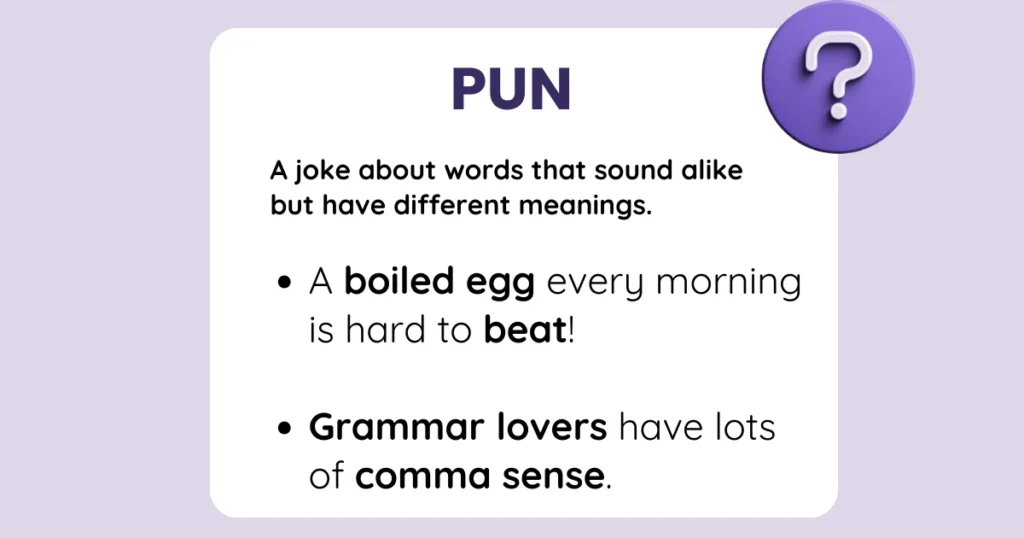
Puns are jokes that play with words that sound alike or have different meanings.
They make people laugh by using the same word in unexpected ways.
Think of puns as verbal magic tricks that surprise your brain.
When you hear a good pun, your mind has to work for a second to “get it.”
That moment of understanding creates the humor we all love.
The Science Behind Why Puns Work
- Research shows that puns activate multiple areas of the brain at once.
- Your brain processes the literal meaning and the joke meaning simultaneously.
- This mental gymnastics creates a small “reward” feeling when you understand the pun.
- Studies from Harvard University found that people who enjoy puns score higher on creativity tests.
- Puns also help improve memory because they create memorable connections between words.
Types of Puns: Breaking Down the Categories
Homophonic Puns
- These puns use words that sound the same but have different meanings.
- “I wondered why the baseball kept getting bigger. Then it hit me.”
- The word “hit” sounds the same whether you mean physical contact or sudden understanding.
- Homophonic puns are the most common type you’ll encounter daily.
- They work because English has thousands of words that sound identical.
Homographic Puns
- These puns use words that are spelled the same but have different meanings.
- “Time flies like an arrow; fruit flies like a banana.”
- The word “flies” means both “moves quickly” and “small insects.”
- Homographic puns require readers to think about multiple word definitions.
- They’re especially effective in written communication where spelling is visible.
Compound Puns
- These puns combine multiple word tricks in one sentence.
- “A bicycle can’t stand on its own because it’s two tired.”
- This example uses both “two” (number) and “too” (excessive) plus “tired” (exhausted) and “tires” (bicycle parts).
- Compound puns show advanced wordplay skills.
- They create layers of meaning that reward careful listeners.
Visual Puns
- These puns work through images or visual word arrangements.
- Think of signs that say “Donut Give Up” with a picture of a donut.
- Visual puns combine text and images for maximum impact.
- They’re popular in advertising and social media content.
- Social media posts with visual puns get 67% more engagement than regular posts.
Best Pun Examples With Detailed Meanings
Classic Puns Everyone Should Know
“I’m reading a book about anti-gravity. It’s impossible to put down!”
This pun works because “put down” means both “stop reading” and “place something lower.”
Anti-gravity would literally prevent you from putting anything down.
The humor comes from the double meaning creating an unexpected connection.
“Did you hear about the mathematician who’s afraid of negative numbers? He’ll stop at nothing to avoid them!”
“Nothing” refers to the number zero, which comes before negative numbers.
“Stop at nothing” also means “do everything possible.”
This pun combines math concepts with common expressions.
“I told my wife she was drawing her eyebrows too high. She looked surprised.”
High eyebrows create a surprised facial expression.
The word “surprised” describes both her reaction and her appearance.
This pun uses visual imagery to create humor.
Food-Related Puns
“Why don’t eggs tell jokes? They’d crack each other up!”
Eggs literally crack when broken.
“Crack up” means to laugh very hard.
This pun connects physical properties with emotional responses.
“What do you call a nosy pepper? Jalapeño business!”
“Jalapeño” sounds like “all up in yo” (slang for “all up in your”).
This pun uses food names that sound like common phrases.
It combines Spanish words with English slang effectively.
“I’m on a seafood diet. I see food and I eat it.”
“Seafood” (ocean fish) sounds like “see food” (observe meals).
This pun plays with diet terminology and eating habits.
It’s memorable because it describes common behavior.
Animal Puns
“What do you call a sleeping bull? A bulldozer!”
A bulldozer is heavy construction equipment.
“Dozer” also means “one who dozes” (sleeps).
This pun combines animal behavior with machinery names.
“Why don’t elephants use computers? They’re afraid of the mouse!”
Computer mice are small input devices.
Real mice are small animals that supposedly scare elephants.
This pun bridges technology with animal folklore.
“What do you call a bear with no teeth? A gummy bear!”
Gummy bears are chewy candy without hard textures.
“Gummy” also describes mouths without teeth.
This pun connects candy names with physical descriptions.
Advanced Pun Techniques for Better Writing
Creating Context for Your Puns
- Good puns need proper setup to work effectively.
- You can’t just throw random wordplay into sentences.
- The surrounding context must support the double meaning.
- Think of puns as mini-stories that need beginning, middle, and end.
- The setup creates expectation, the pun delivers surprise.
Timing Your Puns for Maximum Impact
- Written puns work differently than spoken puns.
- In writing, readers process puns at their own pace.
- This gives you more flexibility with complex wordplay.
- Spoken puns require immediate understanding to be funny.
- Consider your audience and delivery method when crafting puns.
Avoiding Overuse of Puns
- Too many puns in one piece of writing become overwhelming.
- Readers stop appreciating the wordplay when it’s constant.
- Use puns strategically to highlight important points.
- Space them out to maintain their special impact.
- Quality beats quantity every time with puns.
How Puns Improve Communication Skills
Building Vocabulary Through Wordplay
- Puns force you to think about multiple word meanings.
- This mental exercise expands your vocabulary naturally.
- You start noticing word relationships you never saw before.
- Regular pun practice makes you more aware of language patterns.
- Teachers report that students who enjoy puns score higher on vocabulary tests.
Enhancing Creative Thinking
- Creating puns requires creative problem-solving skills.
- You must find unexpected connections between different concepts.
- This mental flexibility helps with other creative tasks.
- Puns train your brain to think outside conventional patterns.
- Business leaders who use puns often excel at innovative thinking.
Improving Memory and Retention
- Puns create strong memory links between related concepts.
- The surprise element makes information more memorable.
- Students remember lessons better when teachers include relevant puns.
- Marketing messages with puns stick in consumers’ minds longer.
- Memory experts recommend puns for learning new languages.
Common Mistakes When Using Puns
Forcing Puns Into Inappropriate Contexts
- Not every situation calls for wordplay humor.
- Serious topics require respectful communication approaches.
- Puns can seem insensitive when used at wrong times.
- Read the room before dropping puns into conversations.
- Professional settings often require more formal language.
Making Puns Too Complicated
- Simple puns work better than complex ones.
- Readers shouldn’t need dictionaries to understand your wordplay.
- Over-complicated puns confuse rather than entertain.
- The best puns feel natural and effortless.
- If you have to explain a pun, it probably needs work.
Using Outdated or Offensive Puns
- Language evolves, and some old puns don’t age well.
- Avoid puns that might offend or exclude certain groups.
- Cultural sensitivity matters even in humor.
- What seemed funny years ago might not work today.
- Test your puns with diverse audiences before publishing.
Puns in Different Languages and Cultures
English Puns vs. Other Languages
- English has more puns than most languages because of its complex history.
- We borrowed words from Latin, French, German, and many other languages.
- This creates numerous sound-alike words perfect for puns.
- Other languages have fewer homophones, making puns more challenging.
- Translation often kills puns because wordplay doesn’t cross language barriers.
Cultural Context in Pun Appreciation
- Different cultures have varying attitudes toward puns.
- Some societies view puns as clever wordplay worth celebrating.
- Others see puns as low-form humor not worth serious attention.
- Understanding cultural context helps you use puns appropriately.
- International communication requires careful consideration of humor styles.
Teaching Puns to Students
Age-Appropriate Pun Examples
- Young children enjoy simple puns about familiar topics.
- Elementary students love animal puns and food wordplay.
- Teenagers appreciate puns about technology and social situations.
- Adults prefer sophisticated puns with cultural references.
- Match your pun complexity to your audience’s development level.
Using Puns for Educational Purposes
- Puns make learning more enjoyable and memorable.
- Science teachers use puns to explain complex concepts.
- History lessons become more engaging with period-appropriate wordplay.
- Math puns help students remember formulas and operations.
- Language arts classes benefit from exploring pun construction.
Creating Your Own Puns
The Process of Pun Development
- Start with a topic you want to make humorous.
- List words related to that topic.
- Find words that sound similar but have different meanings.
- Experiment with different combinations until something clicks.
- Test your puns with friends before using them publicly.
Tools and Resources for Pun Creation
- Rhyming dictionaries help find sound-alike words.
- Thesauruses provide words with multiple meanings.
- Online pun generators offer inspiration for stuck moments.
- Word association games train your pun-creation muscles.
- Regular reading exposes you to professional pun examples.
Puns in Professional Writing
Business Communication and Puns
- Puns can make business writing more memorable.
- Company names often use puns to stick in customers’ minds.
- Marketing campaigns leverage puns for viral potential.
- However, professional contexts require careful pun selection.
- Know your audience before adding wordplay to business documents.
Academic Writing and Wordplay
- Academic writing traditionally avoids puns for serious tone.
- However, some educational contexts benefit from strategic wordplay.
- Conference presentations can use puns to engage audiences.
- Research titles sometimes employ puns for memorability.
- Consider your field’s conventions before including puns.

The Psychology Behind Pun Appreciation
Why Some People Love Puns
- Pun lovers tend to score higher on openness personality tests.
- They enjoy mental challenges and linguistic creativity.
- These individuals often excel at pattern recognition.
- Pun appreciation correlates with higher education levels.
- Creative professionals often gravitate toward pun-based humor.
Why Others Hate Puns
- Some people find puns predictable and uninspired.
- They prefer humor that doesn’t require mental work.
- Pun-haters often value direct communication over wordplay.
- Cultural background influences pun appreciation significantly.
- Personal humor preferences develop early in childhood.
Modern Puns in Digital Communication
Social Media and Pun Culture
- Twitter’s character limit makes puns perfect for viral content.
- Instagram captions often feature puns for engagement.
- TikTok creators use puns in video titles and descriptions.
- Memes frequently combine visual elements with punny text.
- Digital communication has created new pun formats and styles.
Texting and Pun Evolution
- Autocorrect creates accidental puns in text messages.
- Emoji combinations can create visual puns.
- Abbreviations and acronyms generate new pun possibilities.
- Voice-to-text technology sometimes produces humorous pun mistakes.
- Digital natives have developed unique pun communication styles.
FAQs
What are the 10 figures of speech with examples?
Here are 10 common ones:
-
Simile – “He’s as brave as a lion.”
-
Metaphor – “The world’s a stage.”
-
Personification – “The sun smiled down.”
-
Hyperbole – “I’ve told you a million times!”
-
Alliteration – “She sells sea shells…”
-
Onomatopoeia – “Boom! Crash!”
-
Oxymoron – “Deafening silence.”
-
Pun – “Time flies like an arrow; fruit flies like a banana.”
-
Irony – A fire station burns down.
-
Euphemism – “Passed away” instead of “died.”
What are 30 figures of speech?
Here’s a list of 30 with brief examples:
-
Simile – “Fast like lightning”
-
Metaphor – “He’s a rock”
-
Personification – “Time waits for no one”
-
Hyperbole – “Endless paperwork”
-
Onomatopoeia – “Splash!”
-
Alliteration – “Wild and windy”
-
Pun – “Jokes about vegetables are corny”
-
Irony – “A dentist with cavities”
-
Oxymoron – “Bittersweet”
-
Euphemism – “Let go” (for fired)
-
Synecdoche – “All hands on deck”
-
Metonymy – “The pen is mightier than the sword”
-
Apostrophe – “Oh death, where is thy sting?”
-
Anaphora – “We will fight, we will win…”
-
Antithesis – “Many are called, few are chosen”
-
Climax – “He came, he saw, he conquered”
-
Tautology – “Free gift”
-
Litotes – “Not bad at all”
-
Paradox – “Less is more”
-
Idiom – “Kick the bucket”
-
Chiasmus – “Never let a fool kiss you or a kiss fool you”
-
Assonance – “Hear the mellow wedding bells”
-
Consonance – “Pitter patter”
-
Zeugma – “She broke his car and his heart”
-
Anadiplosis – “Fear leads to anger. Anger leads to hate…”
-
Polysyndeton – “He ran and jumped and laughed…”
-
Asyndeton – “I came, I saw, I conquered”
-
Rhetorical question – “Who cares?”
-
Pleonasm – “I saw it with my own eyes”
-
Spoonerism – “It’s roaring with pain” → “It’s pouring with rain”
What are the 7 figures of speech in English?
The 7 most taught are:
-
Simile
-
Metaphor
-
Personification
-
Hyperbole
-
Onomatopoeia
-
Alliteration
-
Oxymoron
What are the figures of speech? Pick out examples.
Figures of speech are creative expressions used to enhance language.
Example: Simile – “Her smile was like sunshine.”
What are 20 figures of speech?
Here’s a compact list of 20 key types:
-
Simile
-
Metaphor
-
Hyperbole
-
Personification
-
Alliteration
-
Onomatopoeia
-
Irony
-
Oxymoron
-
Euphemism
-
Idiom
-
Pun
-
Antithesis
-
Apostrophe
-
Synecdoche
-
Metonymy
-
Litotes
-
Paradox
-
Tautology
-
Climax
-
Rhetorical question
What is an oxymoron with 10 examples?
An oxymoron combines contradictory terms for dramatic effect.
Examples:
-
Bittersweet
-
Deafening silence
-
Jumbo shrimp
-
Living dead
-
Clearly confused
-
Original copy
-
Open secret
-
Alone together
-
Passive-aggressive
-
Awfully good
Conclusion: Mastering the Art of Puns
Pun examples figures of speech add humor and memorability to your communication.
Understanding different pun types helps you create better wordplay.
Practice with simple puns before attempting complex combinations.
Remember that timing and context determine pun effectiveness.
Use puns strategically to enhance your writing and speaking.
Start incorporating these pun examples into your daily communication.
Your audience will appreciate the clever wordplay and memorable messages.
Keep practicing, and soon you’ll be creating original puns that make people laugh and remember your words.
The best puns feel natural, surprise the audience, and leave lasting impressions.
Master these techniques, and you’ll never run out of ways to make language more engaging and fun.
