


Definition of Overstatement
Overstatement is a literary device that is used in making the exaggerated statement or claim, which is not to be taken seriously. It is also known as hyperbole. This technique is used to stress a certain feeling, or pain in an individual or a group of the people.
Overstatements are usually found in the poetry, prose and in colloquial language. It is a stylistic device that contributes to the enhancement of expressiveness and the intensification of the ideas expressed by the author.
Functions of Overstatement
In literature, the use of overstatement is aimed at exaggerating the significance of a given theme, occurrence or personalities’ character vices.
By exaggerating the certain aspects, the authors can draw readers’ attention to some qualities or feelings that would not be as clearly seen at first sight. This device is most commonly used where the author needs to stir the reader’s emotions.
Furthermore, the overstatement is also used to bring a sense of humor or satire in the writing in order to create curiosity and provoke an interest among the readers.
That is why some authors expanded the parameters of reality and gave hints to the reader in order to make people think more about the actual meaning of the work.
Examples of Overstatement in Literature
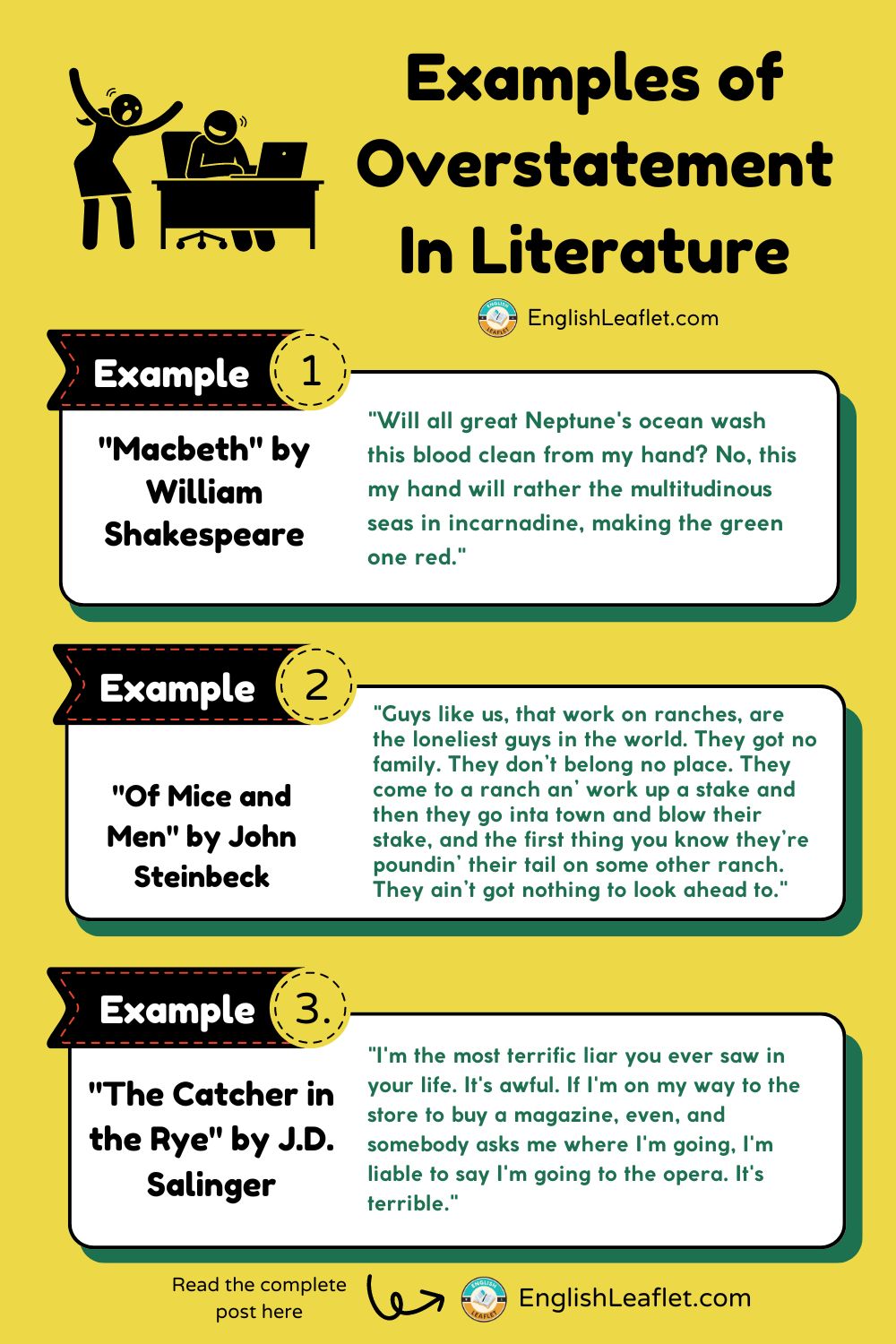
1- “Macbeth” by William Shakespeare
“Will all great Neptune’s ocean wash this blood clean from my hand? No, this my hand will rather the multitudinous seas in incarnadine, making the green one red.”
In this line from Act 2, Scene 2, Macbeth expresses regret of being unable to wash off the blood from his hand even if he uses all water from the ocean.
This is an exaggeration suggesting the level of guilt that Macbeth experiences after the murder of Duncan the King. The exaggeration indicates the evilness of his sin and the depth of his remorse.
2- “The Adventures of Tom Sawyer” by Mark Twain
“There was a rustling of dresses, and the standing congregation sat down. The boy whose history this book relates did not enjoy the prayer, he only endured it—if he even did that much. He was restive all through it; he kept tally of the details of the prayer, unconsciously—for he was not listening, but he knew the ground of old, and the clergyman’s regular route over it—and when a little trifle of new matter was interlarded, his ear detected it and his whole nature resented it; he gaped and stretched, and soon began to steal furtive glances at the cracks in the floor, and the flies navigating the aisle of the church. He wished the bald-headed man would move away—he was reflecting sunlight like a mirror, and hurting his eyes. He shifted restlessly in his seat, then he put his knees together and his elbows on them and his chin in his hands. He forgot the clergyman and everything else. His heart ached to be free; his lips quivered, and he was almost crying. His spirit was chafing under the slow torture of captivity.”
Through overstatement, Tom’s feeling of boredom as well as inconvenience during the church prayer has been showed. Twain takes the audience through Tom’s restlessness and irritation to the point of exaggeration that brings out the humorous part in the book.
Tom does not enjoy the prayer. He just puts up with it. He knows the prayer so well that he counts its parts in his head. He even gets annoyed when small changes are made to it. The exaggeration of the situation views Tom’s experience from his own eyes and brings some humor to the torture that he daily receives.
3- “A Tale of Two Cities” by Charles Dickens
“I would embrace any sacrifice for you and for those dear to you. Try to hold me in your mind, at some quiet times, as ardent and sincere in this one thing. The time will come, the time will not be long in coming, when new ties will be formed about you—ties that will bind you yet more tenderly and strongly to the home you so adorn—the dearest ties that will ever grace and gladden you. Oh, Miss Manette, when the little picture of a happy father’s face looks up in yours, when you see your own bright beauty springing up anew at your feet, think now and then that there is a man who would give his life, to keep a life you love beside you!”
The given passage contains the example of the overstatement. The speaker’s highly paradoxical and rather pathetic remarks indicate his willingness to die for Miss Manette’s, and her close ones’ happiness show just how passionate and genuine he is.
Thus, using references to the scenes of family happiness in the future and referring to the desire to sacrifice himself for preserving the happiness, the speaker enhances the passionate feeling and demonstrates his love and devotion in the performative key.
4- “The Great Gatsby” by F. Scott Fitzgerald
“I’m p-paralyzed with happiness.”
In this line one can find the emotional state of Daisy Buchanan upon seeing Nick Carraway. Daisy exaggerates her happiness, saying that she is “paralyzed with happiness”.
Daisy employs overstatement to stress her excitement, despite the fact that exaggeration is giving hint at a superficial expression of emotion. It reflects the themes of the novel i.e. realty and illusion.
5- “Of Mice and Men” by John Steinbeck
“Guys like us, that work on ranches, are the loneliest guys in the world. They got no family. They don’t belong no place. They come to a ranch an’ work up a stake and then they go inta town and blow their stake, and the first thing you know they’re poundin’ their tail on some other ranch. They ain’t got nothing to look ahead to.”
The excerpt focuses on the overstatement of suffering of migrant ranch workers during the Great Depression. Through enhancing the aspects of loneliness, family nonexistence, and the circle repetitiveness of their labor, the author illustrates their hardships.
He exaggerates their characteristics and implies that all the ranch workers have same strategies of working, spending and mobility in town, and proceeding to the next job.
The cruelest overextension is when they say that they have nothing to look forward to, underlining the characters’ hopelessness.
These exaggerations create a sense of shared identity and bonding among the workers, which makes the reader sympathetic towards them.
6- “The Catcher in the Rye” by J.D. Salinger
“I’m the most terrific liar you ever saw in your life. It’s awful. If I’m on my way to the store to buy a magazine, even, and somebody asks me where I’m going, I’m liable to say I’m going to the opera. It’s terrible.”
In the text, Salinger overstates Holden Caulfield’s impression of himself and his actions with the purpose of portraying a certain image.
Holden declares himself “the most terrific liar you ever saw in your life” and states the he could lie “on unnecessary subjects” though “ninety-eight out of a hundred times” when, for example, he could say “I’m going to the opera.
The use of terms such as awful and terrible are considered severe which supports the arrogant dishonest character assumption of the writer.
These hyperboles serve multiple purposes: It reveals interpersonal skills through dramatic gestures and body language, expresses Holden’s awareness of himself, and speaks about the internal conflict regarding the lack of true identity.
In general, it is essential to mention that this overstatement strengthens Holden’s peculiar narration, thus making the character more interesting while gradually exposing his inner conflict.
Literary Devices Related to Overstatement
1- Understatement
Understatement is the opposite of overstatement. While making understatement, something is intentionally presented as less significant and serious. This particular device creates amuse or ironic effect underplaying of the scenario or event in question.
2- Litotes
Litotes is a kind of understatement where the affirmative statement is expressed in terms of the opposite of its negative. They use SQL queries often in association with double negative and have an indirect, but forceful way of expressing enhancements.
See also: Literary Devices That Start With O
