


What is Canto?
Canto is a term used in poetry to refer to a major division of a long poem. It is a subdivision of a larger work, often a narrative poem. It is used to create a structure within the work. Cantos are commonly used in epic poetry, but they can also be found in other forms of poetry. Cantos are often numbered or titled and serve to organize the narrative or thematic flow of epic poems. The key features of the canto include variable length, the ability to stand alone yet connect to an overarching storyline and the use of poetic techniques like rhyme schemes.
How to Write a Canto?
Following are some important aspects to write a canto: –
1. Choose a Theme
The first step to write a successful canto is to choose a theme. This will be the unifying thread that ties your canto together. The theme should be broad enough to allow for exploration and development, but specific enough to provide focus and direction to your writing.
2. Determine the Structure
After determining the theme in mind, the next step is to decide about the structure of the canto. Firstly, it should be followed by a specific rhyme scheme or meter. Secondly, it is written in a free verse form. Always consider that how the structure will impact the overall tone and meaning of your canto.
3. Develop Characters and Setting
Just like any other type of writing, a canto should include well-developed characters and setting. Take the time to flesh out your characters and create a vivid setting that complements your theme.
4. Include Symbolism
Symbolism is an important aspect of poetry and can add depth and meaning to your canto. While writing canto, it is necessary to include symbols, metaphors and other figurative language to enhance the themes and ideas explored in your writing.
5. Revise and Edit
The final round after writing the canto is to revise and edit it several times. It is necessary to look for ways to tighten up your language and strengthen your imagery and symbolism. Canto should be read loudly to make sure that the rhythm and pacing are working well. Consider sharing your work with others and getting feedback to help you improve your writing. It is to remember that writing a canto is a process, so be patient and keep working at it until you are satisfied with the final product.
How many lines are in a canto?
The number of lines in a canto can vary, as there is no set rule for the length of a canto. Some cantos may have only a few lines, while others could be quite lengthy. The length of a canto is often determined by the poet’s intended structure and the themes they wish to explore.
The number of lines in a canto can vary depending on the poet’s preference. It can range from just a few lines to multiple pages. Generally, a canto is a self-contained section of a longer poem, so the length is determined by the poet’s desired structure and pacing.
How many cantos are in each poem?
The number of cantos in a poem also varies and is entirely up to the poet’s discretion. Some epic poems may have multiple cantos, while other forms of poetry, such as sonnets may consist of only one canto. The decision on how many cantos to include will depend on the overall structure and themes of the poem.
The number of cantos in each poem is also determined by the poet’s preference and the overall structure of the work. Some epic poems, such as Dante’s “Divine Comedy,” have multiple cantos (100 in this case), while others may have only one or a few. The number of cantos is often determined by the scope and complexity of the poem’s themes and narrative.
What is Stanza?
A stanza is a grouped set of lines within a poem, usually set off from other stanzas by a blank line. Stanzas have a recurring pattern of meter, rhyme and number of lines.
Canto VS Stanza
Differences between canto and stanza are given below:
- Canto and stanza are both elements of poetry, but they differ in their length and function. A canto is a major division of a long poem, while a stanza is a smaller division of a poem.
- A canto can stand alone as a complete poem in its own right, and typically has a unifying theme or purpose that ties it together. Cantos are often used in epic poetry, which tells a long story and they help to structure the work. On the other hand, a stanza is a group of lines within a poem, usually separated by a blank line from other stanzas in the same poem. Stanzas are used to organize a poem and create a pause or break in the flow of the text.
- Cantos are typically longer and more self-contained than stanzas. They both serve to structure a poem and provide a sense of organization to the work.
- Canto and stanza are both structural elements used in poetry, but there are some key differences between the two.
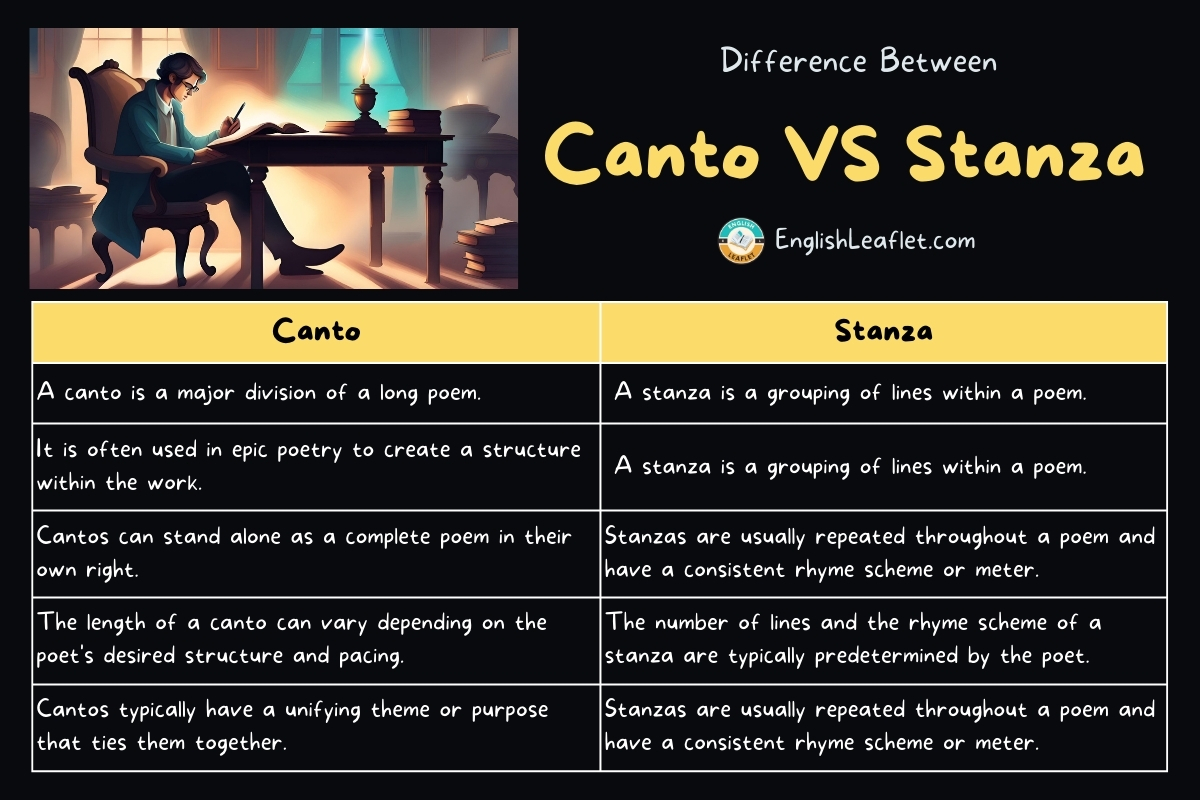
Quick Review of Difference between canto and stanza
| Canto | Stanza |
| A canto is a major division of a long poem. | A stanza is a grouping of lines within a poem. |
| It is often used in epic poetry to create a structure within the work. | A stanza is a grouping of lines within a poem. |
| Cantos can stand alone as a complete poem in their own right. | Stanzas are usually repeated throughout a poem and have a consistent rhyme scheme or meter. |
| The length of a canto can vary depending on the poet’s desired structure and pacing. | The number of lines and the rhyme scheme of a stanza are typically predetermined by the poet. |
| Cantos typically have a unifying theme or purpose that ties them together. | Stanzas are usually repeated throughout a poem and have a consistent rhyme scheme or meter. |
Further Reading
