

The phrase “Crime Doesn’t Pay” is a famous aphorism that has been used for many years with the intention of passing a moral message to the society on the implication of participating in criminal activities. This expression has its origin in the belief that crime, however profitable in the short run, leads to punishment, loss and even remorse. The term has been used in literature, movies, and advertisements. It has become a slogan used by the police as a warning and a moral message.
Meaning of “Crime Doesn’t Pay”
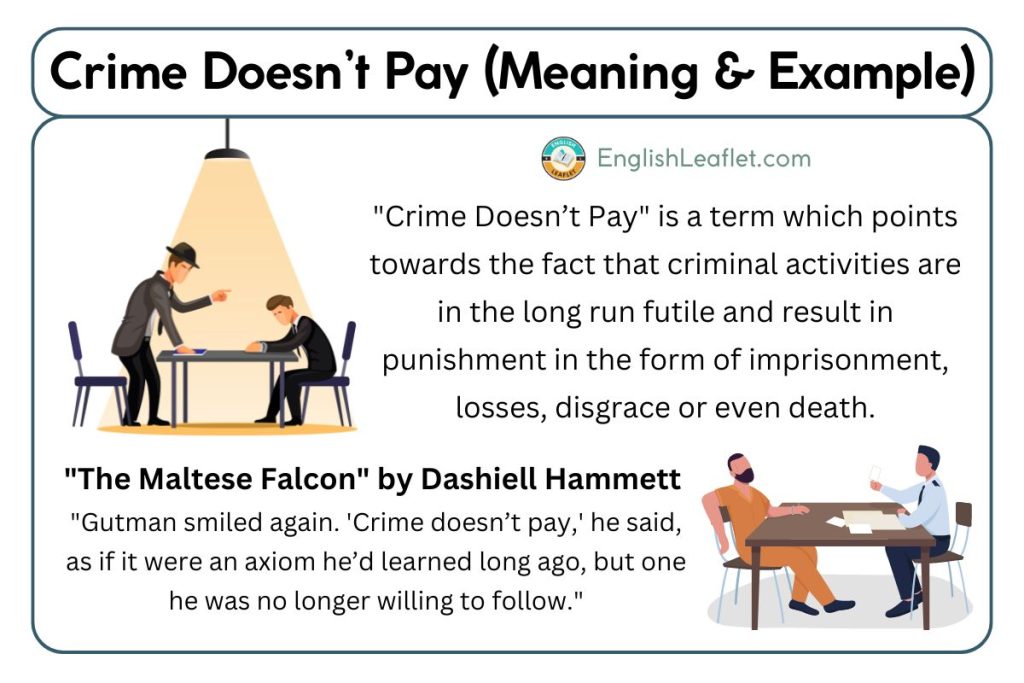
“Crime Doesn’t Pay” is a term which points towards the fact that criminal activities are in the long run futile and result in punishment in the form of imprisonment, losses, disgrace or even death.
The phrase captures the idea that the gains of criminal activities are based on illusion and the advantages of criminal conduct are always accompanied by disadvantages and harsh consequences. It presents a message that one should not cheat or do wrong in the pursuit of success and happiness.
The proverb also captures a certain cultural standard of justice whereby the perpetrators of crimes will be apprehended and punished, and that only right conduct will lead to success and happiness in life. It portrays the fact that there are consequences for the people who decide to embark on the criminal activities, and the fact that honesty and integrity are the core values of a society.
Origin of “Crime Doesn’t Pay”
The phrase “Crime doesn’t pay” was popularized in the early 20th century and was utilized as a moral lesson in American society. It portrays the message that vices or criminal activities makes no one rich or happy in the end.
The idea that criminals will one day get caught or meet with misfortune in their endeavors became the biggest deterrent to criminal activities. It is possible to detect the phrase in newspapers and moralistic literature of the period: crime may seem to pay with high rewards for the moment, but punishment or remorse will follow sooner or later.
The phrase got popularity in the 1930s and 1940s, especially in America, where it was used in movies, particularly crime films, pulp novels and comic strips. Both the government and the entertainment industry accepted the message as a tool of promoting law and order.
Crime related programs in this era depicted criminals getting what they deserved, so the public will appreciate repercussions of criminal conducts. The 1935 MGM Studios film series “Crime Does Not Pay” further popularized the phrase and strengthened the notion that anyone who tries to “get away with crime” will always be punished.
The phrase became a popular refrain by the mid-20th century and was used in public service announcements, crime narratives and in everyday speech. It remained as a stark message that crime, however alluring, is never profitable in the long run. The longevity of phrase lies in its clear message: crime does not pay it leads to tragedy and this has made it famous in the society as a lesson to deter people from engaging in criminal activities.
Use of “Crime Doesn’t Pay” in Literature
Example#1
“The Maltese Falcon” by Dashiell Hammett
“Gutman smiled again. ‘Crime doesn’t pay,’ he said, as if it were an axiom he’d learned long ago, but one he was no longer willing to follow.”
In this line, Gutman, a criminal mastermind, uses the phrase almost sarcastically, acknowledging the fact that crime does not pay, yet he goes on with criminal activities. This use reflects that how the criminals may be aware of the moral lesson but decide to go against it thinking that they are not the type to be affected by the moral lesson.
Example#2
“To Kill a Mockingbird” by Harper Lee
“Atticus said something like, ‘Crime doesn’t pay in the long run,’ as he looked through the papers, but the sadness in his voice told me he wished that were always true.”
In the novel, the phrase was uttered by the character Atticus Finch in relation to criminal behavior, which leads to repercussions or remorse. However, the fact that Atticus sounds passionate in his speech implies that there are situations where justice is not clear, which points towards the social issues of race and the flaws of the legal system.
Example#3
“Crime and Punishment” by Fyodor Dostoevsky
“They say crime doesn’t pay, but for Raskolnikov, the toll of his sins was not in gold or rubles but in the slow, suffocating collapse of his own mind.”
Although the novel was written before the modern phrase “crime doesn’t pay”, however this passage embodies the same concept. Raskolnikov’s punishment is not only legal but also psychological one and it proves that he pays the price of his sin through suffering from guilt. It emphasizes the fact that no matter how one escapes the repercussions of his or her actions, the guilt still catches up with him
Example#4
“The Godfather” by Mario Puzo
“Michael had seen too much. Too many men believed crime didn’t pay—until they were in too deep, swimming with blood on their hands.”
In the novel, the use of phrase demonstrates how the criminal world appears to be profitable but in fact results in death and chaos. Michael Corleone observes the misfortunes of the criminals who believe that they can evade consequences, only to find themselves trapped by the crimes they wanted to commit. The phrase implies the principle of cause and effect in a world where crime syndicates are in control.
Example#5
“The Big Sleep” by Raymond Chandler
“Crime doesn’t pay, Marlowe thought, not when you see the bodies stacked up like firewood. You never end up ahead; you just end up dead or worse.”
In this detective novel, the phrase “crime doesn’t pay” is used by Philip Marlowe to think about the death and the damage that has been done by criminals. The role of a private investigator makes him see the real-life consequences of crime; that even those who try to benefit from it are left with nothing in the end, thus, making the phrase correct.
See also: Don’t Go There Meaning
Use of “Crime Doesn’t Pay” in Modern Contexts
The phrase “Crime Doesn’t Pay” is also used in the present time. The phrase can be seen in various discourses, such as in criminal justice, law enforcement, and society’s conduct. The idea that crime results in undesirable outcomes has been used in many awareness campaigns, legal system and educational programmes.
In Law Enforcement and Public Awareness Campaigns
To discourage the criminal activities, the law enforcement agencies across the globe are used this particular phrase. Such campaigns often focus mainly on the consequences of crime, which include arrest, imprisonment, and the effects that one is likely to face in the future, including damage to one’s reputation. These campaigns seek to deter people, especially the youths, from participating in criminal activities as crime does not pay.
For example, the anti-drug campaigns may employ the phrase to depict the effects of drug trafficking and abuse where one can lose his life or face the legal consequences. Likewise, the anti-fraud programmes may use this term to discourage the people from attempting frauds, because the gains appear to be sweet but the chances of getting caught and punished are high.
In Popular Culture
The phrase “Crime Doesn’t Pay” has also been used in the movies, TV shows, songs and other forms of entertainment. It is very common in crime dramas and thrillers where it is used to bring out the ethical and legal repercussions of the crime.
It is also a noticeable trend in these narratives that the characters who are involved in criminal activities end up suffering a lot of consequences and this shows that crime does not pay.
For example, in the television series “Breaking Bad”, the main character Walter White, who engages in manufacturing and selling of drugs and experiences a number of mishaps resulting to his death.
This series is complex and morally ambiguous, but in the end, it presents an idea that crime, no matter how one tries to justify it, is bad and has negative effects.
In Education and Moral Teachings
The society especially the educators and the parents always use the phrase ‘Crime Doesn’t Pay’ in order to try and teach the youth the right things to do. The saying also emphasize the fact that only hard work, honesty and integrity pays off while trying to get things done the wrong way only ends up in failure and sorrow. Through explaining the repercussions of crime, educators try to assist young persons to make correct choices and be law-abiding citizens within the society.
See also: Country Bumpkin Meaning & Examples
