

Introduction to “Brave New World”
The novel “Brave New World” was penned by Aldous Huxley in 1932. It is a classic dystopian novel that explores the society that is controlled by technology, totalitarianism and the erasure of individualism. The novel is set in the World State, a utopian society, where the happiness and stability are maintained through the stringent control of the society, the use of drugs and the conditioning of people from birth. In this world, there are no families, religion and personal freedom as it is known in the contemporary world; everything is based on the principle of utility, where the needs of the community are above the needs of the individual.
Huxley’s work features a number of themes that are still pervasive in the present world. These themes are closely interrelated with the plot of the novel and make Brave New World not only a novel of political or social criticism but also a philosophical work. It shows the possible results of the denial of the value of the individual for the sake of the welfare of the community.
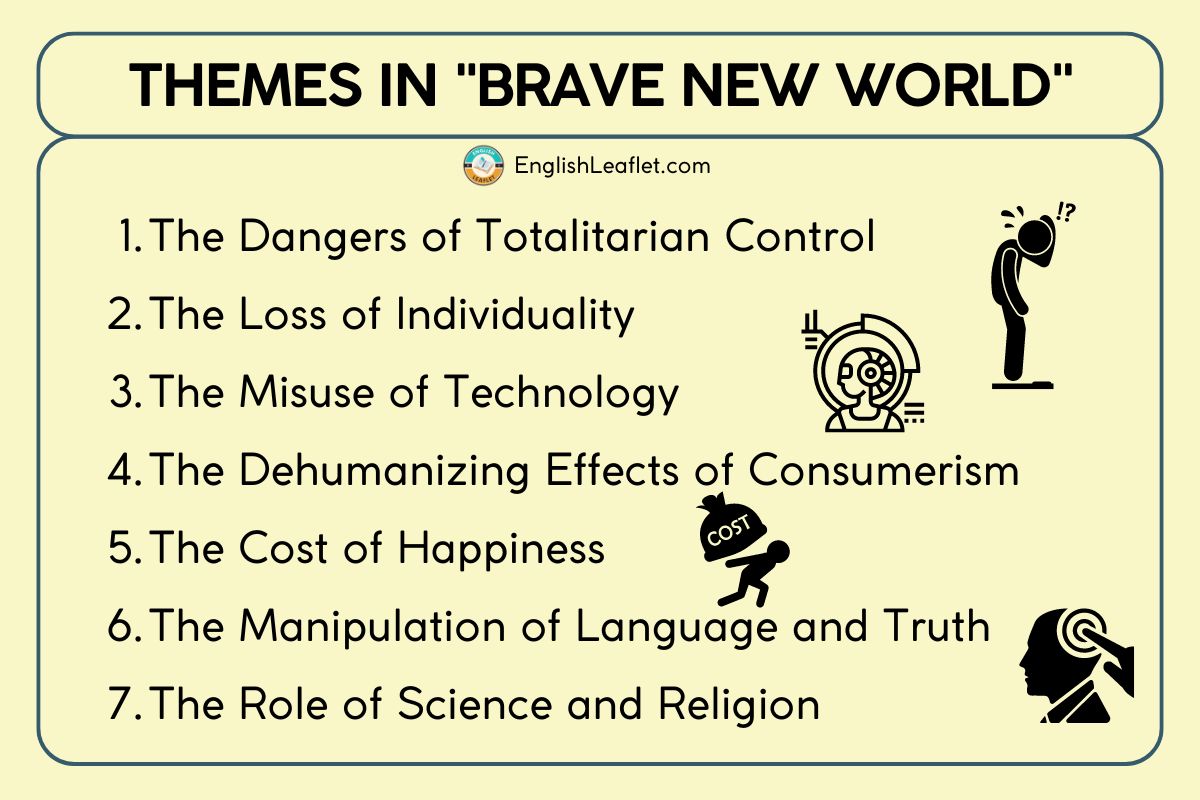
Themes in “Brave New World”
Theme#1
The Dangers of Totalitarian Control
In World State the Government has total control over the lives of the people. All aspects of their lives, minds, souls, roles and their relationships are also under the control of the Government. This is done using technology, changing people’s psychological condition, and not allowing any form of rebellion or resistance.
Technology is also employed to regulate the numbers of the population. This process is known as Bokanovsky’s Process of artificial reproduction of human beings whereby the embryos are artificially fertilized and social conditioned to fit certain categories of the society. The Director of Hatcheries and Conditioning explains:
“One egg, one embryo, one adult—normality. But a bokanovskified egg will bud, will proliferate, will divide. From eight to ninety-six buds, and every bud will grow into a perfectly formed embryo, and every embryo into a full-sized adult. Making ninety-six human beings grow where only one grew before. Progress.” (Chapter 1)
This passage shows the level of the control that the World State has over the lives of its citizens, or rather the mere objectification of humans. The dehumanizing process, which is inherent in such an approach, is emphasized by the contrast with the World State perceiving it as ‘progress.
Theme#2
The Loss of Individuality
Another important theme in the novel is the loss of individuality. In the World State, people do not grow up as individuals with personalities and ambitions of their own; their desires are programmed by the World State’s institutions. This loss of individuality is therefore a direct result of the state ideology focused on the need for order, and that order is upheld at the cost of people’s desire and their individuality.
From conception, people in the World State are conditioned to fit social roles. For instance, Epsilons get less oxygen as embryos to limit intelligence for manual work. The Director describes this process:
“We also predestine and condition. We decant our babies as socialized human beings, as Alphas or Epsilons, as future sewage workers or future… Directors of Hatcheries.” (Chapter 1)
This passage raises the issue that how much people abandon the concept of individualism in order to maintain order within the society. The dominance of State over the growth of its citizens ensures that everyone follow their predetermined roles with no chance of personal growth and self-determination.
Theme#3
The Misuse of Technology
The misuse of technology in the World State is multifaceted: on the one hand, people are conditioned to be obedient; on the other, technology helps the World State decrease people’s potential by erasing all aspects of their lives that might be inconvenient for the system.
Soma is another example of the perversion of technology, through which the human feelings and emotions are suppressed. Soma is the embodiment of the state’s dependence on technology to control the population so that it can eradicate any kindness and thereby eliminate rebellion. The drug is so effective that it eliminates the need for traditional forms of social control, such as laws or moral codes:
“The world’s stable now. People are happy; they get what they want, and they never want what they can’t get.” (Chapter 3)
This passage conveys how the World State manipulates people into thinking and feeling happy and content but all lies in technological as the citizens are degraded and have no identity.
The novel is also implicitly satirising in the aspects of entertainment technology as represented in the “feelies”, sensory films where citizens are not only able to watch what is happening on the screen but also to feel it. The feelies represent the ultimate form of escapism, providing shallow pleasures that distract people from the emptiness of their lives:
“Going to the Feelies this evening, Henry?” enquired the Assistant Predestinator. “I hear the new one at the Alhambra is first-rate. There’s a love scene on a bearskin rug; they say it’s marvellous. Every hair of the bear reproduced. The most amazing tactile effects.” (Chapter 3)
The feelies are a fine embodiment of the World State’s goal to keep people from developing any deeper desire in the form of technological pleasure. Thus, the state constantly supplies as much sensory data as possible to ensure that the people do not question the nature of their lives.
Huxley is actually cautioning the world against the regrettable fact that basically, technology controls the lives of people. Thus, the novel points to the fact that even as technology means comfort and enjoyment, when it is applied irrespective of possible negative impacts on people, it may lead to their dehumanization.
Theme#4
The Dehumanizing Effects of Consumerism
Consumerism is also one of the significant theme that can be identified in Brave New World. As a result, the society of the ‘World State’ is a consumer society in a way that the consumption is not only welcomed but also necessary to maintain social stability. This society is based on the best traditions of a society of consumption and production in the mass production scale, making people obsessed with buying more goods and services. Such emphasis on consumerism helps to keep the population’s focus away from the questions regarding their lives and strengthens the state authority.
The three guiding principles of the society depicted by the world state: ‘Community, Identity, Stability’ which reveals the role of consumerism for pacification of the society. The government actively discourages practices such as repairing or reusing items, as this would reduce consumption and threaten the economy:
“Ending is better than mending. The more stitches, the less riches.” (Chapter 3)
A phrase that is oft repeated in the novel sums up the philosophy of the World State, of encouraging overindulgence and consumption. By conditioning people to believe that “ending is better than mending”, the state guarantees that the population remains in constant demand of more goods, which in effect boosts the economic and social structure of the society.
Theme#5
The Cost of Happiness
Here, ‘happiness’ is presented rigidly as something that can be produced and directed, yet the cost is disquietingly high. While the members of the World State are searching for happiness, the society is deprived of opportunities to embrace ‘real’ emotions, conflicts are avoided, and happiness is fake – produced by drugs and technological advancement. But this happiness entails the repression of individuality, freedom and genuinely human experiences.
The World State’s view on happiness is an all-pervasive concept that is based on gratification and the avoidance of any discomfort or pain. The use of soma, as previously discussed, is central to this pursuit of happiness, as it allows people to escape from reality and avoid any negative emotions:
“There is always soma, delicious soma, half a gramme for a half-holiday, a gramme for a weekend, two grammes for a trip to the gorgeous East, three for a dark eternity on the moon…” (Chapter 3)
This passage reveals how far the state depends on soma in order to keep society peaceful and the masses happy. By making people feel nothing and by eradicating the concept of suffering the society of the World State offers an empty and meaningless kind of happiness.
The character of John the Savage also bears the burden of opposition to the World State concept of happiness, as an individual who transforms the society he is living in. Having grown up in an environment which is different from that of the World State and without being conditioned, John has different personal attributes: he strives for liberty, rejects the unthinking obedience to the system, and appreciates the genuine experiences of the life. When confronted with the shallow pleasures of the World State, he rejects them in favor of a more meaningful existence, even if it involves suffering:
“But I don’t want comfort. I want God, I want poetry, I want real danger, I want freedom, I want goodness. I want sin.” (Chapter 17)
John’s denial of the World State’s vision of happiness is a core idea of this novel which depicts a society that willingly renounces depth and truth in exchange for safety. Huxley treats the subject of happiness writing that true happiness is not something that can be produced by some external cause or force, but it is only the result of one’s efforts, of one’s activities meaning that one has to work at it, that one has to take the rough with the smooth.
Theme#6
The Manipulation of Language and Truth
The manipulation of language and truth is the other important theme in the book. The language is controlled and manipulated to reinforce the societal values and suppress objection. The government controls language and history to ensure that the people remain unaware about different lives or ideas.
In the World State, the minds of the people are programmatically formed through various propaganda methods since childhood. The main method of indoctrination is hypnopaedia or sleep teaching, which is used to implant the state’s values in the children. The messages in the shape of common phrases and slogans are whispered into their ears when they are asleep, which help them to accept the state’s ideology without question. One of the most famous hypnopaedic phrases is:
“A gramme is better than a damn.” (Chapter 3)
This phrase reminds of the soma’s usage in order to avoid any negative emotions. The novel promotes the idea that it is better to suppress feelings rather than to experience them entirely. The slogans, and the constant repetition of some ideas, make the ideas seem natural and unquestionable to the citizens of the World State.
Theme#7
The Role of Science and Religion
The writer unfolds the tensity between science and religion, and how these are used to control the society. Science and technology are evident in the World State, but with the society being fully based on science and technology it lacks religion. However, the belief of State on science does not mean that there is no spiritual or religious idea, it has only brought a new type of pseudo-religion of science and technology, and the state.
John the Savage fights for himself and faces the confrontation of science and religion in the novel. He grows up on the Savage Reservation, where religion still exists. He clashes with the secular and scientific World State. He is very troubled by their rejection of religion and materialistic society:
“God’s the reason for everything noble and fine and heroic. If you had a God, you’d have a reason for self-respect.” (Chapter 17)
John’s faith and his search for spiritual purpose illustrate the deficiency of a society that finds meaning and fulfilment in science and technology. In his dialogues with Mustapha Mond, John makes a case that the lack of religion in the World State has reduced people to mere emptiness where they are denied to search for the meaning of life or morality.
Using the theme of science and religion, Huxley raises the bar on the risks of a society that is more preoccupied with the scientific progress at the expense of other facets of life. Brave New World has provoked many crucial issues concerning the relationship between science and religion and the possibilities of the society which has rejected spirituality for the materialism.
