


Meaning of “A Wild Goose Chase”
The phrase ‘a wild goose chase’ means to chase after something that one is not going to get or a search that is likely to lead nowhere. It proposes that all the energy invested in the pursuit is useless since the aim is either unachievable or non-existent. The phrase is commonly employed to refer to circumstances under which a person is deceived or influenced to make a choice that is destined to produce no favorable outcome.
The meaning of a ‘a wild goose chase’ is rather simple and can be defined as an activity that is as unproductive as trying to catch a wild goose – an almost impossible task since the bird is not easy to catch and, even if caught, it may not produce any tangible result.
Origin of “A Wild Goose Chase”
The phrase ‘a wild goose chase’ is said to have begun in the early 17th century. It first came into use in the work of William Shakespeare in the play Romeo and Juliet in about 1592. In Act 2, Scene 4, Mercutio says:
“Nay, if thy wits run the wild-goose chase, I am done: for thou hast more of the wild goose in one of thy wits than, I am sure, I have in my whole five.“
In Shakespeare’s time, a ‘wild-goose chase’ was a horse race. The lead horse would establish the format and the other horses had to do the same in the same way. It was called the ‘wild-goose chase’ because the pattern of the race was imitative of the erratic movements of wild geese in the sky. Gradually the term transformed from referring to one type of race to the current meaning of any task that one is likely to fail at.
Example Sentences of “A Wild Goose Chase”
- Searching for my lost keys without retracing my steps would be a wild goose chase.
- The detective went on a wild goose chase pursuing clues that led nowhere.
- I spent all day on a wild goose chase trying to find rare collectible toys for my son.
- Following rumors about celebrity sightings often leads to a pointless wild goose chase.
- We realized our efforts to find the buried treasure were just a wild goose chase with no chance of success.
- I hope this new business venture isn’t just another wild goose chase where we waste time and money.
- The tabloid sent reporters on a wild goose chase after a false tip about the famous couple.
- She left me on a wild goose chase trying to find her surprise birthday party location.
- I went on a wild goose chase all over town searching for car parts that I can’t even find online.
- Finding an affordable apartment in this city seems to be a wild goose chase unless we increase our budget.

Examples of “Wild Goose Chase” in Literature
Example#1
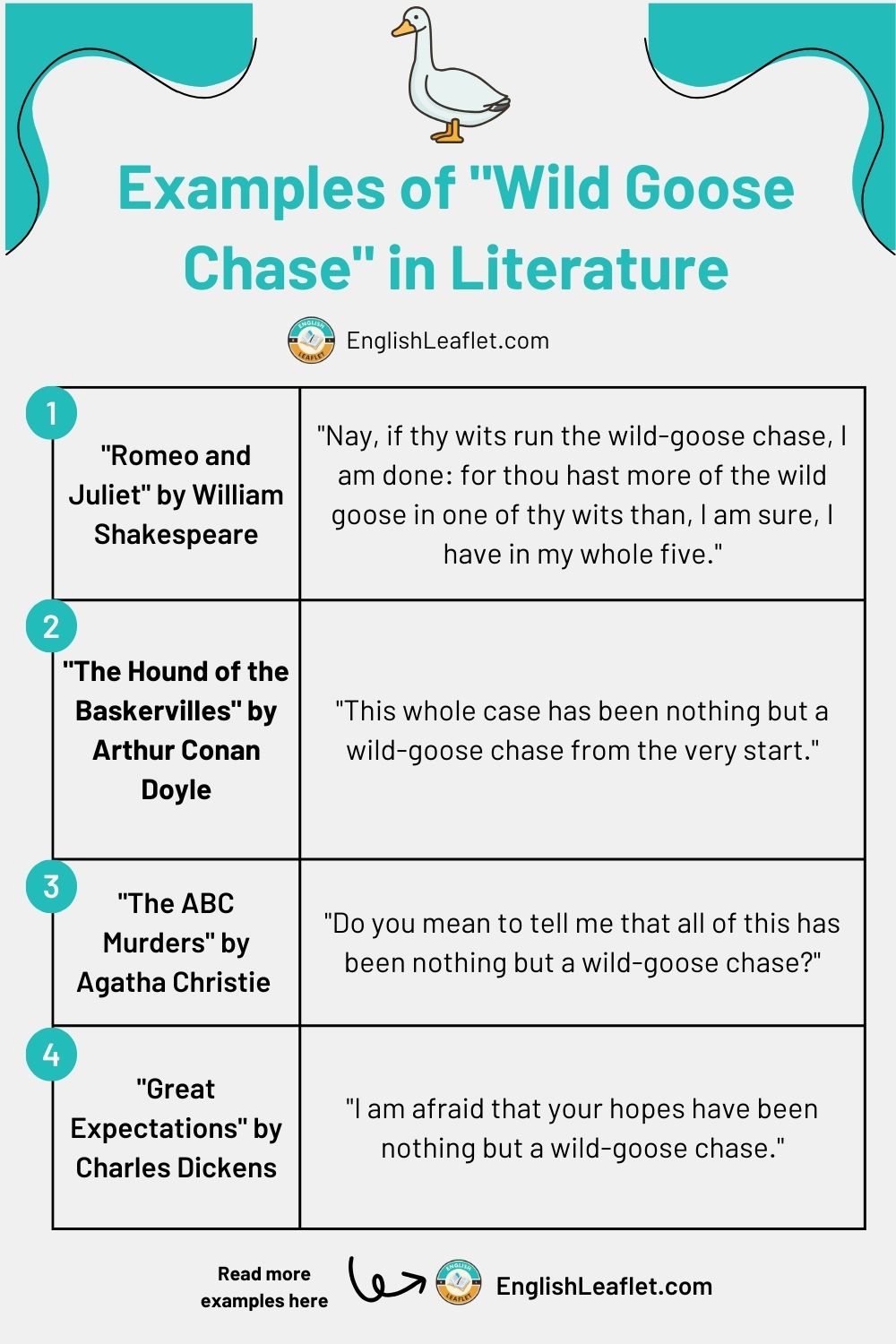
“Romeo and Juliet” by William Shakespeare
“Nay, if thy wits run the wild-goose chase, I am done: for thou hast more of the wild goose in one of thy wits than, I am sure, I have in my whole five.”
Here Mercutio is just teasing Romeo as best friends are used to do. He calls the whole session a ‘wild-goose chase’, which indicate that he seems to have lost Romeo in his wordplay war – the latter is unpredictable and hard to tag like the splendid bird, much like a wild goose.
Example#2
“The Hound of the Baskervilles” by Arthur Conan Doyle
“This whole case has been nothing but a wild-goose chase from the very start.”
The classic example of the use of the phrase comes with Arthur Conan Doyle’s book ‘The Hound of the Baskervilles’ where a ‘wild-goose chase’ is one that yields no fruitful results. It also draws the attention to the obstacles and hopelessness involved by the characters in the investigation.
Example#3
“The ABC Murders” by Agatha Christie
“Do you mean to tell me that all of this has been nothing but a wild-goose chase?”
In this classic mystery novel, ‘wild-goose chase’ is a phrase adopted to indicate the characters that they are victims of a prank or a scheme that makes them run in circles. The term relays the feeling of futility – or more accurately, exhaustion – of chasing something that seems to go nowhere.
Example#4
“Great Expectations” by Charles Dickens
“I am afraid that your hopes have been nothing but a wild-goose chase.”
In the novel, the phrase ‘wild-goose chase’ is adopted by the writer to portray the hero’s futile endeavor. The phrase gives a picture of the relativity, and the suspense of giving efforts towards something which one could not realize that was out of their reach.
Example#5
“Ulysses” by James Joyce
“We have been led on a wild-goose chase, my friend.”
The phrase has been used to describe the protagonist’s understanding that he has been going round in circles and there is nothing in terms of a valuable product at the end. It fits in the futility and the idea of being guided in the wrong direction.
Example#6
“The Adventures of Tom Sawyer” by Mark Twain
“Well, this is just a wild-goose chase!”
The phrase depicts the frustration of the character in an organization and planning only to get the funny result of a wild-goose chase. He uses the phrase in order to underline the foolishness of the endeavor.
Example#7
“The Lord of the Rings” by J.R.R. Tolkien
“It seems we are on a wild-goose chase, Gandalf.”
Another striking example of the phrase has been used in the novel to demonstrate the frustration of the character that they have gone off track in their quest. It reflects the obstacles and temptations which have been faced by the characters on their way.
Example#8
“The Great Gatsby” by F. Scott Fitzgerald
“All this time, we have been chasing a wild goose.”
In the novel, this phrase is used to refer the attempts at chasing for the American Dream. The phrase gives the feeling of despair that is characteristic of the characters’ lives due to the false hope that they are all pursuing.
Example#9
“1984” by George Orwell
“The Party sent us on a wild-goose chase, and we fell for it.”
In the Orwell’s novel, the phrase a ‘wild-goose chase’ refers to a situation whereby the characters are left with the bitter knowledge that they have been made to run in circles with no positive outcome. It can be considered as a manifestation of the themes of deception and control which has been depicted in the novel.
Example#10
“Of Mice and Men” by John Steinbeck
“We went on a wild-goose chase, and look where it got us.”
The phrase has been employed at the end when the dream that the characters have pursued is no longer tenable and is looked on as hopeless. The phrase stresses the futility of their struggles and the harsh realities of their lives.
Why Do Writers Use “wild goose chase?”
Some writers deploy the phrase ‘wild goose chase’ for a number of reasons because of its picturesqueness, the historical connotation, and the euphonic sense of futility or a chase in the wrong direction. Here are a few key reasons why this phrase is often employed in writing:
1- Vivid Imagery
The phrase puts to mind an exact easily understandable image of chasing a wild goose, a bird that is especially known to be sly in its movements and would be difficult to corner. It is with this imagery that the idiom became useful in explaining any task or endeavor that seems pointless and elusive.
2- Expressing Futility
The phrase ‘a wild goose chase’ can be used to describe any task that a person is undertaking with little chance of success. It reflects an intense feeling of futility and despair of the endeavor, hence it is often used by writers when they wish to describe the notion of an effort in vein or a search that leads nowhere.
3- Cultural Resonance
This phrase can be traced back to Shakespearean English and has been in used up to the present time. The phrase has cultural significance and it is a common way of conveying an intricate idea into the text.
4- Adding a Literary or Dramatic Flair
To use an idiom such as ‘a wild goose chase’ means that you have added a certain sophistication or drama to your writing, or made it more literate. It can add a more poetic or metaphoric aspect to the story which is useful in storytelling and poetry and other creative writings.
5- Reflecting Human Experience
The idea of a ‘wild goose chase’ is something that can be easily associated with life in general – every person has probably at some point felt that they are chasing phantoms or struggling with problems that seem unsolvable. It’s a phrase that the writers employ to create an implicit reference point that helps readers develop a certain level of empathy for the story.
See also: List of Literary Devices
