

2 letter words with V are essential tools for word game enthusiasts and language learners alike. Whether you’re playing Scrabble, Words With Friends, or studying English vocabulary, mastering these compact combinations can significantly boost your performance.
The letter V, worth 4 points in Scrabble, creates unique opportunities for strategic plays. Understanding these short but powerful words helps players maximize their scoring potential while expanding their linguistic knowledge.
This comprehensive guide explores everything about 2 letter words containing V, their applications, and how to use them effectively in various contexts.
Understanding 2 Letter Words With V
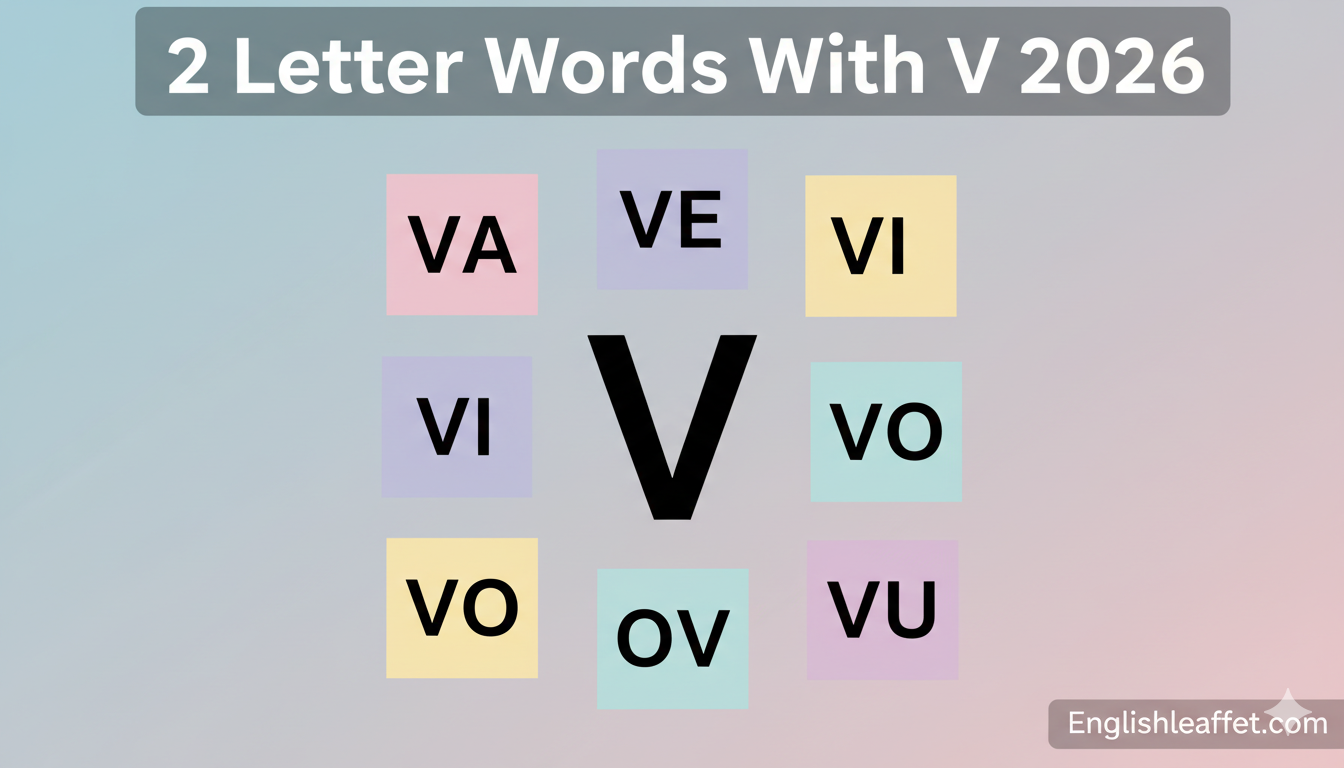
Two-letter words with V represent a fascinating category in English word games. The letter V is considered one of the more challenging letters to use effectively.
In standard English dictionaries and official Scrabble word lists, there is actually only one valid 2 letter word containing the letter V. This scarcity makes V-containing two-letter combinations particularly valuable knowledge for serious players.
The rarity of V in short words stems from English phonetic patterns. V typically appears in longer words where it can combine with vowels more naturally.
The Complete List: VU
VU is the only valid 2 letter word with V accepted in most official dictionaries. This word originates from the French term “déjà vu” meaning “already seen.”
In Words With Friends, VU scores 7 points, making it one of the higher-scoring two-letter options. In Scrabble, VU is worth 5 points using standard scoring.
The word VU can be placed strategically on premium squares to maximize points. Smart placement on double or triple letter/word squares significantly increases your score.
Why Are 2 Letter Words With V Important?
Understanding 2 letter words with V gives you a competitive edge in word games. These compact words help you utilize difficult letters efficiently.
When you’re stuck with a V tile late in the game, knowing VU can save your turn. It prevents you from having to pass or exchange tiles.
Two-letter words are essential for creating parallel plays on the board. They allow you to score points from multiple words simultaneously.
Learning these words improves your overall vocabulary and language skills. Even rare combinations teach you about word formation patterns.
VU: Definition and Meaning
VU is defined as a feeling of having already experienced the present situation. It’s a shortened form of the psychological term “déjà vu.”
The phenomenon describes that eerie sensation when something feels familiar despite being encountered for the first time. Psychologists have studied this experience extensively.
In casual conversation, people often say “I’m having a vu moment” to express this feeling. The term has become widely recognized in popular culture.
Scrabble Strategy With V Words
In Scrabble, the letter V is worth 4 points, making it a valuable tile. Combining V with U creates opportunities for decent scoring plays.
Place VU near premium squares to multiply your points effectively. A double letter score on V gives you 8 points just from that letter.
Use VU to create parallel words when the board becomes crowded. This strategy allows you to form multiple words in a single turn.
Consider saving your V for late-game opportunities when bonus squares are still available. Strategic timing can make the difference between winning and losing.
Words With Friends Tips
In Words With Friends, VU scores 7 points due to different letter values. This makes it even more valuable than in Scrabble.
The Words With Friends board layout differs from Scrabble with unique premium square placements. Study the board to identify optimal VU placement locations.
Combine VU with existing words to create multiple scoring opportunities. Look for hooks where adding VU extends another word.
Practice recognizing situations where VU provides your best scoring option. Quick recognition saves time and reduces mistakes.
Common Mistakes to Avoid
Many players assume more 2 letter words with V exist beyond VU. This misconception leads to invalid play attempts and lost turns.
Some try to play “AV” or “EV” thinking they’re valid words. These combinations aren’t recognized in official Scrabble dictionaries.
Don’t forget that VU requires the U tile to be valid. Planning ahead ensures you have both letters when needed.
Avoid using V in positions where better-scoring options exist. Sometimes exchanging V for better letters yields higher long-term points.
Learning Techniques for Word Games
Memorize VU through repetition and practice games. The more you use it, the more naturally it comes to mind.
Create flashcards with the word, its definition, and point values. Visual learning aids retention significantly.
Play online word games regularly to reinforce your knowledge. Daily practice builds muscle memory for quick recall.
Study word lists systematically, starting with two-letter words before moving to longer ones. Building a strong foundation improves overall performance.
Alternative V Words for Different Lengths
While 2 letter words with V are limited, 3 letter options abound. Words like “VAN,” “VET,” and “VOW” provide more scoring opportunities.
Four-letter V words include “VIBE,” “VOTE,” and “VEIL.” These offer even greater point potential and board flexibility.
Five-letter combinations like “VOICE,” “VALUE,” and “VALID” dominate mid-game plays. They help you clear multiple tiles efficiently.
Learning V words across all lengths creates a comprehensive strategy. You’ll always have options regardless of your tile rack.
Historical Context of V in English
The letter V entered English from Latin through Norman French influences. Its use evolved significantly over centuries.
In Old English, V was often interchangeable with U in writing. Modern standardization separated these letters distinctly.
V appears less frequently than many consonants in English text. This rarity makes V-containing words particularly noteworthy.
Understanding linguistic history enriches your appreciation of word games. It also helps predict valid word patterns.
Regional Dictionary Variations
Different Scrabble dictionaries recognize different word sets. The TWL (Tournament Word List) is used in North America.
The CSW (Collins Scrabble Words) dictionary applies in most other English-speaking countries. Some words valid in one aren’t accepted in the other.
Always verify which dictionary your game uses before playing. This prevents disputes and invalid plays.
VU appears in both major dictionaries, making it universally playable. This consistency makes it reliable knowledge for all players.
Point Maximization Strategies
Calculate potential scores before playing to ensure optimal point gains. Consider all board positions and premium squares.
VU on a triple word score can yield 15+ points easily. Factor in any additional words formed simultaneously.
Time your V plays for maximum impact during the game. Sometimes holding V for a better opportunity pays off.
Balance aggressive scoring with defensive board control. Prevent opponents from accessing premium squares when possible.
Practice Exercises
Challenge yourself to find all valid V placements on practice boards. This exercise sharpens your strategic vision.
Play speed rounds focusing solely on short word recognition. Quick identification improves your competitive timing.
Analyze professional games to see how experts use V words. Learning from skilled players accelerates your improvement.
Set personal goals for incorporating VU into your games. Track your progress to measure improvement over time.
Online Resources and Tools
Word game apps provide excellent practice opportunities with built-in dictionaries. Apps like Wordfeud and Lexulous offer similar gameplay.
Online word finders help verify valid words and calculate scores. Use these tools for studying, not during competitive play.
Join online communities and forums dedicated to word games. Sharing strategies with other players enhances your skills.
YouTube tutorials offer visual demonstrations of advanced techniques. Video learning complements text-based study effectively.
Competitive Play Considerations
Tournament rules strictly enforce dictionary standards and fair play. Familiarize yourself with official regulations before competing.
Memorizing VU and other rare words demonstrates preparation and seriousness. Tournament players expect comprehensive vocabulary knowledge.
Practice under timed conditions to simulate competitive pressure. Time management skills are crucial for tournament success.
Study past tournament games to understand high-level strategies. Professional players offer valuable insights through their moves.
Teaching V Words to Children
Introduce 2 letter words early in children’s language education. Short words build confidence and foundational skills.
Make learning fun with games and interactive activities. Children retain information better through play-based learning.
Use visual aids and storytelling to explain word meanings. Contextual learning makes vocabulary more memorable.
Celebrate progress and encourage continued exploration of language. Positive reinforcement motivates ongoing learning.
V in Other Word Games
Crossword puzzles frequently use VU as a valuable fill word. Its short length fits tight spaces perfectly.
Word search puzzles may include VU among hidden words. Training your eye to spot it quickly improves solving speed.
Boggle and similar games allow V words when dice placement permits. Knowing VU helps you score more points consistently.
Each game type offers unique challenges and learning opportunities. Diversifying your practice improves overall word recognition.
Advanced Board Positioning
Understanding optimal V placement requires studying board geometry. Corner and edge plays often yield surprising point totals.
VU can create powerful hook opportunities with existing words. Adding letters before or after multiplies your scoring potential.
Consider defensive positioning to block opponents’ high-scoring moves. Strategic placement limits their board access.
Master parallel play techniques where VU scores from multiple words simultaneously. This advanced strategy separates novice from expert players.
Memory Techniques and Mnemonics
Create memorable associations to cement VU in your mind. “V-U” sounds like “view,” connecting to “déjà vu.”
Use acronyms and rhymes to make recall easier. Playful learning methods work better than rote memorization.
Practice retrieval through self-testing rather than passive review. Active recall strengthens neural pathways more effectively.
Link VU to personal experiences or stories for deeper retention. Emotional connections enhance long-term memory formation.
Tournament Preparation Tips
Build a comprehensive word list including all short words. Systematic study prevents gaps in your knowledge.
Simulate tournament conditions during practice sessions. Pressure training prepares you for actual competition stress.
Review common board positions and optimal responses. Pattern recognition speeds up your decision-making process.
Get adequate rest before competitions to ensure mental sharpness. Physical wellness directly impacts cognitive performance.
Digital vs Physical Game Differences
Digital platforms often include built-in validators and dictionaries. This changes the strategic emphasis toward creative play.
Physical board games require manual score calculation and rule enforcement. These skills develop mental math abilities.
Some players prefer the tactile experience of physical tiles. Others appreciate the convenience of digital gameplay.
Both formats offer valuable practice and skill development. Diversifying your experience makes you a more versatile player.
Community and Social Aspects
Word games create opportunities for social connection and friendly competition. Club memberships foster lasting friendships.
Online communities provide support, advice, and camaraderie. Sharing your journey enhances enjoyment and motivation.
Organize local game nights to practice with friends. Social play reduces pressure while maintaining engagement.
Attend conventions and gatherings to meet fellow enthusiasts. Networking expands your knowledge and opportunities.
Analyzing Professional Gameplay
Study championship matches to observe expert strategies. Professional players demonstrate optimal decision-making under pressure.
Note how champions use V words in various board situations. Their placement choices reveal strategic thinking patterns.
Review commentary and analysis from experienced players. Expert insights accelerate your learning curve significantly.
Apply lessons learned from professional games to your practice. Emulation of successful techniques improves your performance.
Future of Word Gaming
Technology continues evolving word game experiences with AI opponents. These tools provide unlimited practice opportunities.
Mobile gaming has made word games more accessible worldwide. Millions of new players join communities annually.
Educational institutions increasingly recognize word games’ cognitive benefits. Schools incorporate them into language curricula.
The competitive scene grows with larger prize pools and global tournaments. Professional word gaming gains mainstream recognition.
Dictionary Reference and Validation
Official Scrabble dictionaries serve as the ultimate authority for valid words. The NASPA Word List 2020 (NWL) governs North American play.
Collins Scrabble Words dictionary applies to international competitions. Both recognize VU as a valid playable word.
Always consult official resources when disputes arise during games. Dictionary apps provide quick verification for casual play.
Understanding dictionary standards prevents invalid plays and wasted turns. Serious players invest in physical dictionary copies for study.
Building Your V-Word Vocabulary
Beyond 2 letter words, expanding your V vocabulary improves overall game performance. Focus on memorizing common 3-5 letter V words first.
Create themed lists grouping words by length and letter patterns. Organized study proves more effective than random word learning.
Practice using new words in actual games immediately after learning them. Application reinforces memory better than passive review alone.
Set weekly goals for learning specific numbers of new V words. Consistent progress compounds over time into substantial knowledge.
Psychology of Word Game Success
Mental preparation significantly impacts your word game performance. Confidence in your vocabulary knowledge reduces game-time anxiety.
Understanding opponent psychology helps you predict their likely moves. Anticipation allows you to block high-scoring opportunities defensively.
Maintaining focus throughout long games requires mental stamina training. Practice sessions should simulate actual game duration and intensity.
Develop emotional resilience to handle losses and setbacks gracefully. Growth mindset attitudes accelerate skill development over time.
Scoring Optimization Techniques
Calculate multiple move options before committing to a play. Compare potential scores to ensure you’re maximizing point opportunities.
Factor in rack balance when choosing between similar-scoring plays. Leaving yourself with better letter combinations aids future turns.
Consider endgame implications during mid-game decisions. Strategic planning prevents getting stuck with unplayable tiles later.
Track which premium squares remain available throughout the game. Target these high-value positions whenever possible with V words.
Educational Benefits of Word Games
Playing word games regularly expands vocabulary and improves spelling. These skills transfer directly to academic and professional contexts.
Critical thinking develops through strategic planning and decision-making. Players learn to evaluate multiple options and consequences simultaneously.
Pattern recognition abilities strengthen with exposure to varied word combinations. This cognitive skill applies broadly across different domains.
Social skills improve through interaction with fellow players and opponents. Healthy competition teaches sportsmanship and respectful communication.
Common V-Letter Combinations
Understanding frequent V pairings helps you spot word opportunities faster. V commonly appears with vowels like A, E, I, O.
The “EV” combination starts many longer words like “EVER” and “EVEN.” Recognizing this pattern helps with word-building strategies.
“AV” appears in words such as “HAVE,” “SAVE,” and “GRAVE.” These common endings provide multiple hooking opportunities.
Studying these patterns accelerates your ability to form valid words quickly. Pattern knowledge distinguishes expert players from beginners.
Mobile App Recommendations
Words With Friends remains the most popular mobile word game globally. Its user-friendly interface appeals to casual players especially.
Scrabble GO offers official Scrabble gameplay on mobile devices. The app includes various game modes and difficulty levels.
Wordscapes combines word search with crossword puzzle elements. Its relaxing gameplay provides excellent vocabulary practice.
Lexulous offers Scrabble-like gameplay with slightly different rules. Variety in game types keeps practice sessions engaging and fresh.
Tile Management Strategies
Balancing your rack between vowels and consonants prevents getting stuck. Aim for roughly 3 vowels and 4 consonants typically.
Avoid hoarding high-value letters unnecessarily waiting for perfect plays. Sometimes using V for moderate points beats holding it longer.
Exchange tiles strategically when your rack offers limited options. Fresh tiles often provide better scoring opportunities than forcing weak plays.
Track which letters remain in the bag to inform late-game decisions. This knowledge helps you anticipate opponent possibilities and plan accordingly.
Crossword Puzzle Applications
VU frequently appears in crossword puzzles as valuable fill. Its short length and common letters make it editor-friendly.
Solving crosswords regularly improves your word game performance. The skills overlap significantly between these puzzle types.
Pay attention to crossword cluing patterns for words like VU. Understanding how words are defined helps with recall during games.
Create your own crossword puzzles to deepen word knowledge. The construction process requires intimate familiarity with word relationships.
Time Management in Competitive Play
Competitive games typically enforce strict time limits per turn. Practicing under timed conditions prepares you for tournament pressure.
Develop a systematic approach to evaluating board positions quickly. Routinized thinking processes save precious seconds during gameplay.
Prioritize high-probability moves over exhaustive position analysis. Perfect plays aren’t worth timing out or rushing subsequent turns.
Reserve extra time for critical endgame situations when possible. Final moves often determine victory or defeat in close matches.
International Word Game Variations
Different countries have unique word game traditions and preferences. Scrabble variations exist in numerous languages worldwide.
Learning international Scrabble rules broadens your playing opportunities. Some variations use different board layouts or letter values.
Online platforms connect players globally across time zones. This accessibility enables practice against diverse playing styles.
Participating in international competitions provides enriching cultural experiences. Travel opportunities combine gaming passion with world exploration.
Creating a Study Schedule
Consistent daily practice yields better results than sporadic intensive sessions. Dedicate 15-30 minutes daily to vocabulary study.
Alternate between different study methods to maintain engagement. Variety prevents boredom while covering material comprehensively.
Review previously learned words regularly to prevent forgetting. Spaced repetition systems optimize long-term retention effectively.
Track your progress in a journal or spreadsheet. Visible improvement provides motivation to continue studying consistently.
Handling Difficult Letter Combinations
V combines challenging characteristics with valuable scoring potential. Learning to manage V effectively distinguishes skilled players.
When stuck with multiple difficult letters, consider exchanging strategically. Sometimes sacrificing a turn yields better subsequent opportunities.
Study which letters pair well with V for future planning. This knowledge helps you retain useful tiles while discarding problematic ones.
Practice specialized drills focusing exclusively on difficult letter scenarios. Targeted practice builds confidence in challenging situations.
Board Vision Development
Expert players see multiple moves ahead simultaneously. This skill develops through extensive practice and pattern recognition.
Train yourself to scan the entire board methodically. Systematic searching prevents overlooking valuable opportunities.
Use your finger to trace potential word placements physically. Kinesthetic engagement aids visualization and planning.
Analyze completed games to identify missed opportunities retrospectively. Learning from mistakes accelerates improvement significantly.
Etymology and Word Origins
Understanding word origins deepens your appreciation of language. Etymology reveals fascinating connections between related words.
VU derives from French “déjà vu,” itself from Latin roots. This international heritage reflects English’s diverse influences.
Studying word families helps you predict valid word forms. Related words often share similar patterns and spellings.
Historical linguistic knowledge enriches your overall vocabulary understanding. This foundation supports more effective word game performance.
Maintaining Long-Term Motivation
Set both short-term and long-term goals for continued growth. Achievement milestones provide motivation to persevere.
Join clubs or leagues for social accountability and support. Community involvement sustains interest through relationship building.
Celebrate progress and improvements rather than focusing solely on outcomes. Growth mindset attitudes prevent discouragement from setbacks.
Periodically reassess your goals and adjust study approaches. Flexibility maintains relevance and prevents stagnation over time.
Frequently Asked Questions
What is the only 2 letter word with V?
VU is the only valid 2 letter word containing V in official Scrabble dictionaries. It means a feeling of having already experienced something, derived from “déjà vu.”
How many points is VU worth in Scrabble?
VU is worth 5 points in Scrabble using standard letter values. The V contributes 4 points while the U adds 1 point to the total score.
Can you play VU in Words With Friends?
Yes, VU is a valid word in Words With Friends and scores 7 points. The higher score reflects Words With Friends’ different letter value system.
Are there any other 2 letter V words?
No, VU is the only accepted 2 letter word with V in standard English dictionaries. Words like AV or EV are not valid in competitive play.
What does VU mean in English?
VU represents the feeling of familiarity when experiencing something new. It’s a shortened form of the French phrase “déjà vu” meaning “already seen.”
How do you use VU strategically in Scrabble?
Place VU on premium squares like double or triple letter scores to maximize points. Use it for parallel plays to score from multiple words simultaneously.
Is VU valid in international Scrabble?
Yes, VU appears in both TWL (North American) and CSW (International) Scrabble dictionaries. This makes it universally playable across different regional rulesets.
What are the best 3 letter words with V?
Popular 3 letter V words include VAN, VET, VOW, VIM, and VEX. These provide more scoring flexibility than 2 letter options.
Why is V difficult to use in word games?
V appears infrequently in English and has limited 2-letter combinations. Its high point value makes it valuable but challenging to place effectively.
Should I memorize all 2 letter words for Scrabble?
Yes, memorizing all 107 valid 2-letter Scrabble words significantly improves gameplay. This includes VU and provides maximum strategic flexibility during matches.
Conclusion
2 letter words with V, specifically VU, represent essential knowledge for word game enthusiasts at all skill levels. While limited in number, understanding this single valid combination provides strategic advantages in Scrabble, Words With Friends, and similar games.
The letter V’s high point value combined with effective placement can dramatically impact your scoring potential. Whether you’re a casual player seeking improvement or a competitive gamer aiming for tournament success, mastering VU and related V-word strategies enhances your gameplay.
Continue practicing, studying word patterns, and applying these techniques to elevate your word game performance. Your dedication to learning these linguistic tools will reward you with consistent victories and deeper language appreciation.
