

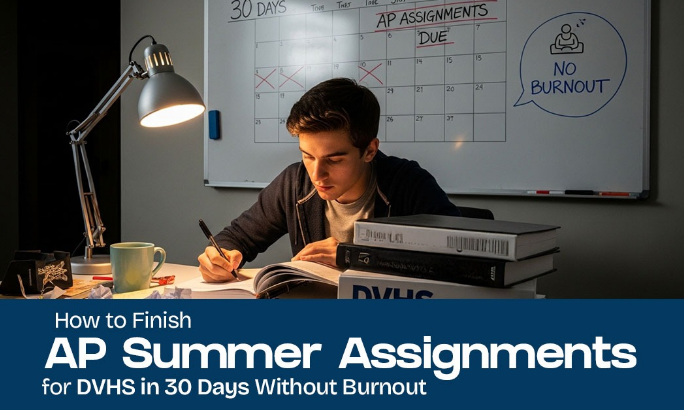
Summer is not about being stressed; it should be about freedom. Nevertheless, AP summer assignments are critical to the students of DVHS every year. These are activities that are not in vain. AP summer assignments DVHS are taught at a more rapid rate because of the requirements of the College Board. Summer work, therefore, assists in bridging the gap of the necessary materials before the beginning of school.
According to the survey published at all access, 73% of students take AP exams in the USA every year and pass them. In the meantime, there are schools which have pass rates of 96 percent when well prepared. Such disparity demonstrates that summer assignments are important. Students that do summer work demonstrate better levels of confidence.
They are exposed to basic ideas even before the commencement of classes. Besides, they pose superior questions during discussion. This, in turn, increases their overall performance in exams significantly. Summer work in short maximises learning time. It is because your performance in exams is enhanced.
Keynotes:
- AP summer assignments DVHS moves at an accelerated pace, so summer assignments help students cover essential content before the school year begins.
- Always studying before the test in AP summer assignments DVHS is no match to consistent study.
- Establish definite time limits when preparing for AP summer assignments DVHS with yourself currently.
- By prioritising your weaknesses before your strengths, you address gaps in understanding efficiently.
- Quiz yourself to check your understanding on a regular basis. Pass ideas on to another person where possible.
Why AP Summer Assignments Matter at DVHS
AP summer assignments DVHS moves at an accelerated pace, so summer assignments help students cover essential content before the school year begins. Although classes start later, AP exams are scheduled for May, making early preparation crucial.
Summer work, therefore, removes a whole chapter of revision. Educators can then sink into new content at once. Moreover, AP summer assignments DVHS enhance important skills. As an example, AP Biology assignments help get a head start on a huge curriculum.
According to survey data at Modestum, 71.4 % of students found AP Chemistry summer assignments helpful, showing that these tasks play a meaningful role in reinforcing learning and preparing students for the course.
30-Day Plan to Prepare for AP Summer Assignments DVHS Without Burnout
This is because it seems daunting to complete AP summer assignments. Nevertheless, with a 30-day well-planned approach designed with the support of writers in the essay writing service department at Cheap Essay Writing UK, you can get a stress-free plan to improve your learning skills. . You do not have to miss all your summer to get it all done. Always studying before the test is no match for consistent study. Thus, stress and burnout will be eliminated. Proper planning will win you the dream AP scores.
1. Orientation and Goal Setting
Begin by taking some delicate self-reflection, and then start. Invest an hour in knowing what your particular AP summer assignments DVHS will require. Ask yourself important questions on course focus. Is it content-oriented, writing-based, labs, and problem-solving oriented? What time would you like to commit every week? Identify a specific number of one to three measurable goals.
The next step would be to develop your study schedule. Establish definite time limits when you start practising AP summer assignments DVHS. Students who have certain plans spend time in the appropriate way. As a result, they have reduced stress in the final moments. You should visit your AP teacher before summer if you can. But during summer recess, many teachers do not respond to email.
Key Orientation Steps for Success in AP Summer Assignments DVHS
- Study course outline: Learn important issues and forms of examination.
- Self-evaluation: Find out what your strengths and weaknesses are in academics.
- Goal weekly time-wise: Should have 5-8 hours planned time weekly, depending on your summer schedule.
- Set deadlines on the calendar: Mark significant milestones of every assignment section.
- Prepare all materials needed: Prepare textbooks, online access codes and materials.
- Form study groups where applicable: Find people to hold you accountable and help you.
2. Core Content Chunk One
Begin your first content section with focused concentration. Schedule 2–3 study sessions each lasting 60–90 minutes, to maximise retention. During these sessions, actively engage with the material using active recall techniques. Additionally, record detailed and effective notes for every session, ensuring that you organise them using a colour-coded system. By prioritising your weaknesses before your strengths, you address gaps in understanding efficiently. Consequently, this method of active learning leads to improved exam performance.
Plan Your Study Sessions Wisely
Begin your first content section with focused concentration. Schedule 2–3 study sessions, each lasting 60–90 minutes, to maximise retention. During these sessions of AP summer assignments, actively engage with the material using active recall techniques.
Additionally, record detailed and effective notes for every session, ensuring that you organise them using a colour-coded system. By prioritising your weaknesses before your strengths, you address gaps in understanding efficiently. Consequently, this method of active learning leads to improved exam performance.
Take Efficient Notes During Study
Make effective notes at every session. Always prepare your notes in colour code.
- Green: I know this all right. Soon, I will have to review, and the word yellow means it.
- Red: I do not really know this, but.
This system develops a definite study plan. Begin by red, and then yellow, and then green. As a result, you solve weaknesses prior to strengths.
Master Active Learning Techniques
Passive review is never an effective strategy in AP summer assignments DVHS would rather use active recall. Quiz yourself to check your understanding on a regular basis. Pass ideas on to another person where possible.
The real knowledge is uncovered in practice questions. Thus, do not passively read and highlight. It is retrieval practice that helps your brain to develop stronger connections. Active learning will result in improved exam scores eventually.
3. Core Content Chunk Two
Do the same to your second major unit. Even 30-40 minutes will contribute to cognitive skills development. In case of APs that are essay-based, practice one free-response outline. Alternate difficult tasks with easy victories to motivate oneself all the time.
Set a daily studying time when trying to prepare for AP summer assignments DVHS. Even in productive periods, rest and take a break. This practice avoids burnout to a great extent. Your mind requires rest to reinforce learning.
| Strategy | Why It Works | How to Implement |
| Timed practice sessions | Builds exam stamina and speed | Start with 30 minutes, increase gradually |
| Mix difficult and easy tasks | Maintains motivation throughout | Alternate challenging topics with familiar ones |
| Set firm stop times | Prevents mental exhaustion completely | Choose 5 PM or 6 PM daily cutoff |
| Review previous content | Strengthens long-term memory | Spend 10 minutes reviewing Week 1 notes |
| Practice free-response | Develops writing skills early | Outline one essay answer weekly |
4. Skills and Practice Integration
This week is devoted to the practice of acquired concepts. One untimed practice test is worth doing to get good feedback. Examine your flaws thoroughly and frankly. Detect the trends of what you missed regularly. Appeal to different resources to make more sense. Therefore, the retention is much enhanced with time. Various explanations approach the various learning styles.
Analyse Your Performance Deeply
Learn about your mistakes and then check different assignment writing handbooks to know their roots. Had you read the questions wrong or been out of content knowledge? Technical mistakes in AP summer assignments DVHS should receive various correction approaches. The areas of content to be looked at further need a more detailed review. So classify all the mistakes that you make. This review informs your succeeding research. Finally, specific practice is more effective.
Use Varied Learning Resources
Always seek different resources to understand more. Online study guides, textbooks, and YouTube videos are useful for preparation of AP summer assignments DVHS. Each of them offers useful insights into the problematic issues. Listening to concepts taught in other ways tends to cause aha moments. As a result, the retention increases significantly with time. Various explanations approach the various learning styles. Thus, find several resources with difficult material.
5. Repair and Strengthen Weak Areas
Revise your weak areas in the diagnostic. Add additional time to red and yellow time. However, study with a friend once this week, if possible. Studying in groups imitates the classroom responsibility.
Besides, explaining concepts to someone will further your knowledge. Generate visual aids for the difficult material. The concept map during the practice of assignments connects the ideas between your task and your understanding. This is a unique technique that is especially effective with Biology, History, and Chemistry. This method is of great benefit to the visual learners.
6. Consolidate and Recharge
Your last week will be dedicated to a light review. Make a one-page cheat sheet of a study for the fall semester. The resource will also come in handy once the classes resume. Get happy and show your gains publicly. Indicate accomplishments on a progress board or a calendar. Lastly, sleep down and out to school. You had worked hard to deserve this relaxation.
How to Finish Your Assignment Strong and Rest Well
Your last week will be dedicated to a light review. Make a one-page cheat sheet or take it from the coursework writing services to get a good study plan for the fall semester. Included essential formulas, dates and themes, and strategies. The resource will also come in handy once the classes resume.
Get happy and show your gains publicly. Indicate accomplishments on a progress board or a calendar. This acknowledgement is a good motivating factor. Lastly, sleep down and out to school. You had worked hard to deserve this relaxation.
| Final Week Tasks | Why They Matter | Time Required |
| Create a one-page cheat sheet | Quick reference during the busy school year | 60-90 minutes |
| Review weak topics briefly | Reinforce challenging material before fall | 30-45 minutes |
| Organise all notes by unit | Easy access when classes start | 45-60 minutes |
| Mark accomplishments visibly | Acknowledge hard work and stay motivated | 15-20 minutes |
| Rest completely before school | Prevent burnout and recharge energy | The entire final week |
Conclusion
It is entirely evident that AP summer assignments DVHS can be done in 30 days. Get ahead and develop a realistic schedule. Make weekly routines that will not overwork you. Active study methods should be used to improve memorisation. Balance-oriented exercise with actual rest. Keep in mind the reason for the existence of these assignments.
AP courses go through content and are speedy. Summer work is a guarantee that you arrive ready, not frantic. Summer in fine spending is no study all the way. It is more about coming back smarter and prepared to do better. Your teachers in AP summer assignments DVHS have faith in you. So, idea, do not doubt yourself, and go on with this plan. On the way, prevent burnout altogether. Thereby, enter the fall semester confidently and sincerely prepared.
Frequently Asked Questions about AP Summer Assignments DVHS
1. What if I don’t complete my AP summer assignments DVHS?
Missing summer work does not mean that one cannot pass. But it does make it very difficult to succeed. According to teachers, recovery can be observed to lead to working extra hard in the future. The task will probably not bring you down. However, it never goes wrong to be on track to succeed in the long term. Thus, do what you will realistically be able to handle. Then simply tell your teacher the truth.
2. How many hours weekly should I dedicate?
To prepare in a balanced way, one should have 5-8 hours a week. This will be equivalent to 3-4 committed study sessions. The rhythms of light during your learning are at 5-6 hours per week. Although intensive rhythms may go up to 15+ hours during each session of AP summer assignments DVHS. So it is recommended to begin with light or equal rhythms. Raising intensity should only be done when there is no change in energy. Last, but not least, alternate interesting work in real rest. As a result, you are constantly improving during the summer. The brain requires a rest so that it can better consolidate learning.
