

You love reading stories that transport you to faraway lands.
But what happens when you want to share your own stories with an international audience?
Adapting books and novels for global readers can be tricky.
Why Adapt Your Book for Global Audiences?
When you publish a book, you might dream of reaching readers across continents.
After all, stories can unite people by sparking imagination and empathy.
In 2022, over 650 million print books were sold in the United States alone.
Readers worldwide are constantly on the lookout for fresh, compelling stories.
If you are a global brand, e-commerce platform, or part of the entertainment industry, tapping into international markets is vital.
And if you are an advertising or marketing agency, you know that brand storytelling is now more important than ever.
When you adapt your book for different cultures, you create a powerful connection.
This helps your brand or story become more relatable and memorable in every market.
Translation vs. Transcreation: Understanding the Difference
Translation: Preserving the Original Meaning
Translation involves converting the text from one language into another.
The goal is to keep the primary meaning and structure intact.
It works best when accuracy and clarity are top priorities.
For example, technical manuals, legal documents, or straightforward nonfiction often require exact, word-for-word renditions.
However, with fictional works or novels that rely on emotion and cultural references, translation might fall short.
It can sometimes lose the flair, tone, or humor that made your story special.
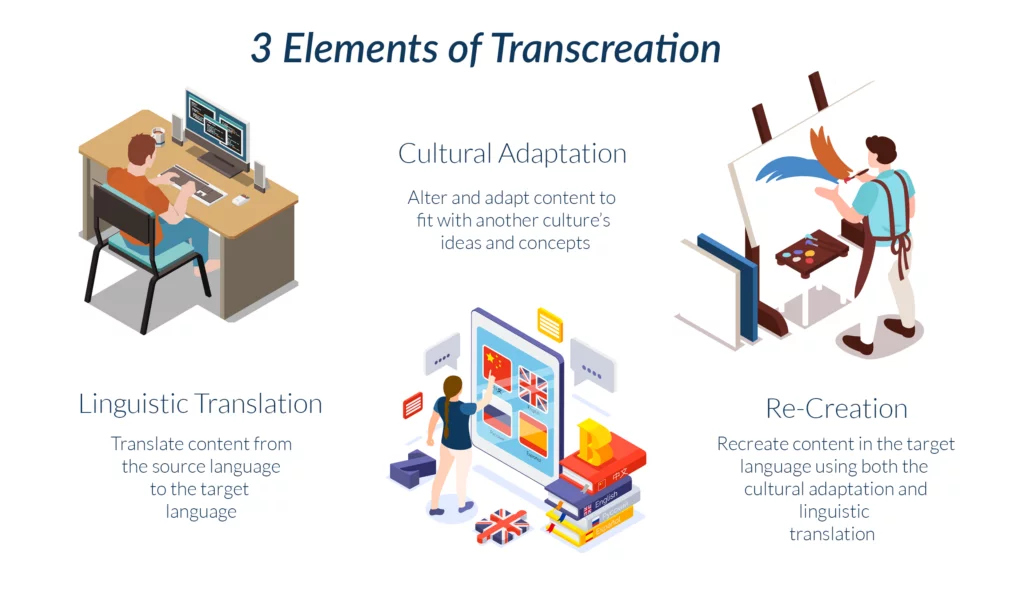
Transcreation: Reimagining the Content
Transcreation is about adapting your text so that the emotional essence remains intact.
It involves rewriting certain parts to fit cultural norms, idioms, and humor in the target language.
It’s much more than just “convert words.”
It’s about bringing the flavor and heart of your story to life in a way that resonates with local readers.
For novels or brand storytelling that rely heavily on tone and atmosphere, transcreation can be a game-changer.
It preserves the magical elements that draw readers in, ensuring they experience your story as you intended.
Why Does This Matter to Global Brands and Corporations?
You might think books and novels are only for publishing houses or authors.
But plenty of global brands release brand narratives, creative campaigns, or marketing materials that read like stories.
Consumers today crave genuine engagement.
If your brand uses storytelling in brochures, ebooks, or brand-building material, you need to adapt it for international markets.
Brands that master creative adaptation often see higher engagement and customer loyalty.
They speak to people in a way that feels personal, not forced.
Consider the international phenomenon of brand-based storytelling.
Major companies use short stories, graphic novels, or cinematic narratives to enhance their brand image.
By employing transcreation, these brands ensure their global audience feels the same excitement as local audiences.
They keep the story’s soul alive in every language.
The Importance of Cultural Nuances
Local Customs and Traditions
Some cultures have specific customs around food, family, or holidays.
If your novel references a holiday in your country, you might need to explain it or adapt it for new readers.
You don’t want them scratching their heads, missing the significance of that festive scene.
Transcreation respects these customs, weaving them into the story in a way that feels seamless.
Humor and Idioms
Jokes can fall flat if they rely on language-specific wordplay.
That’s why comedic novels are notoriously challenging to adapt.
An English pun might need a totally different pun in Spanish or Chinese.
Transcreation captures the laughter, even if the words change.
Emotional Tone
Maybe your novel is filled with suspense, sadness, or romance.
You want your readers to feel those emotions deeply, no matter where they live.
With transcreation, the translator might shift certain phrases to maintain that emotional impact.
This ensures the heart of your story stays strong across languages.
Practical Steps for Adapting Your Book or Novel
Step 1 – Determine Your Goal
Are you aiming for a faithful translation or a culturally rich adaptation?
Decide early on whether you need strict accuracy or more creative freedom.
Step 2 – Work with Native Speakers
Collaborate with translators or transcreation experts who are native speakers of your target language.
They understand the cultural context better than anyone else.
Step 3 – Provide Contextual Notes
Share your story’s background, tone, character motivations, and cultural references.
This helps the linguists grasp the essence behind the words.
Step 4 – Review and Revise
You will likely need back-and-forth discussions with your team.
Refine phrases, jokes, or emotional cues until they click perfectly.
Step 5 – Test with a Local Audience
Give a sample to some readers in your target market.
Ask if the story feels natural, entertaining, and relatable.
These steps help ensure your adapted novel or brand story remains engaging and true to its original spirit.
Using Data to Support Adaptation Efforts
You might wonder if all this effort truly matters.
Consider these facts:
- According to the International Publishers Association, there are more than 2.2 million new titles published worldwide each year.
- Around 59% of consumers prefer purchasing products from websites that provide content in their native language (CSA Research).
- The global eBook market is projected to reach nearly USD 15.6 billion by 2027, indicating a rising demand for digitally accessible content across languages (Statista).
These numbers highlight how vital language adaptation can be for reaching a broader audience.
When you adapt your content, you stand a better chance of connecting with readers who might otherwise scroll right past you.
Adapting Different Genres: One Size Does Not Fit All
Romance
Romance novels often rely on intense emotions and cultural cues about love and relationships.
You need to ensure those passionate exchanges still feel intimate and personal in every language.
Mystery & Thriller
Mystery stories use suspense and subtle clues.
If a clue is tied to a play on words in the original language, you must find an equivalent in the target language.
Fantasy & Sci-Fi
World-building in fantasy or sci-fi is crucial.
You want your readers in any culture to feel the wonder of your created universe, with consistent naming conventions and logical rules.
Children’s Books
Children need stories that are easy to understand.
Adapting jokes, rhymes, or repeated sounds can require a complete rewrite to keep them fun and catchy.
Potential Challenges in Book Adaptation
Overly Literal Translations
If you stick too closely to the original wording, you risk sounding robotic or unnatural.
It might bore or confuse your readers in the new language.
Cultural Mismatches
Certain themes or topics may not translate well.
What’s acceptable in one country might be taboo in another.
Time and Cost
High-quality transcreation can be more time-consuming and expensive.
But the payoff in reader satisfaction and market reach is often worth it.
Maintaining Author’s Voice
Authors have distinctive voices, tones, or styles.
You must preserve that unique voice, even if some words or phrases shift.
Role of a Transcreator in the Process
A transcreator is a translator, but also part writer, editor, and cultural guide.
They interpret your text while keeping the emotional core intact.
This professional might suggest rewrites, new metaphors, or local idioms.
They serve as a creative bridge between your original story and the target language.
Transcreators often have backgrounds in writing or literature.
They know how to spin words into powerful narratives that still feel familiar to native readers.
Practical Tips for Successful Book Launches in Global Markets
- Plan Early: Start the adaptation process long before your launch date.
- Set a Realistic Budget: Quality work costs money, but it prevents costly mistakes later.
- Collaborate Closely: Keep communication open with your linguists, editors, and marketing team.
- Design for Each Market: Book covers, blurbs, and marketing materials should also resonate culturally.
- Leverage Social Media: Engage with international fans, ask for feedback, and build excitement for your release.
These pointers apply whether you’re self-publishing or working under a corporate umbrella.
Strong planning and collaboration are essential to avoid hiccups.
Beyond Text – Visuals and Layout
Adapting a book isn’t only about words.
Illustrations or cover art might need tweaks to suit local tastes or sensitivities.
Colors hold different meanings in different cultures.
You wouldn’t want your heartwarming story to have a cover that unintentionally signals danger or mourning somewhere else.
Think about layout and page design too.
Some languages expand or contract more than others, changing the length of each page.
This is especially crucial for picture books and graphic novels.
You must ensure the speech bubbles or text boxes still look clean and appealing.
Legal and Financial Considerations
Now, if you’re part of a legal or financial firm, you might adapt educational books or training materials for staff worldwide.
Accuracy is paramount for contracts, statutes, or guidelines.
Though the tone might be formal, you still need clarity.
Translations should be correct, and the language should be accessible, not filled with legal jargon that confuses readers.
Financial documents, even when used for educational or marketing purposes, also need precise adaptation.
Transcreation can help break down complex terms in a user-friendly way, making it easier for international employees or clients to grasp key concepts.
The Rising Demand for Audiobooks and Ebooks
Audiobooks and ebooks continue to grow in popularity.
Globally, audiobook revenue is forecasted to exceed USD 15 billion by 2030, according to market research.
Transcreating audiobooks involves adapting the script and working with voice actors who understand local nuances.
Ebooks require you to ensure formatting and metadata are optimized for each region’s digital platforms.
This makes the adaptation process even more complex, yet even more rewarding.
If you can meet these demands, you reach readers who prefer digital or audio formats.
Maintaining Consistency Across Your Brand
If your novel ties into your brand identity, consistency is crucial.
Readers should recognize the same tone, style, and core values across all materials.
Keep a style guide with key terms, phrases, character names, and brand elements.
Share it with every team or agency handling your adaptation project.
By unifying your approach, you reduce the risk of disjointed brand messages.
This leads to a stronger, more cohesive presence in international markets.
How to Know When to Use Transcreation
Transcreation is ideal when:
- Your book relies heavily on cultural humor or idioms.
- You want to evoke specific emotions, like awe or joy.
- You have a target audience that appreciates local touches in storytelling.
- You need to preserve your brand voice in a culturally sensitive way.
If your text is purely informational, translation might suffice.
But if you want your words to dance off the page, consider transcreation to keep them lively in any language.
Wrapping it up
Adapting books and novels for international readers isn’t just about changing words.
It’s about reshaping your story so it feels alive and resonant to people in every corner of the globe.
When you blend creativity, cultural understanding, and linguistic expertise, you ensure your story finds a special place in each reader’s heart.
That’s the real magic of translation and transcreation.
