

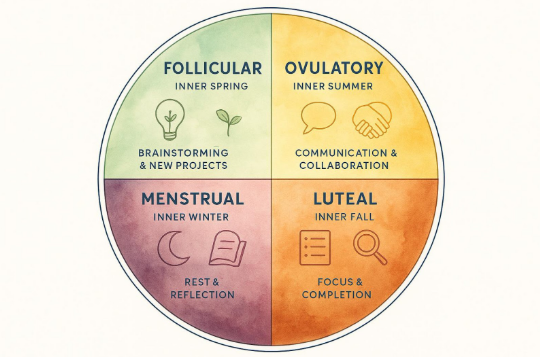
Aligning your work schedule with your menstrual cycle-often called “cycle syncing”-means planning your main work tasks around the four hormonal phases of your month: menstrual, follicular, ovulatory, and luteal.
When you know when your energy, mood, and focus usually rise and fall, you can plan big meetings, creative work, and admin-heavy “deep work” to fit your natural rhythm. This approach moves away from the usual 24-hour work pattern and instead follows your body’s changing needs across the month.
Using this method, sometimes called “Working in Flow,” can help you get more done in less time and lower your risk of burnout. As experienced cycle coach Jema Lee explains, seeing your menstrual cycle as a “sixth vital sign” can help you connect more closely with your body. What once felt like a monthly problem can become a strong support for long-term career success and emotional well-being.
What Does It Mean to Align Your Work Schedule With Your Menstrual Cycle?
What Is Cycle Syncing for Productivity?
Cycle syncing for productivity is a body-aware way of working that recognizes that people who menstruate do not run only on a fixed 24-hour clock. They also follow an “infradian rhythm” that affects how the body and brain work over about 28 days. During this time, levels of estrogen, progesterone, and testosterone go up and down, which can change thinking, mood, energy, and how social or confident you feel.
When you sync your work, you are basically “mapping” your tasks to your phases. For example, you might use the follicular phase for starting new projects when ideas come easily, and the luteal phase for detail work like bookkeeping or editing. This helps you avoid forcing yourself through low-energy days with stress hormones like cortisol, which can lead to heavier periods, irregular cycles, and a weaker immune system.
Who Can Benefit From Matching Work to Menstrual Phases?
Anyone with a menstrual cycle can benefit from this way of working, but it can be especially helpful for people whose symptoms affect daily life. This includes those with Polycystic Ovarian Syndrome (PCOS), endometriosis, or Premenstrual Dysphoric Disorder (PMDD). By lowering expectations in more sensitive phases, they can keep up with work without harming their mental health.
Entrepreneurs and remote workers often find it easiest to start cycle syncing because they usually have more control over their time. But even people in strict 9-5 jobs can benefit by adjusting their internal approach-being more reflective during their period and more outspoken during ovulation, even if they cannot change the timing of meetings.
How Do the Four Phases of the Menstrual Cycle Influence Work Performance?
Follicular Phase: Increasing Creativity and Energy
Often called your “inner spring,” the follicular phase starts when your period ends and usually runs from day 6 to 14. As estrogen rises, you may feel more energy, a brighter mood, and more interest in social plans. This is a great time for brainstorming, starting new projects, and tackling work that needs fresh ideas and excitement.
At work, use this phase to build on insights from your last cycle and turn them into action. Because thinking and creativity tend to feel sharper now, you may find it easier to work longer, learn new skills, or try new tools. This is a phase of opening up to new tasks, people, and opportunities.
Ovulation Phase: Maximizing Communication and Collaboration
The ovulatory phase is your “inner summer,” a short but powerful window (usually days 15-18) when estrogen peaks and luteinizing hormone (LH) surges. During these days, confidence, charm, and communication skills are often at their highest. Your body is wired to be more outgoing and persuasive, which makes this a smart time for important meetings, negotiations, presentations, and sales calls.
Use this boost by planning networking events, performance reviews, or tough conversations during this phase when possible. You may notice that you speak more clearly and connect more easily with others. Some people feel mild abdominal pain during ovulation, so if that happens, balance the busy schedule with short rest breaks or lighter tasks between big events.
Luteal Phase: Boosting Focus, Organization, and Task Completion
As you move into the luteal phase (your “inner fall,” days 19-28), progesterone becomes the main hormone. Progesterone tends to have a calming effect on the brain, helping you feel more settled and detail-focused. This is the “get things finished” phase where you may excel at wrapping up projects, doing admin work, and polishing reports that need careful attention.
Near the end of this phase, you might start to feel tired or notice PMS symptoms like mood changes, irritability, or cramps as hormones drop. This is a good time to listen closely to your gut feelings. If something about a project feels wrong, your luteal mind may be catching issues you missed before. Use this phase for editing, checking details, and organizing, rather than kicking off new, big projects.
Menstrual Phase: Prioritizing Reflection and Rest
The menstrual phase (days 1-5) is your “inner winter.” Estrogen and progesterone are low, and your body is shedding the uterine lining, which takes a lot of internal effort. You might feel more tired, quiet, and sensitive to pain. This is usually not the best time for nonstop pushing or constant meetings. Instead, it’s a time for review and letting go of what is no longer working.
At work, stick to lower-energy tasks where possible. Use this time to reflect on the past month: What worked well? What drained you? Which people or projects felt supportive? You can journal, review goals, and set intentions for the next cycle. By respecting your need for more rest now, you give yourself the strength to move faster and more clearly once the follicular phase starts again.
What About Testosterone and Motivation Fluctuations?
Estrogen and progesterone are the main hormones in the 28-day cycle, but testosterone matters too. There is often a small testosterone spike around ovulation, which adds to the rise in confidence, drive, and libido.
In contrast, people with typical male hormone patterns tend to run on a 24-hour testosterone cycle-higher in the morning and lower at night. This helps explain why a steady, unchanging workweek often feels more suited to male biology than to a cyclical female pattern.
How to Track and Map Your Cycle for Personalized Work Planning
Which Tools or Apps Help Sync Work and Cycle?
To start “Working in Flow,” you first need information about your cycle. Popular apps like Clue, Flo Health, and Glow let you log not only your period dates but also your energy, mood, and focus. If you like digital planning, you can add “Menstruation Days” as a repeating event in your Google Calendar so you can see your phases while you book meetings and deadlines.
If you prefer pen and paper, a simple planner or a “cycle journal” works well. The main idea is to see your month laid out visually so you can quickly notice when you will be in your “inner summer” versus your “inner winter.”
What Patterns Should You Look For When Tracking Productivity?
As you track, pay attention to repeated patterns rather than one-off days. Do you often feel mentally slow or foggy around day 26? Do you feel powerful and outgoing around day 14? You can also track sleep, digestion, and skin changes.
After three or four cycles, you will likely notice a clear rhythm: a peak in motivation and social energy, followed by a natural pull back toward quieter, more focused work. Seeing these patterns helps you stop blaming yourself for “off” days and instead see them as a normal reset built into your body.
Practical Strategies for Scheduling Work Around Your Cycle
Adapting Meetings, Deadlines, and Core Tasks by Cycle Phase
One of the simplest methods is to “batch” similar tasks by phase:
- Follicular: Creative brainstorming, planning, and new client outreach.
- Ovulatory: Presentations, interviews, podcast recordings, and networking.
- Luteal: Bookkeeping, editing, data review, and finishing open tasks.
- Menstrual: Strategy review, long-term planning, and tidying your systems or workspace.
If a big deadline lands during your menstrual phase, try to complete most of the heavy work during your luteal phase. Then you only need to do light edits or final checks when your energy is lower.
Managing Energy, Stress, and Motivation Fluctuations at Work
Managing stress is key, because high cortisol can interfere with reproductive hormones and may cause heavier, more painful, or irregular periods. To keep stress hormones lower, aim for 7-9 hours of sleep, and add simple tools like deep breathing, stretching, or short meditations into your day.
If you feel easily overwhelmed in the luteal phase, try more frequent breaks, shorter meetings, and less screen time when possible. For more specialized techniques on aligning your lifestyle with your hormonal shifts, you can explore the resources provided by Cyclical School, which focus on holistic cycle management.
Diet, Exercise, and Lifestyle Adjustments to Support Each Phase
Your habits outside work strongly affect how you feel at work. During your period, choose warming, iron-rich foods like lentils, beans, and spinach to support blood loss. During follicular and ovulatory phases, you may feel ready for more intense workouts such as HIIT, spinning, or running.
As you move into the luteal and menstrual phases, shift toward gentle movement like walking, Pilates, or restorative yoga. Drinking enough water through the entire month can also help with cramps, headaches, and focus.
How to Communicate Cycle Needs and Boundary Setting at Work
Clear communication helps you protect your time and energy. You do not have to share your exact cycle details to set limits. For example, during your menstrual phase you might say, “This week I’m focusing on high-focus strategy work, so I’ll have limited time for last-minute meetings.”
This kind of language protects your bandwidth without talking directly about your period, and helps you avoid overloading yourself during low-energy days.
What If You Can’t Flex Your Work Schedule?
If your job is very fixed, you can still make internal changes. You may not be able to move a meeting, but you can wear softer, more comfortable clothes, use a discreet heating pad, keep pain relief handy, and go to bed earlier that night.
You can also adjust your food choices, caffeine intake, and exercise style to match your phase. Even small daily changes in self-care can ease the impact of a strict 9-5 schedule.
How Does Aligning Your Schedule With Your Cycle Impact Well-being and Productivity?
Benefits for Mental Focus, Creativity, and Emotional Health
When you stop fighting your body’s pattern, your mind often settles. Many people discover that “laziness” or “lack of willpower” is actually just a phase where rest is needed. By working with these shifts instead of against them, you drop the shame around low-energy days. Over time, this supports steadier self-confidence and a stronger trust in your own abilities, because you are planning your workload to match your natural strengths.
Reducing Burnout, PMS Symptoms, and Absenteeism
Studies show that workplaces that ignore menstrual health lose a lot of potential productivity. In contrast, period-supportive policies-like flexible hours or work-from-home options during certain phases-can raise both profits and productivity, in some cases by more than 60%. Allowing rest when the body needs it most lowers the chance of burnout and emergency sick days. This steady, preventative approach helps people stay healthier, happier, and more effective over the long term.
Frequently Asked Questions
Is Cycle Syncing Effective for Irregular or Menopausal Cycles?
Yes. If your cycle is irregular, you can still track your symptoms and base your work and self-care on how you feel and which phase your signs suggest you are in. For people who are menopausal or do not have a period, some choose “moon phase cycling.” This means loosely matching their phases to the lunar cycle-for example, New Moon as the menstrual phase and Full Moon as ovulation-to create a steady rhythm and sense of routine.
How Do Medical Conditions Like PMDD Affect Work Scheduling?
PMDD can cause strong mood and thinking changes that make a normal work schedule feel very hard. For people with PMDD, cycle syncing is often less about “being more productive” and more about staying safe, stable, and kind to themselves. Working with a therapist, doctor, or menstrual coach to track symptoms can help you find the exact days when you need to slow down, reduce workload, or ask for more support, and which days are better for higher output.
Can Cycle Syncing Benefit Hybrid or Remote Workers?
Remote workers are in a strong position to use cycle syncing. They can choose to work on the couch with a heating pad during their period or take a mid-day walk during the follicular phase when their energy climbs. Hybrid workers can try to match their in-office days with their outgoing ovulatory phase, and plan work-from-home days for their quieter, more reflective phases such as late luteal or menstrual.
Are There Workplaces With Menstrual-Friendly Policies?
Many places are starting to shift. Countries such as Spain, Japan, and South Korea already offer some form of menstrual leave. The U.S. Department of Labor now supports ideas for menstruation-friendly workplaces, including free period products and flexible scheduling. Employers who support menstrual health are becoming more attractive to skilled workers and can build a reputation for caring about staff well-being.
Key Takeaways: Making Your Cycle Work for You and Your Career
Working with your menstrual cycle is about more than managing cramps or mood; it is about taking back control of your work life in a way that respects your body’s timing. As we move into the future of work, those who learn to use rest and effort in cycles-not constant hustle-are likely to feel more resilient, creative, and stable. Treating your cycle as a key health signal and a guide can help you build a career that is both high-performing and sustainable over many years.
The shift toward period-supportive workplaces is growing. Companies that bring in cycle-aware wellness programs are seeing higher innovation, better staff satisfaction, and stronger public image. By starting to sync your own cycle with your work now, you support your personal health and also help push forward a wider change that respects different bodies and promotes fair, healthy work environments for everyone.
