

Finding a 5 letter word with most vowels can transform your Wordle gameplay and boost your vocabulary skills instantly.
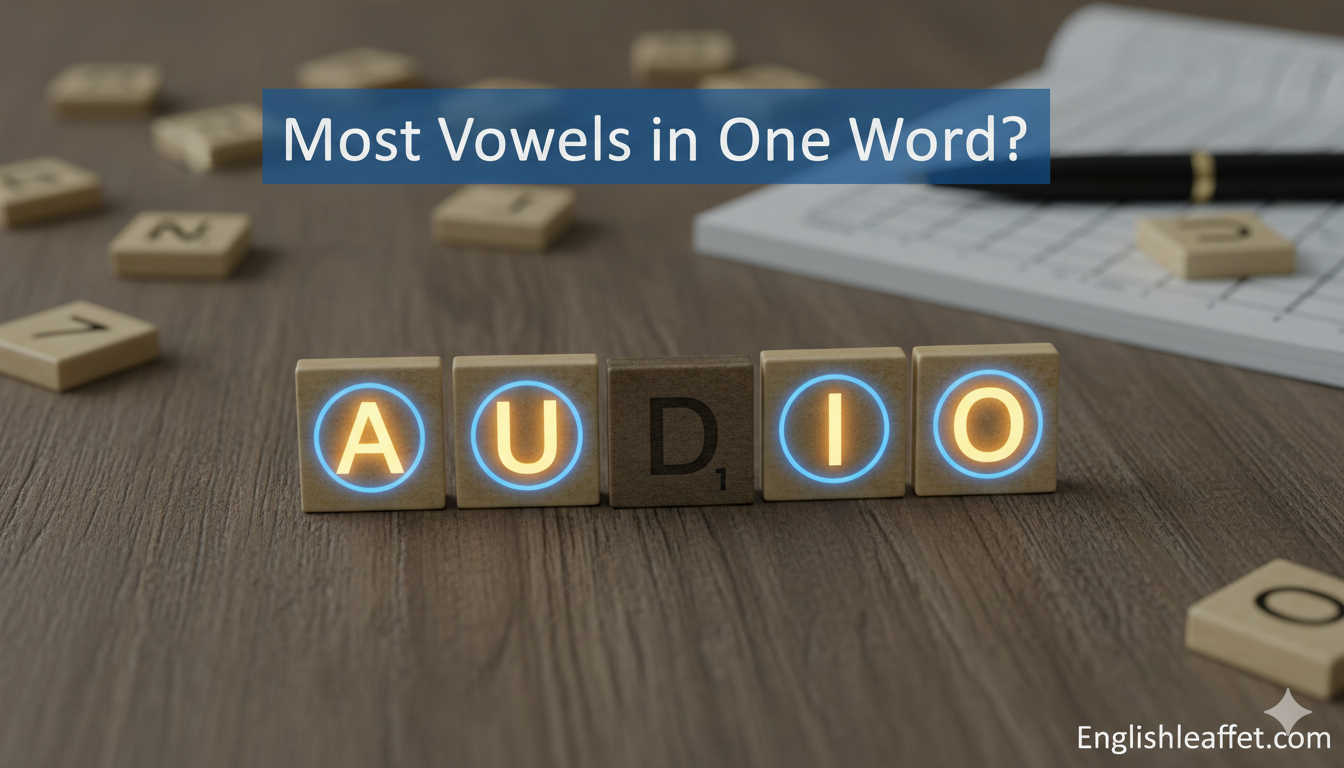
Words like audio, adieu, and ouija contain four vowels each, representing the maximum vowel count possible in five-letter English words.
Understanding these vowel-rich words helps players eliminate possibilities faster, improves spelling patterns, and enhances word recognition.
This guide explores every aspect of vowel-heavy words, from practical applications to strategic usage in word games and daily communication.
What Are 5 Letter Words With Most Vowels?
A 5 letter word with most vowels contains the highest possible number of vowel letters (A, E, I, O, U) within a five-letter format. The maximum is four vowels with one consonant.
These words represent unique linguistic structures. English doesn’t allow five-letter words made entirely of vowels. Every valid example requires at least one consonant for proper pronunciation and word formation.
The vowel-to-consonant ratio in these words creates distinctive phonetic patterns. Words like “audio” (4 vowels, 1 consonant) exemplify this balance perfectly.
Why Do 5 Letter Words With 4 Vowels Matter?
Vowel-heavy words serve multiple practical purposes beyond word games. They help language learners understand vowel placement patterns and improve pronunciation skills significantly.
In Wordle and similar puzzles, these words provide maximum information per guess. Testing four vowels simultaneously narrows down possibilities much faster than consonant-heavy alternatives.
Spelling improvement comes naturally from studying vowel patterns. Recognizing common vowel combinations helps avoid spelling mistakes in everyday writing and communication.
Complete List of 5 Letter Words With 4 Vowels
Here’s a comprehensive table of legitimate five-letter words containing four vowels:
| Word | Vowels | Meaning | Common Usage |
|---|---|---|---|
| Audio | A, U, I, O | Sound or hearing | Technology, media |
| Adieu | A, I, E, U | Goodbye (French) | Formal farewells |
| Ouija | O, U, I, A | Spirit board | Games, paranormal |
| Queue | U, E, U, E | Waiting line | British English |
| Aurei | A, U, E, I | Roman gold coins | History, numismatics |
| Louie | O, U, I, E | Ice skating turn | Sports terminology |
| Miaou | I, A, O, U | Cat sound | Onomatopoeia |
| Ourie | O, U, I, E | Shivering cold | Scottish dialect |
| Uraei | U, A, E, I | Egyptian serpents | Ancient history |
| Aalii | A, A, I, I | Hawaiian shrub | Botany |
| Aecia | A, E, I, A | Fungal structures | Biology |
| Aerie | A, E, I, E | Eagle’s nest | Wildlife |
| Aquae | A, U, A, E | Waters (Latin) | Scientific terms |
| Eerie | E, E, I, E | Spooky, strange | Common adjective |
| Aioli | A, I, O, I | Garlic sauce | Culinary arts |
Best 5 Letter Words With 3 Vowels for Wordle
Three-vowel words strike the perfect balance between information gathering and realistic answer probability. Most Wordle solutions fall into this category.
Strategic players use three-vowel words after testing four-vowel starters. This approach confirms vowel positions while checking common consonants simultaneously.
Popular three-vowel options include: arise, irate, media, ocean, piano, radio, raise, sauce, stone, and unite. Each combines frequent vowels with high-value consonants like R, S, T, and N.
Top 20 Three-Vowel Words for Word Games
| Word | Vowels Present | Strategic Value |
|---|---|---|
| Arise | A, I, E | Tests R and S |
| Irate | I, A, E | Common positions |
| Media | E, I, A | Tests M and D |
| Ocean | O, E, A | Tests C and N |
| Piano | I, A, O | Tests P and N |
| Radio | A, I, O | Tests R and D |
| Raise | A, I, E | Optimal positions |
| Sauce | A, U, E | Tests S and C |
| Stone | O, E | Tests consonants |
| Unite | U, I, E | Tests N and T |
| Alone | A, O, E | Common word |
| House | O, U, E | High frequency |
| Juice | U, I, E | Tests J and C |
| Movie | O, I, E | Modern vocabulary |
| Naive | A, I, E | Common adjective |
| Quiet | U, I, E | Tests Q early |
| Route | O, U, E | Common noun |
| Voice | O, I, E | High frequency |
| Waive | A, I, E | Tests W early |
| Guide | U, I, E | Common verb |
Can Any 5 Letter Word Have All 5 Vowels?
No standard five-letter English word contains all five vowels (A, E, I, O, U) in everyday usage or Wordle’s answer database.
The word “iouea” technically exists as a scientific genus name for an extinct sponge. However, it appears in specialized taxonomic literature only, not regular dictionaries or word games.
Four vowels represent the absolute maximum for playable five-letter words. This limitation stems from English phonetic rules requiring consonant sounds for proper word structure and pronunciation.
Vowel Distribution Patterns in English
Understanding vowel frequency helps predict word patterns. The letter E appears most frequently in English, followed by A, then O, I, and U in descending order.
Vowel position matters significantly. E dominates final positions in five-letter words, while A commonly appears in second or third positions throughout English vocabulary.
Double vowels create unique challenges. Words with repeated vowels like “queue” or “eerie” provide less information per guess in elimination games compared to words with four distinct vowels.
How to Use Vowel-Heavy Words in Wordle Strategy
Starting with four-vowel words reveals maximum information about vowel presence and position. This aggressive strategy works best for players prioritizing speed over conservative guessing.
Follow-up strategy depends on initial results. If your four-vowel starter reveals two or three vowels, your second guess should focus on common consonants like R, S, T, L, and N.
Balance remains crucial. Exclusively using vowel-heavy words can waste guesses. The optimal approach combines one vowel-heavy opener with consonant-testing follow-ups for complete letter coverage.
Wordle Strategy Table
| Starting Word | Vowels Tested | Best Follow-Up | Reasoning |
|---|---|---|---|
| Audio | A, U, I, O | Stern, Flint | Tests remaining vowel E plus common consonants |
| Adieu | A, I, E, U | Storm, Bronc | Covers O and high-frequency consonants |
| Raise | A, I, E | Mount, Cloth | Balances vowels with R, S, T testing |
| Irate | I, A, E | Sound, Lymph | Covers O, U with strong consonants |
| Ocean | O, E, A | Shirt, Blunt | Tests remaining vowels and consonants |
Real-Life Applications of Vowel-Heavy Words
Professional writers use vowel-heavy words strategically in headlines and titles. Words like “audio” and “media” create visual balance and improve readability in digital content.
Language teachers employ these words for pronunciation practice. The clear vowel sounds in “audio” help students distinguish between different vowel phonemes effectively.
In competitive Scrabble, vowel-heavy words solve rack management problems. Drawing multiple vowels becomes advantageous when you know words like “aurei” or “ouija” exist.
Example 1: News Headlines Media companies frequently use “audio” in digital headlines: “Audio Quality Matters in Podcasts” – the word’s four vowels create visual appeal and clarity.
Example 2: Educational Settings ESL classrooms use “queue” to teach British English conventions. The unusual vowel pattern (U-E-U-E) demonstrates English spelling complexity effectively.
Example 3: Technical Documentation Audio engineering textbooks rely on “audio” appearing dozens of times per chapter. Its vowel-heavy structure makes it instantly recognizable for quick scanning.
Common Mistakes With Vowel-Rich Words
Assuming all vowel-heavy words work equally well represents a critical error. Context matters – “adieu” helps in Wordle but rarely appears in everyday conversation.
Overlooking consonant importance undermines strategy. Words like “irate” succeed because R and T are extremely common, not just because of the three vowels present.
Ignoring letter position data wastes information. A yellow vowel indicates presence but wrong position – choosing another word testing that vowel in different positions maximizes efficiency.
Scientific Words With High Vowel Counts
Scientific terminology often features unusual vowel combinations. The biological term “aecia” (fungal structures) contains four vowels and demonstrates specialized vocabulary’s linguistic diversity.
Medical terminology includes “uraei” (plural of uraeus), referring to ancient Egyptian serpent symbols. This historical-medical crossover shows how specialized fields preserve vowel-rich terminology.
Botanical names like “aalii” (a Hawaiian shrub) preserve indigenous language patterns. These words maintain cultural and scientific significance despite seeming unusual in standard English.
Letter Frequency Analysis for Word Games
Statistical analysis reveals E appears in approximately 11% of all English words. This frequency explains why E-testing should occur early in elimination games.
Consonant frequency follows specific patterns. R, S, T, N, and L dominate consonant usage, making words like “stern” or “slant” valuable for information gathering.
Understanding frequency distributions improves guessing efficiency. Combining high-frequency vowels (E, A) with high-frequency consonants (R, S, T) creates statistically optimal opening words.
Letter Frequency Table
| Letter | Frequency (%) | Position Preference | Strategic Value |
|---|---|---|---|
| E | 11.2 | End positions | Highest priority vowel |
| A | 8.5 | Middle positions | Second priority vowel |
| O | 7.2 | Middle positions | Third priority vowel |
| I | 6.9 | Middle positions | Fourth priority vowel |
| U | 2.7 | Middle positions | Lowest priority vowel |
| R | 7.6 | Any position | Highest priority consonant |
| S | 6.3 | Start/end | Second priority consonant |
| T | 9.1 | Any position | Third priority consonant |
| N | 6.7 | End positions | Fourth priority consonant |
Historical Context of Vowel-Heavy Words
Language evolution influenced vowel patterns significantly. Old English contained different vowel distributions, with modern English showing increased vowel frequency in borrowed words.
French borrowings like “adieu” entered English maintaining original spelling. These loanwords preserved vowel-heavy patterns from Romance languages, enriching English vocabulary diversity.
Latin and Greek roots contribute scientific terms with unusual vowel arrangements. Words like “aquae” demonstrate how classical languages influence modern English technical vocabulary.
Pronunciation Guide for Difficult Vowel Words
“Aurei” pronunciation follows Latin rules: “OW-ray-eye” with three syllables. The four vowels create distinct syllable breaks making pronunciation clearer than spelling suggests.
“Ouija” commonly mispronounced actually sounds like “WEE-juh.” The vowel combination O-U-I-A creates two syllables, demonstrating how vowel clusters can simplify pronunciation unexpectedly.
“Miaou” represents the British spelling of cat sounds, pronounced “mee-OW.” This onomatopoeia shows how vowels capture natural sounds in written form.
Advanced Wordle Techniques Using Vowels
Two-word combination strategies maximize information gathering. Using “audio” first, then “stern” second covers all five vowels plus seven common consonants in just two guesses.
Position-specific testing improves efficiency. If your first guess reveals E in position five, choose second words with E in that position to confirm placement immediately.
Hard mode changes vowel strategy significantly. When forced to reuse discovered vowels, three-vowel words become more valuable than four-vowel words for positional testing.
Vowel Patterns in Different Word Types
Nouns tend toward balanced vowel-consonant ratios. Common nouns like “house” and “ocean” typically contain 2-3 vowels, representing standard English word structure.
Adjectives show slightly higher vowel frequencies. Words like “eerie,” “naive,” and “alone” demonstrate how descriptive words often emphasize vowel sounds for emotional impact.
Verbs rarely exceed three vowels in five-letter forms. Action words require strong consonant support, making four-vowel verbs extremely uncommon in English vocabulary.
Regional Variations in Vowel-Heavy Words
British English preserves words like “queue” used daily, while American English speakers find it less common. Regional usage affects which vowel-heavy words feel natural versus unusual.
Scottish dialect includes “ourie” (meaning shivering with cold), demonstrating regional vocabulary’s vowel diversity. These dialectical variations enrich English’s vowel-word collection significantly.
Hawaiian loanwords like “aalii” introduce unfamiliar vowel patterns to English. These borrowings maintain original pronunciation, expanding English vowel combination possibilities.
Memory Techniques for Learning Vowel Words
Mnemonic devices help retention significantly. For “aurei,” remember “Ancient Unique Roman Empire Items” – each word’s first letter matches the vowel sequence A-U-E-I.
Visualization strengthens memory formation. Picture an “audio” speaker when learning the word’s spelling – the visual association reinforces the four-vowel pattern permanently.
Grouping similar words aids recall. Learning “audio,” “adieu,” and “aurei” together as “A-U starting words” creates categorical memory pathways for faster retrieval.
Competitive Scrabble Applications
High-value vowel dumping solves rack problems. Drawing A-E-I-O-U becomes manageable when knowing “audio” scores 6 points and clears four vowels simultaneously.
Bonus square placement maximizes vowel-word scoring. Placing “queue” on a double-word score transforms its 14-point value into 28 points despite being vowel-heavy.
End-game strategies utilize vowel words effectively. When opponents hold consonants, playing remaining vowels in words like “eerie” or “aioli” prevents their scoring opportunities.
Why Y Sometimes Counts as a Vowel
Linguistic rules define Y as a vowel when producing vowel sounds. In words like “glyph” or “nymph,” Y functions identically to I, creating vowel phonemes.
Five-letter words with Y expand vowel-word possibilities. Examples include “byway,” “gypsy,” and “slyly” where Y acts as the primary or secondary vowel sound.
Wordle accepts Y-vowel words in answers. Understanding Y’s dual nature helps players recognize additional vowel-testing opportunities beyond A, E, I, O, U exclusively.
Comparative Analysis: Vowels vs Consonants
Vowel-first strategies reveal answer categories quickly. Starting with “audio” immediately indicates whether the solution is vowel-heavy or consonant-heavy, directing subsequent guesses.
Consonant-first approaches work better for consonant-cluster words. Words like “trunk” or “script” respond better to consonant-testing starters than vowel-heavy openers.
Balanced strategies prove most consistent statistically. Combining moderate vowel testing (2-3 vowels) with common consonants (R, S, T) achieves optimal success rates across diverse answers.
Etymology of Common Vowel-Heavy Words
“Audio” derives from Latin “audire” meaning “to hear.” The Latin root’s vowel structure transferred directly into English, maintaining the four-vowel pattern through centuries.
“Queue” borrowed from French “cue” extended to “queue,” preserving the unusual vowel repetition. This French origin explains the word’s spelling complexity and vowel dominance.
“Eerie” evolved from Scottish “eirie” meaning fearful. The vowel doubling intensified over time, creating the modern three-vowel, highly distinctive spelling and pronunciation.
Digital Tools for Finding Vowel Words
Online word finders filter by vowel count instantly. Websites like WordFinder or Wordle Solver let users specify “5-letter words, 4 vowels” for comprehensive lists.
Anagram solvers help discover obscure options. Entering available letters reveals vowel-heavy possibilities you might never consider independently, expanding vocabulary effectively.
Dictionary APIs enable programmatic word analysis. Developers create tools analyzing entire dictionaries for vowel patterns, vowel frequency, and positional distributions automatically.
Psychological Impact of Vowel-Heavy Words
Visual processing responds faster to vowel-dense words. Research suggests words with more vowels appear more readable and friendly in written communication contexts.
Pronunciation ease affects word preference. Vowel-heavy words like “audio” flow smoothly when spoken, creating positive associations that consonant clusters cannot match.
Memory retention improves with clear vowel patterns. Distinctive four-vowel words create stronger mental anchors than generic three-vowel alternatives, improving long-term recall significantly.
Future Trends in Word Game Strategy
AI analysis reveals optimal opening words through millions of simulated games. Current data suggests “slate” slightly outperforms “audio” statistically despite fewer vowels.
Dynamic strategy adaptation gains popularity. Advanced players adjust their vowel-testing intensity based on puzzle difficulty patterns and personal success rate tracking.
Community-sourced strategy databases continue evolving. Platforms like Reddit’s Wordle community share statistical analyses, refining collective understanding of vowel word effectiveness constantly.
Frequently Asked Questions
What is the 5 letter word with the most vowels?
The 5-letter words with the absolute most vowels contain four vowels and one consonant. Examples include audio, adieu, ouija, aurei, and queue – each containing four distinct or repeated vowel letters with only one consonant.
Are there any 5 letter words with all 5 vowels?
No playable English words contain all five vowels in five letters. The word “iouea” exists in scientific taxonomy but doesn’t appear in standard dictionaries or word games like Wordle. Four vowels represents the practical maximum.
What are the best 5 letter words for Wordle?
The best starting words balance vowels and common consonants. “Slate,” “irate,” “arise,” and “audio” rank highest statistically. Each combines frequent letters testing multiple positions, maximizing information per guess while maintaining realistic answer probability.
Can you use 4 vowel words effectively in Scrabble?
Yes, vowel-heavy words solve rack management problems in Scrabble. When holding excess vowels, words like “audio” (6 points) or “queue” (14 points) clear your rack while maintaining scoring potential, especially near bonus squares.
Why doesn’t English have 5-letter words with only vowels?
English phonetic rules require consonants for proper pronunciation and syllable structure. Pure vowel sequences lack the articulatory breaks consonants provide, making pronunciation unclear and word formation impractical in standard English language patterns.
What vowel appears most in 5-letter words?
The letter E appears most frequently in five-letter words, particularly in final positions. It occurs in approximately 11% of all English words, making E-testing a priority in elimination games and word puzzles.
How do you remember 4-vowel words quickly?
Use mnemonic devices like “Audio Drives Intelligence Often” for remembering audio’s spelling. Visualization helps too – picture an audio speaker or adieu farewell gesture. Grouping similar words creates categorical memory pathways improving recall speed.
Should I start Wordle with vowel-heavy words?
Starting with vowel-heavy words works well for aggressive information gathering. However, balanced words like “irate” or “raise” often perform better statistically by testing both common vowels and high-frequency consonants simultaneously.
What’s the difference between British and American vowel words?
Regional differences affect usage frequency rather than existence. British English uses “queue” daily while Americans prefer “line.” Words like “ourie” (Scottish) or “aalii” (Hawaiian) show regional vocabulary preserving unique vowel patterns.
Are vowel-heavy words good for spelling practice?
Yes, studying vowel-heavy words improves vowel placement recognition and spelling accuracy. Words like “eerie” or “queue” teach unusual patterns, helping learners understand English spelling complexity and vowel combination rules effectively.
Conclusion
Understanding 5 letter words with most vowels provides significant advantages across word games, vocabulary building, and language learning.
Words containing four vowels represent the maximum possible in five-letter English words, with examples like audio, adieu, and ouija offering powerful tools for Wordle strategies and spelling improvement.
While no five-letter word contains all five vowels in standard usage, mastering these vowel-heavy options enhances your linguistic capabilities substantially.
The strategic application of vowel-rich words depends on context. Wordle players benefit from four-vowel starters for rapid information gathering, while maintaining balance with consonant-testing follow-ups proves most effective statistically.
Beyond gaming, these words improve pronunciation skills, demonstrate English spelling patterns, and solve practical challenges in competitive word games like Scrabble.
Remember that vowel frequency knowledge combined with position awareness creates optimal strategies. The letter E dominates English text, followed by A and O, making these vowels priority testing targets. Whether you’re improving your Wordle performance, expanding vocabulary, or simply appreciating linguistic patterns, vowel-heavy words offer fascinating insights into English language structure and usage. Practice with these words regularly, and you’ll notice improvements in word recognition speed, spelling accuracy, and strategic thinking across all word-based challenges.
