

5 letter words with o in the middle are essential vocabulary tools for word game enthusiasts and language learners alike.
Whether you’re tackling Wordle puzzles, competing in Scrabble matches, or simply expanding your English vocabulary, understanding words like “stone,” “brown,” and “glory” can significantly enhance your linguistic skills.
What Are 5 Letter Words With O in the Middle?
Five letter words with o in the middle are words where the letter ‘O’ occupies the third position. These words follow the pattern: _ _ O _ _ where the underscores represent any letter.
Words like “about,” “phone,” and “store” are perfect examples. The middle ‘O’ creates a natural pivot point that makes these words memorable and easy to recognize in both written and spoken English.
This pattern is incredibly common in English vocabulary. From everyday conversation to professional writing, you’ll encounter these words constantly. Understanding their structure helps improve spelling accuracy and word recognition speed.
Common 5 Letter Words With O in the Middle
Everyday Words You Already Know
Some of the most frequently used words in English have ‘O’ in the middle. Words like “about,” “those,” “whole,” and “whose” appear in daily conversation countless times.
Other common examples include “above,” “alone,” “among,” “phone,” and “photo.” These words form the backbone of basic English communication and are essential for fluent expression.
Business and academic writing often feature words like “front,” “group,” “prove,” and “wrote.” Mastering these common patterns helps build confidence in both speaking and writing.
Popular Game Words
For word game enthusiasts, knowing high-scoring options is crucial. Words like “froze,” “brown,” “crown,” and “drown” offer excellent letter combinations for Scrabble and Words with Friends.
Wordle players frequently encounter words such as “stone,” “store,” “short,” and “shout.” These common patterns help narrow down daily puzzle solutions quickly.
Strategic players focus on words with uncommon letters like “proxy,” “fjord,” and “gnome.” These options maximize points while utilizing challenging letter combinations effectively.
Complete List of 5 Letter Words With O in the Middle
Words Starting with A
The letter A combines beautifully with middle ‘O’ to create numerous useful words. “About” and “above” lead the list as two of the most common English words overall.
“Adopt,” “adore,” and “avoid” represent action-oriented verbs that express important human behaviors. Each word carries distinct meaning while sharing the middle ‘O’ pattern.
Less common but equally valid words include “abode,” “abort,” “acorn,” “afoot,” “aloft,” and “aloof.” These words add variety and sophistication to your vocabulary arsenal.
Words Starting with B
The B-starting group features powerful imagery words like “blood,” “brown,” and “broad.” These descriptive terms create vivid mental pictures in communication.
Action words in this category include “broke,” “bloom,” and “blown.” Each verb describes distinct physical or metaphorical changes that occur in various contexts.
Game-friendly options like “booth,” “books,” “boost,” and “boots” provide excellent consonant-vowel balance. These words score well in competitive word games while remaining easy to remember.
Words Starting with C
Cloud-related imagery dominates this section with “cloud,” “crowd,” “crown,” and “clown.” The consonant cluster ‘CL’ or ‘CR’ creates memorable word patterns.
Everyday objects appear frequently: “clock,” “cloth,” “close,” and “chose.” These practical words describe common items and actions in daily life situations.
More complex options include “chord,” “chore,” “choke,” and “clone.” These words demonstrate the versatility of combining ‘CH’ with middle ‘O’ for diverse meanings.
Words Starting with D
The D-group showcases action-oriented vocabulary with “drove,” “drone,” “drown,” and “droop.” Each word conveys movement or downward motion in some form.
“Drops” serves multiple purposes as both noun and verb, demonstrating English flexibility. The word appears in countless contexts from weather to music.
Lesser-known but valid words include “droll” and “droid,” offering unique letter combinations. These options provide strategic advantages in word games requiring uncommon patterns.
Words Starting with E
This smaller group includes technologically relevant words like “emoji” and “ebook,” reflecting modern vocabulary evolution. These newer additions show how language adapts to cultural changes.
Classical options like “epoch,” “elope,” and “erode” carry more traditional meanings. Each word serves specific purposes in formal or literary communication contexts.
“Evoke” and “emote” represent emotional or memory-related concepts. These words help express complex psychological states in concise, clear language.
Words Starting with F
Front-position words dominate: “front,” “frost,” “froze,” and “frown.” These F-words often relate to facial expressions or weather conditions.
“Float,” “flock,” “floor,” and “flood” describe various states of matter or movement. Each word creates distinct visual imagery in the reader’s mind.
“Flora,” “froth,” and “frock” offer more specialized vocabulary. These words appear less frequently but carry specific, precise meanings when used correctly.
Words Starting with G
The G-section features supernatural and spatial words: “ghost,” “gnome,” and “globe.” These words span from mythology to geography in their applications.
Emotional descriptors include “groan,” “gloom,” and “glory.” Each word conveys different aspects of human experience from despair to triumph.
Action verbs like “groom,” “grope,” and “grown” describe physical activities or states of development. These versatile words work in numerous sentence structures.
Words Starting with H-L
The H through L range offers diverse vocabulary options. “House,” “horse,” “honey,” and “hover” represent the H-group with both concrete and abstract meanings.
I-starting words remain limited but include valuable options like “ivory” and “idols.” These words carry cultural and historical significance in their usage.
J-words provide variety: “joker,” “joint,” and “joust.” Each word serves distinct purposes from card games to medieval combat descriptions.
K-group features “knock,” “known,” and “knots,” demonstrating silent letter patterns. These words help learners understand complex English spelling rules and pronunciation.
L-section includes “looks,” “loose,” “loony,” and “loopy.” These words range from serious observation to playful description of mental states.
Words Starting with M
Money and measurement words appear frequently: “money,” “month,” “model,” and “motor.” These practical terms relate to finance, time, and mechanics.
Emotional states get representation through “moody,” “mourn,” and “moron.” Each word describes different aspects of human feelings or character traits.
Common objects like “mouse,” “mouth,” “motel,” and “moist” fill out this category. These everyday words form essential components of basic English vocabulary.
Words Starting with N-O
The N-section remains relatively small with “noose,” “nooks,” and “noons.” These words carry specific, sometimes ominous meanings in their contexts.
O-starting words create interesting patterns: “ozone,” “ovoid,” and “odors.” These words span scientific terminology to everyday sensory experiences.
Less common options include “oboes” and “okoro,” expanding vocabulary for music and cultural terms. These specialized words serve specific communication needs.
Words Starting with P
Phone-based words include obvious choices like “phone” and “photo.” These technology-related terms have become indispensable in modern communication.
Personality descriptors appear with “proud,” “prose,” and “prone.” Each word helps characterize human attitudes, writing styles, or physical positions.
Strategic game words include “proxy,” “promo,” and “props.” These versatile terms work across business, entertainment, and everyday conversation contexts.
Words Starting with Q-R
Q-words remain virtually absent from this pattern, highlighting the letter’s rarity. This scarcity makes Q-starting words extremely valuable in word games.
R-section offers practical options: “rooms,” “roofs,” and “roomy.” These architectural and spatial terms describe common living spaces and conditions.
Less common but valid choices include “roost,” “rooks,” and “riots.” These words serve specific purposes from bird behavior to social unrest descriptions.
Words Starting with S
The S-group provides abundant options: “stone,” “store,” “story,” and “short.” These frequently-used words appear across all forms of English communication.
Action verbs dominate with “shoot,” “shout,” “shove,” and “smoke.” Each verb describes distinct physical actions with clear, immediate meanings.
Descriptive words include “stout,” “stony,” and “sworn.” These adjectives and past participles help create detailed, precise descriptions in writing.
Words Starting with T
Time and trial words appear: “those,” “thorn,” “trout,” and “troop.” These T-words span temporal references to military terminology.
“Throw,” “threw,” and “thrown” demonstrate verb conjugation patterns. Understanding these forms helps master English grammar and tense usage.
Specialized terms like “trove,” “troth,” and “troll” offer variety. These words range from treasure hunting to internet behavior descriptions.
Words Starting with U-Z
U-starting words remain absent from this pattern, another letter showing limited middle-O combinations. This gap represents an interesting quirk of English phonetics.
V-words contribute minimally with rare options appearing occasionally. This scarcity reflects pronunciation challenges with V-O-consonant patterns.
W-section provides classics: “whole,” “whose,” “wrote,” and “wrong.” These essential words carry fundamental meanings in English communication.
X-words remain virtually nonexistent, while Y offers “youth,” “young,” and “yokel.” The Y-group mixes age descriptors with regional character types.
Z-words like “zoned,” “zooms,” and “zloty” complete the alphabet. These final entries show how even uncommon letters form valid middle-O words.
5 Letter Words With O in the Middle for Wordle
Starting Letters Strategy
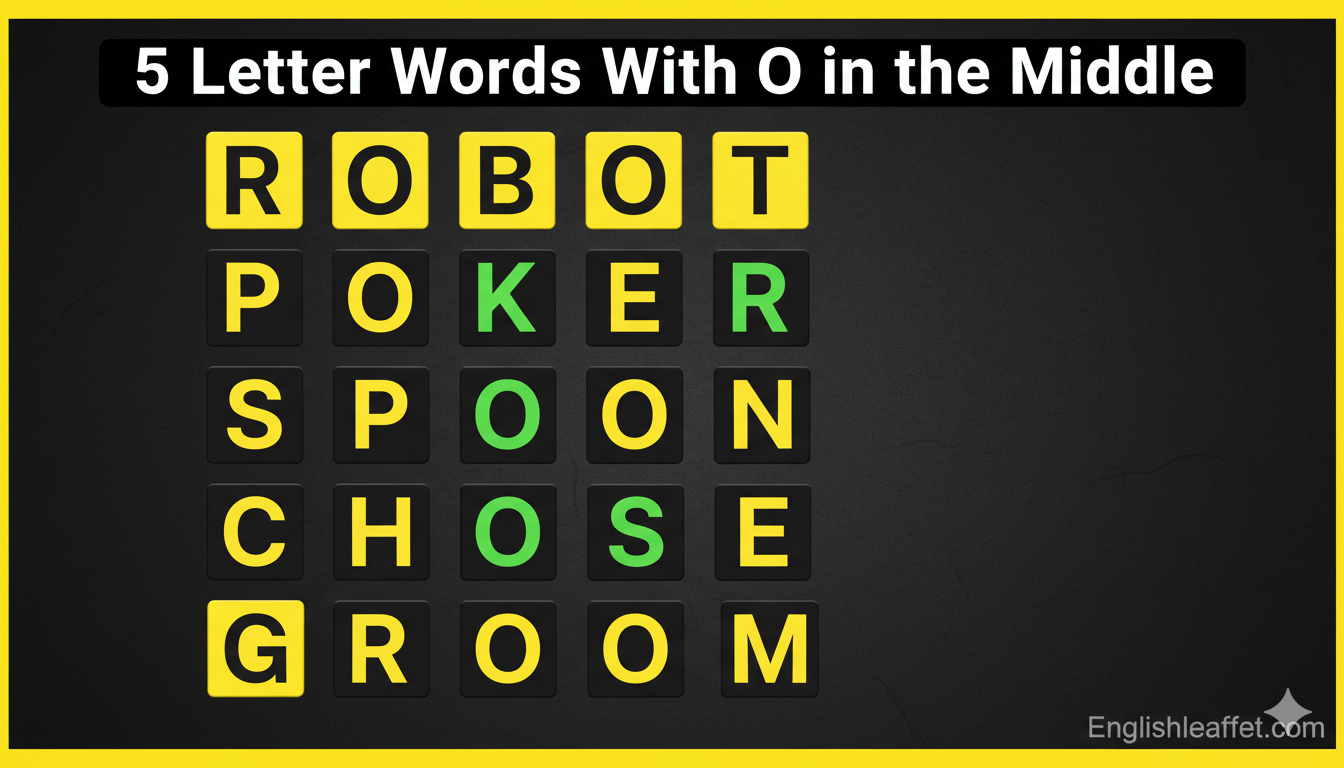
When playing Wordle, knowing common starting letters helps eliminate possibilities quickly. Words beginning with S, T, or C appear most frequently in Wordle solutions.
Starting with “stone,” “store,” or “stole” tests multiple common consonants. This strategic approach maximizes information gained from initial guesses.
Alternative openings like “those,” “whose,” or “close” provide different letter coverage. Varying your strategy based on previous results improves solving efficiency.
Ending Patterns
Words ending in common suffixes help narrow options rapidly. The “-ose” ending appears in “those,” “whose,” “close,” and “chose.”
The “-ove” pattern creates words like “above,” “drove,” “grove,” and “stove.” Recognizing these patterns speeds up puzzle-solving significantly.
Other productive endings include “-oke” (smoke, broke, choke) and “-ore” (shore, store, score). These patterns help organize mental word lists efficiently.
Letter Frequency Analysis
Understanding letter frequency improves Wordle performance dramatically. The letters S, T, R, and N appear most commonly in middle-O words.
Vowel placement matters too, with ‘A’ and ‘E’ appearing frequently in first and last positions. Words like “above,” “alone,” and “stone” demonstrate this pattern.
Uncommon letters like X, Q, and Z rarely appear in Wordle solutions. Focusing on high-frequency letter combinations yields better results consistently.
5 Letter Words With O in the Middle for Scrabble
High-Scoring Combinations
Scrabble success depends on maximizing point values through strategic letter placement. Words containing X, Z, or Q score highest when available.
“Proxy” and “froze” demonstrate how combining uncommon letters with common patterns creates scoring opportunities. These words work especially well on double or triple letter squares.
Consonant clusters like “CL,” “CR,” and “GR” often score well in Scrabble. Words such as “crown,” “cloth,” and “grope” utilize these high-value combinations effectively.
Using Premium Squares
Placing words strategically on premium squares multiplies your score significantly. Double word squares work best with longer, higher-value words.
Triple letter squares maximize points for single high-value letters. Positioning the ‘Z’ in “froze” on a triple letter square creates massive point gains.
Planning ahead for these premium placements separates expert players from beginners. Always scan the board for optimal placement opportunities before playing.
Common Scrabble Words
Memorizing frequent Scrabble words improves gameplay consistency. Words like “those,” “whose,” “close,” and “chose” appear regularly on game boards.
Short words with strategic letters work well for board management. Options like “clot,” “slot,” and “knot” help create multiple scoring opportunities simultaneously.
Building vocabulary of two-letter words using ‘O’ complements your strategy. These tiny words help connect larger plays and maximize point potential.
Words With Double Letters
Double O Combinations
Words featuring double ‘O’ patterns create memorable vocabulary items. “Blood,” “flood,” “proof,” and “spoon” demonstrate this distinctive pattern.
These words often relate to essential concepts or everyday objects. “Boots,” “books,” “looks,” and “rooms” appear constantly in daily conversation.
Game players value double-O words for their strategic flexibility. “Bloom,” “gloom,” “broom,” and “groom” offer excellent consonant-vowel balance.
Double Consonants
Double consonants paired with middle ‘O’ create stable word structures. “Motto,” “ditto,” and “lotto” show double-T patterns clearly.
Words like “folly,” “dolly,” and “holly” feature double-L combinations. These patterns help with spelling retention and word recognition skills.
Strategic double-consonant words score well in competitive games. “Flock,” “block,” and “clock” utilize double letters for optimal point values.
Thematic Word Groups
Nature and Weather Words
Environmental vocabulary features prominently in middle-O words. “Cloud,” “frost,” “storm,” and “flood” describe various weather phenomena.
Plant-related terms include “flora,” “bloom,” and “thorn.” These botanical words help describe natural environments with precision.
Animal words appear with “trout,” “goose,” and “moose.” Each word names specific creatures found in different habitats worldwide.
Action and Movement Words
Physical actions dominate this category with clear, immediate meanings. “Throw,” “shoot,” “shout,” and “float” describe distinct bodily movements.
Downward motion appears in words like “droop,” “swoop,” and “stoop.” These verbs convey specific directional movements with vivid imagery.
General movement words include “drove,” “strode,” and “prowl.” Each verb suggests different speeds, purposes, or qualities of motion.
Emotion and Expression Words
Emotional vocabulary helps express complex feelings concisely. “Proud,” “moody,” “glory,” and “gloom” span positive and negative states.
Facial expressions get their own words: “frown,” “scowl,” and “smote.” These terms describe visible emotional reactions clearly.
Mental states appear through words like “known,” “prone,” and “sworn.” These words relate to consciousness, tendency, or commitment levels.
Regional and Specialized Vocabulary
British vs American Spellings
While most middle-O words remain consistent across English variants, pronunciation differences exist. British speakers may emphasize different syllables than Americans.
Certain words carry different connotations regionally. “Bloke” remains distinctly British while “dude” represents American slang equivalents.
Vocabulary choices reflect cultural preferences too. British speakers favor “phone” over “ring” in some contexts compared to American usage.
Technical and Scientific Terms
Specialized fields contribute unique middle-O vocabulary. “Anode,” “biome,” and “ozone” represent scientific terminology.
Medical words include “colon,” “donor,” and “tumor.” These anatomical and health-related terms serve specific professional purposes.
Technical jargon appears in words like “proxy,” “codec,” and “modem.” Understanding these terms helps navigate modern technology discussions effectively.
Archaic and Literary Words
Historical vocabulary adds depth to classical literature understanding. “Troth,” “sworn,” and “smote” appear frequently in older texts.
Poetic language utilizes words like “grove,” “shore,” and “glory.” These terms create romantic or elevated imagery in creative writing.
Rarely used but valid words include “whore,” “afore,” and “gnome.” These archaic terms occasionally appear in fantasy literature or period pieces.
Learning Strategies and Tips
Memory Techniques
Grouping words by starting letter helps organize mental vocabulary lists. Creating alphabetical categories improves recall speed significantly.
Visual associations strengthen memory retention for difficult words. Imagining “throne” as a royal chair helps cement spelling and meaning.
Repetition through games and puzzles reinforces learning naturally. Regular Wordle practice builds familiarity with common patterns effortlessly.
Pattern Recognition
Recognizing common prefixes and suffixes accelerates vocabulary building. The “UN-” prefix negates words while “-ED” indicates past tense.
Consonant clusters like “BR,” “CR,” and “GR” appear frequently. Identifying these patterns helps predict word structure and spelling accurately.
Rhyming families share ending sounds and often similar meanings. “Stone,” “bone,” “cone,” and “zone” demonstrate this helpful pattern.
Practice Methods
Daily word games provide consistent vocabulary practice opportunities. Apps like Wordle, Scrabble Go, and crosswords build skills gradually.
Reading diverse materials exposes you to varied vocabulary naturally. Fiction, news, and technical writing each offer different word usage examples.
Writing exercises force active vocabulary use rather than passive recognition. Journaling or creative writing challenges expand linguistic capabilities effectively.
Frequently Asked Questions
What are the most common 5 letter words with O in the middle?
The most common words include “about,” “those,” “whole,” “phone,” “stone,” “store,” and “brown.” These words appear frequently in daily conversation and writing across all English-speaking regions.
How many 5 letter words have O in the middle?
There are approximately 986 to 1,169 valid five-letter words with ‘O’ in the middle position. This count varies depending on whether you include proper nouns, archaic terms, or technical jargon.
What are good Wordle starting words with O in the middle?
Excellent Wordle starters include “stone,” “those,” “arose,” and “shone.” These words contain common consonants and vowels that help eliminate possibilities quickly while testing high-frequency letter combinations.
Which 5 letter words with O in the middle score highest in Scrabble?
High-scoring options include “froze,” “proxy,” “gnome,” and “fjord.” These words combine uncommon letters with the middle-O pattern to maximize point values, especially when placed strategically on premium squares.
Are there any 5 letter words with double O in the middle?
Yes, numerous words feature double ‘O’ patterns like “blood,” “flood,” “proof,” “spoon,” “bloom,” and “broom.” These distinctive words are memorable and frequently appear in word games.
What verbs are 5 letter words with O in the middle?
Common verbs include “broke,” “chose,” “drove,” “froze,” “wrote,” “adopt,” “adore,” “prove,” “shoot,” and “throw.” These action words describe various physical and mental activities in English.
Can you use 5 letter words with O in the middle for word games?
Absolutely! These words work excellently for Wordle, Scrabble, Words with Friends, and crossword puzzles. Learning common patterns significantly improves your competitive game performance and puzzle-solving speed.
What are rare 5 letter words with O in the middle?
Rare examples include “fjord,” “gnome,” “whore,” “troth,” “smote,” and “afore.” These less common words add vocabulary depth while providing strategic advantages in competitive word games.
Do 5 letter words with O in the middle appear in English literature?
Yes, frequently! Both classical and modern literature utilize these words extensively. Words like “stone,” “glory,” “grove,” and “sworn” appear regularly in poetry, novels, and dramatic works throughout English literary history.
How can I remember 5 letter words with O in the middle better?
Use memory techniques like alphabetical grouping, visual associations, and pattern recognition. Regular practice through word games, reading diverse materials, and writing exercises reinforces learning naturally and improves long-term retention.
Conclusion
5 letter words with o in the middle represent a fundamental pattern in English vocabulary, offering over 1,000 options for communication, writing, and word gaming.
From everyday essentials like “about” and “phone” to strategic game words like “froze” and “proxy,” mastering this pattern enhances your linguistic capabilities significantly.
Whether you’re solving Wordle puzzles, competing in Scrabble matches, or simply building vocabulary, understanding middle-O words provides a solid foundation for English language success.
Practice regularly, recognize common patterns, and soon these words will become natural components of your everyday language toolkit.
